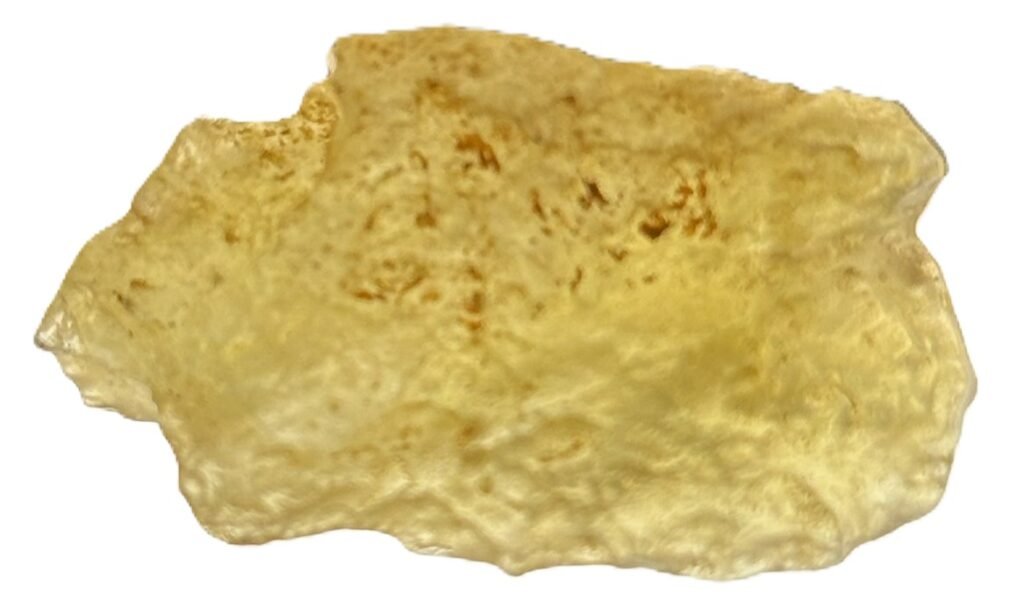
Libyan Desert Glass (often abbreviated as LDG) is an exceptionally rare, translucent yellow natural glass found exclusively across a remote stretch of the Great Sand Sea in the Eastern Sahara, straddling the border between western Egypt and eastern Libya. Formed approximately 28.5 to 29 million years ago during the Oligocene epoch, this luminous golden-yellow material is neither a true crystalline mineral nor a volcanic obsidian. Instead, it is an impactite—a natural silica glass forged in the unimaginably violent heat and shock pressure of an extraterrestrial meteorite impact that flash-melted quartz-rich desert sands at temperatures exceeding 1,600°C.
Revered since the Palaeolithic era for razor-sharp tools and famously immortalised as the carved winged scarab at the centre of Pharaoh Tutankhamun’s funerary pectoral, Libyan Desert Glass bridges planetary science, ancient archaeology, and modern esoteric practice. With total natural reserves estimated at roughly 1,400 tonnes—and strict Egyptian export embargoes limiting new supply—it remains one of the most sought-after collector materials on Earth.
Alternate Names
Across scientific literature, lapidary markets, and metaphysical circles, Libyan Desert Glass is known by several trade, historical, and geological designations:
- Libyan Gold Tektite: A widespread commercial trade name (though strictly speaking, planetary scientists classify it as a proximal impactite rather than a classic distal tektite).
- Great Sand Sea Glass: A geographic designation referencing the vast erg (sand dune sea) where the strewn field sits.
- Libyan Silica Glass: Used in mineralogical and archaeometric studies to highlight its extraordinary ~98% silicon dioxide purity.
- Sun of the Libyan Desert: A poetic historical moniker inspired by its warm, honey-gold luminescence against the Sahara sands.
- LDG: The standard shorthand used by meteorite collectors, gemmologists, and dealers.
The Stone’s Science and Composition
Unlike quartz, citrine, or topaz, Libyan Desert Glass has no internal crystal lattice. Because the molten silica cooled too rapidly for atoms to arrange into an ordered crystalline structure, it solidified as an amorphous mineraloid.
- Chemical Composition: Composed of approximately 96.5% to 98% pure silica ($\text{SiO}_2$), making it the purest natural silica glass known to science—significantly purer than volcanic obsidian (~70–75% $\text{SiO}_2$) or green Moldavite (~75–80% $\text{SiO}_2$). Trace impurities include iron, titanium, aluminium, and minute meteoritic siderophile elements (such as iridium, osmium, and nickel).
- High-Temperature & Shock-Metamorphic Inclusions: Electron microprobe studies have identified microscopic mineral phases within LDG that prove its catastrophic origin:
- Lechatelierite: Pure amorphous silica glass formed by the flash-melting of quartz grains above 1,700°C.
- Cristobalite: A high-temperature polymorph of silica appearing as distinctive white, spherical “snowflake” or spherulitic inclusions.
- Baddeleyite: Zirconium dioxide ($\text{ZrO}_2$) produced when detrital zircon crystals thermally decompose at temperatures above 1,676°C.
- Reidite: A super-dense, high-pressure polymorph of zircon discovered inside LDG zircon grains. Because reidite forms only under immense shock pressures (greater than 30 gigapascals) generated by a hypervelocity ground impact—and never during atmospheric airbursts—its presence resolved a decades-long scientific debate in favour of a direct meteorite impact over an aerial explosion.
Key Physical Characteristics
For gemmologists, lapidaries, and collectors verifying authenticity, Libyan Desert Glass displays unmistakable physical and optical benchmarks:
| Property | Specification / Diagnostic Value |
| Mineral Class | Mineraloid / Natural Impact Glass (Impactite) |
| Chemical Formula | $\text{SiO}_2$ (~98% Silica) |
| Crystal System | Amorphous (Non-crystalline) |
| Hardness (Mohs Scale) | 5.5 – 6.5 (Softer than quartz at 7; easily scratched by a steel file or quartz point) |
| Specific Gravity (Density) | ~2.20 – 2.21 g/cm³ (Noticeably lighter than citrine quartz at ~2.65 g/cm³) |
| Refractive Index (RI) | 1.460 – 1.465 (Singly refractive / isotropic; no birefringence) |
| Lustre | Vitreous (glassy) on fresh fractures; frosted, matte, or satiny on wind-eroded exteriors |
| Fracture & Cleavage | Conchoidal (shell-like curved fractures) with razor-sharp edges; zero cleavage |
| Streak & Fluorescence | White streak; inert under long-wave and short-wave UV light |
| Surface Texture | Ventifact pitting, grooves, and smooth wind-abraded contours caused by millions of years of Saharan sandblasting |
Common Geologic Varieties
While all genuine Libyan Desert Glass comes from a single strewn field, specimens are categorised by collectors and lapidaries into distinct visual varieties based on clarity, inclusions, and colour saturation:
- Gem-Grade Translucent Yellow (Canary / Honey Gold): Clear to semi-transparent golden-yellow nodules with minimal cloudiness. These command the highest prices per gram and are prized for faceting and cabochon cutting.
- Milky / Frothy Cream LDG: Opaque to semi-translucent pale cream or ivory-yellow glass dense with microscopic gas bubbles. Formed where volatile gases were trapped during rapid quenching.
- Banded / Swirled “Schlieren” LDG: Pieces displaying dramatic fluid flow lines, smoky brown-grey streaks, and dark carbonaceous or meteoritic vapour wisps.
- Cristobalite-Included (“Snowflake”) LDG: Translucent golden specimens speckled with distinct white, spherical devitrification clusters of cristobalite.
- Sand-Crusted / Ventifact Specimens: Unpolished, wind-sculpted field stones retaining desert varnish and embedded quartz sand grains in deep surface pits.
Global Mining and Volcanic Sources
There are no active commercial mines or volcanic sources for Libyan Desert Glass.
- Exclusive Locality: Every authentic specimen originates from a single strewn field covering roughly 6,500 square kilometres between the towering longitudinal dunes of the Great Sand Sea in southwestern Egypt (near the Gilf Kebir plateau) and adjacent eastern Libya.
- Not Volcanic: Unlike obsidian or Pele’s hair, LDG has zero connection to volcanism. While the parent crater remains buried beneath hundreds of metres of shifting Saharan dunes—with potential candidate structures like the Kebira, BP, and Oasis craters still studied by planetary geologists—the glass itself lies as loose surface “float” in the interdune corridors.
- Conservation & Export Status: Because the strewn field lies within a protected Egyptian desert region and supplies are finite, the Egyptian government enforces strict bans on commercial excavation and unpermitted export, meaning legitimate market supply relies almost entirely on legacy collections.
Crystal Pairings: What to Combine and Avoid
Because Libyan Desert Glass carries an intense, high-frequency solar and extraterrestrial resonance in metaphysical traditions, pairing it thoughtfully balances its stimulating energy.
Optimal Crystal Pairings
- Moldavite: The classic “cosmic synergy” pairing. Moldavite (green Czech tektite) opens the Heart Chakra for rapid spiritual transformation, while Libyan Desert Glass anchors that transformation into the Solar Plexus through personal willpower, courage, and decisive action.
- Black Tourmaline or Smoky Quartz: Essential grounding companions. Because LDG stimulates upper chakras and mental focus, dense iron- or aluminium-bearing grounding stones prevent energetic over stimulation, lightheadedness, or restlessness.
- Citrine (Natural) or Golden Healer Quartz: Amplifies themes of abundance, creative confidence, and solar vitality without muddying the clear, focused frequency of the glass.
- Lapis Lazuli: A historically resonant pairing—mirroring the exact combination used by ancient Egyptian royal jewellers in Tutankhamun’s pectoral—linking solar willpower with higher wisdom and truth.
Crystal Pairings to Avoid
- Physical Storage Warnings (Harder Stones): Never store or tumble Libyan Desert Glass loosely alongside harder crystalline minerals such as Quartz, Amethyst, Topaz, Corundum (Ruby/Sapphire), or Diamond. At Mohs 5.5–6.5, LDG is brittle and will easily scratch, chip, or suffer conchoidal edge fractures against Mohs 7+ stones.
- Energetic Over-Stimulants (for Sensitive Users): Combining LDG simultaneously with multiple high-vibration, fiery stones—such as Phenakite, Brookite, Tanzanite, and Carnelian all at once—can feel overwhelming or anxiety-inducing for practitioners sensitive to high-frequency tektites and impactites.
Archaeology, Art and Ancient History
Long before modern planetary science understood meteorite impacts, ancient humans recognised the utility and sacred beauty of Libyan Desert Glass:
- Palaeolithic and Neolithic Tool making: Archaeological surveys in the Great Sand Sea have documented bifacial Acheulean hand axes, Mousterian scrapers, and Neolithic blades knapped directly from LDG. Roughly 10% of surface fragments show deliberate percussion flaking, prized by Stone Age hominins for yielding surgical-grade cutting edges much like obsidian.
- Tutankhamun’s Winged Scarab Pectoral: The most celebrated artistic use of LDG was discovered in 1922 when Howard Carter unsealed the tomb of Pharaoh Tutankhamun (reigned c. 1332–1323 BC). At the centre of an ornate gold, lapis lazuli, carnelian, and turquoise breastplate sits a carved yellow-green winged scarab representing Khepri—the god of the rising sun and rebirth. Initially catalogued as chalcedony, optical and Raman spectroscopy testing in 1998 confirmed the scarab was carved from genuine Libyan Desert Glass.
- Rediscovery in 1932: Although Bedouin nomads had navigated the strewn field for millennia, LDG entered modern scientific literature on 29 December 1932, when British surveyor Patrick Clayton encountered scattered yellow glass fragments while mapping the uncharted dunes of the Great Sand Sea.
Folklore, Legends and Sacred Tales
- Ancient Egyptian Solar Mythology: To the priests and artisans of New Kingdom Egypt, a luminous golden stone discovered in the western desert—the realm of the setting sun and the afterlife—was viewed as solidified sunlight or a gift from the sun deity Ra. Carving it into the scarab Khepri symbolised eternal regeneration and the soul’s triumphant rebirth across the underworld.
- Bedouin Desert Lore: Traditional desert travellers referred to the translucent stones as Amulet Stones or “frozen lightning,” believing the glass fell from the heavens during cosmic storms and carried protective talismanic power against desert perils and the evil eye.
- Modern Cosmic Folklore: Within contemporary metaphysical lore, LDG is often called a “star-born talisman,” believed to hold the encoded memory of the union between celestial fire and earthly sand—acting as a bridge between cosmic consciousness and grounded human purpose.
Metaphysical and Mystical Healing Properties
Disclaimer: Metaphysical and spiritual properties reflect traditional folklore and holistic wellness practices; they are not a substitute for professional medical diagnosis or treatment.
In crystal healing traditions, Libyan Desert Glass is regarded as one of the most potent stones for personal empowerment, manifestation, and energetic shielding:
- Willpower, Confidence & Sovereignty: Strongly aligned with solar energy, it is traditionally used to dissolve self-doubt, impostor syndrome, and chronic indecision, fostering bold leadership and personal authenticity.
- Manifestation & Goal Setting: Practitioners hold or place LDG over written intentions during meditation, viewing its impact-forged nature as a catalyst that accelerates turning abstract ideas into tangible reality.
- Auric Shielding: Unlike porous stones that absorb dense energy, LDG is believed to project a bright, radiant boundary around the auric field, deflecting energy vampires and psychic interference without requiring frequent energetic clearing.
- Holistic Physical Folklore: In traditional crystal therapy lore, its golden ray is symbolically linked to digestive vitality, metabolic energy, and overcoming lethargy.
Astrological Connections
- Primary Zodiac Signs: Leo and Aries. Leo resonates naturally with LDG’s radiant solar frequency, confidence, and royal Egyptian heritage, while Aries aligns with its fiery, pioneering, and decisive spark.
- Secondary Affinity: Cancer (often associated in modern astrological guides with lunar-solar balance and protective emotional boundaries).
- Planetary Ruler: The Sun (vitality, ego integrity, self-expression, and illumination).
- Element: Fire (transformation, alchemical purification, and kinetic willpower).
The Chakra System
Libyan Desert Glass works primarily across two key energy centres:
- Solar Plexus Chakra (Manipura — Primary): Located in the upper abdomen, Manipura governs personal power, self-esteem, boundaries, and willpower. LDG’s golden-yellow wavelength acts as a direct tonic for a sluggish or blocked Solar Plexus, restoring drive and emotional resilience.
- Sacral Chakra (Svadhisthana — Secondary): Stimulates creative flow, passion, and courage to step outside comfort zones.
- Crown & Third Eye Chakras (Sahasrara & Ajna): Due to its extraterrestrial impact origin, meditators also place LDG at the Third Eye or Crown to foster mental clarity, higher perspective, and intuitive insight.
Interesting Facts
- Older Than Humanity by 28 Million Years: When Libyan Desert Glass formed ~29 million years ago, the Sahara was not a hyper-arid desert—it was a lush, humid subtropical landscape teeming with early Oligocene mammals and river systems.
- Hotter Than Lava: Basaltic volcanic lava erupts at roughly 1,100°C to 1,200°C. The impact event that forged Libyan Desert Glass exceeded 1,600°C–2,000°C—hot enough to boil quartz sand into pure silica vapour and decompose zircon crystals into baddeleyite.
- Where Is the Crater? Despite decades of satellite radar mapping, no definitive impact crater has been confirmed in the Great Sand Sea—most planetary geologists believe the crater was either eroded away over 29 million years or lies buried beneath massive migrating sand dunes.
- Safe in Sunlight: Unlike Amethyst, Rose Quartz, or Kunzite—which fade when exposed to UV rays—Libyan Desert Glass is completely colour-stable in direct sunlight.
Modern Milestones: Birthstones and Anniversaries
- Birthstone Status: Libyan Desert Glass is not a traditional or modern official birthstone (such as Citrine or Topaz for November). However, it is widely adopted in contemporary holistic jewellery as an alternative midsummer solar talisman for those born under Leo (July 23 – August 22).
- Anniversaries & Life Milestones: Because of its cosmic rarity and association with personal transformation, LDG is increasingly gifted to mark major career launches, entrepreneurial milestones, graduation, or recovery from personal setbacks—symbolising strength forged under extreme pressure.
Libyan Desert Glass Frequently Asked Questions
Is Libyan Desert Glass a crystal or a glass?
It is a natural glass (amorphous mineraloid), not a true crystal. True crystals have an ordered, repeating internal atomic lattice, whereas Libyan Desert Glass cooled so rapidly after a meteorite impact that its silica molecules froze in a random, non-crystalline glass state.
How can I tell real Libyan Desert Glass from fake yellow glass?
Check four diagnostic markers:
- Surface Texture: Unpolished pieces exhibit a frosted, matte, wind-pitted skin (“desert varnish”) rather than a uniform, shiny, mould-cast exterior.
- Colour Tone: Genuine LDG ranges from pale champagne and milky cream to warm honey-gold. Overly bright, uniform “neon lemon” or “canary” glass is typically artificial.
- Internal Inclusions: Under backlighting, authentic specimens show stretched gas bubble streams, dark wispy streaks, or tiny white spherical cristobalite spots—never uniform, perfectly round factory-glass bubbles.
- Density & Refractive Index: Real LDG feels noticeably lightweight (SG ~2.21) compared to citrine or leaded glass, with an RI of ~1.46.
Is Libyan Desert Glass radioactive or hazardous to wear?
No. Libyan Desert Glass is composed of ~98% inert silicon dioxide ($\text{SiO}_2$) and is completely non-radioactive and safe to handle or wear against the skin. However, raw, unpolished fragments can have razor-sharp conchoidal edges, and lapidaries cutting or grinding LDG must use wet-grinding and respiratory protection (P3/N95) to avoid inhaling amorphous silica dust.
Can Libyan Desert Glass go in water or sunlight?
Yes, with sensible precautions. Because it is pure silica glass, LDG does not dissolve in water and will not fade in direct sunlight. Avoid boiling water, ice water, or ultrasonic cleaners, however, as sudden temperature shifts (thermal shock) can cause internal fractures.
Why is Libyan Desert Glass so expensive?
Pricing reflects three factors: extreme geographic isolation in the Great Sand Sea, a finite natural supply estimated at ~1,400 tonnes, and strict Egyptian export restrictions that prevent new commercial harvesting. Gem-grade, transparent golden pieces with minimal cloudiness command significant premiums per gram.
Is Libyan Desert Glass durable enough for everyday rings?
At 5.5 to 6.5 on the Mohs scale, it is durable enough for pendants, earrings, and occasional-wear rings, provided it is set in a protective bezel setting. Because it is softer than quartz dust (Mohs 7) and brittle on sharp edges, prong-set LDG rings worn daily are prone to scratching and edge chipping.
These are my personally selected and curated Libyan Desert Glass products