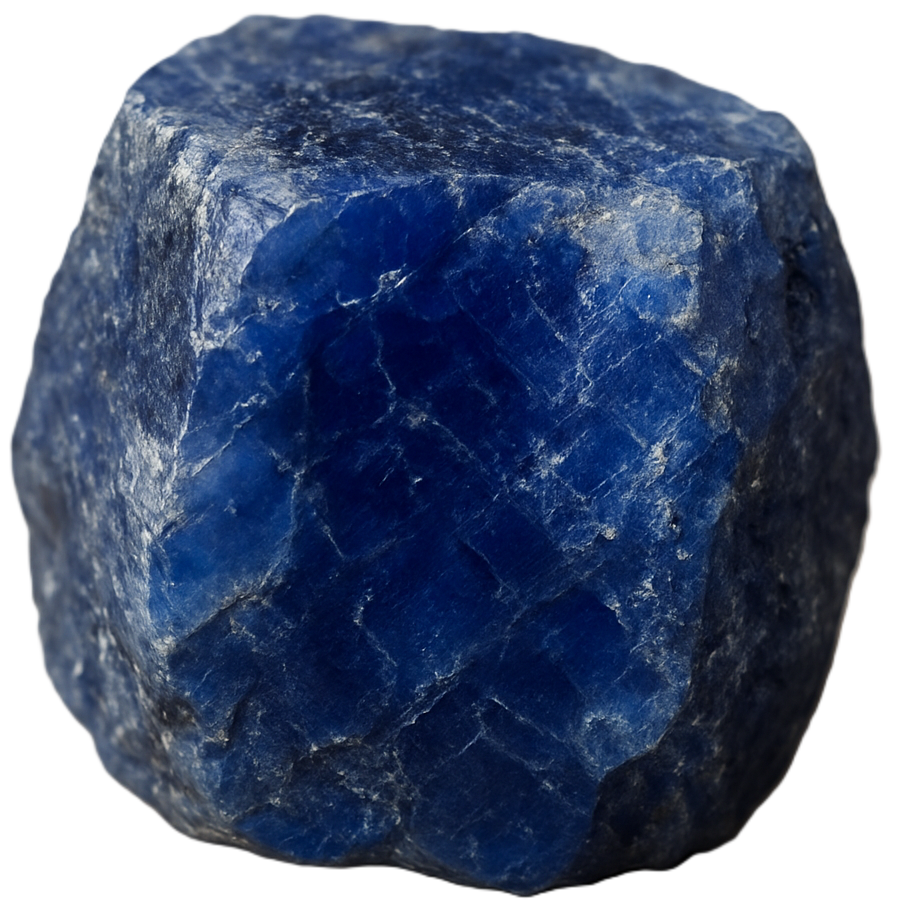
Epitomising timeless elegance, royal legacy, and profound cosmic power, the Blue Sapphire stands as one of the most revered gemstones in human history. Belonging to the prestigious corundum mineral family, this magnificent precious stone is celebrated not only for its breathtaking, celestial hues but also for its extraordinary physical durability, ranking second only to the diamond on the Mohs hardness scale.
The name sapphire itself carries deep historical resonance, derived from the Latin sapphirus and the Greek sappheiros, terms which originally commemorated “blue stone” across the ancient Mediterranean. In Sanskrit, it is revered as Neelam, a name intimately bound to the gemstone’s potent, fast-acting reputation in Vedic astrology. From the signet rings of ancient kings to the iconic engagement jewellery of modern royalty, the Blue Sapphire has long served as a universal symbol of truth, nobility, divine protection, and unyielding mental clarity. Whether sought for its exceptional geological purity or its rich mystical heritage, it remains the ultimate gemstone of wisdom and spiritual authority.
Alternate Names
Blue Sapphire is known by several prestigious titles across different languages, cultures, and historical eras. In Sanskrit, it is revered as Neelam (or Nila), a name deeply tied to its sacred role in Vedic astrology. In ancient Hebrew, it is referred to as Sapir, whilst Old French texts document it as Safir. Additionally, high-quality specimens from specific regions are frequently trade-named after their origins, such as Kashmir Sapphire and Ceylon Sapphire.
The Stones Science and Composition
Scientifically, Blue Sapphire is a variety of the mineral corundum, an aluminium oxide compound with the chemical formula $\text{Al}_2\text{O}_3$. In its pure state, corundum is completely colourless. The magnificent blue colouration is achieved through trace chemical impurities; specifically, the interstitial absorption of iron ($\text{Fe}$) and titanium ($\text{Ti}$) ions within the crystal lattice.
Key Physical Characteristics
- Chemical Formula: $\text{Al}_2\text{O}_3$ (Aluminium Oxide)
- Mohs Scale Hardness: 9 (Making it exceptionally durable and one of the hardest natural gemstones, surpassed only by diamond)
- Crystal System: Trigonal / Hexagonal
- Lustre: Vitreous (glass-like) to adamantine
- Transparency: Transparent to translucent
- Pleochroism: Strong (exhibits variations of violet-blue and greenish-blue when viewed from different angles)
- Refractive Index: 1.762–1.770
Common Geologic Varieties
- Kashmir Sapphire: Globally legendary, these stones are celebrated for their highly coveted “cornflower blue” shade and a distinctive velvety texture caused by microscopic inclusions that softly scatter light.
- Ceylon Sapphire: Sourced from Sri Lanka, these varieties are famous for their brilliant clarity and vibrant, lighter, pastel-to-medium sky-blue shades.
- Padparadscha Sapphire: A remarkably rare and highly prized pink-orange hybrid variety of corundum, resembling the tones of a tropical lotus blossom.
- Star Sapphire: A spectacular variety exhibiting asterism. This optical phenomenon creates a distinct six- or twelve-rayed star pattern that dances across the surface of the gemstone under direct light, caused by the reflection of light off dense, needle-like inclusions of rutile (commonly known as “silk”).
Global Mining and Volcanic Sources
Corundum forms deep within the Earth’s crust inside metamorphic rocks (such as schists and gneisses) or plutonic igneous rocks (like syenites). Over millions of years, weathering releases these durable gems into alluvial deposits and riverbeds. Key global mining locations include:
- Kashmir (India): The remote Himalayan region that yielded the world’s benchmark silky-blue gems during the late 19th century.
- Sri Lanka (formerly Ceylon): One of the oldest continuous gem-mining sources on Earth, famed for clear, radiant specimens.
- Myanmar (Burma): Renowned for producing deep, saturated, “royal blue” gemstones.
- Madagascar: A vital modern mining hub yielding stones of exceptional visual clarity and colour profile.
- Thailand, Australia, and Montana (USA): Important sources that typically produce darker, inky-blue or unique greenish-blue varieties.
Crystal Pairings: What to Combine and Avoid
Metaphysically, Blue Sapphire is a highly disciplined, structural, and high-frequency crystal. Because it carries the potent energy of the cosmos and the planetary influence of Saturn, pairing it with other stones requires careful consideration to balance its strong vibrations.
Optimal Crystal Pairings
- Diamond: The ultimate pairing. Diamond amplifies Blue Sapphire’s innate clarity, mental focus, and purity, creating a shield of spiritual protection.
- Amethyst: Combining Amethyst with Sapphire activates the higher crown frequencies, enhancing spiritual growth, psychic intuition, and serene meditation.
- Lapis Lazuli: Melding Lapis Lazuli with Blue Sapphire bridges the energies of inner wisdom and external truth, aiding articulate, honest expression.
- Clear Quartz: Acting as a master amplifier, Clear Quartz elevates the natural vibrational energy of the sapphire, clearing any surrounding energetic stagnant zones.
Crystal Pairings to Avoid
- Ruby or Red Coral: These stones are ruled by the fiery, impulsive planet Mars. Their volatile, heat-driven energy directly clashes with the cold, patient, and highly disciplined restriction of Saturn (which rules Blue Sapphire), leading to internal friction or chaotic moods.
- Pearl: Ruled by the fluctuating, emotional energy of the Moon, Pearl can directly counteract the sharp mental discipline, logic, and laser-focused boundary work that Blue Sapphire facilitates.
Archaeology, Art and Ancient History
Archaeological evidence confirms that Blue Sapphires have been treasured for well over two millennia. The earliest formal sapphire mines date back over 2,000 years in ancient Ceylon. In the ancient Mediterranean and Near East, sapphires were meticulously carved into intaglios and set into high-status signet rings.
Throughout medieval Europe, the gemstone became intricately woven into ecclesiastical art; Catholic bishops and high clergy wore sapphire rings on their right hands to signify their holy vows of chastity, divine wisdom, and heavenly connection. In secular art, sapphires heavily adorned royal crowns, scepters, and ceremonial scabbards across Europe and Asia.
Folklore, Legends and Sacred Tales
In ancient Persian mythology, legends claim that the Earth was actually balanced atop a colossal, giant blue sapphire, and it was the reflection of this magnificent stone that gave the sky its bright blue hue.
Medieval European folklore attributes magical anti-poison remedies to the stone, with superstitions asserting that a sapphire could protect its wearer from dark spells, jealousy, and unexpected betrayal.
In sacred Hindu lore, Neelam is directly tied to Shani (the deity manifesting as the planet Saturn). Sacred texts warn that Neelam is an incredibly fast-acting, dual-edged stone. If aligned with the wearer, it can instantly bestow immense wealth, political power, and spiritual alignment; however, if misaligned, tales warn it can trigger immediate misfortune, requiring users to test the stone under their pillows before wearing it permanently.
Metaphysical and Mystical Healing Properties
Metaphysically, Blue Sapphire is widely celebrated as the definitive stone of mental clarity, self-discipline, and deep cosmic order. It is an excellent tool for dispelling scattered thoughts, relieving brain fog, and calming emotional turmoil. Mystical healers utilise the stone’s cooling energy to soothe an overactive nervous system, alleviate stress, and bring structural alignment to the emotional body. On a physical level, crystal practitioners traditionally use it to support eye health, ease headaches, and balance thyroid function.
Astrological Connections
In Western astrology, Blue Sapphire aligns beautifully with the structured minds of Virgo, the balanced scales of Libra, and the earthy patience of Taurus.
In Vedic (Sidereal) astrology, its connection is far more profound. It is governed by Saturn (Shani) and is the primary astrological gemstone for Capricorn and Aquarius. It rewards hard work, perseverance, and ethical living, acting as a karmic equalizer that brings structure and stability to those navigating difficult planetary transitions.
The Chakra System
Blue Sapphire operates on an incredibly high vibrational frequency, primarily resonating with:
- The Throat Chakra (Vishuddha): By opening this energy center, it removes communication blockages, allowing you to speak your absolute truth with calm confidence and crystal-clear articulation.
- The Third Eye Chakra (Ajna): It stimulates deep inner vision, enhances intuition, unlocks higher states of consciousness, and strengthens your capacity for analytical reasoning.
Interesting Facts
- Shared Chemistry: Sapphire and Ruby are identical twin minerals—both are corundum. The only feature that separates them is trace elemental inclusions; chromium turns corundum red (Ruby), while iron and titanium turn it blue (Sapphire).
- Thermal Enhancement: The vast majority of commercial sapphires undergo traditional heat treatment to permanently enhance their colour intensity and dissolve minor internal imperfections.
- Hidden Glow: Certain natural blue sapphires exhibit fluorescence, revealing a distinct red or violet glow when exposed to shortwave or longwave ultraviolet light.
Modern Milestones: Birthstones and Anniversaries
In modern culture, Blue Sapphire serves as the official and traditional birthstone for September, representing themes of sincerity, wisdom, and virtue. It is also the designated milestone gemstone gifted for the 45th wedding anniversary, symbolising an enduring, unbreakable lifelong commitment, deep trust, and marital fidelity.
Blue Sapphire frequently asked questions (FAQ)
What is the most valuable colour of a blue sapphire?
A: The most expensive and sought-after blue sapphires are those displaying a highly saturated, vivid, medium to medium-dark violet-blue or “royal blue”. Stones that are overly pale or look too dark and inky in normal room lighting generally command lower market values.
How are blue sapphires officially graded and valued?
A: Gemmologists value sapphires using a system similar to diamonds, prioritising colour (hue, tone, and saturation) above all else. This is followed closely by clarity. While natural sapphires almost always contain minor internal inclusions (“silk”), visible inclusions are acceptable as long as they do not disrupt light reflection or threaten the structural durability of the stone.
Are all sapphires blue?
A: No. While blue is the most famous and iconic shade, sapphires occur naturally in an array of “fancy colours”, including yellow, pink, green, orange, purple, and white. The only colour a sapphire cannot be is red—because red corundum is classified exclusively as a Ruby.
How can I tell if my blue sapphire is real or fake at home?
A: A quick indicator is the breath test: hold the gemstone to your mouth and breathe on it to fog it up. On a genuine sapphire, the mist should dissipate almost instantly (in 1 to 2 seconds). If the fog lingers for several seconds, it is likely glass or plastic. Furthermore, under a magnifying loupe, a real sapphire will show tiny, irregular natural inclusions, whereas a glass counterfeit often contains perfectly round, trapped air bubbles.
Is Blue Sapphire suitable for daily wear and engagement rings?
A: Yes, absolutely. Scoring a 9 on the Mohs scale, sapphire is incredibly scratch-resistant and durable. It does not chip or scratch easily, making it an excellent, long-lasting alternative to traditional diamonds for everyday jewellery and engagement rings.
How do I safely clean and energetically charge my Blue Sapphire?
A: To clean it physically, wash the jewellery in lukewarm water mixed with a few drops of mild soap, gently cleaning behind the setting with a soft-bristled toothbrush before drying it with a lint-free microfibre cloth. Energetically, you can safely cleanse and charge its vibration by placing it on a Selenite plate, smudging it with sacred incense smoke (like sandalwood), or leaving it out overnight to absorb the cooling light of a full moon. Avoid harsh commercial chemical cleaners.
These are my personally selected and curated Blue Sapphire products