
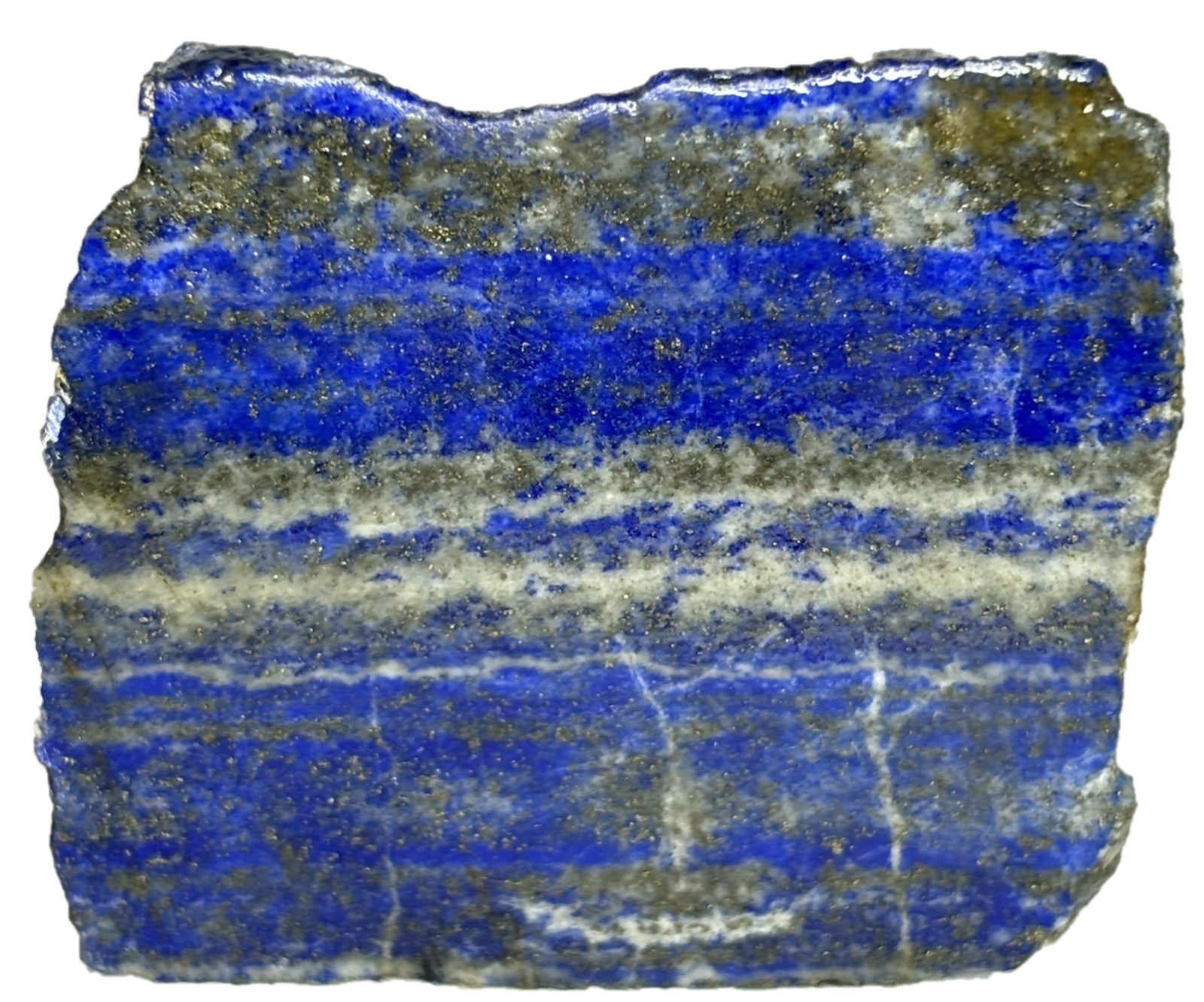
Lapis lazuli is an opaque metamorphic rock celebrated for millennia for its celestial, deep-cobalt hue dusted with glittering gold flecks. Unlike single-mineral gems like diamonds or emeralds, lapis lazuli is a composite aggregate consisting primarily of lazurite, calcite, and pyrite. Mined continuously for over 6,500 years, it has served as an emblem of royal status, a sacred conduit for divine wisdom, and the source of pure ultramarine—the most prized pigment in art history.
Alternate names
- Lapis / Lazuli: Standard shortened commercial trade terms.
- Ultramarine Raw Mineral: Historical artist designation referencing ultramarinus (“beyond the sea”).
- Sapphirus (Antiquity): Pliny the Elder and classical Roman/Greek writers referred to lapis lazuli as sapphirus (“spotted with gold”), as modern corundum sapphires were rarely recognised in their era.
- Khesbed: Ancient Egyptian name denoting cosmic truth, royalty, and the night sky.
- Nila / Lajward (Persian & Arabic): Root of the word “azure” and origin of the modern scientific name.
- Denim Lapis: Commercial trade name for paler varieties heavily marbled with white calcite.
The Stone’s Science and Composition
Lapis lazuli is not a single mineral species; it is a polymineralic metamorphic rock formed via contact metasomatism (the interaction of high-temperature hydrothermal fluids with carbonate rocks like limestone or marble).
- Lazurite ($(\text{Na,Ca})_8[\text{AlSiO}_4]_6(\text{SO}_4,\text{S},\text{Cl})_2$): Constitutes 25% to 40% of the total rock and delivers its characteristic intense royal blue. The blue colour is caused by charge transfer between trisulphur radical anions ($\text{S}_3^-$) trapped inside the cubic aluminosilicate framework.
- Calcite ($\text{CaCO}_3$): Forms white or light grey veins, clouds, and matrix patches. High calcite content dilutes the colour intensity and lowers gem grade.
- Pyrite ($\text{FeS}_2$): Brass-yellow metallic crystals dispersed throughout the stone. Finely dispersed specks enhance market appeal; heavy patches weaken structural integrity.
- Accessory Minerals: Frequently contains sodalite, diopside, wollastonite, augite, enstatite, and nosean.
Key Physical Characteristics
| Property | Value / Diagnostic Metric |
| Chemical Classification | Metamorphic aggregate rock (feldspathoid group host) |
| Mohs Hardness | 5.0 to 5.5 (relatively soft; susceptible to scratches and abrasions) |
| Specific Gravity | 2.70 to 2.90 (fluctuates based on pyrite and calcite concentrations) |
| Refractive Index | ~1.50 (spot reading; aggregate shows diffuse values) |
| Lustre | Vitreous to dull, greasy when cut and polished |
| Cleavage | Imperfect / None (fractures unevenly with a granular or conchoidal surface) |
| Transparency | Completely opaque |
| Acid Reaction | Effervesces mildly and releases hydrogen sulphide gas ($\text{H}_2\text{S}$, rotten-egg odour) upon exposure to dilute hydrochloric acid ($\text{HCl}$) |
Common Geologic Varieties
- Persian / Afghan Grade (Grade AAA): Uniform, deep royal or indigo blue with minimal calcite and micro-flecks of brassy pyrite.
- Denim / Chilean Grade: Chalky or sky-blue tones marked by prominent white and grey calcite marbling; mined extensively in the Ovalle region of Chile.
- Siberian / Russian Grade: Intense dark blue with heavy pyrite dispersal, often displaying noticeable calcite patches.
- Pyrite-Dense Grade: Specimen quality where golden pyrite forms large veins or solid patches across the face, popular among collectors of raw minerals.
Global Mining and Metasomatic Sources
- Badakhshan Province, Afghanistan (Sar-e-Sang Mines): The oldest continually worked mines on Earth. Formed by contact metamorphism of limestone beds injected by granitic pegmatites. Produces the world standard for deep royal blue.
- Ovalle, Coquimbo Region, Chile (Flor de los Andes Mine): High-altitude deposits producing lighter blue material with heavy calcite veining. Chile adopted lapis lazuli as its official national gemstone.
- Lake Baikal Region, Russia (Slyudyanka River): Dolomitic marble contact zones yielding deep violet-blue stones with pyrite concentrations.
- Secondary Deposits: Minor deposits occur in the Pamir Mountains (Tajikistan), Mogok (Myanmar), San Bernardino County (California, USA), and Mount Vesuvius (Italy).
Crystal Pairings: What to Combine and Avoid
Optimal Crystal Pairings
Clear Quartz: Acts as an amplifier. Clear quartz clarifies lapis’s heavy Third Eye stimulation, preventing psychic fatigue while boosting mental focus.
Turquoise: Balances the Throat Chakra. While lapis accesses deep internal truth, turquoise softens external communication, promoting diplomatic expression.
Amethyst: Bridges intellectual understanding with intuitive spiritual awareness, harmonising the Third Eye and Crown chakras.
Pyrite: Enhances the natural grounding element already present within lapis, anchoring abstract mental concepts into concrete physical execution.
Crystal Pairings to Avoid
Red Jasper & Carnelian (Unregulated Root Stones): Red jasper drives fast-paced, primal physical vitality, which clashes directly with lapis’s contemplative, ethereal frequency. Pairing them without an intentional bridging stone (such as smoky quartz) can cause cognitive scatter or physical agitation.
Black Obsidian: Strong energetic purge stones like obsidian pull unresolved shadow material to the surface rapidly. When combined with lapis lazuli’s truth-revealing properties, the combination can feel overwhelming for sensitive practitioners.
Archaeology, Art and Ancient History
- Mesopotamia & Sumer: Sumerian cylinder seals dating back to the 4th millennium BCE were carved from lapis. Royal graves of Ur (circa 2600 BCE) contained thousands of beads, daggers, and gaming boards inlaid with lapis.
- Ancient Egypt: Regarded as the flesh of the gods. Egyptian amulets, scarabs, and the famous funerary mask of Pharaoh Tutankhamun prominently integrated lapis lazuli alongside carnelian, turquoise, and gold. It was also ground into protective eye pigments.
- The Renaissance Ultramarine Revolution: Extracted through a labour intensive process of kneading ground lapis into wax and lye, the resulting true ultramarine pigment was reserved exclusively for the most sacred subjects—most notably the robes of the Virgin Mary in works by Titian, Vermeer, and Fra Angelico.
Folklore, Legends and Sacred Tales
- The Descent of Inanna: In Sumerian myth, the goddess of love and warfare, Inanna, descends to the underworld carrying a lapis measuring rod and wearing a lapis necklace to affirm her cosmic sovereignty.
- King Solomon’s Ring: Medieval Jewish and Islamic legends recount that the seal ring granted to King Solomon to command djinns and protect his temple was set with a carved lapis lazuli stone.
- The Roman Amulet of Venus: Romans associated deep lapis with celestial heavens and the evening star, wearing it to attract love and protect travellers navigating dark roads.
Metaphysical and Mystical Healing Properties
- Intellectual Clarity & Truth: Known metaphysically as the “Stone of Total Awareness,” lapis assists in dispelling mental fog, breaking self-deception, and supporting objective decision-making.
- Emotional Release: Assists in unblocking repressed emotions, reducing defensive postures, and clearing persistent throat-constricting anxieties.
- Energetic Protection: Historically regarded as a psychic shield that reflects negative intentions back toward their origin while sealing the auric field against energy drains.
Astrological Connections
Sagittarius: Governed by Jupiter. Lapis lazuli aligns with Sagittarius’s constant quest for higher truth, philosophical expansion, and freedom of expression.
Libra: Aligns with Venusian diplomacy and balance, enabling Librans to communicate candidly without compromising relational harmony.
Secondary Resonances: Resonates strongly with Taurus (throat balance) and Aquarius (innovative vision and higher mental processing).
The Chakra System
- Throat Chakra (Vishuddha): Lapis unblocks suppressed communication, facilitating honest self-expression, public speaking confidence, and vocal clarity.
- Third Eye Chakra (Ajna): Awakens the centre of intuition, critical visualisation, and inner perception. Placing lapis directly over the brow during meditation stimulates lucid dreaming and deep contemplative states.
Interesting Facts
- Pricier Than Gold: During the 14th to 17th centuries, genuine Afghan ultramarine pigment cost more per ounce than pure gold.
- Vermeer’s Debt: Johannes Vermeer fell deeply into debt partly due to his obsession with ultramarine, famously seen in Girl with a Pearl Earring.
- Medical Cleanser of the Ancients: Ancient Greek physician Dioscorides documented the use of pulverised lapis as an antidote for snakebites and an eye wash.
- Synthetic Replacement: In 1826, French chemist Jean-Baptiste Guimet synthesised French Ultramarine, dramatically cutting the price of the blue pigment and ending the centuries-old monopoly of raw lapis lazuli imports.
Modern Milestones: Birthstones and Anniversaries
- Traditional Birthstone: Alternative traditional birthstone for September (sharing historical alignment with sapphire) and modern birthstone for December.
- Wedding Anniversary: The traditional gemstone gift commemorating the 9th wedding anniversary, representing wisdom, fidelity, and shared truth.
Lapis Lazuli Frequently Asked Questions
Is lapis lazuli water-safe?
No. Lapis lazuli ranks at 5 to 5.5 on the Mohs scale and is porous due to varying calcite content. Soaking it in water dissolves calcite binders over time, strips high-polish finishes, and causes pyrite inclusions to oxidise and rust. Clean it exclusively with a dry or lightly dampened microfibre cloth.
How can I distinguish authentic lapis lazuli from dyed howlite or sodalite?
- Dyed Howlite: Displays black or dark web-like veining rather than golden pyrite crystals, and a cotton swab soaked in acetone will strip the blue dye.
- Sodalite: Tends toward a darker, royal-to-greyish blue without the golden metallic flecks of pyrite, frequently featuring white feldspar/calcite lines instead.
- Synthetic / Resin Imitations: Often feel lightweight, warm to the touch, and show unnaturally uniform gold flakes under magnification.
Why does some lapis lazuli have white streaks?
White streaks are natural deposits of calcite ($\text{CaCO}_3$). While pure uniform blue is valued higher in gem markets, natural calcite veins provide proof of geological authenticity.
Does lapis lazuli fade in sunlight?
Natural, untreated lapis lazuli is lightfast and will not fade from direct sun exposure. However, stones that have been artificially dyed, resin-treated, or waxed to intensify their blue will fade, dry out, or degrade under prolonged ultraviolet radiation.
Can I wear lapis lazuli every day?
Yes, but caution is necessary. Because it measures 5.0 to 5.5 on the Mohs hardness scale, rings and bracelets should be mounted in protective bezel settings. Remove lapis jewellery prior to dishwashing, exercising, swimming, or handling household chemicals.
These are my personally selected and cr
There are my personally selected and curated Lapis Lazuli products
