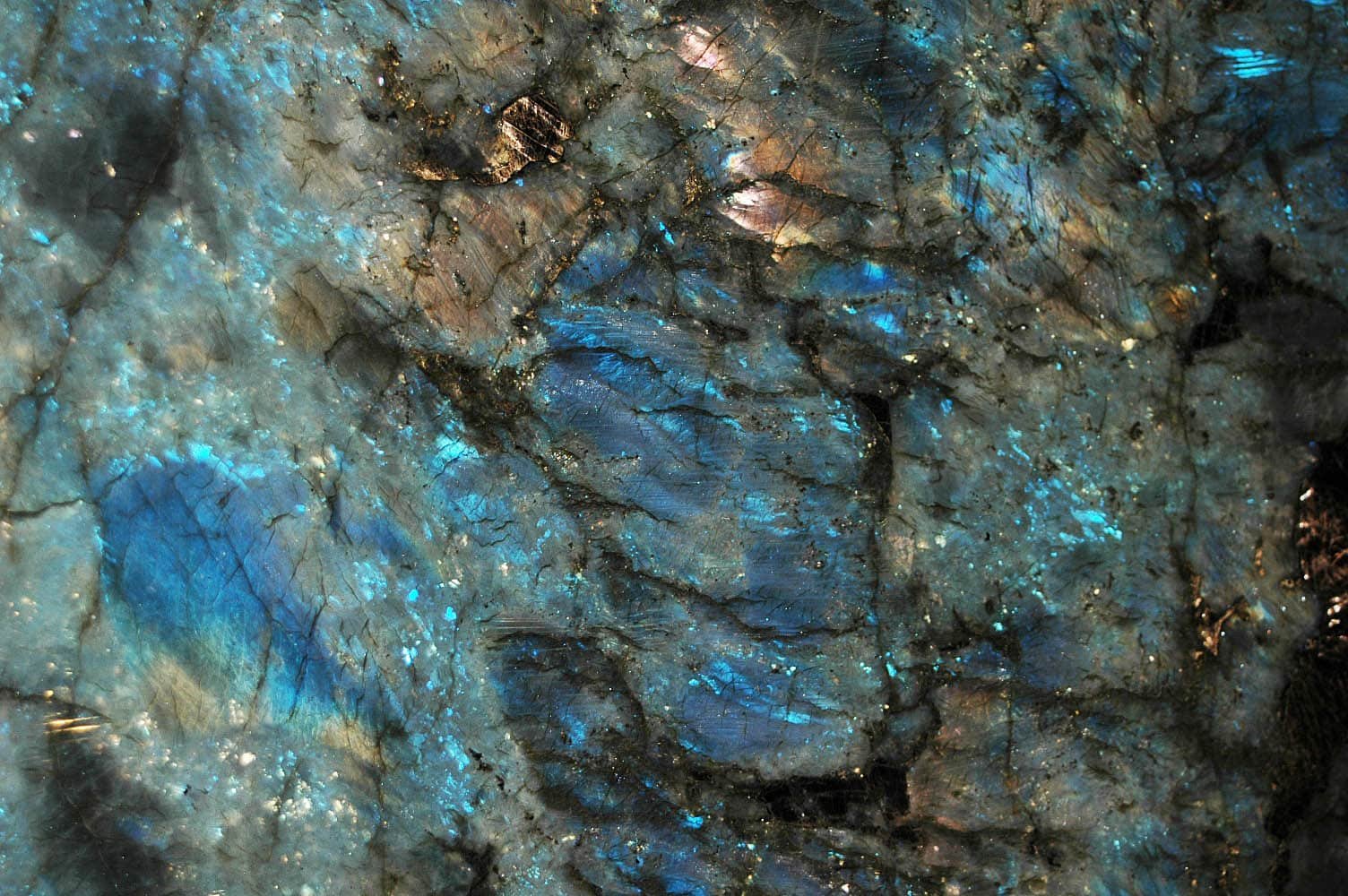
Few natural stones command the visual and geological intrigue of Lemurian Blue Granite. Quarried exclusively from remote Precambrian massifs in the southern highlands of Madagascar, this striking stone pairs an inky charcoal and deep olive-green groundmass with sudden, luminous flashes of electric cyan, royal blue, and violet.
While widely specified across luxury architecture and interior design under the commercial banner of exotic granite, Lemurian Blue is something far rarer: an igneous plagioclase anorthosite dominated by crystalline labradorite. The dynamic peacock-blue light that flares across its surface is not topical pigmentation, but labradorescence—an optical interference phenomenon born from submicroscopic crystal twinning formed hundreds of millions of years ago under intense subterranean heat and pressure.
Beyond its physical durability and architectural prestige as a showpiece surfacing material, the stone carries deep roots in alternative mineralogy. Drawing its modern trade name from the mythical lost continent of Lemuria (Mu), it is celebrated among collectors and crystal practitioners as a potent energetic capacitor—anchoring high-frequency visionary perception into heavy plutonic bedrock.
Whether your interest lies in the petrology of slow-cooling igneous rocks, the fabrication and sealing protocols required for kitchen installations, or the metaphysical mechanics of crystal grids, this comprehensive guide explores every facet of Madagascar’s most hypnotic stone.
Alternate Names
In commercial stone auctions, architectural specifications, and metaphysical lapidary shops, this stone is documented under several commercial and trade names:
- Geological / Petrographic Designation: Labradorite Anorthosite / Plagioclasite
- Architectural Trade Names: Madagascar Blue Granite, Labradorite Lemurian, Bleu Lemur, Lemurian Blue Baobab Granite, Royal Blue Labradorite, Labradorite Green-Blue.
- Esoteric & Lapidary Titles: Blue Lemurian Stone, Celestial Gateway Stone, Stone of the Star Keepers.
The Stone’s Science and Composition
From a petrological standpoint, Lemurian Blue is not a true geological granite. True granite is an intrusive igneous rock containing at least 20% quartz and up to 65% alkali feldspar. Lemurian Blue is classified as an anorthosite—a coarse-grained, plutonic intrusive rock composed almost entirely (85% to 95%+) of calcic plagioclase feldspar, specifically within the labradorite range.
The vivid flashes of colour do not stem from pigmentation or chemical staining. They are produced by labradorescence (a specialised form of the Schiller effect). As molten magma cools at extreme subterranean depths under prolonged lithostatic pressure, alternating submicroscopic lamellae of two distinct plagioclase types (albite and anorthite) undergo phase separation (exsolution). When incident light penetrates the crystal planes, it undergoes constructive and destructive optical interference, reflecting narrow wavelengths of iridescent peacock blue, turquoise, gold, and violet.
The surrounding matrix contains dark accessory minerals:
- Pyroxene (Augite/Hypersthene): Contributes charcoal and forest-green base tones.
- Biotite Mica: Introduces subtle reflective golden platelets.
- Magnetite & Ilmenite: Iron-titanium oxides providing weight, density, and magnetic susceptibility.
- Secondary Quartz: Present in minor, interstitial quantities.
Key Physical Characteristics
| Property | Value / Measurement | Architectural Impact |
| Mohs Hardness | 6.0 – 6.5 | Highly scratch-resistant; requires diamond-tipped tooling to fabricate. |
| Specific Gravity / Density | 2.68 – 2.75 g/cm³ | Heavier than typical commercial granites; demands reinforced cabinetry. |
| Compressive Strength | ~180 – 210 MPa | Exceptional load-bearing capacity for architectural surfacing. |
| Water Absorption Rate | 0.12% – 0.20% | Low porosity, yet cleavable feldspar requires solvent-based impregnating sealers. |
| Thermal Tolerance | Heat resistant up to ~600°C | Resists hot kitchenware; extreme thermal shock may craze internal cleavage planes. |
| Cleavage Planes | Perfect in two directions at ~90° | Prone to spalling if dropped or struck along macro-crystalline edges during edging. |
Common Geologic Varieties
While commercial quarrying yields varying block qualities, Lemurian Blue presents three recognisable geological variations:
- Lemurian Blue Extra / Royal Select: Characterised by large, uniform labradorite megacrysts (5–15 cm across) displaying bright peacock and electric royal blue iridescence with minimal black mafic veining.
- Lemurian Blue Baobab / Green Flash: Displays a dark olive to emerald-green background matrix where the reflective Schiller effect balances warm golden-amber and teal flashes.
- Black Pearl Lemurian: A low-feldspar variation dominated by pyroxene and biotite, where iridescent blue eyes sit isolated inside an obsidian-black field.
Global Mining and Volcanic Sources
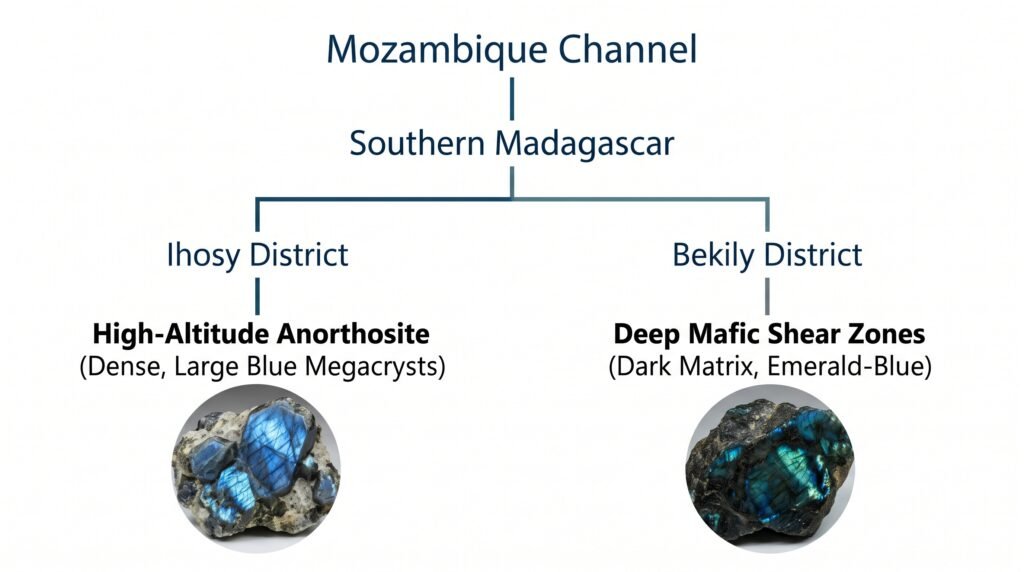
Lemurian Blue Granite is sourced almost exclusively from the southern central highlands of Madagascar.
Geologically, these deposits formed during the late Neoproterozoic Pan-African orogeny (approximately 500 to 600 million years ago) when tectonic collisions welded Madagascar into the super continent Gondwana. Blocks are mechanically extracted using diamond wire saws in open-pit quarries near the town of Ihosy and across the Bekily region, transported by heavy transport to the Port of Toamasina, and exported primarily to Italy, Spain, and China for multi-axis gang-saw processing.
Crystal Pairings: What to Combine and Avoid
In energetic and metaphysical work, the high-frequency vibration of labradorite-bearing anorthosite interacts intensely with other crystal lattices.
Optimal Crystal Pairings
- Clear Quartz: Functions as an energetic amplifier, intensifying the reflective frequencies of labradorite and clarifying visionary work.
- Black Tourmaline / Black Obsidian: Provides grounding to anchor the high-frequency, astral-reaching properties of the blue feldspar, keeping the practitioner tethered to physical reality.
- Amethyst: Harmonies third-eye activation and enhances psychic protection, creating an auric barrier during deep meditation.
- Larimar or Aquamarine: Water-element stones that soften the electrical nature of the feldspar, balancing intuitive downloads with calm emotional articulation.
Crystal Pairings to Avoid
- Carnelian & Red Jasper: High-iron, aggressive base-chakra stones can clash with the introspective, mystical currents of Lemurian Blue, creating emotional agitation or grounding confusion.
- Moldavite (for Beginners): Combining tektite impact energy with intense feldspar flash can induce disorientation, sensory overload, and groundlessness unless managed by experienced practitioners.
- Pyrite: High-density, metallic fire energy disrupts the fluid intuition stimulated by labradorescence, often causing mental restlessness.
Archaeology, Art, and Ancient History
Because modern open-pit quarries in Madagascar were developed in the late 20th century, Lemurian Blue Granite lacks a classical antiquity footprint in Greco-Roman or Dynastic Egyptian architecture. However, anorthosite rocks were revered in ancient empires:
- Old Kingdom Egypt: Pharaoh Khafre commissioned his sacred funerary statues from a related plagioclase anorthosite gneiss (Chephren’s Diorite) quarried at Gebel el-Asr in Nubia, valuing its luminous translucency.
- Malagasy Lapidary Art: Indigenous Malagasy artisans historically worked localised labradorite deposits for protective talismans and ceremonial boundary markers, viewing the iridescent sheen as the breath of spirits trapped in ancient bedrock.
- Contemporary Monumental Art: Today, Lemurian Blue is used for luxury sculptures, bespoke liturgical altars, high-end yacht interiors, and architectural focal walls.
Folklore, Legends and Sacred Tales
The stone draws its trade name from the lost continent of Lemuria (or Mu), which esoteric lore places across the Indian and Pacific Oceans. Theosophists and New Age mystics propose that Madagascar is a remaining above-water mountain peak of this sunken civilisation.
According to lore:
- The Lemurian Light Codes: Practitioners believe Lemurian Blue acts as an organic holographic repository, claiming that ancient matriarchal sages encoded spiritual wisdom into the feldspar crystal matrix prior to cataclysmic tectonic shifts.
- The Celestial Mirror: Malagasy legend recounts that the stone captured pieces of the night sky during creation; looking directly into its blue flashes was said to allow shamans to walk between the worlds of the living and ancestors.
Metaphysical and Mystical Healing Properties
- Emotional Balance: Dissolves self-doubt, dissipates habitual negative internal dialogues, and balances erratic emotional waves.
- Spiritual Awakening: Labradorite stimulates the intuitive mind, sharpens clairvoyance, assists in lucid dreaming, and accesses the subconscious.
- Auric Shielding: Forms an energetic deflection shield, warding off psychic drains, negative thought patterns, and environmental electromagnetic smog.
- Physical (Esoteric Beliefs): In vibrational crystal healing, it is used to alleviate respiratory stress, calm the central nervous system, and ease ocular strain caused by screen fatigue.
Astrological Connections
Lemurian Blue Granite demonstrates strong alignments with signs bridging intellectual exploration and structural mastery:
- Aquarius: Governed by Uranus, Aquarius resonates with the stone’s electric-blue lightning flashes and its stimulation of visionary thought and innovation.
- Capricorn: Provides grounding for Capricorn’s ambition, turning the stone’s ancient plutonic density into steady perseverance.
- Pisces & Cancer: Water signs benefit from the oceanic blue-green iridescence, which provides an auric container that keeps emotional empathy from turning into energetic exhaustion.
- Virgo: Assists in silencing analytical overthinking by opening access to higher intuitive certainty.
The Chakra System
The multi-tonal nature of Lemurian Blue activates three primary chakras:
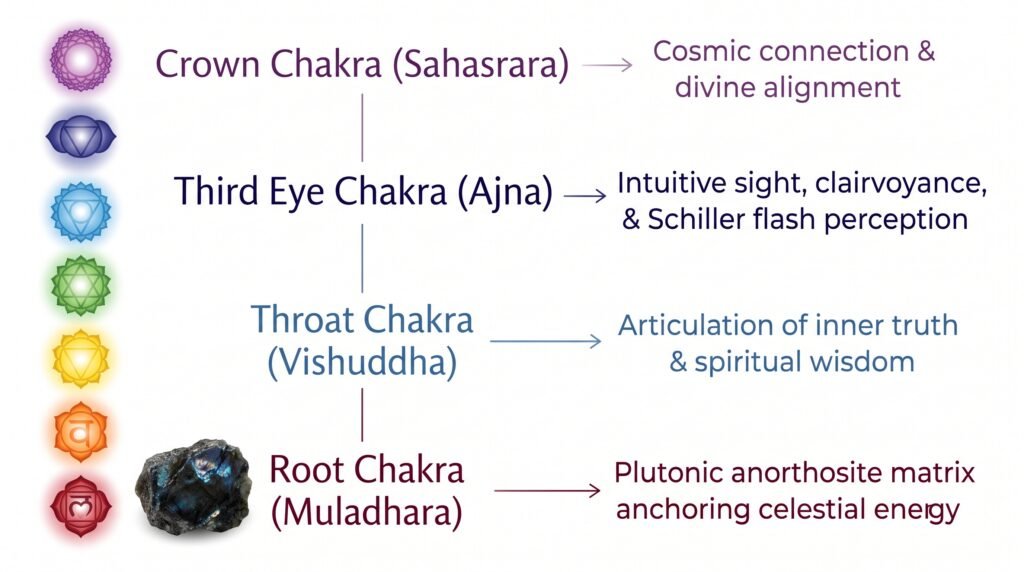
- Third Eye Chakra (Ajna): The blue Schiller flash stimulates the pineal gland, enhancing intuitive vision and inner knowing.
- Throat Chakra (Vishuddha): Supports truthful communication and the articulation of complex spiritual insights.
- Root Chakra (Muladhara): The dense, mafic black matrix grounds galactic energies directly into physical reality, preventing ungrounded spacey states.
Interesting Facts
- Planetary Relatives: Anorthosite, the parent rock of Lemurian Blue, is the dominant rock type composing the Lunar Highlands of the Moon, verified by core samples returned during Apollo 15 and 16.
- Optical Illusion of Depth: Because the blue light reflection occurs below the crystal surface along internal lamellae planes, the stone produces a 3D stereoscopic illusion, making slabs appear liquid and translucent under shifting lighting.
- Not an Engineered Composite: Despite its exotic, gemstone-like appearance that resembles epoxy terrazzo, Lemurian Blue is 100% natural quarried plutonic stone.
Modern Milestones: Birthstones and Anniversaries
- Alternative Birthstone: Embraced as a modern alternative birthstone for February and November, serving as an intuitive counterpart to amethyst and topaz.
- Modern Anniversaries: Frequently gifted on the 8th and 13th wedding anniversaries, symbolising transformation, structural resilience, and enduring mystery.
Lemurian Blue Granite Frequently Asked Questions
Is Lemurian Blue a granite, marble, or quartzite?
Petrologically, it is an anorthosite (a plagioclase feldspar-dominant igneous rock). It is sold commercially as a “granite” because it shares granite’s structural density, hardness, and acid-resistant properties.
Can Lemurian Blue Granite be used in outdoor kitchens?
Yes, but with precautions. The mineral matrix resists freeze-thaw cycles and heat. However, direct prolonged ultraviolet (UV) solar radiation can cause the micro-twinning planes to lose some blue luminescence over decades, so shaded outdoor installations are advised.
How do you clean and seal Lemurian Blue counter tops?
Clean with pH-neutral stone detergents and microfibre cloths. Avoid hydrofluoric acid or abrasive cleansers. Apply a high-grade fluorochemical penetrating impregnator every 12 to 24 months to guard the feldspar cleavage planes against oil and water infiltration.
Why does the blue flash disappear from certain angles?
Labradorescence is directional. It is visible only when the angle of incident light matches the specific alignment of the submicroscopic crystal twin planes. Premium fabricators deliberately template counter tops so that natural room lighting hits these cleavage planes toward the viewer’s line of sight.
How much does Lemurian Blue Granite cost per square foot?
Due to limited quarry reserves in Madagascar and high shipping weights, raw slabs range from £200 to £450+ per square foot fabricated, classifying it as a Tier 5+ luxury exotic stone.