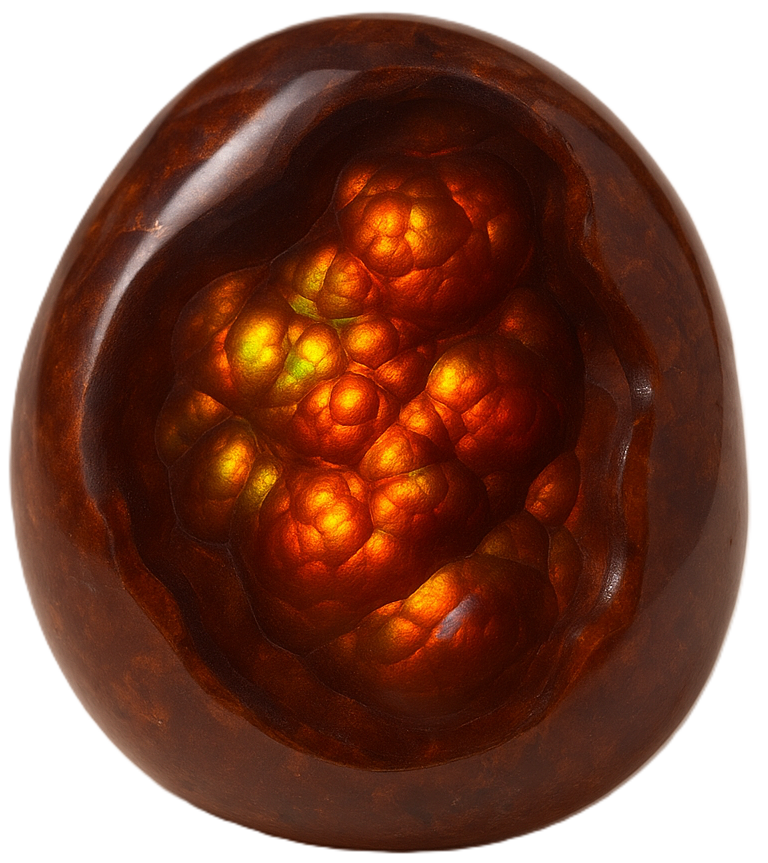
Fire Agate is a rare, iridescent variety of chalcedony celebrated for its internal, flame-like play of colour. Formed millions of years ago in regions of intense volcanic activity, this gemstone features alternating microscopic layers of silica and iron oxide that diffract light, producing brilliant flashes of red, orange, gold, and green. Found predominantly in the arid, mountainous deserts of the southwestern United States and northern Mexico, it is a stone of exceptional depth and durability. Highly prized by lapidaries, collectors, and crystal healers alike, Fire Agate combines profound geological rarity with powerful historical and metaphysical appeal.
Alternate Names
While recognised universally as Fire Agate, this striking gemstone is known by several other descriptive and historical titles within the gemological and metaphysical communities:
- Fiery Chalcedony: A nod to its true mineralogical identity as a cryptocrystalline quartz.
- Iris Agate: Though technically a distinct variety of agate that shows spectral colours via transmitted light, some historical texts use this term interchangeably due to the shared iridescent properties.
- The Spiritual Flame of Absolute Perfection: A metaphysical title bestowed upon the stone by crystal healers for its energetic purity and protective qualities.
- Flame Agate: Occasionally used in casual trade circles to describe specimens with dominant, leaping red-orange patterns.
The Stones Science and Composition
From a scientific standpoint, Fire Agate is a microcrystalline (or cryptocrystalline) variety of quartz belonging to the chalcedony family. Its chemical formula is primarily silicon dioxide ($\text{SiO}_2$).
The phenomenon that sets Fire Agate apart from all other agates is its internal structural iridescence. This optical effect is created through a process known as light interference and diffraction. During its formation, hot, mineral-rich hydrothermal solutions containing silica and iron oxide flooded cavities within volcanic host rocks. As these solutions cooled, they deposited alternating, microscopic layers of silica and iron oxides—specifically haematite ($\text{Fe}_2\text{O}_3$), limonite ($\text{FeO}(\text{OH})\cdot n\text{H}_2\text{O}$), or goethite ($\alpha\text{-FeO(OH)}$).
When light enters the stone, it passes through the clear chalcedony layers and strikes these ultra-thin, botryoidal (bubble-like) iron oxide films. The light waves reflect off both the upper and lower boundaries of these thin films, interfering with one another. This neutralises certain wavelengths while amplifying others, producing a vibrant, multicoloured metallic flash reminiscent of peacock feathers or oil slicks on water.
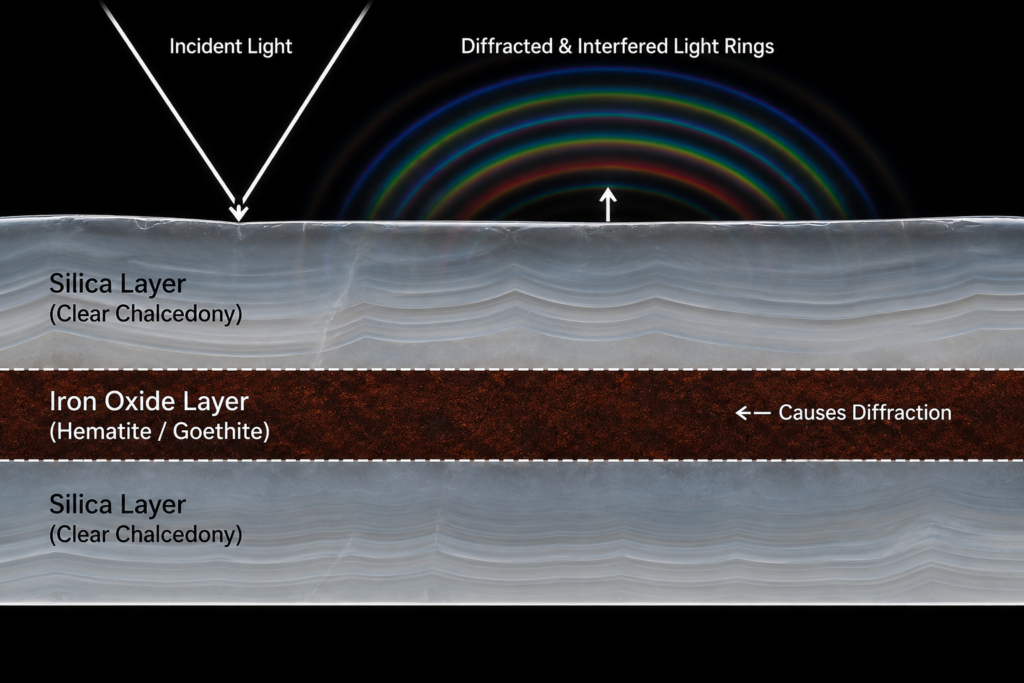
When light enters the stone, it passes through the clear chalcedony layers and strikes these ultra-thin, botryoidal (bubble-like) iron oxide films. The light waves reflect off both the upper and lower boundaries of these thin films, interfering with one another. This neutralises certain wavelengths while amplifying others, producing a vibrant, multicoloured metallic flash reminiscent of peacock feathers or oil slicks on water.
Key Physical Characteristics
Fire Agate possesses distinct physical properties that make it highly resilient, distinct from other iridescent minerals, and notoriously difficult to cut:
- Chemical Formula: $\text{SiO}_2$ with inclusions of $\text{Fe}_2\text{O}_3$ and $\text{FeO}(\text{OH})$
- Crystal System: Trigonal / Microcrystalline
- Mohs Scale Hardness: 6.5 to 7
- Lustre: Waxy to vitreous
- Transparency: Translucent to opaque
- Refractive Index: 1.530–1.540
- Specific Gravity: 2.58–2.64
- Cleavage: None (exhibits a conchoidal fracture)
- Colour Range: Base body colour is typically chocolate brown, dark gray, or black. The iridescent flashes display a spectrum of red, orange, bronze, gold, vivid green, and, on rare occasions, electric blue or purple.
Common Geologic Varieties
Fire Agate is classified primarily by its geographic locality, which dictates its underlying aesthetics, colour profile, and structural patterning:
- Mexican Fire Agate: Sourced mainly from Chihuahua, Durango, and Aguascalientes, Mexican specimens are famous for their intense, multicoloured fire. They often showcase tightly packed, bubble-like botryoidal forms with vivid arrays of greens, hot pinks, and purples flashing across a dark base.
- Arizona Fire Agate: Hailing from the desert mountains of Arizona, these stones are renowned for their deep, dark chocolate-brown body colour, contrasted sharply by bright, broad flashes of molten bronze, metallic gold, and fiery red.
- Slaughter Mountain Fire Agate: Located on San Carlos Apache tribal lands in Arizona, this specific locality yields some of the most sought-after and expensive specimens in the world. They are celebrated for their exceptional clarity, high-contrast matrix, and rare, blinding electric green and gold flashes.
Global Mining and Volcanic Sources
Fire Agate is one of the rarest gemstones on Earth due to the highly specific, restrictive geological conditions required for its formation. It formed roughly 24 to 36 million years ago during the Oligocene Epoch, an era marked by massive, explosive volcanic activity in Western North America.
The primary global sources are concentrated almost entirely within an arid, volcanic belt spanning the southwestern United States and northern Mexico:
- United States: Concentrated in the desert expanses of southeastern Arizona (such as the Black Hills, Deer Creek, and Slaughter Mountain), southeastern California (Opal Hill Mine near Palo Verde), and parts of southern New Mexico.
- Mexico: Primarily mined in the states of Aguascalientes, Chihuahua, Durango, and San Luis Potosí.
While minor, low-grade deposits of iridescent chalcedony have occasionally been reported in countries like Brazil, Indonesia, and Australia, these localities lack the distinct structural iron-oxide layering required to produce the true, high-intensity botryoidal fire seen in North American specimens.
Crystal Pairings: What to Combine and Avoid
Pairing crystals involves aligning their mineral structures, elemental assignments, and metaphysical frequencies to ensure they work harmoniously.
Optimal Crystal Pairings
Fire Agate thrives alongside stones that share its fiery, grounding, or solar nature:
- Carnelian: This orange chalcedony shares Fire Agate’s chemical backbone. Together, they form a powerful synergistic link that amplifies creative drive, physical stamina, and personal motivation.
- Hematite: Because haematite is the very iron oxide trapped within Fire Agate, pairing these two amplifies the stone’s grounding properties, locking wandering mental energy firmly into the physical body.
- Sunstone: An excellent solar match. Sunstone injects joyful, optimistic, and expansive energy into Fire Agate’s intensely focused, protective matrix.
- Red Jasper: Provides a steady, slow-burning anchor of physical endurance and courage that stabilises Fire Agate’s sudden, explosive bursts of vitality.
Crystal Pairings to Avoid
Conversely, stones with highly contrasting energy profiles can cause vibrational discord:
- Blue Lace Agate or Selenite: These high-vibrational, cooling, and calming stones are designed to soothe anxiety and slow down energy. Combining them with Fire Agate creates a contradictory push-pull effect, dampening Fire Agate’s motivational spark while disrupting the peace of the calming stone.
- Labradorite: While both are iridescent, Labradorite focuses on ethereal, cosmic exploration and upper-chakra shifting. Its airy, elusive energy directly clashes with the deeply rooted, physical, and highly focused terrestrial nature of Fire Agate.
Archaeology, Art and Ancient History
Archaeological evidence indicates that indigenous peoples of Central and North America discovered and utilised Fire Agate thousands of years before modern lapidaries categorised it. Arrowheads, scrapers, and small talismans carved from fire chalcedony have been excavated near ancient desert campsites throughout the American Southwest and Northern Mexico.
Because the raw stone often looks like a plain, bumpy brown rock until it is wet or worn down, ancient artisans recognised that friction revealed its hidden internal embers. It was incorporated into ceremonial dress, protective breastplates, and burial items to honor the spirit of the desert and ensure safe passage into the afterlife.
In modern art, Fire Agate presents an extreme lapidary challenge. Unlike diamonds or sapphires which are faceted geometrically, Fire Agate must be carved contour-style. Artists must meticulously grind away layers of brown chalcedony under water using dental drills or diamond carvers, stopping mere fractions of a millimetre above the ultra-thin iron oxide layers. Shaving too deeply destroys the fire permanently, making every finished cabochon a custom, sculptural piece of art.
Folklore, Legends and Sacred Tales
In ancient folklore, Fire Agate was believed to be a physical manifestation of living flame frozen in time by the Earth. Desert nomads spoke of the stone being born in the bellies of active volcanoes, capturing the literal essence of the underworld’s fire element.
Native American legends frequently regard Fire Agate as a sacred stone gifted by the gods of fire and lightning. It was carried by warriors to enhance their bravery, instil fearlessness in the face of conflict, and shield them from physical harm.
A recurring theme in historical superstition is Fire Agate’s reputation as a mirror talisman. It was believed to possess a conscious protective barrier capable of detecting ill wishes, curses, or negative intentions directed at its keeper. Instead of merely absorbing this negative energy, the stone’s iridescent layers were said to reflect the malice directly back to its source, acting as a metaphysical shield of cosmic justice.
Metaphysical and Mystical Healing Properties
Within the holistic health and crystal healing communities, Fire Agate is revered as a stone of pure vitality, absolute protection, and deep terrestrial grounding.
- Emotional Healing: Fire Agate acts as a catalyst for conquering apathy, lethargy, and creative stagnation. It gently surfaces repressed fears and insecurities, forcing the individual to confront and dissolve them. By substituting fear with self-confidence, it helps survivors of trauma reclaim their personal power and enthusiasm for life.
- Spiritual Energy: It offers a protective energetic shield around the aura, preventing psychic vampires from draining one’s life force. It encourages a safe spiritual awakening, anchoring higher metaphysical insights into everyday physical reality.
- Physical Associations: Practising crystal healers associate Fire Agate with the enhancement of the physical circulatory system, metabolic function, and sluggish digestion. Its warm, stimulating vibration is frequently used in efforts to combat fatigue, improve night vision, and revitalise reproductive health.
Astrological Connections
Fire Agate naturally aligns with the Fire Element, making it highly resonant with the fire signs of the zodiac:
- Aries: This stone channels the pioneering, explosive energy of Aries, providing the raw stamina needed to finish projects while acting as a structural guardrail against reckless impulses.
- Leo: Fire Agate bolsters Leo’s natural charisma, creativity, and leadership abilities, while keeping their ego grounded and protected from external jealousy.
- Sagittarius: For the celestial archer, Fire Agate fuels the philosophical quest for adventure and truth while offering protection during long travels.
Beyond the fire signs, Fire Agate possesses an intense affinity for Scorpio. It matches Scorpio’s deep, subterranean emotional intensity, providing a safe, grounded conduit for their transformative energy while helping them master emotional control.
The Chakra System
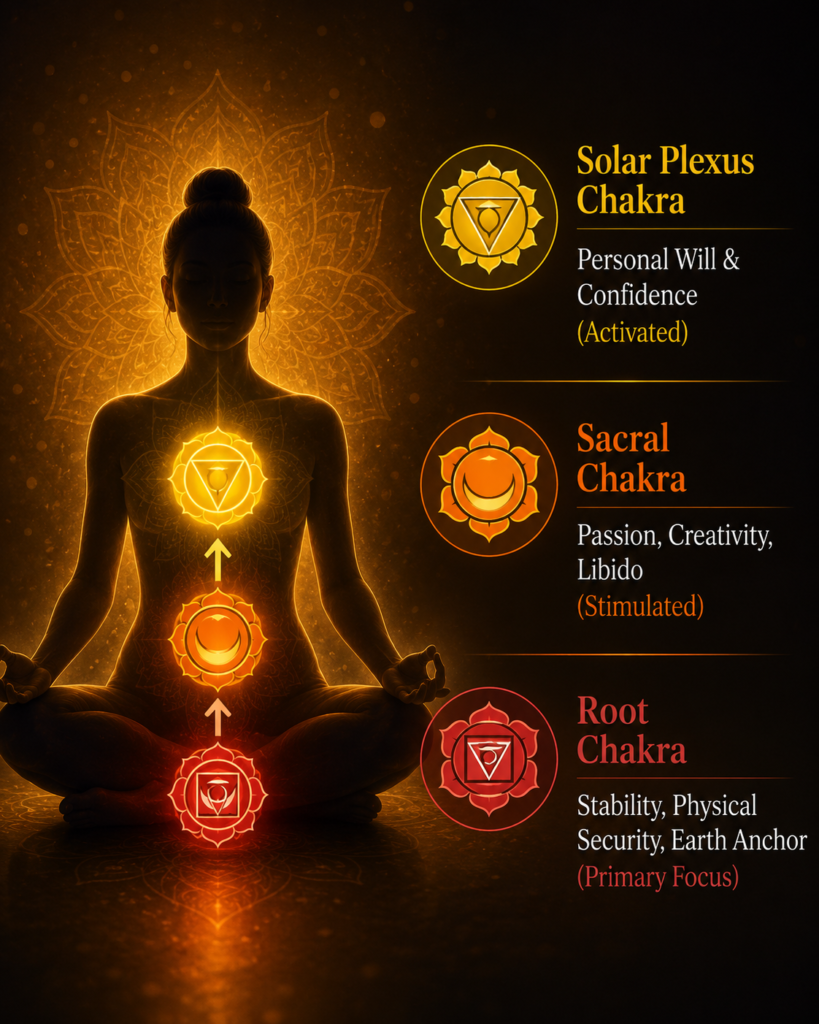
Fire Agate is a foundational stone for the lower chakra network, working upwards from the base of the spine to stimulate action and manifestation:
The Root Chakra (Muladhara)
Fire Agate anchors its primary energetic roots here. It establishes a profound, unshakeable connection to the Earth, eliminating irrational anxiety, replacing it with a deep-seated feeling of safety, stability, and belonging.
The Sacral Chakra (Svadhisthana)
By clearing blockages in the lower abdomen, the stone ignites sexual vitality, artistic expression, and the passion required to manifest desires into physical reality.
The Solar Plexus Chakra (Manipura)
The golden and bronze rays within the stone warm the seat of personal willpower, assisting individuals in overcoming procrastination, setting firm boundaries, and manifesting prosperity.
Interesting Facts
- 100% Natural Flame: The hypnotic iridescence of Fire Agate is completely natural. It cannot be successfully replicated via laboratory synthesis, nor is it enhanced by dyes, heat treatments, or radiation.
- The Biomimicry of Light: The physical laws governing Fire Agate’s colour shift are identical to those found in nature’s most beautiful displays, including the wings of morpho butterflies, iridescent beetle shells, and peacock feathers.
- A Carver’s Nightmare: Because the iridescent layers follow the irregular, bumpy curves of botryoidal chalcedony, it can take a master gem carver up to 10 hours to properly cut and finish a single, high-grade one-carat stone.
Modern Milestones: Birthstones and Anniversaries
While Fire Agate is not listed on the modern, traditional gemstone birthstone charts established in 1912, it has earned a permanent spot as an alternative planetary birthstone for Aries and Leo. It serves as an ideal gift for individuals born in the spring and summer months who desire a stone that mirrors their fiery natal elements.
In terms of modern relationship milestones, Fire Agate is highly celebrated as an alternative gemstone gift for the 6th Wedding Anniversary. Symbolising a marriage that has moved past its initial developmental stages, the stone represents enduring passion, a well-grounded domestic foundation, and fierce mutual protection against external hardships.
Fire Agate Frequently Asked Questions FAQ
Where exactly is Fire Agate found?
True Fire Agate is incredibly localised. It is mined exclusively in the arid desert regions of the southwestern United States (Arizona, California, and New Mexico) and northern to central states of Mexico (Chihuahua, Durango, and Aguascalientes).
How long does it take for Fire Agate to form?
The formation process occurred over millions of years during ancient volcanic epochs. As hydrothermal fluids repeatedly filled and receded from underground rock cavities, microscopic layers accumulated atom by atom. The stones mined today are roughly 24 to 36 million years old.
How can I tell if my Fire Agate is real or a fake?
A: Authentic Fire Agate is highly resilient against counterfeiting due to its complex structure. To spot a real specimen, look for three main factors:
- The Bubble Contour: It features an undulating, uneven, botryoidal surface. Completely flat, perfectly smooth stones with uniform surface flashes are highly suspect.
- Three-Dimensional Depth: The colour flashes must appear to sit deep inside the stone, shifting and moving dynamically as you tilt it under a light source. If the colour is printed or painted superficially on the surface, it is a fake.
- Scratch Test: Boasting a hardness of 6.5 to 7 on the Mohs scale, authentic Fire Agate cannot be scratched by a standard steel pocketknife or window glass.
What is the difference between Fire Agate and Fire Opal?
A: While their names sound similar, they are entirely different minerals:
- Fire Opal is an amorphous, hydrated silica gel ($\text{SiO}_2\cdot n\text{H}_2\text{O}$) that contains up to 21% water. It is significantly softer (5.5 to 6.5 Mohs), fragile, prone to drying out (crazing), and usually translucent-orange throughout its body.
- Fire Agate is a tough, microcrystalline quartz with no water content. It is harder, far more durable, and its colour play is caused by structured iron oxide layers inside an opaque-to-translucent dark chalcedony matrix.
Can I wear Fire Agate jewellery every day?
Yes. Thanks to its structural hardness of 6.5 to 7 and lack of cleavage planes, Fire Agate is tough enough to withstand daily wear in rings, pendants, and bracelets. However, because the iridescent layer itself is microscopically thin beneath the protective quartz cap, avoid deep surface repolishing or exposure to harsh industrial chemicals and ultrasonic cleaners.
Can Fire Agate go in water?
Yes, Fire Agate is perfectly safe in water. Clean it using warm, soapy water and a soft-bristled brush. Avoid prolonged exposure to boiling water or sudden extreme temperature changes, as thermal shock can cause fractures along the host rock matrix.
These are my personally selected and curated Fire Agate products