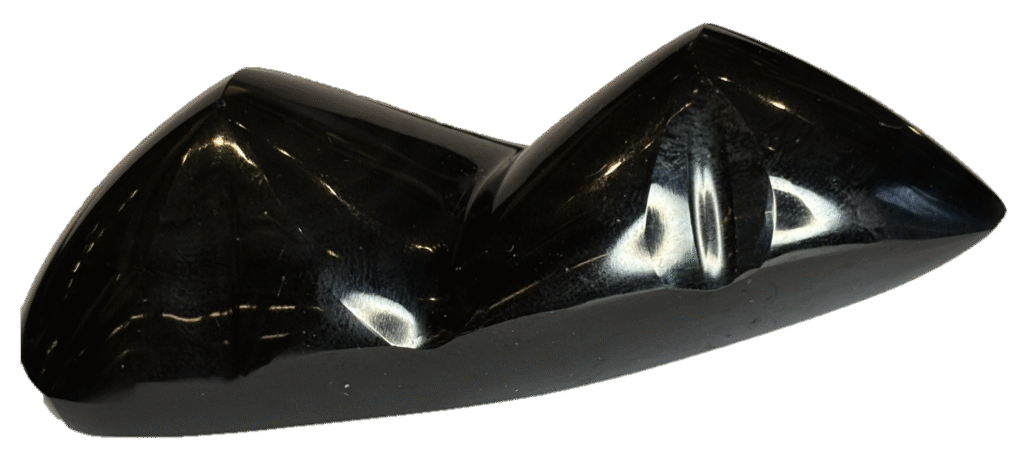
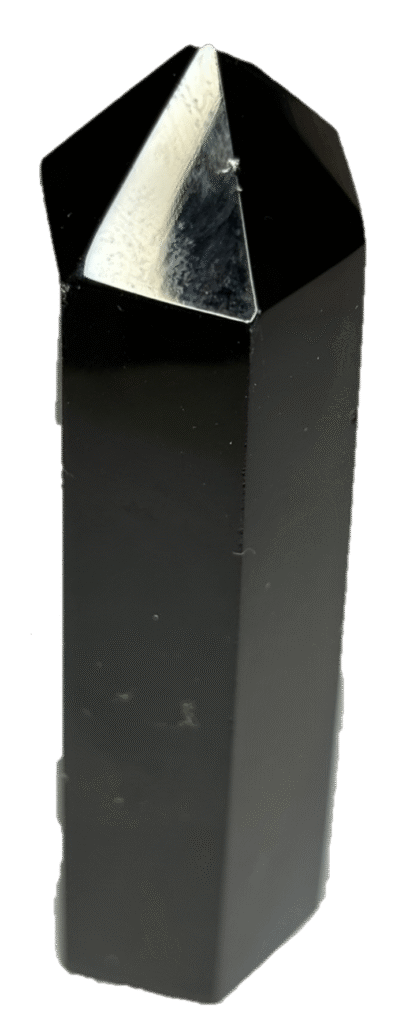
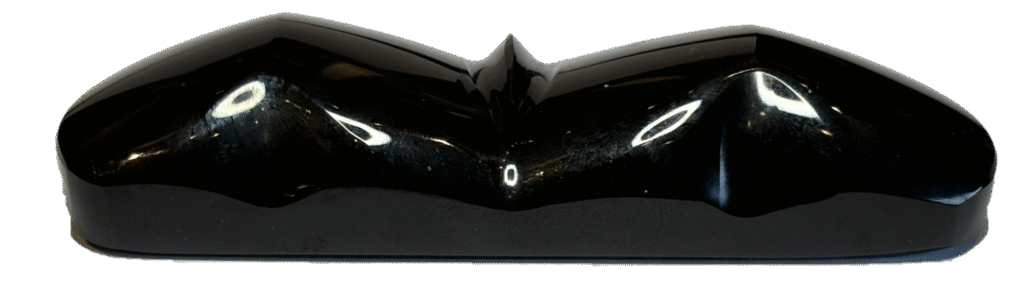
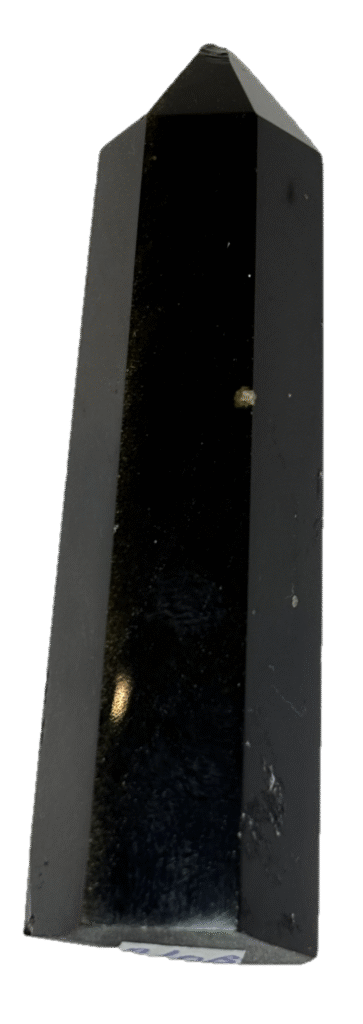
Black obsidian is an intense, glass-like volcanic rock that has fascinated humanity since the Stone Age. Known for its mirror-like sheen and razor-sharp edges, this striking stone forms rapidly from the fiery depths of volcanic eruptions.
Equally treasured throughout history as a formidable weapon, a tool for ancient divination, and a protective stone in modern metaphysics, black obsidian remains one of the most popular and powerful items in the mineral kingdom. This complete guide explores the science, history, and spiritual energy of this dramatic volcanic stone.
What is Black Obsidian? Science and Composition
Unlike standard crystals, black obsidian is not a true mineral. Because it lacks a structured internal crystal framework, geologists classify it as a mineraloid—specifically, an amorphous volcanic glass.
It forms during explosive volcanic eruptions when high-silica felsic lava erupts onto the Earth’s surface and cools micro-instantaneously. The lava cools so quickly that individual mineral atoms do not have enough time to arrange themselves into a ordered crystalline lattice, freezing instead into a chaotic, glass-like state.
Key Physical Characteristics
- Chemical Base: Predominantly silicon dioxide ($SiO_2$) mixed with volcanic gasses and iron oxides.
- Mohs Hardness: 5–5.5 (relatively soft and easily scratched by metals, yet highly durable against chemical weathering).
- Fracture Style: Conchoidal. When struck, obsidian breaks into smooth, curved, shell-like shards with edges that are sharper than the finest steel surgical scalpels.
- Lustre: Highly vitreous (glassy).
Common Geologic Varieties
While pure obsidian is jet-black, microscopic mineral inclusions or gas bubbles trapped during the rapid cooling process create stunning natural variations:
- Mahogany Obsidian: Features rich, reddish-brown streaks caused by high concentrations of iron oxide (hematite).
- Snowflake Obsidian: Contains white, cloud-like patches of sphaerulite crystals (radiating clusters of cristobalite needle crystals).
- Rainbow & Sheen Obsidian: Displays a striking gold, silver, or iridescent multi-coloured flash caused by microscopic water vapour or gas bubbles stretched along the lava flow lines.
Global Mining and Volcanic Sources
Black obsidian can only be found in regions that have experienced relatively recent geological volcanic activity. Because volcanic glass degrades and devitrifies (crystallises) into ordinary rock over tens of millions of years, there is very little truly ancient prehistoric obsidian on Earth. Major active global sources include:
- Mexico: The primary global exporter of premium iridescent, rainbow, and jet-black varieties, heavily mined around Jalisco and Hidalgo.
- Western United States: Abundant deposits run through the active volcanic fields of Oregon, California (such as Mono Lake), Arizona, and Wyoming (Yellowstone).
- Iceland: Famous for raw, glassy volcanic flows yielding dense, pitch-black specimens.
- The Mediterranean: Highly localized sources on the Italian volcanic islands of Lipari and Pantelleria, which supplied the ancient world.
Crystal Pairings: What to Combine and Avoid
In energy healing, black obsidian is treated as a high-speed, uncompromising energetic mirror and grounding force. It acts forcefully, which means choosing the right companion stones is critical to maintaining emotional balance.
Optimal Crystal Pairings
- For Gentle Integration: Rose Quartz or Rhodonite. Black obsidian can pull deeply buried traumas or repressed truths out of your subconscious very quickly, which can feel emotionally jarring. Pairing it with the soft, nurturing frequencies of rose quartz ensures that whatever the “mirror” reveals is met with self-compassion and immediate emotional healing.
- For Ultimate Shielding: Clear Quartz or Selenite. Clear quartz acts as a natural amplifier. When paired with obsidian, it magnifies the stone’s protective boundaries while channelling pure light into the spiritual vacuum that obsidian creates when absorbing negativity.
- For Earth Connection: Smoky Quartz or Haematite. If you are using obsidian for deep shamanic work or journeying, combining it with smoky quartz adds a layer of practical stability, ensuring you remain fully anchored to your physical body.
Crystal Pairings to Avoid
- Hyper-Active Spiritual Stones: Moldavite or Libyan Desert Glass. Moldavite is a high-frequency tektite known for triggering rapid, often chaotic life transformations. Combining the cosmic acceleration of moldavite with the intense shadow-revealing power of black obsidian can create an overwhelming energetic storm, leaving you feeling profoundly ungrounded, anxious, or emotionally exhausted.
- Fiery Solar Crystals: Carnelian or Sunstone. These stones pulse with bright, joyful, outward-moving solar energy designed for creative expression. Obsidian’s dense, void-like, and inward-pulling energy can completely dull this vital fire, rendering both stones ineffective.
Archaeology, Art and Ancient History
Historically, the discovery of obsidian completely transformed early human tool-making and hunting capabilities.
- The Ancient Lapidary Arts: The word obsidian is a Latin corruption of obsidianus, an error recorded in Pliny the Elder’s Naturalis Historia. Pliny noted that the stone was named after Obsidius, a Roman explorer who allegedly discovered the glassy rock while travelling through Ethiopia.
- Prehistoric Weaponry: Long before the discovery of metallurgy, Neolithic cultures prized obsidian for its conchoidal fracture. By striking the stone meticulously (a process called knapping), tribes fashioned arrows, spears, and sacrificial knives. In Mesoamerica, Aztec warriors fielded the macuahuitl—a flat wooden club studded with razor-sharp obsidian blades capable of severing a horse’s head.
- The Royal Office: Because polished obsidian acts as a perfect natural mirror, ancient elites across the Mediterranean and Mesoamerica used it as a functional luxury item. Famously, hot sealing wax does not adhere to polished volcanic glass, making it an excellent medium for royal signets and wax stamps.
Folklore, Legends and Sacred Tales
The deep, enigmatic mirror-sheen of obsidian caused ancient cultures across the globe to view it as a direct portal to the spirit world.
- Aztec and Mayan Polytheism: Both civilisations viewed obsidian as a living manifestation of divine magic. The supreme Aztec deity Tezcatlipoca—whose name translates literally to “The Smoking Mirror”—was the god of the night sky, ancestral memory, and divination. He was traditionally depicted wearing an obsidian mirror on his chest or foot, which he used to witness all human thoughts and cosmic events.
- The Apache Tears Legend: In Arizona, USA, local folklore surrounds small, rounded nodules of black obsidian known as “Apache Tears”. Legend states that in the 1870s, a outnumbered band of Apache warriors rode their horses over a precipice to escape capture. The grieving women of the tribe wept at the base of the cliffs; their tears turned to stone upon hitting the desert floor, creating obsidian nodules that are said to bring comfort to anyone experiencing deep grief.
- Global Divination Practices: In African and native European folk traditions, obsidian was frequently dubbed the “Stone of Truth”. Seers across continents used polished obsidian spheres or plates for scrying (gazing into a reflective surface to receive prophetic visions), believing it would cut through illusions to reveal a person’s authentic destiny.
Metaphysical and Mystical Healing Properties
In modern holistic crystal healing, black obsidian is celebrated primarily as a psychic vacuum cleaner and an absolute spiritual anchor.
- Psychic Protection: Obsidian acts as a highly dense energetic shield around the human aura. It does not simply repel negative energy; it actively absorbs environmental stress, psychic attacks, and harmful projections, trapping them within its amorphous atomic void.
- The Shadow Work Mirror: Metaphysically, obsidian functions like a psychological spotlight. It forces you to look directly at your “shadow self”—your repressed flaws, insecurities, and unhealthy patterns. By bringing these hidden aspects of your mind into conscious awareness, it allows for genuine, deep-seated emotional healing.
- Mental Clarity: By clearing away the stagnant fog of lingering worry, self-doubt, and chaotic thinking, it helps anchor your mind into a practical, logical, and clear-headed state of awareness.
Astrological Connections
In astrology, black obsidian aligns beautifully with zodiac signs that are naturally wired for deep introspection, psychological transformation, and intense focus.
Scorpio (24 October – 21 November)
As a water sign ruled traditionally by Mars and modernly by Pluto, Scorpios are natural psychological detectives. They are fundamentally unafraid of darkness and secrets. Black obsidian perfectly matches Scorpio’s intense vibrational energy. It protects them as they explore their deep emotional waters and provides the spiritual strength needed to fuel their signature trait: complete personal reinvention.
Capricorn (22 December – 19 January)
Capricorn is an earth sign ruled by Saturn, the planet of structure, boundaries, and hard work. Capricorns require grounded, practical stability to thrive. Black obsidian reinforces their natural resilience, absorbs the intense professional stress that ambitious Capricorns often carry, and helps them maintain rigid personal boundaries in difficult working environments.
The Chakra System
Black obsidian operates exclusively within the Root Chakra (Muladhara), located at the base of the spine. The root chakra regulates your base feelings of survival, physical safety, ancestral roots, and core stability.
When this chakra is blocked, you may feel spacey, deeply anxious, scattered, or constantly fearful of change. Because obsidian carries an incredibly heavy, dense volcanic frequency, placing it at the base of the spine during meditation pulls erratic energy down out of your upper chakras and plugs it directly into the grounding grid of the Earth. This clears sluggish blocks along your primary energy pathways and instils a deep sense of personal security.
Modern Milestones: Birthstones and Anniversaries
While not recognised on standard, commercial birthstone charts, black obsidian is highly utilised in modern crystal astrology as an alternative birthstone for November and December, offering a protective anchor for those born during the cold, introspective transition into winter.
Furthermore, because of its rich association with absolute permanence and structural resilience, polished black obsidian jewellery or carvings have become a deeply meaningful, contemporary gift for marking major wedding anniversaries (particularly the 5th or 10th year). It serves as a beautiful physical symbol of a love that has withstood immense real-world pressure and emerged as something brilliant, strong, and completely unbroken.
Extensive FAQ Section
Is black obsidian safe to wash in water?
Yes, black obsidian can safely go in water. Sitting at a 5 to 5.5 on the Mohs hardness scale with an entirely non-porous glass structure, it will not dissolve or crack during a standard wash. You can easily clean it using lukewarm water and a drop of mild soap. However, you must avoid extreme temperature shocks (such as moving it instantly from boiling water to ice water) as this can crack the glass, and never use harsh abrasive chemicals that could etch its mirror-like polish.
Is black obsidian rare or expensive?
No, black obsidian is a highly abundant volcanic rock found in massive, monolithic quantities all over the world. As a result, it is incredibly affordable. Standard tumbled pocket stones or raw chunks are very inexpensive. The price only increases for specimens that display highly symmetrical carving work, or rare optical varieties like high-contrast rainbow, gold-sheen, or fire obsidian.
How can I tell if my black obsidian is genuine or fake?
Because obsidian is cheap to mine, fake pieces are rare, but black window glass or plastic resin replicas do exist. To check authenticity, hold the edge of the stone up directly against a bright torch. Real black obsidian is natural volcanic glass; even the darkest pieces will reveal a cloudy, semi-translucent smoky-brown or greenish-yellow tint around the very thin edges when backlit. If the stone remains 100% opaque black even under a blinding light, or if it contains tiny perfectly round air bubbles, it is likely artificial factory glass.
How do I safely cleanse and charge my black obsidian?
Because black obsidian acts like a spiritual sponge—constantly absorbing heavy environmental stress and negative psychic energy—it requires frequent, regular cleansing. You can cleanse it by holding it under running tap water for a few minutes, burying it in dry sea salt overnight, or smudging it with the smoke of frankincense. To recharge its protective properties, place it outside on the bare earth under the direct light of a Full Moon.
Is it dangerous to keep black obsidian in the bedroom?
For most people, yes. Because obsidian’s energetic frequency functions like an intense vacuum cleaner that pulls subconscious thoughts to the surface, keeping a large piece on your nightstand can severely disrupt your sleep. It can trigger intense, hyper-vivid dreams, night sweats, or restless insomnia as your brain attempts to process deep emotional work while sleeping. For a restful bedroom environment, it is best replaced with calming, low-intensity stones like amethyst or rose quartz.
Why is my black obsidian scratching so easily?
Do not worry, this is completely normal. Obsidian is natural glass, not a diamond or quartz crystal. Sitting at a 5.5 on the Mohs scale, it is physically softer than household dust particles (which often contain quartz), steel keys, and coins. Sliding a highly polished obsidian stone across a rough table or carrying it loose in a pocket with coins will inevitably leave fine swirl scratches on its surface. Always store it wrapped in a soft velvet pouch.
These are my personally selected and curated Black Obsidian products
Products by Category

Black Obsidian BLOBSF
£25.00
Black Obsidian point blobs k
£22.00
Black Obsidian Point BLOBSG
£25.00
Black obsidian point BLOBSI
£18.00