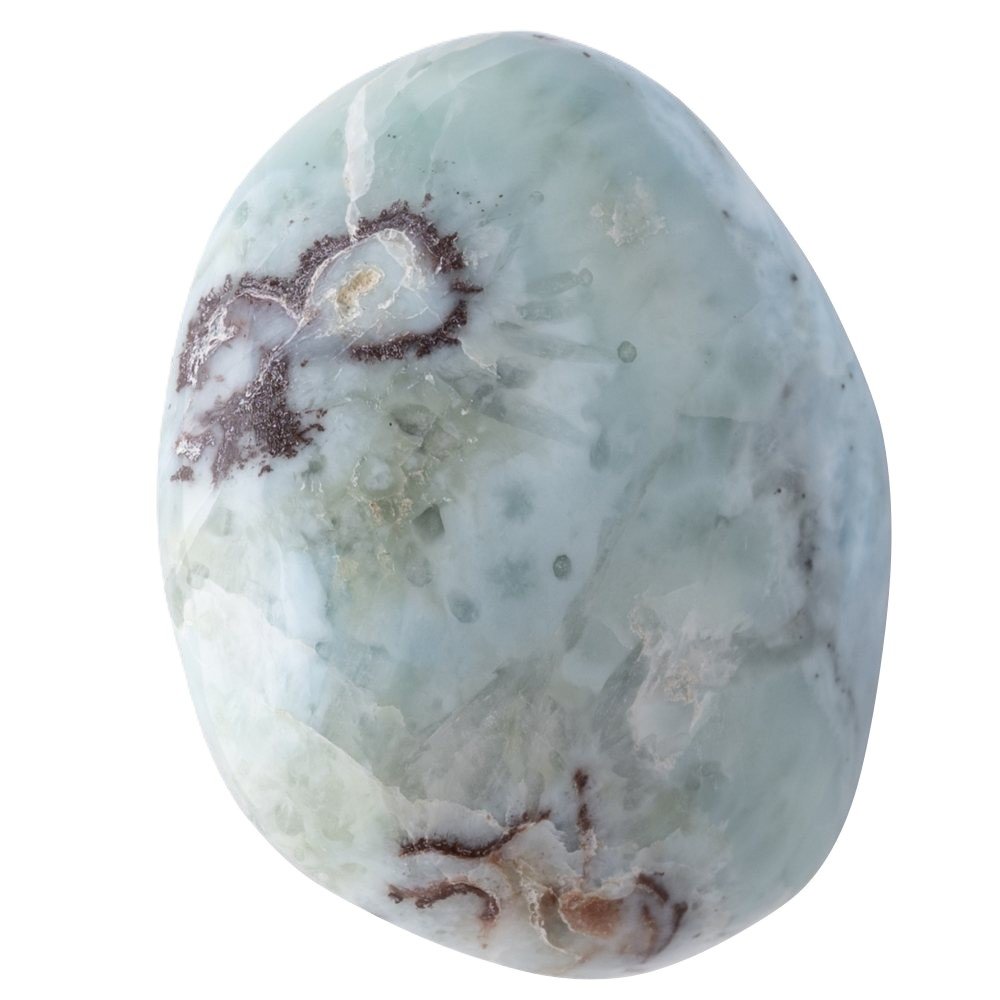
Alternate names
Larimar is celebrated globally by several evocative nicknames that reflect its tropical origin and striking appearance:
- The Atlantis Stone: Inspired by the esoteric belief that the Dominican Republic is a surviving remnant of the sunken continent of Atlantis.
- The Dolphin Stone: Named for its serene, playful energy and its resemblance to light dancing on shallow ocean waters where dolphins swim.
- Stefilia’s Stone: An early alternative name used by locals before its commercial title was formalised.
- The Gem of the Caribbean: A title highlighting its geographic exclusivity and jewel-toned hues.
- Ocean Pectolite / Aqua Pectolite: Descriptive names used in mineralogical circles to denote its aquatic colour profile.
The Stone’s Science and Composition
Larimar is not an independent mineral species; rather, it is a rare, gem-quality blue variety of pectolite. Pectolite is a sodium calcium silicate hydroxide mineral with the chemical formula $\text{NaCa}_2\text{Si}_3\text{O}_8(\text{OH})$.
While ordinary pectolite is found in several locations worldwide, it typically occurs in dull white, grey, or colourless fibrous masses. Larimar’s unique sky-blue to deep turquoise palette is caused by the presence of trace transition metals within the crystal lattice. For decades, copper ($\text{Cu}^{2+}$) substitution was considered the sole cause of its blue coloration. However, modern geochemical analyses (such as LA-ICP-MS) reveal that vanadium ($\text{V}$) and iron ($\text{Fe}$) work in tandem with copper and trace cobalt to produce its signature blues and greens. The iconic white lines that cross-cut the stone are zones of pure calcium carbonate (calcite) or natrolite.
Key Physical Characteristics
- Chemical Formula: $\text{NaCa}_2\text{Si}_3\text{O}_8(\text{OH})$
- Crystal System: Triclinic (occurring in dense aggregates of radiating, acicular needle-like fibres).
- Mohs Hardness: 4.5 to 5 (relatively soft, requiring care when worn or cut).
- Lustre: Vitreous (glass-like) to silky on fractured surfaces.
- Transparency: Opaque to translucent in thin sections.
- Refractive Index: 1.59 to 1.64
- Specific Gravity / Density: 2.62 to 2.90
- Phenomena: Exhibits spherulitic growth (radiating crystal fans that meet to form a distinctive “sea-wave” pattern), and can display moderate greenish-yellow or orange fluorescence under ultraviolet (UV) light.
Common Geologic Varieties
Larimar is categorised commercially and geologically by its varying matrix inclusions and colour zones:
- Volcano Blue Larimar: The rarest and most valuable variety, featuring an intense, deep ultramarine or sky-blue body with sharp white webbing.
- Blue-Green / Teal Larimar: In rows where vanadium or iron exposure is higher, the stone takes on a tropical greenish-blue or sea foam tint.
- Red or Brown-Inclusion Larimar: Specimens that display striking, feather-like patterns of dark red or brown. This is caused by inclusions of haematite or iron oxidation within the host rock.
- Black Matrix Larimar: Larimar inter grown with dark, dendritic patches of the original volcanic basalt matrix.
Global Mining and Volcanic Sources
Larimar is one of the most geographically restricted gemstones on Earth. It is found in only one location: a single square kilometre in the mountainous, restraint-covered region of Los Chupaderos, located in the Bahoruco Mountain Range within the Barahona Province of the Dominican Republic.
Its geological formation occurred approximately 35 million years ago during the Eocene epoch. Hot, mineral-rich hydrothermal fluids charged with sodium, calcium, and copper circulated through fractures and gas cavities (vesicles) within cooling volcanic basalt and andesite lava flows. Over time, these fluids precipitated tightly packed, interlocking fibrous crystals of pectolite. As the surrounding volcanic mountains slowly eroded, alluvial deposits of Larimar were washed down the Bahoruco River into the Caribbean Sea, leading to its eventual coastal discovery.
Crystal Pairings: What to Combine and Avoid
Optimal Crystal Pairings
- For Soothing Anxiety (Water & Air Integration): Combine Larimar with Blue Aragonite or Blue Lace Agate. This trio provides an immensely calming, cooling energy that pacifies a racing mind and settles hyperactive nervous systems.
- For Grounding Higher Frequencies: Pair Larimar with Smoky Quartz or Black Tourmaline. Because Larimar operates on a high, ethereal throat-and-crown frequency, a strong root-chakra stone acts like a lightning rod, safely anchoring its spiritual insights into your daily, physical life.
- For Amplified Heart Healing: Pair Larimar with Rose Quartz or Amazonite. Larimar’s soothing water energy gently dissolves emotional barriers around the heart, while Rose Quartz fills the space with unconditional self-love, and Amazonite inspires hopeful communication.
Crystal Pairings to Avoid
- Hyper-Aggressive Fire Stones (e.g., Carnelian or Sunstone): Fire stones introduce a sudden, intense surge of physical adrenaline and forward movement. Mixing them directly with Larimar creates an energetic stalemate, neutralising Larimar’s peaceful, stress-relieving intentions.
- Intense Emotional Excavators (e.g., Malachite): Malachite aggressively forces buried emotional trauma to the surface. Larimar is designed to soothe and cool the emotional body. Pairing them simultaneously can cause emotional whiplash, as one stone forcefully digs up trauma while the other tries to quiet the energetic field.
- Abrasive Physical Combinations (e.g., Clear Quartz or Diamonds): Because Larimar is soft (Mohs 4.5–5), it should never be stored loosely or strung in direct contact with hard stones like Clear Quartz, Amethyst, or Jasper. The harder minerals will easily gouge, scratch, and dull the surface of your polished Larimar.
Archaeology, Art and Ancient History
Unlike ancient lapis lazuli or turquoise, Larimar does not have a vast archaeological footprint because its primary deposits remained hidden deep within the Caribbean mountains until the 20th century. However, historical evidence indicates that the indigenous Taíno people, who inhabited the island of Hispaniola before the arrival of Europeans, occasionally collected loose, water-tumbled Larimar pebbles from the beaches and river mouths. They revered these rare blue stones as sacred tokens of the ocean and used them to craft primitive amulets, beads, and small decorative items.
In the modern art world, Larimar’s unique, shifting turquoise hue has drawn direct comparisons to “Bellini Blue,” an iconic pigment found in early Renaissance paintings, as well as the striking, stylised pastel blues used by Art Deco master Tamara de Lempicka.
Folklore, Legends and Sacred Tales
Local folklore surrounding Larimar is deeply tied to the lost city of Atlantis. In the early 20th century, a famous American clairvoyant predicted that a portion of Atlantis would be discovered in the Caribbean, and that a beautiful blue stone with profound healing properties would be unearthed there. When Larimar was later rediscovered, spiritualists immediately connected it to this legend, proclaiming it the missing “Atlantis Stone.”
Another beautiful coastal legend speaks of the stone being born directly from the breath of sea mermaids. Indigenous tales suggested that the stones were actual pieces of the Caribbean Sea that had frozen under the gaze of prehistoric dolphins, locking the movement of the ocean waves into solid form forever.
Metaphysical and Mystical Healing Properties
Astrological Connections
Larimar is primarily aligned with the zodiac sign of Leo. While Leos are naturally ruled by the Sun and carry a fiery, passionate, and sometimes hot-tempered disposition, Larimar acts as a cooling counter-balance. It tempers the roaring fire of Leo, smoothing out pride and irritability while enhancing their natural capacity for leadership, creativity, and generosity. It is also highly beneficial for water signs like Pisces and Cancer, helping them navigate deep emotional tides without drowning in anxiety.
The Chakra System
- The Throat Chakra (Vishuddha): Larimar is a premier stone for the Throat Chakra. It clears energetic blockages that prevent clear, honest expression, allowing you to speak your deepest personal truths with absolute calmness and grace.
- The Heart Chakra (Anahata): With its soft blue-green undertones, Larimar cleanses the heart of emotional trauma, guilt, and old relationship fears, allowing unconditional love to flow freely.
- The Third Eye & Crown Chakras: During deep meditation, Larimar raises one’s conscious awareness, facilitating clear communication with higher spiritual realms and spirit guides.
Modern Milestones: Birthstones and Anniversaries
- Zodiac Birthstone: While not part of the traditional Gregorian calendar birthstone list, Larimar serves as a modern, alternative natural birthstone for those born under the winter skies of December or the late-summer sign of Leo.
- Wedding Anniversaries: Larimar is widely used as a unique, contemporary alternative to turquoise or blue zircon for celebrating the 11th wedding anniversary, symbolising enduring peace, clear communication, and emotional fidelity between partners.
- National Recognition: In 2018, the Dominican National Congress officially declared November 22nd as “National Larimar Day,” celebrating the stone as a core national treasure and a symbol of Dominican cultural heritage.
Larimar Frequently Asked Question
Why is Larimar only found in the Dominican Republic?
Larimar requires a highly specific, rare combination of tectonic activity, localised copper-and-vanadium-rich hydrothermal fluid circulation, and an exact host basalt chemistry that occurred exclusively within the Bahoruco Mountain Range. These precise conditions did not occur anywhere else on Earth.
Can Larimar go in water?
Yes, Larimar can handle brief contact with pure water. However, it should never be submerged for long periods, and exposure to salt water, chlorine, or soapy water must be strictly avoided. Because it contains porous calcium carbonate components, chemicals and salts can seep into the stone, causing it to turn brittle, lose its lustre, or change colour.
Does Larimar fade in the sun?
Yes. Prolonged exposure to direct, harsh sunlight or intense UV rays will cause the delicate blue copper-and-vanadium colour centres within Larimar to break down. Over time, leaving your Larimar jewellery on a sunny windowsill will cause it to permanently fade to a dull white or pale grey.
How can you tell if Larimar is real or fake?
- Pattern: Genuine Larimar features irregular, organic, and unique cloud-like or sea-wave patterns. Fake versions (often made of resin, glass, or dyed chalcedony) display perfectly symmetrical, repeated, or printed lines.
- Opacity: Real Larimar is predominantly opaque with scattered, translucent patches where the light pools. Glass imitations are often completely translucent or contain tiny trapped circular air bubbles.
- Temperature: Natural Larimar feels notably cool to the touch when first picked up, whereas plastic or resin counterfeits feel warm almost immediately.
How should I clean and energetically charge Larimar?
To clean Larimar physically, use a soft, damp microfiber cloth with cold water and dry it immediately. Energetically, do not cleanse it in salt water or direct sunlight. Instead, pass it through the smoke of a sacred herb or incense (such as sandalwood or frankincense), place it on a Selenite charging plate, or leave it outside overnight to soak in the gentle, cooling light of a full moon.