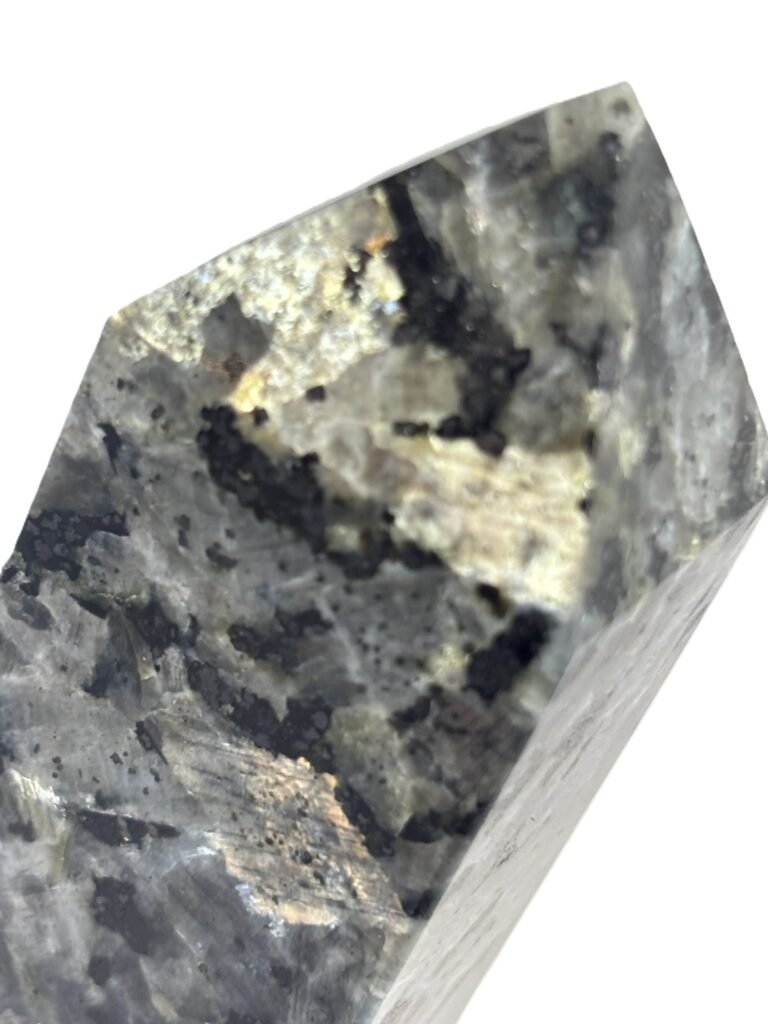
Larvikite is an exquisite igneous monzonite stone formed nearly 300 million years ago within deep plutonic chambers. Renowned for its dark charcoal-to-black matrix illuminated by shimmering flashes of electric blue and silver feldspar crystals, this Norwegian treasure bridges geological wonder and holistic practice. Often favoured by stone carvers, luxury architects, and crystal practitioners alike, Larvikite provides strong grounding energies while promoting intellectual clarity, shielding the subtle body from energetic drainage, and connecting the bearer directly to ancient Earth wisdom.
Alternate Names
Larvikite is frequently labelled across commercial lapidary, trade, and metaphysical markets by several descriptors:
- Black Labradorite (a common commercial misnomer)
- Norwegian Pearl Granite or Blue Pearl Granite (commercial architectural designations; petrologically incorrect as it lacks free quartz)
- Emerald Pearl (a dark greenish-black variety used widely in high-end counter tops)
- Bird’s Eye Granite
- Pub Stone (a colloquial British nickname, given its prevalence as polished pub counter surfacing and shopfront fascia throughout the United Kingdom)
- Larvik Granite
The Stones Science and Composition
Geologically, Larvikite is a coarse-grained, plutonic augite syenite (or monzonite) belonging to the Permian Oslo Paleorift system.
- Primary Mineral Makeup: It consists predominantly (around 85–90%) of ternary alkali-rich feldspar (anorthoclase, orthoclase, and albite-oligoclase solutions).
- Accessory Minerals: Contains augite, titanaugite, biotite, barkevikite (amphibole), apatite, zircon, and minor magnetite or ilmenite.
- Optical Mechanism (Schiller / Cryptoperthite): The stone’s unmistakable silvery-blue optical flash is caused by cryptoperthitic unmixing. During slow subterranean cooling, potassium feldspar and sodium feldspar separate into microscopic, alternating sub-lamellae. Incident light refracts and interferes across these micro-layers, producing a dynamic optical phenomenon known as labradorescence or the Schiller effect.
Key Physical Characteristics
| Characteristic | Measurement / Attribute |
| Mohs Hardness | 6.0 – 6.5 |
| Specific Gravity | 2.59 – 2.72 |
| Lustre | Vitreous to greasy on fracture; sub-metallic to pearlescent on cleavages |
| Cleavage | Perfect in two directions intersecting near 90° (inherited from ternary feldspars) |
| Fracture | Uneven to conchoidal |
| Crystal System | Monoclinic / Triclinic components (plutonic granular mass) |
| Colour Range | Dark silvery-grey, steel-blue, charcoal, greenish-black, midnight grey |
| Transparency | Completely opaque |
Common Geologic Varieties
Larvikite variations are determined by the specific magma pulses and mineral concentrations across the Larvik plutonic complex:
- Blue Pearl (Lys Larvikite): Lighter, slate-to-steel grey background carrying vibrant, expansive silver and azure Schiller flashes. Mined extensively in the Tvedalen sector.
- Emerald Pearl (Mørk Larvikite): Rich, dark charcoal-to-near-black groundmass with deep petrol-green undertones and pinpoint peacock-blue reflections. Mined around Klåstad.
- Royal Blue: A premium grade featuring dense, concentrated electric-blue reflections evenly dispersed across every facet.
- Oxidised / Weathered Larvikite: Naturally altered surface rock exhibiting golden-bronze sheen along weathered planes due to secondary iron-oxide leaching.
Global Mining and Volcanic Sources
Larvikite is geographically exclusive. It is sourced almost entirely from the Larvik Plutonic Complex in Vestfold County, southern Norway, approximately 100 kilometres south of Oslo.
- Geological Origin: It formed during the continental rifting of the Oslo Graben during the Early Permian period (~295 to 290 million years ago). Rather than erupting as surface lava, the magma cooled slowly miles underground, creating large tabular feldspar crystals.
- National Heritage: In 2008, Larvikite was officially declared the National Stone of Norway.
- Minor Occurrences: Petrologically similar nepheline-bearing monzonites exist in small pockets across the Kola Peninsula (Russia) and parts of Canada, but none match the purity, structural integrity, and optical radiance of Norwegian deposits.
Crystal Pairings: What to Combine and Avoid
Optimal Crystal Pairings
- Black Tourmaline (Schorl): A masterclass in psychic grounding. Combining Larvikite with Black Tourmaline establishes an impermeable energetic perimeter, grounding the etheric body into the physical plane.
- Labradorite: While distinct stones, their shared feldspar matrix creates an intuitive harmony. Labradorite opens higher perceptual gateways, while Larvikite ensures the practitioner stays tethered to the Earth.
- Clear Quartz: Amplifies Larvikite’s natural schiller vibration, helping bring subtle mental patterns and subconscious wisdom to the conscious mind.
- Smoky Quartz: Ideal for stress dissolution, environmental EMF clearing, and root chakra stabilisation.
Crystal Pairings to Avoid
- High-Vibration Tektites (Moldavite, Libyan Desert Glass): The intense, ungrounded frequencies of impact glass can produce disorientation or headaches when mixed directly with dense, anchor-focused monzonite.
- Carnelian / Fire Agate (Excess Solar Dynamic): Overly aggressive, impulsive fire-element stones can clash with Larvikite’s calm, introspective, subterranean earth-and-water energy.
- Selenite (Physical Proximity): While metaphysically acceptable, keep them separated physically: Selenite is exceptionally soft (Mohs 2) and will easily suffer abrasion or gouging if tumbled or stored alongside Larvikite (Mohs 6–6.5).
Archaeology, Art and Ancient History
Because Larvikite was formed in deep igneous intrusions, it was largely inaccessible to ancient European toolmakers until quarrying technology advanced. However, its natural coastal outcrops in the Vestfold region exposed smooth, glaciated boulders:
- Norse Coastal Utilisation: Regional Viking communities utilised sturdy local field boulders for structural harbour foundations and domestic hearth perimeters.
- Victorian & Edwardian Architecture: Global commercial quarrying began in the 1880s following industrialisation in Larvik. The stone quickly became an international architectural sensation. Polished slabs were transported by sea to the UK, continental Europe, and the Americas to build grand facades for civic halls, bank vaults, luxury hotels, and department stores.
- Carvings & Lapidary Use: Turn-of-the-century sculptors prized its dense, fine-grained durability, fashioning ornamental plinths, decorative urns, and inkwells that resisted weathering.
Folklore, Legends and Sacred Tales
Although modern scientific cataloguing began in the late 19th century by Norwegian geologist Waldemar Christofer Brøgger, local Nordic folklore quickly enveloped the shimmering stone:
- The Trolls’ Armour: Nordic legends held that Larvikite was the petrified skin or armour of ancient mountain trolls, caught outside at the break of dawn and turned into living stone by the first rays of the sun.
- Water-Sprite Reflections: Coastal folklore suggested that the blue-silver flashes were fragments of moonlight trapped beneath deep glacial fjord waters by ancestral water spirits (Nøkken).
- Wards Against Malice: Local coastal fishermen frequently kept small smoothed pebbles of the stone on their boats, believing it would deflect sudden storms, banish sea phantoms, and anchor the vessel safely through winter gales.
Metaphysical and Mystical Healing Properties
Larvikite acts as an anchor for the mind and spirit:
- Energetic Protection: Often called the “Stone of Reclamation,” it neutralises and dissolves unwanted spells, negative psychic cords, and environmental static.
- Cognitive Focus & Problem Solving: Aids in cutting through mental fog. By calming erratic thought loops, it allows complex analytical thinking and strategic decision-making.
- Past-Life Recall: Many practitioners utilise Larvikite during meditation to facilitate journeys into past-life memories and ancestral lines, providing a steady protective anchor so the subconscious can process deep memories safely.
- Detoxification & Vitality: Holistic lore links the stone to the cellular recovery process, supporting natural metabolic equilibrium, kidney drainage, and nervous system balance.
Astrological Connections
- Primary Zodiac Sign: Aquarius Larvikite grounds Aquarius’s high-frequency intellectual currents. It anchors abstract mental energy into practical, physical realisations while shielding sensitive Aquarians from collective emotional burnout.
- Secondary Sign: Capricorn Resonates with Capricorn’s ruling element (Earth) and planet (Saturn). It reinforces patience, methodical strategy, and long-term ambition while encouraging flexibility through its fluid, light-reflecting schiller.
- Elemental Affinity: Earth and Water.
- Planetary Association: Saturn (structure, discipline, boundary setting) and Neptune (mystical intuition and dreams).
The Chakra System
Larvikite works as a vertical bridge between the physical and higher realms:
- Root Chakra (Muladhara): Sits as the stone’s primary anchor. It pulls erratic mental energy downward through the base of the spine, dissolving irrational dread and stabilising physical existence.
- Third Eye Chakra (Ajna): The silver-blue flashes resonate with intuitive sight, claircognisance, and inner vision, allowing the user to read between the lines during difficult interpersonal interactions.
- Earth Star Chakra (Below the Feet): Larvikite anchors into the transpersonal Earth Star chakra, creating a grounding root into the planetary grid.
Interesting Facts
- Venice and the UN: Famous global landmarks, including the exterior cladding of the United Nations headquarters in New York and components of luxury buildings across Venice and London, feature polished Norwegian Larvikite.
- The “Black Labradorite” Fallacy: Although often sold under this name, it is not Labradorite. While both are feldspar-rich stones, Labradorite is a plagioclase feldspar rock (anorthosite), whereas Larvikite is a monzonite dominated by complex alkali feldspars.
- Space Age Radiometric Clock: The unique zircon and titanite inclusions within Larvikite have provided geologists with precise radiometric dates that anchor the timeline of the entire European Permian rifting era.
- Natural Counter top Resilience: Due to its low porosity and absence of free quartz or acid-sensitive calcite, Larvikite remains one of the world’s most durable and stain-resistant natural stone surfaces.
Modern Milestones: Birthstones and Anniversaries
- Birthstone Status: While not an official birthstone on the standard modern jewellers’ charts, Larvikite is widely embraced as an alternative mystic birthstone for February and December, aligning with deep winter energies.
- Anniversary Association: Informally gifted on the 8th and 19th wedding anniversaries, symbolising unwavering security, resilience against external conflict, and enduring strength.
Larvikite Frequently Asked Question
Is Larvikite the same as Labradorite?
No. While both stones display a shimmering schiller effect and belong to the feldspar family, their geological classification differs. Labradorite is a plagioclase feldspar (calcic-sodic), while Larvikite is an augite syenite/monzonite composed of ternary alkali feldspars. Visually, Labradorite displays broad peacock sheets of green, yellow, and orange labradorescence; Larvikite displays distinct, pinpoint silver, pearl, and electric-blue flashes across a grey or black matrix.
Can Larvikite go in water?
Yes, brief contact with tap or fresh spring water is safe because Larvikite is a hard, dense igneous rock (Mohs 6–6.5). However, prolonged soaking in salt water is not recommended, as saline solutions can penetrate micro-fractures, degrade the polish, and dull its silvery sheen over time.
How do I cleanse and charge my Larvikite?
- Cleansing: Smudge with dried botanical smoke (such as sage, cedar, or mugwort), run under cool running tap water for 60 seconds, or use acoustic clearing (sound baths, brass singing bowls, or tuning forks).
- Charging: Place the stone on natural soil or beneath the light of the Full Moon to recharge its deep subterranean earth energies. Avoid prolonged exposure to harsh, direct summer midday sun to protect any mineral polish treatments.
How can I spot fake Larvikite?
Authentic Larvikite has a cool, heavy heft with irregular, internal silvery-blue flashes that change position as the stone moves under light. Glass or resin counterfeits appear unnaturally lightweight, exhibit uniform surface glitter, or show tiny trapped air bubbles under a 10x jeweller’s