
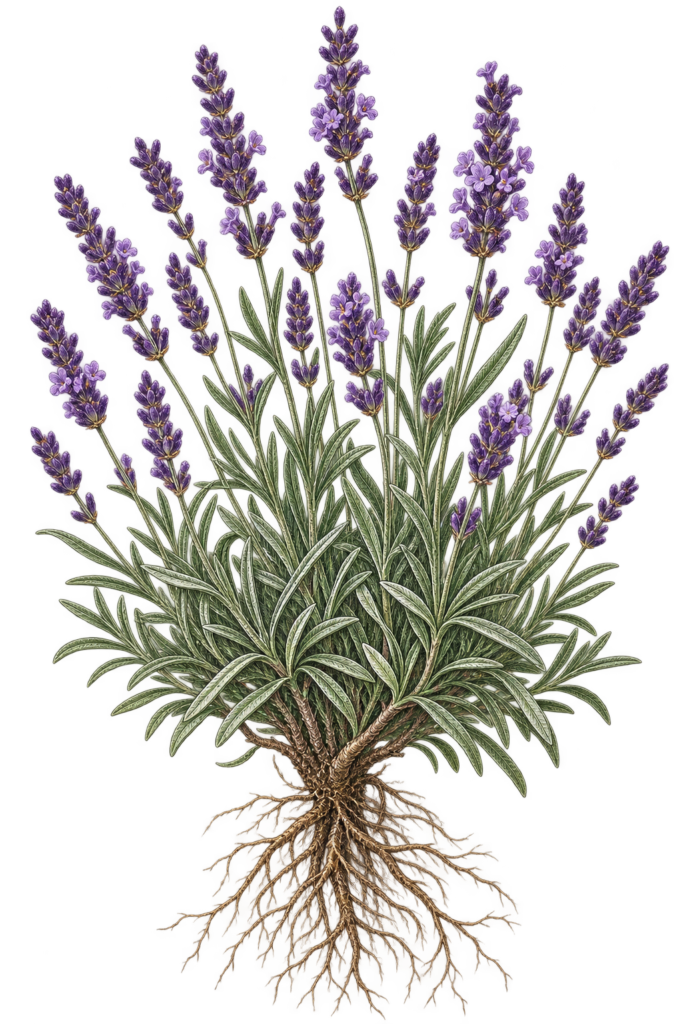
Lavender (Lavandula) is a diverse genus within the mint family (Lamiaceae), comprising 47 known species and hundreds of cultivars prized across millennia for their aromatic oils, floral spikes, and extensive therapeutic value. Native to the arid, rocky soils of the Mediterranean basin, Southern Europe, North Africa, and parts of Southwest Asia and India, lavender has spent over 2,500 years at the intersection of medicine, ritual, and daily domestic life.
Botanical Overview & Key Species
While the genus spans dozens of varieties, three primary species and one hybrid dominate herbalism, commercial agriculture, and garden cultivation:
- English Lavender (Lavandula angustifolia): The quintessential culinary and therapeutic lavender. Compact with narrow leaves and delicate, sweet-floral spikes, it yields high levels of linalool and linalyl acetate with negligible camphor, making it the preferred choice for aromatherapy and fine perfumery.
- Spike Lavender (Lavandula latifolia): A broader-leaved, more robust Mediterranean species with a sharper, camphoraceous scent. Historically prized for liniments and respiratory remedies.
- French/Spanish Lavender (Lavandula stoechas): Recognisable by the distinctive, sterile “butterfly wings” (bracts) crowning its flower heads. Widely referenced in classical antiquity, it possesses a resinous, pine-like aroma.
- Lavandin (Lavandula x intermedia): A sterile, high-yielding natural hybrid of L. angustifolia and L. latifolia. It produces substantial essential oil volume used widely in commercial soaps, detergents, and household goods.
Ancient Origins & Antiquity
Ancient civilisations recognised lavender as a premier cleansing and preservative agent:
- Ancient Egypt: Used lavender-infused resins, unguents, and perfumes (kyphi) in cosmetics, temple offerings, and mummification rites. When Tutankhamun’s tomb was opened in 1922, traces of aromatic lavender unguents still retained faint fragrance after more than three millennia.
- Classical Greece: The Greeks classified lavender under the broad name nardus (derived from the Syrian city of Naarda), often distinguishing French lavender (L. stoechas) as Syrian or wild nard. In 65 AD, Greek physician Pedanius Dioscorides documented its therapeutic virtues in De Materia Medica, prescribing it to relieve chest congestion, ease digestive discomfort, and soothe internal grief.
- Biblical References: Early scriptures record expensive anointing oils derived from aromatic plants; spike lavender and Himalayan spikenard (Nardostachys jatamansi) were both highly prized ointments traded across ancient spice routes.
- The Roman World: The Latin root lavare (“to wash”) gave lavender its modern name. Romans infused public and private bathhouses with its flowers to purify the skin and deter parasites. High-grade dried lavender flowers commanded up to 100 denarii per Roman pound—roughly equivalent to a full month’s wages for an agricultural labourer or soldier.
Folklore, Superstition & Cultural Traditions
Throughout medieval and early modern Europe, lavender occupied a central role in household magic and folklore:
- Warding & Protection: Bundles of dried lavender were pinned above thresholds, tucked into lintels, and strewn across stone floors to repel malignant spirits, ward against the “evil eye,” and mask foul airs believed to carry infectious pestilence.
- Love & Courtship: Alpine folklore held that tucking fresh sprigs into a pillow would induce dreams of one’s future spouse. Women carried lavender sachets in their stays or aprons to attract suitors, while brides wore sprigs tucked into garters as an emblem of fidelity and a charm against ill fortune.
- Marian Association: Christian lore linked lavender directly to the Virgin Mary, claiming the plant acquired its celestial fragrance after Mary laid the infant Christ’s garments upon a lavender bush to dry, establishing the herb as an emblem of purity, humility, and grace.
- Fae Folklore: In British and Celtic tradition, blooming lavender patches were thought to attract gentle nature spirits, brownies, and fae creatures, particularly during Midsummer Eve gatherings.
Therapeutic & Medicinal Applications
Modern pharmacological research validates many traditional uses of lavender essential oil, primarily attributing its calming and antimicrobial actions to linalool and linalyl acetate:
- Nervous System & Sleep Support: Inhalation of volatile lavender compounds modulates GABAergic neurotransmission, significantly reducing autonomic nervous system arousal, lowering cortisol levels, and improving sleep quality in cases of mild insomnia and restlessness.
- Dermatological Healing: Renowned for minor burns, superficial wounds, insect bites, and sunburn. Its natural antiseptic and anti-inflammatory properties accelerate tissue repair while mitigating skin irritation.
- Tension & Headache Relief: Applied topically in a carrier oil to the temples, neck, and shoulders, lavender eases tension headaches, vascular migraines, and stress-related neuralgia.
- Digestive Harmony: Prepared as a mild infusion (L. angustifolia), it acts as a carminative and antispasmodic, relieving nervous stomach cramps, flatulence, and stress-induced nausea.
- Antiseptic Heritage: A foundational ingredient in “Four Thieves Vinegar”—a medieval aromatic concoction used by grave robbers and herbalists during outbreaks of the bubonic plague to prevent infection.
Culinary & Domestic Uses
- Culinary Arts: A staple component of traditional Herbes de Provence blends, L. angustifolia lends a subtle, floral-herbal note to shortbreads, honey infusions, citrus glazes, goat cheeses, and herbal teas.
- Natural Pest Deterrent: High linalool content repels clothes moths, silverfish, fleas, and aphids from pantries and linen presses while serving as a premier nectar source for honeybees and native pollinators.
- Companion Planting: Grown near roses and vegetable gardens to deter pests naturally and improve garden biodiversity.
Spiritual, Energetic & Metaphysical Properties
| Correspondence | Association |
| Element | Air |
| Planetary Ruler | Mercury |
| Energy | Receptive / Feminine |
| Chakra | Third Eye (Ajna) & Crown (Sahasrara) |
In contemporary metaphysical and energetic practices, lavender is used to cultivate emotional equilibrium, sharpen mental discernment, and clear stagnant energy:
- Smoke Cleansing & Space Clearing: Bound into herbal wands alongside garden sage or rosemary, burning lavender purifies environments of residual tension, hostility, and psychic clutter.
- Meditation & Intuitive Work: Used as an anointing oil or diffusing incense during deep meditation. It calms erratic mental chatter, facilitating access to higher states of consciousness, visionary work, and dream recall.
- Emotional Reconciliation: Burned or carried during reconciliation rituals to soften interpersonal conflict, restore open communication, and heal emotional wounds between partners or family members.
Lavender remains one of the most enduring botanical allies in human history. From ancient Roman baths and medieval apothecary gardens to modern aromatherapy and energetic rituals, its signature purple blooms continue to serve as a universal archetype of tranquillity, protection, and renewal.
Difference between English and French Lavender
English Lavender (Lavandula angustifolia) and French Lavender (Lavandula stoechas) produce radically different essential oils due to their divergent dominant chemical families—esters and monoterpenols in English, versus monoterpene ketones and oxides in French.
| Characteristic | English Lavender (L. angustifolia) | French Lavender (L. stoechas) |
| Aromatic Profile | Sweet, soft floral, herbaceous, delicate | Sharp, herbal, pine-like, strongly camphoraceous |
| Primary Chemical Class | Esters & Monoterpenols | Ketones & Oxides |
| Key Constituents | Linalool (25–45%) Linalyl acetate (25–45%) Camphor (<0.5%) | Fenchone (15–40%) Camphor (10–25%) 1,8-Cineole / Eucalyptol (5–15%) |
| Primary Action | Sedative, anxiolytic, skin restorative | Mucolytic, expectorant, decongestant |
| Safety Profile | Extremely gentle; generally non-irritating | High ketone content; neurotoxic & abortifacient risks in high doses |
English Lavender (Lavandula angustifolia)
- Chemical Function: The combination of linalyl acetate (an ester) and linalool (a monoterpenol) works synergistically to downregulate the central nervous system by interacting with GABA receptors. The near-absence of camphor gives it its calming, non-stimulating property.
- Therapeutic Uses:
- Nervous System: Eases anxiety, nervous tension, panic, and sleep fragmentation.
- Dermatology: Accelerates wound healing (cicatrisation), calms inflammatory skin flare-ups, and treats minor burns, eczema, and insect bites.
- Safety: Exceptionally safe for routine diffusion and low-dilution topical use in adults, the elderly, and older children.
French Lavender (Lavandula stoechas)
- Chemical Function: Dominated by ketones (fenchone and camphor) alongside the oxide 1,8-cineole. Ketones break down thick mucus and stimulate cellular turnover, but they also cross the blood-brain barrier rapidly and can act as neurotoxins if misused.
- Therapeutic Uses:
- Respiratory: Strong mucolytic and expectorant action. Useful for breaking up chest congestion, sinus blockages, and bronchial mucus.
- Antimicrobial & Cleaning: Potent antibacterial action suitable for environmental disinfection and diffusions aimed at clearing heavy respiratory pathogens.
- Safety Restrictions: Not recommended for general aromatherapy or relaxation. Strictly avoid during pregnancy, lactation, or with individuals diagnosed with epilepsy due to the convulsive and neurotoxic potential of high ketone concentrations.
This article is part of my wide collection of herbal knowledge, history and usage. More interesting facts can be found in these articles The Ultimate Guide to Alternative Herbs for Smoke Cleansing or Ultimate Guide to Smoke-Cleansing Herbs: Meanings, Uses and Resins
Frequently Asked Questions About Lavender (Lavandula)
Which lavender variety is best for cooking and baking?
English Lavender (Lavandula angustifolia) is the premier culinary choice—specifically cultivars like ‘Munstead’ and ‘Hidcote’. It has a delicate, sweet floral profile with low camphor levels. French lavender (L. stoechas) and Lavandin (L. x intermedia) contain higher concentrations of camphor and terpenes, which impart a harsh, medicinal, soapy bitterness to food.
What is the difference between English, French, and Lavandin lavender?
- English Lavender (L. angustifolia): Compact shrubs with slender green-grey leaves, sweet floral aroma, and high cold hardiness (down to -15°C / 5°F). Used primarily for culinary dishes, high-grade therapeutic oils, and fine perfumery.
- French/Spanish Lavender (L. stoechas): Recognisable by upright, sterile petal-like bracts (“rabbit ears”) atop the flower spikes. Features a pine-camphor aroma and is tender to severe frosts.
- Lavandin (L. x intermedia): A vigorous, sterile hybrid yielding large grey-green shrubs with long, pointed floral wands. It produces high volumes of oil rich in camphor, making it ideal for craft sachets, moth repellents, and commercial cleaning products.
How and when should lavender bushes be pruned?
- Annual Maintenance: Prune in late summer immediately after flowering has finished (typically August in temperate climates). Trim back all spent flower stalks along with roughly 2–3 cm (1 inch) of that season’s soft green vegetative growth, shaping the shrub into a rounded mound.
- Golden Rule: Never cut back into bare, brown, woody stems. Lavender rarely regenerates from old wood; heavy pruning into the woody interior often kills that section of the plant.
Why do lavender plants turn woody, floppy, or die back in winter?
- The two most common causes are insufficient pruning and poor soil drainage:
- Lack of Annual Pruning: Causes the plant’s core to lignify, leading to sprawling, bare, split branches.
- Waterlogged Roots: Lavender requires lean, gritty, well-draining soil and full sun (at least 6–8 hours daily). Heavy, wet clay suffocates root systems and induces root rot (Phytophthora), particularly during cold, damp winter months.
Is lavender safe around household pets?
- Dried Plant Material & Garden Shrubs: Mildly toxic if ingested in large quantities by dogs and cats. Lavender contains linalool, which can cause gastrointestinal upset, vomiting, or lethargy if eaten in bulk.
- Concentrated Essential Oils: High risk for cats. Felines lack the specific liver enzyme (glucuronyl transferase) required to metabolise essential oil compounds. Direct skin application or prolonged ultrasonic diffusion in confined spaces can lead to toxicity and respiratory irritation.
How long does dried lavender retain its scent, and how can it be refreshed?
- Properly dried lavender stored in breathable fabric bags or sachets retains volatile oils within its microscopic calyx glands for 1 to 3 years.
- To revive faded sachets, gently knead or crush the pouch between your fingers to rupture the oil glands, instantly releasing fresh fragrance. A single drop of pure L. angustifolia essential oil can also be added to refresh the material.
Can lavender essential oil be applied directly to human skin without dilution?
While English Lavender is one of the gentlest essential oils, direct “neat” application is not recommended. Routine undiluted use can trigger skin sensitisation and contact dermatitis over time. Always dilute in a carrier oil (such as jojoba, sweet almond, or fractionated coconut oil) at a 1–2% dilution rate (roughly 3–6 drops of essential oil per 10 ml of carrier) for safe topical use
What are the primary metaphysical and energetic correspondences of lavender?
- Element: Air
- Planetary Association: Mercury
- Chakras: Third Eye (Ajna) and Crown (Sahasrara)
- Energetic Properties: Purification, peace, mental clarity, emotional reconciliation, restful sleep, and psychic protection.
