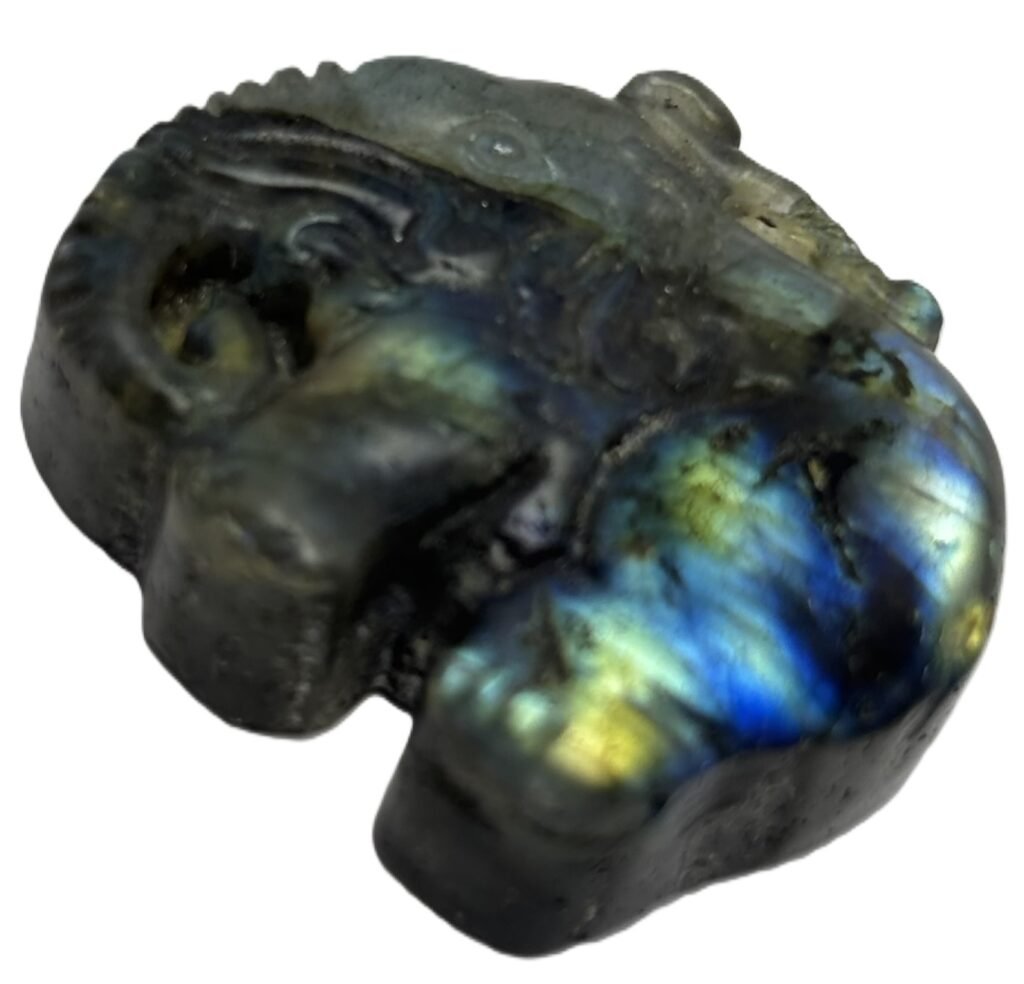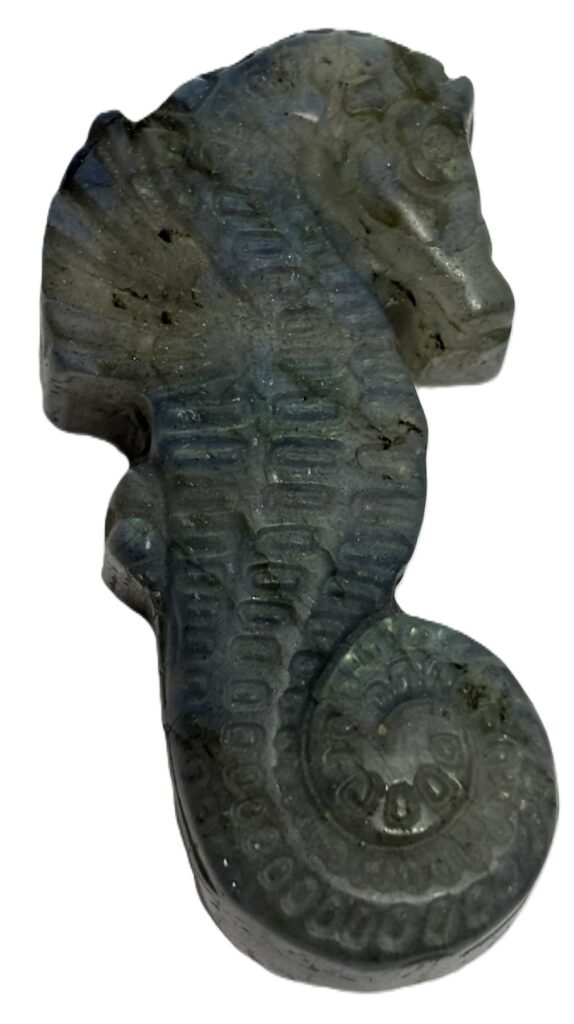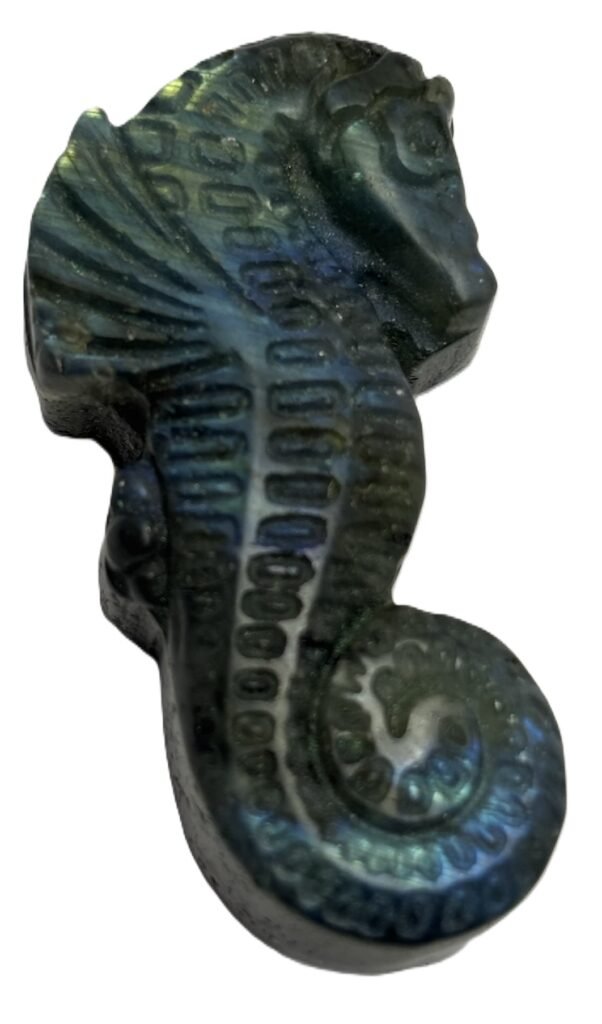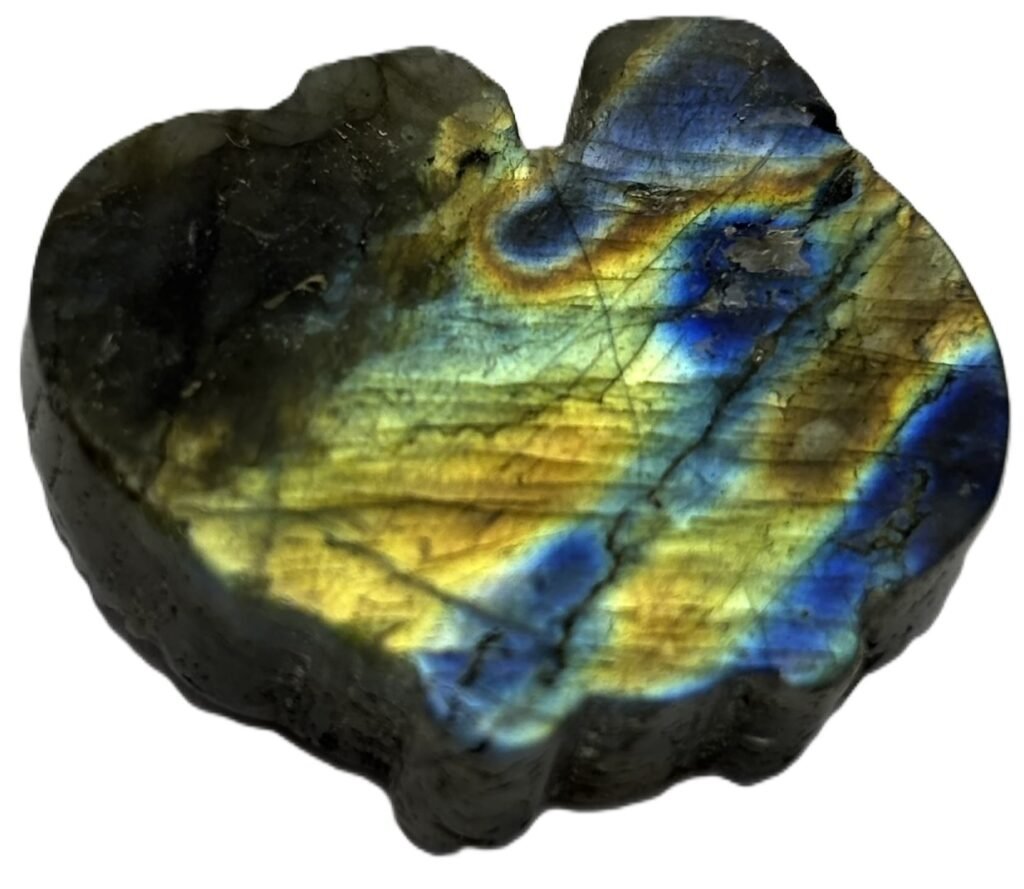
Labradorite is an intermediate-to-calcic plagioclase feldspar mineral celebrated for its schiller effect: an internal, iridescent optical firestorm known as labradorescence. When shifted beneath a light source, its sombre, grey-to-charcoal body transforms into dynamic sweeps of spectral electric blue, iridescent peacock green, burnished copper-gold, and violet.
First identified in European mineralogy in the late 18th century along the rugged coasts of eastern Canada, the stone bridges geology, mythology, and modern gem cutting. In mineral circles, it provides insight into sub-microscopic exsolution lamellae within cooling igneous rock. In artisanal lapidary work, it creates chatoyant cabochons, carved talismans, and architectural slabs. Among spiritual practitioners, it is dubbed the “Stone of Magic”—held as a premier shield for the energetic field and a catalyst for inner awakening.
Alternate names
Throughout history, trade markets, and local folklore, labradorite has accumulated several distinct designations:
- Spectrolite: A registered trade name for high-grade, exceptionally vibrant labradorite exhibiting the full spectral rainbow (including rare oranges, reds, magentas, and purples) against a very dark, opaque matrix.
- Rainbow Moonstone: A trade misnomer referring to nearly transparent or white labradorite with strong blue and multicoloured schiller (more accurately called white labradorite).
- The Stone of Magic: Metaphysical moniker reflecting its association with intuition, transformation, and esoteric journeying.
- The Aurora Stone / Frozen Fire: Vernacular references rooted in Indigenous Arctic legends connecting the stone’s optics to the Northern Lights.
- Carnatite / Labrador Stone: Historic 18th- and 19th-century lapidary and mineralogical references.
- Black Moonstone (with Schiller): Occasionally confused in the marketplace with dark varieties of peristerite or adularescent orthoclase feldspar.
The stones Science and Composition
From a mineralogical perspective, labradorite belongs to the plagioclase feldspar solid-solution series, defined by the formula:
$$(\text{Ca}, \text{Na})[\text{Al}(\text{Al}, \text{Si})\text{Si}_2\text{O}_8]$$
Plagioclase forms a continuous series between pure sodium feldspar (albite, $\text{NaAlSi}_3\text{O}_8$) and pure calcium feldspar (anorthite, $\text{CaAl}_2\text{Si}_2\text{O}_8$). Labradorite sits specifically within the range of 50% to 70% anorthite ($\text{An}_{50}–\text{An}_{70}$) and 30% to 50% albite ($\text{Ab}_{30}–\text{Ab}_{50}$).
The Physics of Labradorescence
Labradorescence is not a surface reflection or simple pigment; it is an optical interference phenomenon caused by Bøggild exsolution intergrowths:
- When molten anorthositic or gabbroic magma cools slowly under deep plutonic conditions, the intermediate plagioclase structure becomes thermodynamically unstable.
- The homogeneous single phase unmixes into two microscopic, chemically distinct plagioclase phases of alternating calcium-rich and sodium-rich lamellae.
- These microscopic lamellar layers range from 120 nm to 400 nm in thickness—matching the exact wavelengths of visible light.
- When incoming white light strikes these sub-microscopic plates, internal reflection and thin-film interference occur. Ray paths reflected from consecutive lamellae interfere constructively or destructively depending on layer thickness, angle of incidence, and refractive index, amplifying specific vibrant wavelengths (predominantly 450–550 nm for blues and greens).
Key Physical Characteristics
| Physical Property | Technical Specification | Practical Lapidary Meaning |
| Chemical Classification | Tectosilicate (Plagioclase Feldspar) | Framework silicate resistant to natural weathering |
| Crystal System | Triclinic ($P\bar{1}$) | Asymmetric crystalline habit; polysynthetic twinning is common |
| Mohs Hardness | 6.0 – 6.5 | Moderately hard; susceptible to scratches from quartz dust |
| Cleavage | Perfect on $\{001\}$, good on $\{010\}$ | Splits cleanly along two planes meeting at ~86°–93° |
| Fracture | Uneven to conchoidal | Brittle fracture when cleaved across lamellar boundaries |
| Lustre | Vitreous to pearly along cleavage faces | Glassy when polished; silky shimmer internally |
| Refractive Index | $n_\alpha = 1.554–1.562$, $n_\gamma = 1.562–1.573$ | Moderate light bending; causes subtle birefringence |
| Birefringence | $\delta = 0.008 – 0.010$ | Low optical splitting |
| Specific Gravity | 2.68 – 2.72 | Standard silicate heft in hand |
| Transparency | Translucent to nearly opaque (rarely transparent) | Body matrix absorbs background scatter, deepening the schiller |
Common Geologic Varieties
- Classic Blue Labradorite: The standard benchmark variety, primarily sourced from Madagascar. Displays brilliant azure, electric cyan, and royal blue flashes across a charcoal-to-smoky grey base.
- Golden / Amber Labradorite: Exhibits rich bronze, honey, canary yellow, and coppery flashes. Often forms when microscopic haematite, ilmenite, or iron inclusions interact with broader lamellar spacing.
- Purple & Sunset (Violet) Labradorite: Exceptionally scarce specimens displaying deep magenta, violet, and peach tones. Requires very precise, uniform thinness in the exsolution layers to reflect the shortest wavelengths of visible light.
- Spectrolite: The crown jewel of labradorite found in Ylämaa, Finland. Unlike standard varieties that flash one or two tones, spectrolite presents the full visible spectrum (deep crimson, orange, yellow, bright green, electric blue, and purple) over an opaque black base.
- Transparent / Gem-Quality Faceted Labradorite: Clear to pale straw-yellow crystals without notable labradorescence, often mined in Oregon or Mexico, cut for high brilliance rather than schiller.
- White Labradorite (“Rainbow Moonstone”): A pale, semi-translucent variety with an ivory or milky body exhibiting blue and rainbow interference flashes.
Global Mining and Volcanic Sources
Labradorite develops predominantly within massive plutonic anorthosites, gabbros, and occasionally within volcanic basalts:
- Paul’s Island & Nain, Labrador (Canada): The historic type-locality discovered in 1770. Hosts substantial deposits within the layered Nain Plutonic Suite.
- Ylämaa, South Karelia (Finland): Unearthed during World War II during the construction of defensive fortifications (the Salpa Line). The source of true spectrolite, hosted in anorthosite intrusions of the Wiborg rapakivi granite batholith.
- Toliara Province & Maniry (Madagascar): The world’s primary commercial source of high-grade cabochon and carving rough, recognised for brilliant peacock blue and turquoise flashes.
- Urals & Ukraine: Supplies extensive decorative and architectural-grade labradorite (often called Volhynite), prized for monument facades, tiles, and interior slabs.
- United States (Oregon, Utah, New York): The Adirondack Mountains host extensive metamorphic anorthosites rich in labradorite; southeastern Oregon produces transparent gem feldspars within basalt flows.
- Secondary Global Deposits: Commercial and gemological extraction occurs across southern India, New South Wales (Australia), Norway, and Mexico.
Crystal Pairings: What to Combine and Avoid
When working with crystalline energy, combining minerals with complementary vibrational signatures optimises desired outcomes, while haphazard combinations can create discordant energetic friction.
Optimal Crystal Pairings
- Moonstone (Adularia): Because both belong to the feldspar family, moonstone’s watery, feminine, receptive adularescence naturally synchronises with labradorite’s fiery, transformative schiller. This pairing deepens dreamwork, cyclic awareness, and emotional stabilisation.
- Amethyst: A classic union for the Third Eye and Crown chakras. Amethyst calms mental chatter and filters psychic static, allowing labradorite to channel higher intuitive clarity safely.
- Black Tourmaline: Serves as a vital anchor. Labradorite expands consciousness into higher dimensional frequencies; pairing it with black tourmaline provides a grounding tether to the physical body and deflects drained energies.
- Clear Quartz: Acts as an amplifier. Clear quartz magnifies the energetic radius of labradorite, making it an exceptional pairing during vision-questing, breathwork, or intensive meditation.
Crystal Pairings to Avoid
- Carnelian: Carnelian radiates an aggressive, physical, lower-chakra heat designed for primal motivation, physical action, and survival drive. This outward kinetic fire clashes directly with labradorite’s subtle, introspective, and etheric frequency, creating scattered or anxious energy.
- Red Jasper: Red jasper provides a heavy, stabilising, immovable earthen gravity. While grounding is beneficial, the density of red jasper can anchor the user’s field too rigidly, impeding the fluid mental shift required for labradorite’s visionary work.
- Sunstone (In High-Stress Contexts): Though chemically related as a feldspar, sunstone is aggressively solar, radiant, and externalised. Combining the two can create internal cognitive restlessness if an individual is already feeling overstimulated or emotionally ungrounded.
Archaeology, Art and Ancient History
Labradorite’s presence in human culture spans prehistoric stone working through high European decorative arts:
- Maritime Archaic & Inuit Toolmaking: Indigenous populations in northeastern North America engaged with labradorite deposits long before European contact. Flakes and roughly shaped tools of labradorite and related regional anorthosites have been recovered at Dorset and Maritime Archaic cultural sites, where its optical flash likely carried spiritual and decorative meaning.
- 18th-Century European Recognition: Moravian missionaries stationed in Nain, Labrador, collected specimens around 1770. Samples sent to England and continental Europe sparked immediate demand among royal gem collectors, establishing labradorite as a sought-after luxury item in London and Paris.
- 19th-Century Romanov Architecture: In Tsarist Russia, massive anorthosite quarries discovered in Ukraine (Volhynia) yielded dense, iridescent stone slabs. Labradorite became a preferred cladding material for imperial mausoleums, palace fireplace surrounds, and decorative urns throughout Saint Petersburg and Moscow.
- Art Nouveau Jewellery: The flowing forms and mystical themes of the late 19th and early 20th centuries saw master jewellers like René Lalique incorporate carved labradorite into bespoke rings, hair ornaments, and insect brooches.
Folklore, Legends and Sacred Tales
The Inuit Legend of the Aurora
The foundational legend of labradorite originates among the Inuit of northern Canada. According to ancestral lore, the vibrant lights of the Aurora Borealis were once trapped inside the rocks lining the coast of Labrador. A courageous Inuit warrior, determined to bring illumination to his people, wandered the coastline and struck the shoreline stones with his spear. The blows shattered the mineral matrix, releasing the majority of the lights into the night sky to dance among the stars. The colours that remained trapped behind within the rock face formed labradorite—leaving mankind with “frozen fire” containing the guidance of ancestral spirits.
The Norse Bifröst Connection
In Scandinavian and Neo-Norse traditions, labradorite has long been linked to Bifröst—the shimmering, prismatic bridge built of burning light that connects the mortal world of Midgard to the realm of the Aesir gods, Asgard. Watched over by the vigilant sentry Heimdall, Bifröst was said to reflect dynamic, shifting colours as divine travellers crossed its expanse. Historical folklore in northern mining regions held that pieces of labradorite were shattered fragments of this bridge that had fallen during celestial battles, functioning as amulets of divine safe-passage for voyagers traversing treacherous seas.
Metaphysical and Mystical Healing Properties
Labradorite is recognised as an energetic shield and a stone of personal metamorphosis:
- Auric Shielding & Psychic Protection: It forms a subtle vibrational boundary that seals the aura, preventing energy leakage (“energy vampires”) and protecting against environmental negativity.
- Awakening Latent Intuition: Encourages the emergence of clairvoyance, synchronicities, telepathic sensitivity, and lucid dreaming by stimulating subconscious processing.
- Navigating Life Transitions: Known as the Stone of Transformation, it imparts perseverance, emotional resilience, and adaptability during career changes, relationship endings, or deep spiritual awakenings.
- Stress & Mental De-cluttering: Eases overactive analytical thinking, reduces fatigue from cognitive overload, and balances intellectual logic with intuitive imagination.
Astrological Connections
Labradorite does not operate as a single sun-sign stone; instead, it resonates with the distinct archetypal elements of three signs:
- Sagittarius (Fire / Mutable): Sagittarians are philosophical seekers driven by an insatiable hunger for truth and distant horizons. Labradorite supports this quest by lifting mundane blinders, sharpening higher vision, and safeguarding their energy during travel.
- Pisces (Water / Mutable): As the most psychic, permeable sign of the zodiac, Pisces frequently absorbs environmental emotional toxins. Labradorite provides Pisces with a stabilising auric filter while heightening their natural creative and dream-based gifts without draining their life force.
- Leo (Fire / Fixed): While Leos are naturally sunny and bold, labradorite aligns with their regal, esoteric side. It tempers egoic pride, awakens self-reflection, and channels their natural charisma toward higher spiritual and humanitarian leadership.
The Chakra System
Labradorite acts as a conduit between the upper spiritual energetic centres and the throat channel:
- The Third Eye Chakra (Ajna): Located between the brows, the Third Eye governs intuition, imagination, and holistic perception. Labradorite clears stagnation within this vortex, encouraging deep meditative states, astral clarity, and the integration of internal insights.
- The Crown Chakra (Sahasrara): Positioned at the top of the cranium, the Crown connects individual awareness to the universal field. The violet and gold flashes in fine labradorite facilitate connection with higher guides, ancestral wisdom, and expanded states of consciousness.
- The Throat Chakra (Vishuddha): Blue-dominant labradorite assists individuals in speaking their spiritual truths clearly, aligning authentic inner knowing with articulate verbal expression.
Interesting facts
- The “Schiller” Effect: The optical flash of labradorite is technically defined as labradorescence, a specific subtype of the broader mineralogical phenomenon known as schiller (from the German word for “twinkle” or “play of colour”).
- Wartime Discovery in Finland: True Finnish spectrolite was discovered accidentally in 1940 by Finnish soldiers quarrying boulders to construct anti-tank obstacles along the Salpa Line during the Winter War.
- Architectural Wonder: The Lenin Mausoleum in Moscow features massive structural blocks of dark Ukrainian labradorite along its exterior facade.
- Space-Age Analogue: Crystalline plagioclase feldspars with identical chemical structures to terrestrial labradorite comprise a significant percentage of lunar rocks (anorthosites) brought back by the Apollo missions.
- Orientation is Everything: Because labradorescence occurs only along specific cleavage planes, a lapidary artist must orient the rough stone precisely along the lamellar sheets before cutting; missing the plane by even a few degrees results in a dull, grey, flash-free cabochon.
Modern Milestones: Birthstones and Anniversaries
- Alternative Birthstone: While not included in the standard Western birthstone charts (such as the traditional 1912 Jewellers of America list), labradorite serves as a popular modern birthstone for February and March (aligning with Pisces) and November/December (aligning with Sagittarius).
- The 21st Wedding Anniversary: Labradorite is the recognised modern gemstone gift for the 21st wedding anniversary. Marking over two decades of shared partnership, it symbolises transformation, illuminated maturity, enduring mutual protection, and the multifaceted nature of long-term love.
Labradorite Frequently Asked Questions
How should I clean and care for labradorite jewellery?
Because labradorite has a Mohs hardness of 6.0 to 6.5 and features distinct internal cleavage planes, clean it using only lukewarm water, mild dish soap, and a soft microfibre cloth. Never place labradorite in an ultrasonic jewellery cleaner or steam cleaner, as high-frequency vibrations and thermal shock can split the exsolution layers and crack the stone.
Can labradorite go in water or salt?
Labradorite is safe for brief rinses in running tap water. However, do not leave it submerged in water for extended periods, and keep it away from salt water or dry salt beds. Salt crystals can lodge in micro-fissures, weakening structural integrity and dulling the polished surface lustre.
What is the actual difference between standard Labradorite and Finnish Spectrolite?
All spectrolite is labradorite, but not all labradorite is spectrolite. Spectrolite is a geologically distinct variety found almost exclusively in Ylämaa, Finland. It features an opaque, near-pitch-black groundmass that allows light interference to produce complete, rich rainbows across the entire visible spectrum (including reds, magentas, and oranges), whereas standard labradorite typically flashes predominantly blue, green, and gold against a translucent grey body.
Why does my labradorite only flash colour from certain angles?
Labradorescence is directional. It depends entirely on the angle at which incoming light hits the microscopic exsolution lamellae within the crystal lattice. If you tilt the stone away from the optimal angle of reflection, light passes straight through or scatters diffusely, making the stone appear dull grey or black.
How can I tell real labradorite from fake or synthetic alternatives?
Labradorite is rarely synthesised in labs because its microscopic lamellar exsolution structure is difficult and expensive to reproduce artificially. Cheap imitations are typically cast resin, glass, or dyed minerals. A genuine specimen will feel cool to the touch, possess noticeable heft (density), and display natural internal inclusions, fine parallel twinning striations, and directional flash that vanishes when tilted away from the light source. Glass or resin replicas show static, uniform surface shimmer or trapped air bubbles.
These are my personally selected and curated Labradorite products
Products by Category

Labradorite Elephant 1
£20.00
Labradorite Seahorse 1
£25.00
Labradorite Seahorse 2
£20.00