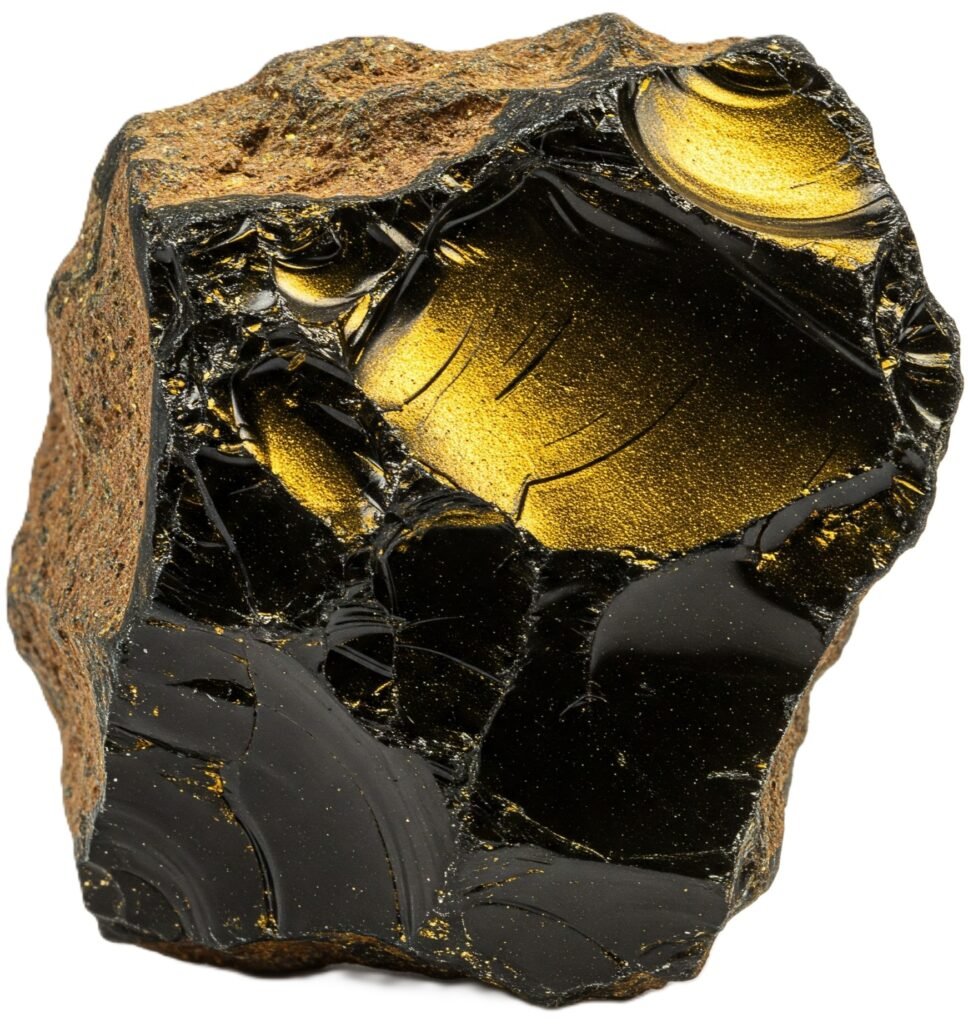
Gold sheen obsidian is an iridescent natural volcanic glass celebrated for its jet-black body and radiant, golden chatoyancy. It forms when high-silica rhyolitic lava cools almost instantly upon contact with air or water, trapping microscopic gas bubbles along flow layers. Valued across millennia, this stone merges utilitarian tool making with deep ritual significance. Today, gold sheen obsidian serves as a cornerstone material for gem collectors, lapidaries, and crystal practitioners alike. Whether examined as a geological phenomenon, an archaeological artefact, or a metaphysical anchor for shielding and personal power, this golden-glazed volcanic glass represents one of nature’s most dynamic geological transformations.
Alternate Names
Gold sheen obsidian is known across geological, gemological, and trade circles by several descriptive names:
- Golden Obsidian
- Gold Lustre Obsidian
- Sheen Obsidian(broad category including silver varieties)
- Chatoyant Obsidian
- Golden Volcanic Glass
- Itztli(Nahuatl/Aztec root term for obsidian)
The Stone’s Science and Composition
Geologically, obsidian is not a mineral because it lacks a crystalline internal structure; instead, it is an amorphous mineraloid and an extrusive igneous rock. It occurs when felsic lava, rich in silica ($SiO_2$), cools so rapidly that individual mineral crystals do not have time to nucleate and grow.
The distinctive golden shimmer is an optical effect driven by flow-banded inclusions:
- Microscopic Gas Bubbles: As the viscous rhyolitic lava flows and violently degasses, microscopic bubbles stretch along parallel flow lines. When light enters the stone, these layered bubble planes reflect and refract light back to the viewer, producing a bright, golden chatoyancy or “schiller” effect.
- Nanoscale Mineral Crystallites: Trace iron oxides, magnetite, and pyroxene crystallites often align within the glass matrix along these same bands, modifying and enriching the golden-bronze colour spectrum.
Key Physical Characteristics
| Property | Value / Specification |
| Chemical Formula | Amorphous $SiO_2$ (70–75%) with $Al_2O_3$, $Fe_2O_3$, $H_2O$ |
| Crystal System | Amorphous (None) |
| Mohs Hardness | 5.0 to 5.5 |
| Luster | Vitreous to sub-metallic (silky on sheen surfaces) |
| Refractive Index | 1.48 – 1.51 |
| Specific Gravity | 2.35 – 2.60 |
| Cleavage | None |
| Fracture | Conchoidal (produces razor-sharp edges) |
| Diaphaneity | Translucent along thin edges; opaque in mass |
Common Geologic Varieties
Obsidian manifests in diverse visual varieties depending on trace elements, inclusions, and cooling dynamics:
- Silver Sheen Obsidian: Formed identically to gold sheen, but with thinner bubble distributions or orientation angles that reflect a silvery, lunar shimmer.
- Rainbow Obsidian: Contains microscopic layers of pyroxene or feldspar nanorods, scattering light into concentric bands of green, purple, and magenta.
- Snowflake Obsidian: Features spherulitic cristobalite (a silica polymorph) clusters that appear as white, starburst patterns through devitrification.
- Mahogany Obsidian: Inclusions of oxidised iron (haematite) yield rich reddish-brown swirls mixed with black glass.
- Apache Tears: Rounded nodules of dark obsidian embedded within weathered perlite matrixes.
Global Mining and Volcanic Sources
Because gold sheen obsidian requires precise magma chemistry and cooling conditions, viable deposits are concentrated around major volcanic belts:
- Mexico (Jalisco and Hidalgo): The primary commercial source of premium gold sheen obsidian. The volcanic flows near Magdalena produce dense glass with striking, mirror-like gold surfaces.
- United States:
- Oregon (Glass Buttes): Renowned for producing high-grade sheen, rainbow, and fire obsidian.
- California (Davis Creek, Warner Mountains): Famous for expansive volcanic flow fields rich in sheen varieties.
- Idaho and Arizona: Localised deposits tied to ancient caldera eruptions.
- Guatemala (El Chayal and San Martín Jilotepeque): Ancient quarry sites mined extensively by the Maya civilisation.
- Japan (Hokkaido and Nagano prefectures): Notable deposits used historically in Jōmon-period tools and ornamental carvings.
- Armenia and Turkey (Caucasus/Anatolia): Geologically historic obsidian zones containing minor sheen-bearing volcanic flows.
Crystal Pairings: What to Combine and Avoid
Optimal Crystal Pairings
- Black Tourmaline: Pairs grounding stability with gold sheen obsidian’s reflective shielding, establishing an energetic barrier against negative environments.
- Iron Pyrites Shares the golden, reflective aesthetic and solar resonance, reinforcing mental clarity, focus, and drive.
- Citrine: Blends obsidian’s grounding with solar plexus vitality, supporting personal empowerment, confidence, and manifest action.
- Clear Quartz: Amplifies the light-bearing sheen of the obsidian, assisting in deep reflective meditation and shadow work.
Crystal Pairings to Avoid
- Moldavite: Combining high-velocity, disorienting tektite frequencies with the intense underworld shadow-work of gold sheen obsidian can lead to emotional overwhelm and grounding disconnects.
- Scolecite or Selenite (for beginners): Very high-vibrational, ethereal stones can directly counteract the dense, anchoring energy of volcanic glass, creating scattered focus if not deliberately balanced.
Archaeology, Art, and Ancient History
Due to its conchoidal fracture pattern, obsidian chips down to edges only molecules thick—substantially sharper than modern surgical steel blades. Ancient civilisations recognised both its functional utility and its mesmerising reflective properties.
- Mesoamerica (Aztecs, Maya, Teotihuacan): Known as itztli, obsidian was vital to ancient Mesoamerican life. The Aztecs carved flat, polished mirrors of dark and sheen obsidian associated with the deity Tezcatlipoca (“Smoking Mirror”), ruler of the night sky, ancestral memory, and divine rulers. High priests used these polished slabs for divination, scrying, and coronation rites.
- Ancient Mediterranean & Middle East: Pliny the Elder recorded that the Roman explorer Obsius brought samples of volcanic glass from Ethiopia, providing the root for the name obsidianus. Roman artisans carved mirrors, seals, and amulets from glassy specimens.
- Native North American Cultures: Indigenous peoples traded obsidian across thousands of miles. Prized deposits in Oregon and California supplied raw material for durable projectile points, skinning knives, and ornamental treasures.
Folklore, Legends, and Sacred Tales
Across folklore, gold sheen obsidian is revered as a catalyst of absolute truth:
- The Mirror of Tezcatlipoca: Mesoamerican lore holds that peering into a polished obsidian mirror stripped away deceit, forcing the viewer to confront both their mortal flaws and divine light.
- The Warrior’s Shield: Legends held that obsidian preserved the fiery wrath of volcanic birth, bestowing physical stamina and psychic protection to warriors carrying it into conflict.
- The Alchemist’s Lens: Renaissance-era European occultists, notably Dr. John Dee (court astrologer to Queen Elizabeth I), utilised Aztec obsidian mirrors for spirit communication and angel scrying, believing the dark reflective glass bridged physical and spiritual planes.
Metaphysical and Mystical Healing Properties
In modern holistic healing and energetic practices, gold sheen obsidian is regarded as an indispensable tool for introspective transformation:
- Clearing the Ego & Shadow Work: The golden flash breaking through black glass symbolises uncovering personal wisdom buried within the subconscious (“the shadow self”). It aids in resolving past trauma and releasing self-sabotage.
- Aura Shielding: Acts as an energetic buffer, deflecting psychic debris, emotional manipulation, and low-vibration environments.
- Clarity and Motivation: The golden sheen stimulates willpower, helping practitioners dissolve procrastination and align their actions with authentic intent.
Astrological Connections
- Primary Zodiac Sign: Scorpio — Mirrors Scorpio’s transformational drive, comfort with the subconscious, and focus on personal power.
- Secondary Zodiac Sign: Sagittarius — The golden flash resonates with the Centaur’s optimism, quest for truth, and expansive outlook.
- Planetary Rulers:
- Pluto: Governs the underworld, transmutation, deep volcanic origins, and the unearthing of hidden truths.
- The Sun: Informs the golden sheen, introducing vitality, conscious awareness, and clarity into the obsidian’s dark base.
- Elemental Resonance:Earth & Fire — Born of liquid fire that solidifies directly into the Earth, balancing intense catalytic change with steadfast physical grounding.
The Chakra System
Gold sheen obsidian forms an energetic bridge between the base of the energetic body and the centre of personal agency:
- Root Chakra (Muladhara): Anchor point. It pulls scattered energy down into the physical body, instilling a sense of safety, presence, and environmental stability.
- Solar Plexus Chakra (Manipura): The golden sheen stimulates this centre, activating personal willpower, determination, and identity.
- Third Eye Chakra (Ajna): Polished spheres and cabochons are commonly employed during meditation to quiet conscious internal chatter, facilitating scrying and visionary practice.
Interesting Facts
- Sharper Than Steel: A clean fracture in obsidian splits between molecules, yielding cutting edges hundreds of times finer than steel scalpels, occasionally inspiring specialised medical blade research.
- No Crystalline Structure: Because it cools in days or weeks rather than millennia, obsidian is frozen lava without an orderly internal lattice—classifying it as a true natural glass.
- Directional Flash: The golden sheen is strictly optical and directional; a stone must be properly oriented and cut en cabochon along its original flow bands for the golden schiller to appear.
- A Temporal Window: Over millions of years, obsidian naturally hydrates, weathers, acolornd devitrifies into fine-grained quartz crystals, making deposits older than the Cretaceous era exceptionally rare.
Modern Milestones: Birthstones and Anniversaries
- Traditional Birthstone: While not an official birthstone on the standard jewellers’ list, gold sheen obsidian is embraced as an alternative birthstone for November (Scorpio/Sagittarius) and January (Capricorns seeking grounding).
- Modern Anniversary Gift: Associated with the 1st and 13th wedding anniversaries as a protective, grounding talisman symbolizing clear communication, honesty, and mutual resilience against external stresses.
Frequently Asked Questions
How is gold sheen obsidian formed?
It forms when highly viscous, silica-rich rhyolitic lava rapidly cools into natural glass while capturing aligned microscopic gas bubbles and iron-rich crystallites along its flow layers.
Is gold sheen obsidian dyed or synthetic?
No. High-quality gold sheen obsidian is completely natural. The golden glimmer is an internal optical reflection caused by ancient gas bubbles, not surface treatments, dyes, or foil backings.
How do I clean and physically care for gold sheen obsidian?
Because obsidian has a Mohs hardness of 5.0 to 5.5, it can scratch easily. Clean it with warm water, mild soap, and a soft microfiber cloth. Avoid ultrasonic cleaners, harsh chemicals, steam, and abrasive surfaces.
How do I clean and physically care for gold sheen obsidian?
Because obsidian has a Mohs hardness of 5.0 to 5.5, it can scratch easily. Clean it with warm water, mild soap, and a soft microfiber cloth. Avoid ultrasonic cleaners, harsh chemicals, steam, and abrasive surfaces.
How can I tell the difference between gold sheen and silver sheen obsidian?
Direct sunlight or focused white light reveals the difference immediately: gold sheen produces a warm, bronze-to-yellow metallic glow, whereas silver sheen exhibits a cool, grey to white lunar luminescence.
Can gold sheen obsidian go in water?
Yes, brief rinses in plain water are safe. However, prolonged soaking should be avoided, as microscopic fissures or natural boundary layers can be degraded over long periods by mineralised water.
How do I use gold sheen obsidian for scrying or meditation?
Hold a polished cabochon or place a mirror/sphere at an angle where ambient light catches the gold flash without blinding the viewer. Relax your gaze past the surface of the glass, using the dark depth to settle thoughts and focus the mind.
How do can I tell if my Gold Sheen Obsidian is fake?
If you want to be able to tell the difference between genuine Obsidian, natural and man made alternatives see my article How to Spot Fake Obsidian: Tektite, Slag and Glass
These are my personally selected and curated Gold Sheen Obsidian products