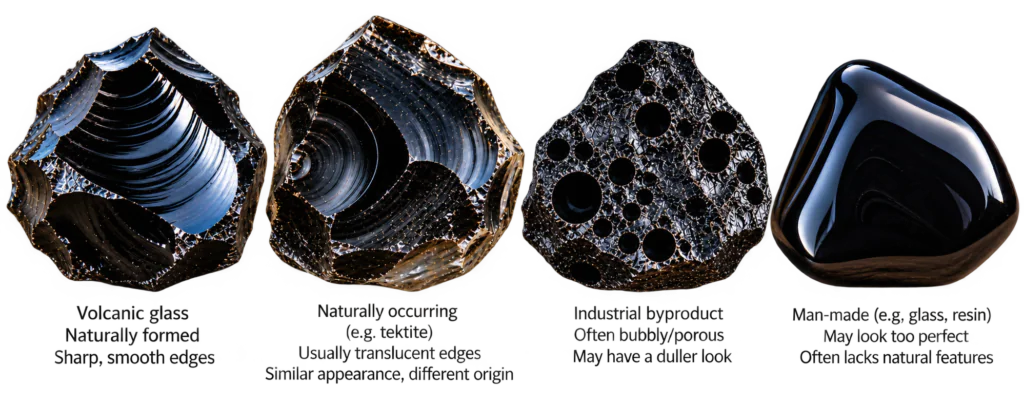
Because obsidian is an amorphous natural glass rather than a crystalline mineral, it is one of the most frequently imitated stones on the market. Manufacturers routinely pass off industrial cullet glass, smelter slag, and moulded plastics as rare volcanic specimens. Learning how to spot fake obsidian compared to genuine volcanic glass, requires an understanding of how magma cools, how natural inclusions behave, and how common workshop fakes are produced.
Variety-by-Variety Guide to Spotting Fakes
1. Black Obsidian
- The Common Fake: Moulded black soda-lime glass, industrial cullet, or dyed black resin.
- The Back light Test: Natural black obsidian is rarely 100% pitch-black when viewed through a thin section. Hold a bright LED torch directly behind a tapered edge or chip. Authentic black obsidian displays a warm, smoky brown, tea-yellow, or olive-amber translucency due to sub-microscopic iron oxide particles ($FeO$ and $Fe_3O_4$). Cheap manufactured glass typically remains dead opaque or reveals an unnatural cold purple, cobalt blue, or bottle-green cast.
- The Weight & Touch: Resin fakes warm to skin temperature within two seconds and feel noticeably light. Authentic volcanic glass has higher thermal inertia—it feels distinctly cold against the wrist and takes time to absorb body heat.
2. Gold Sheen & Silver Sheen Obsidian
- The Common Fake: Surface-coated glass (using metallic paint, vacuum metallization, or synthetic chemical vapour deposition/CVD) or glass slag containing random metallic foils.
- Inclusion Depth & Geometry: In natural sheen obsidian, the shimmer originates from within the stone along internal, parallel flow planes. The golden or silvery schiller is caused by millions of microscopic, stretched gas bubbles and tiny magnetite crystallites.
- Directional Chatoyancy: Natural sheen is directional; when you tilt the stone, the flash turns “on” and “off” as light catches the aligned planes. If an item exhibits a uniform, glittery sparkle at every conceivable angle, or if the metallic sheen can be scratched off the surface with a steel point, it is an artificial coating.
3. Rainbow & Fire Obsidian
- The Common Fake: Glass layered with synthetic iridescent foils, dichroic glass, or surface “aurora borealis” coatings.
- Subtle Interference vs. Loud Flash: Genuine rainbow obsidian derives its colour bands from thin-film light interference caused by nanoscale magnetite crystals and pyroxene nanorods arranged along flow bands. The colours (often soft greens, purples, bronzes, and magentas) are subtle, sitting slightly below the surface. They emerge clearly under direct, focused sunlight or a torch beam.
- The “Oil Slick” Red Flag: If the entire exterior displays a loud, hyper-saturated iridescence like gasoline on water regardless of lighting angle, it is a surface-treated synthetic.
4. Snowflake Obsidian
- The Common Fake: White enamel painted onto smooth black pebbles, or moulded white and black resin/glass swirled together.
- Spherulitic Cristobalite Structure: In genuine snowflake obsidian, the white patches are cristobalite (a high-temperature polymorph of quartz) formed by partial devitrification. Under a 10x jeweller’s loupe, genuine “snowflakes” display distinct, radiating needle-like or fibrous structures (spherulites) branching outward from a central point.
- Flat Patches: In fake versions, the white spots look like flat, unstructured blobs, printed decals, or liquid swirls that lack radial crystallite geometry.
5. “Blue,” “Green,” “Aqua,” and “Red” Obsidian
- The Reality:Almost all transparent, vibrant neon blue, emerald green, vivid aqua, bright yellow, and ruby-red “obsidians” sold online are 100% man-made cullet glass or smelter slag.
- Trade Names to Avoid: “Siberian Blue Obsidian,” “Himalayan Blue Quartz/Obsidian,” “Gaia Stone,” “Mount St. Helens Obsidian” (man-made coloured glass compounded from ash), and “Andara Crystal.”
- The Science: True natural obsidian forms almost exclusively in dark, earth-bound palettes—black, smoky grey, deep mahogany brown, and muted dark olive. While natural greenish-black obsidian exists (such as Mexican Pachuca obsidian), it appears near-black at rest and only reveals deep olive tones when sliced thin against back light. Any brightly transparent, candy-coloured stone advertised as raw obsidian is industrial glass.
4 Field Tests to Authenticate Obsidian
| Test Method | Genuine Obsidian | Fake (Glass Slag / Synthetic Resin) |
| 1. Gas Bubble Check (10x Loupe) | Trapped bubbles are microscopic, stretched, needle-shaped, or flattened along directional lava flow lines. | Gas bubbles are large, round, spherical, and randomly scattered (typical of low-pressure factory cooling). |
| 2. Fracture & Edges | Displays textbook conchoidal fractures with razor-sharp, paper-thin, shell-like rippled edges. | Resin shows dull, rounded fractures. Moulded glass often displays mould seam lines or rounded, fire-polished drill holes. |
| 3. Hardness (Mohs) | Scores 5.0 to 5.5. Scratches plastic and standard window glass (around Mohs 5.0) with firm pressure, but can be scratched by a hardened steel file (Mohs 6.5). | Plastic (Mohs 2–3) scratches easily with a copper penny or steel pin. High-fired silica glasses often resist scratching entirely. |
| 4. Surface & Flow Banding | Under magnification, often reveals subtle, fluid, uneven banding (waves from molten lava cooling in motion). | Completely homogeneous without flow lines, or exhibits artificial swirled pigment trails. |
Red Flags When Buying Obsidian
- Vivid, Transparent Neon Colours: Any crystal seller listing gem-clear turquoise, electric blue, or lime green “rough obsidian chunks” is selling industrial glass cullet.
- Impossibly Cheap Carvings with Zero Grain: If a large black carving or sphere shows neither flow lines, mineral dust around drill holes, nor slight smoky edge translucency, suspect black industrial container glass.
- Visible Mould Marks: Genuine obsidian must be knapped, cut, or carved using diamond lapidary equipment. Faint seams, sunken flat spots, or rounded drill-hole rims indicate melted, moulded polymer or cast glass.
- Uniform “Glitter”: Real sheen obsidian must be oriented properly to the light to view the schiller. If the golden or silvery shimmer appears equally intense from every single viewing angle, it is a synthetic glitter-infused polymer or glass simulant.