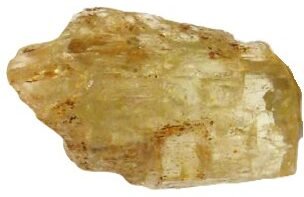
Golden apatite is a luminous calcium phosphate mineral prized for its warm, honey-to-amber tones and glass-like brilliance. Radiating an unmistakable solar glow, it captures the attention of mineral collectors, lapidaries, and holistic practitioners worldwide. Chemically grouped under the apatite mineral supergroup, this vibrant stone owes its name to the Greek word for deception, as its brilliant crystal formations historically led prospectors to mistake it for precious beryl, chrysoberyl, tourmaline, or topaz. Today, golden apatite stands in its own spotlight, celebrated as a premier gemstone for stimulating intellectual clarity, creative will, and purposeful personal ambition.
Alternate names
Mineralogists, gem collectors, and crystal healers refer to golden apatite by various trade, historical, and geological designations:
- Yellow Apatite: The most common commercial and gemological descriptor for the material.
- Gold Beryl of the Deceived: A historical collector’s moniker stemming from early misidentifications with heliodor.
- Fluoroapatite (or Fluorapatite): The precise mineral species name for the vast majority of gem-quality golden apatite specimens.
- Asparagus Stone: A classical 18th- and 19th-century trade name originally coined in Spain for translucent, yellowish-green to yellow-gold varieties.
- Solar Apatite: A contemporary trade name used in crystal markets to highlight vibrant, deep-gold crystals.
The stones Science and Composition
Golden apatite belongs to the phosphate mineral family, existing primarily as an isomorphic member of the apatite group. At a structural level, natural gem-grade golden apatite is dominated by the fluorapatite end-member, defined by the generalised chemical formula:
$$\text{Ca}_5(\text{PO}_4)_3\text{F}$$
In broader mineralogical systems, it incorporates varying ratios of halogens and hydroxyl anions within its hexagonal lattice:
$$\text{Ca}_5(\text{PO}_4)_3(\text{F}, \text{Cl}, \text{OH})$$
The characteristic golden, lemon, and amber hues are produced by trace structural substitutions and natural irradiation. Trace quantities of rare earth elements (REEs) such as cerium (Ce), neodymium (Nd), and praseodymium (Pr), along with iron chromophores and stable colour centres within the phosphate framework, selectively absorb high-energy blue wavelengths while transmitting radiant yellow light.
Key Physical Characteristics
| Property | Value / Diagnostic Metric |
| Mohs Hardness | Exactly 5.0 (Standard reference mineral on the Mohs scale) |
| Crystal System | Hexagonal ($6/m$) |
| Crystal Habit | Prismatic hexagonal columns, tabular crystals, massive crystalline aggregates |
| Luster | Vitreous (glassy) to sub-resinous |
| Transparency | Transparent to translucent |
| Refractive Index | 1.628 to 1.649 |
| Birefringence | 0.002 to 0.008 (Uniaxial negative) |
| Cleavage | Poor/indistinct parallel to basal plane {0001} |
| Fracture | Conchoidal to uneven; inherently brittle |
| Specific Gravity | 3.16 to 3.23 |
| Fluorescence | Weak to moderate yellow, lilac, or mustard-yellow under short-wave/long-wave UV |
Common Geologic Varieties
Golden apatite forms across multiple geological petrogeneses, leading to distinct physical and structural varieties:
- Fluorapatite: The most abundant variety. It crystallises in fluorine-rich environments, producing the crispest, most transparent golden crystals with the highest vitreous lustre.
- Chlorapatite: Formed in chlorine-rich environments. Typically exhibits deeper greenish-yellow tones and higher specific gravity, though transparent gem crystals are exceptionally rare.
- Hydroxylapatite: Hydroxide-dominant variant. Primarily known in geochemical and biomaterial contexts, forming milky or semi-translucent yellowish crusts and botryoidal aggregates.
- Chatoyant Golden Apatite (Cat’s Eye): Formed when parallel needle-like inclusions of rutile or fluid channels develop along the c-axis of the hexagonal crystal. When cut en cabochon, it reflects a sharp line of light reminiscent of a cat’s pupil.
Global Mining and Volcanic Sources
Golden apatite develops in high-temperature pegmatites, hydrothermal veins, carbonatites, and contact metamorphic skarns. Key extraction locations include:
- Durango, Mexico (Cerro de Mercado): The world’s benchmark locality for gem-grade golden fluorapatite. The iron mines here produce sharp, highly transparent, bright yellow-gold prisms embedded in martite and volcanic tuff.
- Madagascar: The pegmatite fields of the Antsirabe and Betafo regions yield rich, honey-toned and neon-golden crystals, frequently cut into larger faceted gemstones.
- Brazil (Minas Gerais): Renowned for producing large tabular crystals and vibrant gem rough within granitic pegmatites.
- Spain (Murcia): The historic origin of the yellowish-green “asparagus stone,” discovered in volcanic host rocks and lamproites near Jumilla.
- Canada (Ontario & Quebec): Significant deposits in Grenville Province marbles and skarns, yielding massive crystalline masses and large golden-brown prisms.
Crystal Pairings: What to Combine and Avoid
Combining crystals requires evaluating complementary or conflicting metaphysical energies, elemental associations, and physical durability.
Optimal Crystal Pairings
- Citrine (Fire/Solar Connection): Amplifies the solar plexus resonance of golden apatite, reinforcing personal manifestation, financial clarity, and decisive action without energetic dissonance.
- Pyrite (Grounding Shield): Anchors golden apatite’s high mental output into physical reality. Pyrite provides structural focus, helping prevent creative burnout.
- Clear Quartz (Universal Amplifier): Enhances the vitreous, high-frequency energy of apatite, expanding mental focus and clarity during intense problem-solving sessions.
- Carnelian (Sacral Alignment): Merges golden apatite’s cerebral willpower with carnelian’s sensual, creative spark, bridging conceptual ideation with physical motivation.
Crystal Pairings to Avoid
- Black Tourmaline or Obsidian (Over-Dampening): Extremely dense, heavy grounding stones can stifle golden apatite’s quick, uplifting, and intellectual energy, creating a sluggish metaphysical dynamic.
- Blue Lace Agate or Lepidolite (Contradictory Currents): The deeply sedative, slow-paced frequencies of calming throat and heart stones can directly neutralise golden apatite’s assertive drive.
- Harder Stones in Direct Physical Contact (Sapphire, Topaz, Quartz): Due to apatite’s low hardness (Mohs 5), storing or wearing it loose against quartz (Mohs 7), topaz (Mohs 8), or corundum (Mohs 9) will quickly scratch, abrade, and dull its faceted facets.
Archaeology, Art and Ancient History
Golden apatite carries a complex archaeological legacy defined by its chameleon-like nature. Because modern mineral analysis only matured in the late 18th century, ancient artisans routinely utilised golden apatite under alternative identities:
- Mediterranean Carvings & Seals: Roman and Hellenistic lapidaries utilised golden-hued minerals for engraved intaglios and amulets, often categorising transparent golden apatite alongside yellow beryl, chrysolite, and tourmaline.
- Mesoamerican Ornamentation: Pre-Columbian cultures in central Mexico utilised naturally occurring yellow and green apatite minerals for mosaic masks, ceremonial beads, and inlay tiles alongside jadeite and turquoise.
- The Scientific Breakthrough of 1786: German geologist Abraham Gottlob Werner formally studied the mineral and designated it “apatite” from the Greek apatao (“I deceive”). Werner recognised that numerous historical gemstones catalogued across royal European collections as chrysoberyl, olivine, or peridot were, in fact, crystalline calcium phosphate.
Folklore, Legends and Sacred Tales
Across folklore traditions, golden apatite was long viewed as a mineral infused with direct solar rays:
- The Mirror of Deceit: Ancient folkloric talismans carved from apatite were carried by travellers to detect treachery and deceit in business transactions, playing ironically on the stone’s linguistic reputation for disguise.
- The Lightbringer’s Guide: Central European mining lore associated golden crystals found in deep iron seams with earth spirits leading prospectors toward rich mineral veins.
- The Golden Intellect: Renaissance alchemical fragments attributed yellow-hued phosphate crystals with the capacity to dissolve melancholia, igniting the user’s “inner sulphur”—the philosophical principle of willpower, warmth, and conscious drive.
Metaphysical and Mystical Healing Properties
Disclaimer: Metaphysical concepts are based on spiritual traditions and personal practice; they are not intended to substitute for qualified medical advice.
- Mental Organisation and Focus: Golden apatite is revered among practitioners as an intellectual synthesiser. It assists in sorting complex information, dispelling brain fog, and synthesising disparate facts into coherent strategies.
- Motivation and Overcoming Procrastination: By working through internal doubts, it promotes proactive behaviour, helping individuals step away from passive daydreams into deliberate, measurable execution.
- Emotional Transformation: It dissolves lingering feelings of unworthiness, victimhood, and apathy, replacing emotional lethargy with optimistic self-reliance.
- Energetic Vitality: Crystal healers use golden apatite along the biofield to clear sluggish energy pathways, encouraging a buoyant, energised physical disposition.
Astrological Connections
Golden apatite links directly to fire signs and planets associated with illumination, expansion, and clarity:
- Leo: Resonates strongly with Leo’s governing body, the Sun. It boosts Leo’s native charisma, leadership drive, and creative confidence while grounding potential hubris in lucid self-awareness.
- Gemini: Governed by Mercury, Gemini finds an energetic ally in golden apatite’s ability to streamline hyperactive thoughts into focused, constructive communication.
- Sagittarius: Aligns with Sagittarian pursuits of philosophy, long-range vision, and higher learning, mitigating restlessness and sharpening goal execution.
The Chakra System
Golden apatite is primarily anchored to the Manipura (Solar Plexus Chakra), situated just above the navel:
- Centre of Personal Power: The Solar Plexus acts as the energetic furnace of the body, governing self-discipline, personal authority, digestive transformation, and the ego.
- Clearing Blockages: A deficient solar plexus manifests as indecision, low self-worth, and fear of confrontation; an overactive centre results in domineering or critical behaviours. Golden apatite balances this vortex, promoting balanced, assertive confidence.
- Secondary Resonance (Third Eye Chakra / Ajna): High-clarity golden crystals simultaneously stimulate the Third Eye, weaving intellectual clarity and intuitive insight directly into the Solar Plexus for decisive, aligned action.
Interesting facts
- Standard on the Mohs Scale: Golden apatite defines the exact baseline for a hardness of 5 on Friedrich Mohs’ mineral hardness scale, serving as an international scientific benchmark.
- Constituent of Bones and Teeth: The human skeletal system and tooth enamel are primarily made of biological hydroxylapatite, a direct structural sibling of golden fluorapatite.
- Lunar Mineral Presence: Lunar rock samples brought back by NASA’s Apollo missions contained trace apatite crystals within lunar basalts, proving its existence across celestial bodies.
- Industrial Foundation: While gem-quality golden apatite is faceted for jewellery, bulk apatite rock is the world’s primary source of phosphorus for agricultural fertilisers and chemical applications.
- Rare Earth Content: Certain golden apatite specimens from alkaline pegmatites contain notable levels of rare earth elements, making them valuable indicator minerals for geological prospecting.
Modern Milestones: Birthstones and Anniversaries
- Alternative Birthstone: Golden apatite serves as a modern, vibrant alternative birthstone for Gemini (May/June) and Leo (July/August), offering an accessible alternative to yellow sapphire or imperial topaz.
- Zodiac Birthstone Alignment: Often selected by modern astrologers as a talismanic birthstone for those born under solar-dominated charts.
- Anniversary Celebrations: Gemstone enthusiasts use golden apatite as an alternative celebratory gem for the 3rd and 19th wedding anniversaries, symbolising illuminated love, resilience, shared prosperity, and mutual intellectual appreciation.
Frequently Asked Questions
Is golden apatite suitable for everyday rings?
Because golden apatite measures 5 on the Mohs scale and features brittle tenacity, it is susceptible to abrasion and accidental impacts. It is best suited for earrings, pendants, brooches, or protective bezel-set settings reserved for occasional wear rather than high-impact everyday rings.
How do I clean and care for golden apatite jewellery?
Clean golden apatite using lukewarm water, mild dish soap, and a soft micro fibre cloth. Never use steam cleaners or ultrasonic cleaning tanks, and keep the stone away from household acids, vinegar, and abrasive cleaners, which can dissolve or etch phosphate minerals.
What causes golden apatite’s colour to fade?
Prolonged exposure to intense direct sunlight, high heat, or UV lamps can destabilise the natural radiation-induced colour centres within the stone, leading to gradual fading or discolouration over time.
How can I distinguish real golden apatite from citrine or yellow beryl?
Golden apatite is notably softer than citrine (Mohs 7) and beryl (Mohs 7.5–8); it will easily be scratched by a steel file or a quartz crystal point. Additionally, apatite has a higher specific gravity (3.16–3.23) and refractive index than quartz (2.65), causing it to feel slightly denser in hand.
Does golden apatite undergo common gemstone treatments?
Most gem-quality golden apatite on the market is entirely untreated and displays natural colour. Some darker or greenish stones may be gently heat-treated to improve transparency or adjust the tone, but legitimate dealers should always disclose such modifications.
How to tell if my Apatite stone is real and not a fake?
Apatite is know as the Mineral born to deceive and has a long history of being altered or substituted with other stones. To assist you in verifying your stone, see my article How to spot fake Apatite: The Mineral Born to Deceive