
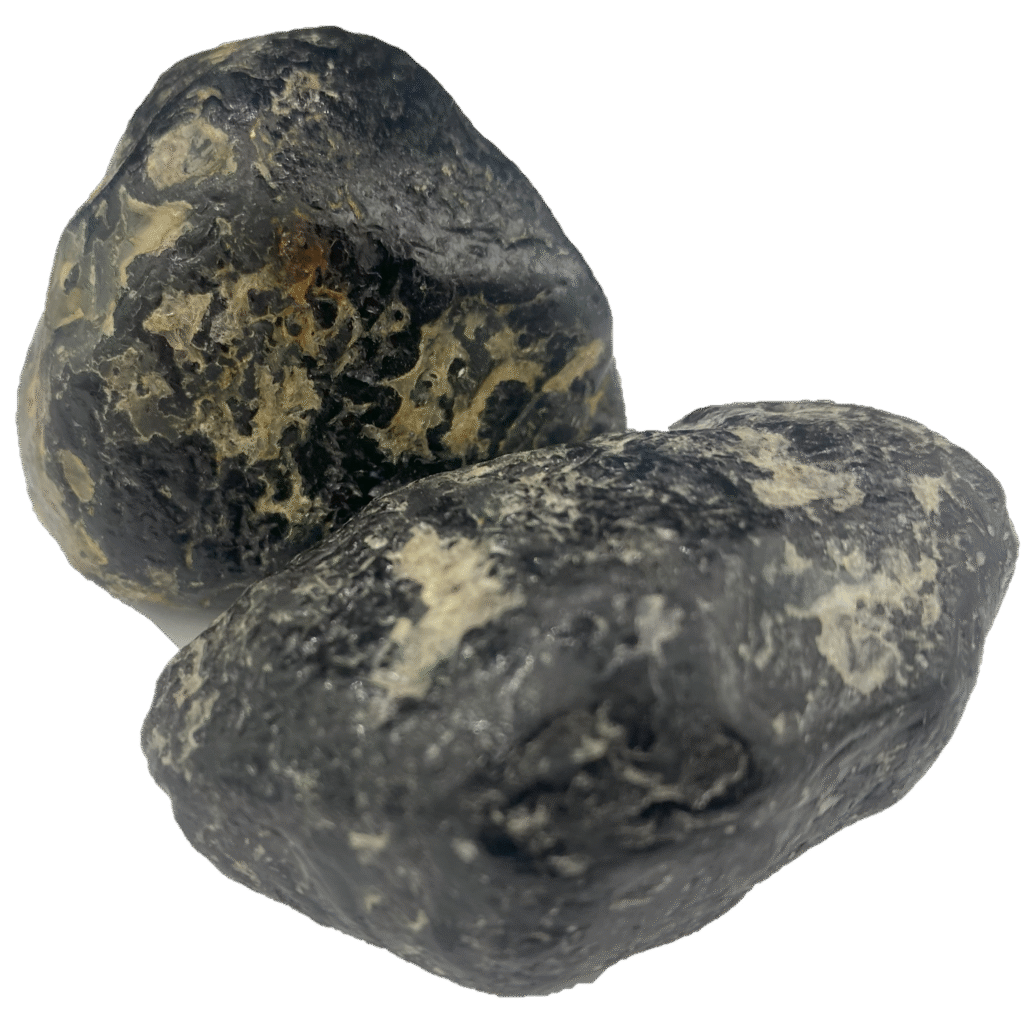
Apache Tears are a unique, captivating variety of black obsidian. Unlike typical jagged volcanic glass, these stones are naturally rounded, smoother in texture, and carry a deeply comforting metaphysical energy. Alternative names for these stones include “obsidian nodules” and “marekanite”, a lesser-known term used by geologists and collectors for certain natural obsidian formations found within perlite matrices.
When exposed to light, their hidden translucent quality becomes beautifully evident, revealing a smoky, dark-brown or grey interior that instantly distinguishes them from other completely opaque black stones like Onyx or Jet.
Composition and Physical Characteristics
Geologically, Apache Tears are not true minerals but rather volcanic glass. They are sub-spherical nodules or pebbles composed primarily of silica-rich lava ($SiO_2$).
- Formation: Volcanic eruptions that created Apache Tears occurred millions of years ago, making each piece an ancient relic of Earth’s geological history. They form within flows of perlite (a hydrated volcanic glass). As the surrounding perlite hydrates and weathers away over millennia, these solid obsidian cores remain as smooth pebbles.
- Hardness: They score a 5 to 5.5 on the Mohs hardness scale.
- Texture and Luster: They have a vitreous (glass-like) luster. While raw nodules have a matte, pitted, or white-crusted exterior, they reveal a perfectly glassy, smooth interior when fractured or tumbled.
Geographical Locations Where It Is Found
Apache Tears are most famously located in the volcanic regions of the Southwestern United States, with exceptionally high-quality deposits in Arizona (particularly around Superior and Clinton), Nevada, and New Mexico. However, variant forms of these obsidian nodules (often referred to as marekanite) are also found globally in places like the Marekanka River region in Siberia, Russia, as well as parts of Mexico and Iceland.
Folklore, Legends, and Tales
The poignant name of this stone stems from a historical Native American legend. In the 1870s, a outnumbered band of Apache warriors faced a military battle on a mountain overlooking what is now Superior, Arizona. Rather than face defeat and captivity, the remaining warriors bravely rode their horses over the precipice to their deaths.
When the broken-hearted women and families of the tribe gathered at the base of the cliff to mourn, their intense grief moved the Great Spirit. It is said that their falling tears were turned to stone upon hitting the desert floor, creating these dark volcanic pebbles. According to southwestern lore, anyone who carries an Apache Tear is said to never have to weep in grief again, as the stone holds the tears for them.
Historical, Archaeological, and Current Usage
- Archaeological Finds: Historically, regular obsidian was widely traded across ancient civilisations for making razor-sharp arrowheads, mirrors, and ritual cutting tools. However, because Apache Tears naturally form as smaller, rounded nodules, archaeologists have frequently found them in ancient indigenous burial sites and hoards across North America, where they were kept as sacred talismans of protection and mourning.
- Current Usage: Today, they are incredibly popular in lapidary work. When placed in a rock tumbler, they polish up into exceptionally glossy, liquid-like gemstones used in wire-wrapped pendants, pocket stones, and protective crystal grids.
Beneficial Healing and Mystical Properties
Mystical Healing Properties, Astrology, and the Zodiac
Metaphysically, Apache Tears are regarded as supreme stones of emotional support. They act like an energetic sponge, absorbing sorrow, trauma, and lingering grief from the auric field. Unlike traditional Black Obsidian, which can violently force repressed emotions to the surface, the energy of an Apache Tear is incredibly gentle, allowing you to process pain at a manageable pace.
In astrology, Apache Tears are heavily tied to the intense, transformative sign of Scorpio, providing comfort during moments of personal rebirth. They also bring much-needed emotional grounding to the sensitive water sign of Pisces, and offer strength to the fire sign of Aries, representing both destruction and renewal in volcanic processes.
The Chakra System
Apache Tears operate directly within The Chakra System, focusing their vibrational frequency on the Root Chakra (Base Chakra). By clearing blockages here, they help anchor floating or anxious energy back into the physical body. It restores your sense of safety, vitality, and trust in the physical world, making it easier to let go of old behavioural patterns rooted in fear.
Use as a Birthstone and for a Wedding Anniversary
While not a traditional calendar birthstone, Apache Tears serve as an excellent natural birthstone for those born under the dark, introspective days of late autumn (mid-October to late November).
In modern gemstone traditions, obsidian varieties are occasionally gifted on the 10th Wedding Anniversary or 15th Wedding Anniversary to symbolise resilience, protection, and the ability to survive life’s turbulent storms together.
Beneficial Crystal Pairings for Apache Tears
The best crystal combinations are those that safely support emotional healing or gently elevate its deep, protective vibrations.
1. Rose Quartz (The Ultimate Grief Relief)
Pairing Apache Tears with Rose Quartz creates a beautiful, compassionate safety net. While the Apache Tear gently extracts deep-seated pain and grief, Rose Quartz floods the Heart Chakra with unconditional love, warmth, and reassurance.
- Best for: Overcoming bereavement and deep emotional recovery.
2. Black Tourmaline (The Shield of Protection)
Black Tourmaline repels external negativity and environmental smog, while Apache Tears work internally to clear negative thought patterns and anxiety.
- Best for: Empaths and clearing toxic environments.
3. Clear Quartz (The Light in the Darkness)
Clear Quartz brings a much-needed dose of light and clarity to your practice. It amplifies the healing properties of the Apache Tear while ensuring you do not get bogged down by dense energy.
- Best for: Shadow work and spiritual breakthroughs.
Crystal Pairings to Avoid with Apache Tears
| Crystal | Why It Clashes with Apache Tears |
| Moldavite | Moldavite triggers rapid, often chaotic life upheavals. Apache Tears are meant to provide stability and comfort. Combining them creates an intense energetic friction. |
| Carnelian | Carnelian is a fiery, high-energy stone of physical action. This loud, fast-paced vibration directly conflicts with the quiet, reflective, and absorbing nature of Apache Tears. |
| Malachite | Malachite violently pulls buried emotions to the surface without a filter. If you are already processing grief, adding Malachite can cause an emotional flood that is too intense to manage safely. |
Interesting Facts
- The Perlite Matrix: In nature, Apache Tears look like little dark eyes peering out from chalky, grey-white perlite rocks.
- Natural Glass: Because they cooled down so quickly after an eruption, the lava didn’t have time to grow internal crystalline structures, meaning Apache Tears are technically amorphous glass rather than crystals.
- The “Tear” Effect: Their unique smoky transparency can usually only be seen when you hold a flashlight directly behind the stone—otherwise, they appear perfectly opaque.
Apache Tears Frequently Asked Questions (FAQ)
What is the difference between Apache Tears and regular Black Obsidian?
While both are forms of volcanic glass, regular Black Obsidian is typically fractured, sharp, and entirely opaque. Apache Tears are naturally weathered, sub-spherical nodules that look black at a glance but reveal a smoky, translucent core under direct light. Metaphysically, Apache Tears carry a much gentler energy than standard obsidian
Can Apache Tears go in water?
Yes, Apache Tears are water-safe. Because they do not contain toxic metals or water-soluble minerals, you can safely cleanse them under running water. However, like all volcanic glass, they can crack if exposed to sudden, extreme temperature changes (thermal shock), so always use lukewarm water.
How do I cleanse and charge Apache Tears?
Because Apache Tears act like an energetic sponge, they require frequent cleansing. You can cleanse them by running them under cool tap water, burying them in the earth overnight, or using sound healing. To charge them, place them under the light of a Full Moon or sit them on a Selenite charging plate. Avoid long exposure to intense sunlight.
