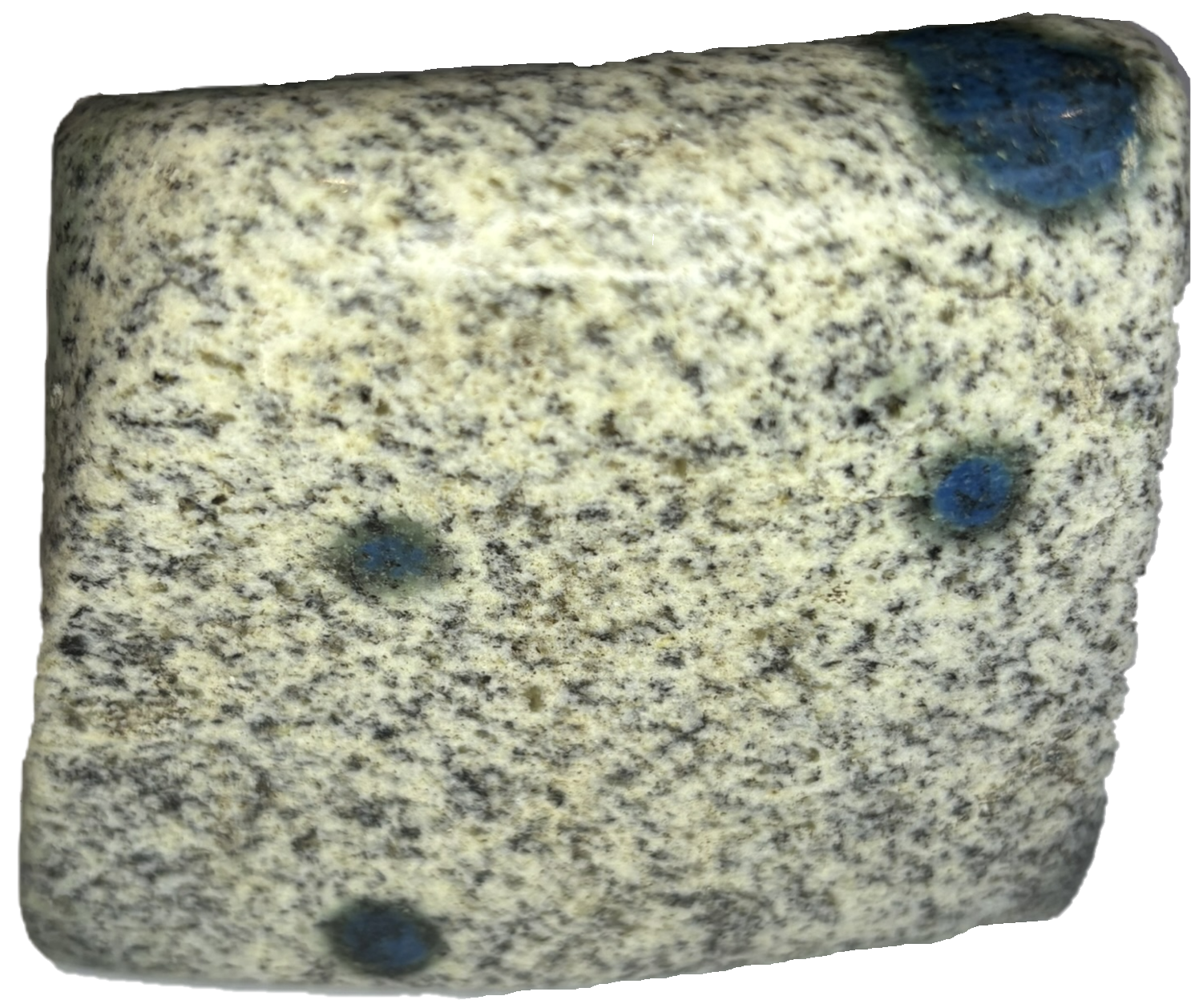
K2 stone is a striking, relatively recent mineral discovery characterized by vivid, circular blue droplets suspended across a fine-to-medium-grained white, grey, and black granitic matrix. Named after the world’s second-highest mountain peak, Mount Godwin-Austen (K2), near whose base it was first discovered, the rock is a natural composite material rather than an individual mineral species.
While it resembles a synthetic artisan composite or dyed stone at first glance, petrological testing by gemological laboratories confirms that K2 stone is an entirely natural geological formation: igneous granite hosting secondary copper carbonate mineralization.
Alternate names
- K2 Jasper: The most ubiquitous commercial trade name, although petrologically inaccurate as the host rock contains no microcrystalline quartz jasper.
- K2 Granite: The scientifically accurate descriptive trade term denoting the granitic base.
- Azurite Granite: A mineralogical description highlighting the presence of secondary azurite.
- Raindrop Azurite / Blue Raindrop Granite: A descriptive lapidary nickname based on the discrete, spherical morphology of the blue blebs.
- K2 Blue: A concise commercial moniker common in jewelry and crystal-trading circles.
The stones Science and Composition
K2 stone is a multi-mineral rock composed of two distinct geological phases: a primary plutonic igneous host and a secondary hydrothermal or supergene mineral impregnation.
- Matrix Minerals: The host rock is a classic granite to granodiorite composed primarily of quartz ($\text{SiO}_2$), sodic plagioclase feldspar ($\text{NaAlSi}_3\text{O}_8$), potassium feldspar ($\text{KAlSi}_3\text{O}_8$), and fine flakes of dark biotite mica ($\text{K(Mg,Fe)}_3\text{AlSi}_3\text{O}_{10}\text{(F,OH)}_2$).
- Secondary Inclusions: The spherical blue spots consist of azurite, a basic copper carbonate with the formula:$$\text{Cu}_3(\text{CO}_3)_2(\text{OH})_2$$Occasionally, trace green blebs appear, caused by malachite ($\text{Cu}_2\text{CO}_3(\text{OH})_2$), which forms when azurite undergoes localized hydration and alteration.
- Paragenesis: The granite crystallized first deep underground during regional tectonic and plutonic events. Long after solidification and fracturing, alkaline copper-bearing fluids migrated along intergranular grain boundaries. Under specific, localized pH and oxidation conditions, the copper carbonate precipitated as spherical secondary orbicular stains, bleeding outward from micro-fractures into the surrounding feldspar and quartz grains.
Key Physical Characteristics
| Property | Measurement / Observation |
| Rock Type | Plutonic Igneous Rock (Granite / Granodiorite) with Secondary Carbonates |
| Mohs Hardness | Variable: 6 to 6.5 for the granitic matrix; 3.5 to 4 within the azurite spots |
| Colour Spectrum | White, light grey, salt-and-pepper base speckled with vivid sky-blue to royal-blue orbs; rare green orbs |
| Lustre | Vitreous to dull in raw matrix; vitreous to sub-adamantine on polished surfaces |
| Diaphaneity | Opaque |
| Specific Gravity | $\approx 2.65 – 2.82$ (increases with copper mineral concentration) |
| Refractive Index | Aggregate: Quartz ($1.544 – 1.553$), Feldspar ($1.52 – 1.54$), Azurite ($1.730 – 1.838$) |
| Cleavage | Perfect in feldspar and biotite; none in quartz aggregate; uneven/conchoidal overall |
| Acid Reaction | Effervesces mildly in dilute hydrochloric acid ($\text{HCl}$) exclusively on the blue azurite orbs |
Common Geologic Varieties
Because K2 stone is a rock rather than a pure mineral, its appearance varies significantly depending on local fluid chemistry and fracture density:
- Classic Orbicular K2: Pristine, circular blue azurite spots cleanly dispersed across a bright, salt-and-pepper white and black granite base.
- Malachite-Bearing K2 (K2 Green): Rare specimens displaying emerald-green spots alongside or replacing the blue spots, resulting from secondary alteration of azurite to malachite.
- Veined or “Spiderweb” K2: Formations where the copper-bearing fluid traveled along planar fault micro-veinlets rather than blooming radially, creating blue lines and webs rather than round orbs.
- Low-Grade Matrix (“Shadow Granite”): The underlying biotite granite containing faint, washed-out cyan tinting or lacking azurite deposits entirely.
Global Mining and Volcanic Sources
Contrary to misconceptions implying a volcanic (extrusive) source, K2 stone is strictly plutonic (intrusive igneous) in origin, formed under elevated lithostatic pressure and subsequently brought toward the surface through tectonic uplift and erosion.
- Primary Source: The Skardu region of Gilgit-Baltistan in northern Pakistan. Mining occurs near the base of the Karakoram Mountain Range, close to the southern slopes of Mount K2.
- Mining Conditions: Deposits sit at extreme elevations ($3,000$ to over $4,500$ meters above sea level) in rugged, snow-covered terrain. Extraction is artisanally driven, strictly seasonal, and limited to brief summer windows when high-altitude passes thaw. Hand tools and low-impact quarrying methods are used due to the steep, inaccessible terrain.
- Alternate Localities: While granite and azurite each occur worldwide, this specific combination—azurite spherules embedded in an unaltered granitic matrix—remains largely exclusive to the Karakoram deposits of Pakistan. Minor, isolated occurrences of copper-stained granites have surfaced in parts of China and the southwestern United States, but none replicate the characteristic circular blue orbs of classic K2.
Crystal Pairings: What to Combine and Avoid
Optimal Crystal Pairings
- Clear Quartz: Acts as an energy and clarity amplifier, reinforcing the crystalline framework of the granite’s native quartz content.
- Lapis Lazuli or Sodalite: Resonates directly with the Third Eye and Throat chakras; their deep indigo shades complement the bright azurite blues for meditation focused on communication and intellect.
- Black Tourmaline or Smoky Quartz: Grounding minerals that anchor the elevated cognitive vibration of the azurite, matching the stabilizing weight of the granite base.
- Chrysocolla: Shares secondary copper carbonate chemistry, creating a harmonic frequency for emotional processing and heart-throat integration.
Crystal Pairings to Avoid
- Aggressive, High-Fire Stones (e.g., Red Carnelian, Pyrite): High-energy, solar-driven minerals can overwhelm the tranquil, intuitive state facilitated by azurite and biotite.
- Moisture-Sensitive or Highly Friable Stones in Direct Contact (e.g., Selenite): When worn as stacked jewelry, hard granitic quartz ($6–6.5$) will quickly abrade softer stones like Selenite ($2$) or Halite ($2.5$).
- Acidic Cleansing Solutions: While not a pairing of minerals, combining K2 with chemical or salt-based liquid cleansing mediums permanently degrades the copper carbonate inclusions.
Archaeology, Art and Ancient History
Because of its recent commercial debut and the remote, inhospitable terrain where it forms, K2 stone lacks an extensive record in classical antiquities:
- Ancient Petroglyphs of the Indus River: Skardu and the broader Gilgit-Baltistan valleys contain thousands of prehistoric petroglyphs carved into granitic outcrops, dating from the Neolithic to the Buddhist eras ($1\text{st millennium BCE}$ to the $8\text{th century CE}$). While ancient artisans routinely utilized regional river boulders for rock art, there is no documented archaeological evidence that Neolithic or Bronze Age craftsmen targeted the rare azurite-rich pockets specifically for talismans.
- Modern Art and Lapidary Adoption: K2 emerged onto the global lapidary scene during the early 2010s at major mineral exhibitions such as the Tucson Gem and Mineral Show. Gem cutters quickly popularized it for smooth cabochons, freeform carvings, spheres, pendulums, and beads, celebrating the stark pop-art contrast of royal blue dots against pale, speckled granite.
Folklore, Legends and Sacred Tales
Though modern in identification, K2 stone has rapidly absorbed legends tied to the mythos of the Karakoram Range:
- The Guardian of Chogori: Indigenous Balti lore reveres K2 as Chogori (“King of Mountains”). Folk tales emerging from local miners describe the stone as “the mountain’s tears,” believed to freeze droplets of sky inside the granite to preserve clarity and balance for travelers facing lethal altitudes.
- The Fusion of Sky and Earth: Contemporary metaphysical folklore describes K2 as the symbolic marriage between primal earthly anchors (the ancient granitic core of the continent) and celestial consciousness (the azure spots of heaven), acting as a bridging talisman for mountain mystics.
Metaphysical and Mystical Healing Properties
- Clarity and Higher Consciousness: The azurite component is celebrated in energy work for activating intuitive perception, lucid dreaming, and psychic vision.
- Emotional Grounding: Unlike pure azurite, which can feel unmooring or disorienting to sensitive meditators, the granitic matrix stabilizes the energetic body, maintaining presence during deep introspective work.
- Harmonious Communication: Supports measured, thoughtful expression, dismantling mental blockages and facilitating rational dialogue in high-stress environments.
- Stress Dissipation: Promotes mental equilibrium by grounding racing thoughts, making it a staple tool in modern breathwork and mindfulness exercises.
Astrological Connections
- Primary Zodiac Sign — Sagittarius: Governed by Jupiter, Sagittarius seeks philosophical truth, expansive knowledge, and broad horizons. K2 stone complements this quest by combining the far-reaching perception of azurite with the steady discipline required to walk long paths.
- Secondary Zodiac Sign — Gemini: Ruled by Mercury, Gemini benefits from the dual structure of K2 stone: the grounding granite disciplines mental hyperactivity, while azurite sharpens focused communication.
- Planetary Rulers: Saturn (represented by the foundational, structural granite and mica) and Jupiter / Venus (governing azurite’s expansion of higher wisdom and copper-infused balance).
The Chakra System
K2 stone operates concurrently on opposite ends of the energetic spectrum, forming a vertical circuit:
- Third Eye Chakra (Ajna): The azurite component stimulates insight, deep introspection, pattern recognition, and spiritual awareness.
- Crown Chakra (Sahasrara): Connects mundane awareness with transpersonal states, quieting the ego during meditation.
- Root Chakra (Muladhara): The feldspar, quartz, and biotite granite matrix anchors the biofield into the physical body, preventing the “ungrounded” feeling common when working with pure azurite.
- Throat Chakra (Vishuddha): Secondary azurite and occasional malachite elements encourage clear, honest articulation of inner realizations.
Interesting facts
- Not a Jasper at All: Despite its dominant trade label (“K2 Jasper”), it contains no chalcedony or chert. It is a genuine, coarse-grained igneous granite.
- Initial Skepticism: When first displayed at gem fairs, many mineralogists and dealers assumed it was a hoax—suspecting that unscrupulous artisans had injected blue ink or dye into porous granite. Spectroscopic analysis eventually verified the natural occurrence of azurite.
- Differential Hardness Challenge: Lapidaries face distinct challenges polishing K2 stone. Because the azurite orbs ($3.5-4$) are significantly softer than the enclosing quartz and feldspar ($6-6.5$), heavy-handed polishing can undercut the spots, leaving shallow pits across the surface.
- A Weathering Conundrum: Azurite typically forms near oxidizing, near-surface copper deposits, whereas granite forms deep in the continental crust. The presence of secondary copper carbonates impregnating pristine plutonic granite requires unusual tectonic and supergene conditions, making K2 a geological anomaly.
Modern Milestones: Birthstones and Anniversaries
- Modern Birthstone Associations: While not recognized on traditional Gregorian birthstone charts, K2 is widely adopted by contemporary gem therapists as an alternative stone for Sagittarius (November–December).
- Anniversary Associations: Unofficially assigned to the 33rd Wedding Anniversary, symbolizing the union of steadfast endurance (granite) and ongoing shared wisdom and vision (azurite).
- Industrial History: First commercially logged in western markets in the early 21st century ($2010–2013$), making it one of the youngest recognized decorative composite gemstones in modern lapidary arts.
Extensive FAQ Section
Is K2 stone dyed or completely natural?
Authentic K2 stone is 100% natural. The blue spots are genuine azurite formed by copper-rich alkaline fluids filtering into the granite. While cheap knockoffs using dyed howlite or epoxy-injected granite exist, genuine K2 displays discrete mineral boundaries under microscopic examination.
Can K2 stone go in water?
Brief rinses under cool water are fine, but do not submerge or soak K2 stone. Azurite is a porous, hydrous copper carbonate that degrades, loses polish, and oxidizes when exposed to extended water baths. It should never be cleansed in saltwater or ultrasonic cleaners.
How should I clean and care for K2 jewelry?
Wipe it clean with a soft, dry or slightly damp microfiber cloth. Avoid steam cleaners, harsh soaps, household detergents, and ultrasonic devices. Store it separately from harder gems (such as topaz, sapphire, or diamonds) to prevent surface scratches.
Why is K2 stone so expensive compared to ordinary granite?
Ordinary granite is abundant, but K2 stone is sourced from a single, remote high-altitude location in the Karakoram Mountains of Pakistan. The short mining window, hazardous extraction conditions, and unique natural aesthetic command a premium on the lapidary market.
These are my personally selected and curated K2 Stones