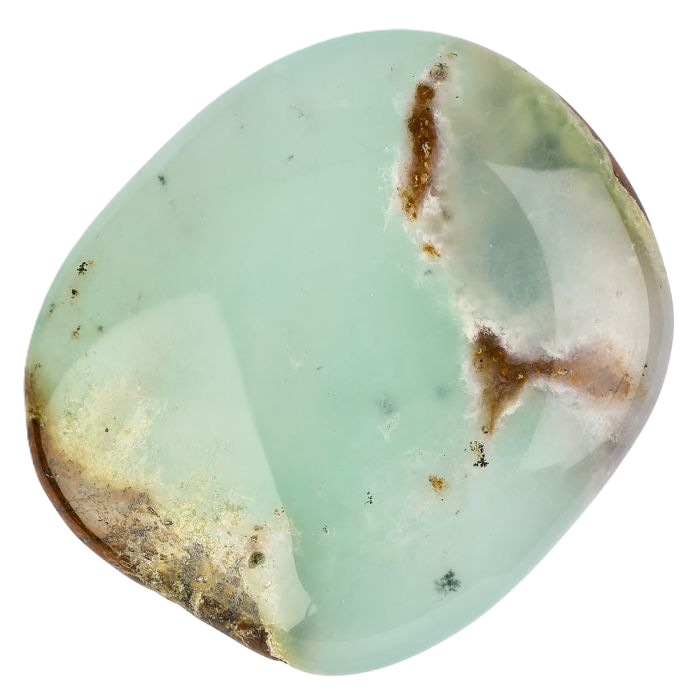
Epitomising the fresh vitality of spring, emotional renewal, and deep heart-centred healing, Chrysoprase stands as one of the most coveted varieties within the chalcedony family. Celebrated for its unique, luminous apple-green to rich grassy hues, this magnificent gemstone appears almost backlit, casting a soft, translucent glow that has captivated humanity for millennia. Unlike many other green stones that owe their colouration to chromium or vanadium, Chrysoprase is uniquely coloured by trace amounts of nickel, setting it apart both gemologically and visually. Whether appreciated by mineral collectors for its elegant microcrystalline structure, or by crystal practitioners for its soothing, manifestation-boosting energy, Chrysoprase serves as an exquisite bridge between earthy abundance and profound spiritual serenity.
Alternate names
Throughout its rich history across various cultures and trade markets, Chrysoprase has been recognised under several different monickers and historical spellings:
- Chrysophrase / Chrysoprasus: Older historical and European spellings found frequently in archaic texts, lapidaries, and medieval records.
- Nickel Chalcedony: A scientifically accurate descriptive name highlighting its chemical classification and key colouring agent.
- Australian Jade: A popular but technically incorrect commercial trade name coined due to high-grade specimens mimicking the fine translucency and colour profile of Imperial Jade.
The stones Science and Composition
From a mineralogical perspective, Chrysoprase is a gemstone variety of chalcedony, which is a microcrystalline or cryptocrystalline form of silica. Instead of forming large, distinct crystals visible to the naked eye (like amethyst or smoky quartz), it is composed of incredibly sub-microscopic, compact fibrous aggregates of quartz interlocking together.
Its chemical formula is primarily Silicon Dioxide ($\text{SiO}_2$), but its hallmark green palette is explicitly caused by trace chemical inclusions of nickel ($\text{Ni}^{2+}$). This nickel typically diffuses through the stone as minute, scattered inclusions of nickel-bearing phyllosilicates, such as pimelite, kerolite, or willemseite, which form inside the silica matrix during geological alteration.
Key Physical Characteristics
To successfully identify Chrysoprase and appreciate its structural durability, gemologists look to several distinct physical criteria:
- Colour: Ranges from a bright, delicate pastel apple-green to a highly saturated, deep mint or grassy green.
- Mohs Hardness: Typically ranks between 6 to 7 on the Mohs hardness scale, making it relatively scratch-resistant and highly durable for various jewellery applications.
- Lustre: Exhibits a beautiful waxy to vitreous (glassy) lustre when expertly polished.
- Transparency: Varies from nearly semi-transparent to completely opaque, with translucent specimens commanding the highest value.
- Cleavage & Fracture: Possesses no distinct cleavage planes; it displays a classic conchoidal (shell-like) fracture pattern when broken.
- Specific Gravity: Ranges tightly around 2.6.
Common Geologic Varieties
While Chrysoprase is generally uniform compared to heavily banded agates, subtle variations exist based on its geographic origin and mineral density:
- Pure Translucent Chrysoprase: The premium grade variety that features an even, highly saturated apple-green tone completely free of dark matrix rock lines or white spots.
- Australian Chrysoprase: A geological benchmark variety highly celebrated in the modern gem trade for its exceptionally vibrant, uniform colouration and superior structural stability.
- Prase: A closely related, general gemological term sometimes used to describe darker, muddier, or more olive-green chalcedonies. However, true prase is technically coloured by chlorite or actinolite inclusions rather than nickel, making it a completely separate variety.
Global Mining and Volcanic Sources
Chrysoprase does not typically crystallize inside deep volcanic chambers; instead, it is a secondary mineral that forms through a process known as lateritic weathering. Over millions of years, the intense weathering and chemical breakdown of nickel-rich ultramafic rocks (like serpentinite) allow nickel and silica to leach out into groundwater, subsequently pooling and depositing inside structural fissures, veins, and cavities near the Earth’s surface.
Key global mining localities include:
- Australia: The primary modern powerhouse, with major deposits located in Queensland (Marborough region) and Western Australia, yielding the highest quality commercial material.
- Poland (Szklary/Lower Silesia): Highly significant as the premier historic European source mined heavily from the Middle Ages through the 18th century.
- Tanzania (Haneti): Known for producing unique specimens with an intense, bright neon-green saturation.
- Other Sources: Notable deposits are successfully worked in Indonesia (Java), Russia (the Ural Mountains), Brazil, Germany, and the United States (primarily Arizona and California).
Crystal Pairings: What to Combine and Avoid
In holistic crystal healing and metaphysical layouts, pairing stones intentionally allows practitioners to either amplify specific emotional pathways or ground high-frequency energetic fields safely.
Optimal Crystal Pairings
- For Deep Heart Healing: Combine Chrysoprase with Rose Quartz, Morganite, or Rhodonite. This beautiful synergy blends the gentle, unconditional self-love of pink stones with the renewal and emotional forgiveness properties of green Chrysoprase, perfect for clearing away old relationship wounds.
- For Abundance and Luck: Combine with Green Aventurine, Peridot, or Emerald. This elemental alliance heavily amplifies the frequencies of prosperity, fresh financial starts, and professional growth.
- For Calm, Compassionate Communication: Pair with Amazonite or Aquamarine. These throat chakra stones help soothe frayed nerves, allowing you to speak your inner boundaries calmly and express your absolute truth straight from the heart.
- For All-Around Amplification: Combine with Clear Quartz or Selenite to gently cleanse the energetic field of the stone and magnify its soothing vibrations without inducing energetic overwhelm.
Crystal Pairings to Avoid
- High-Octane Cosmic Activators: Avoid combining Chrysoprase with high-vibration tektites or transformational minerals like Moldavite, Phenacite, or Libyan Desert Glass during sensitive heart sessions. The intense, fast-acting energy of these stones can easily clash with or completely overpower the soft, stabilising, and nurturing frequency that Chrysoprase provides.
- Heavy Grounding Stones (With Caution): Stones like Black Obsidian or Haematite should be used intentionally. If your precise healing goal is lightness, emotional buoyancy, and opening up your heart, these deep, dense root chakra stones may occasionally create an energetic “dragging” sensation that slows down your emotional release.
Archaeology, Art and Ancient History
Chrysoprase boasts an illustrious pedigree in historical craftsmanship and sacred art. During the Medieval and Renaissance eras in Central Europe, it was revered as a premier stone of spiritual prestige. A breathtaking example of this remains preserved within the famous St Wenceslas Chapel inside St Vitus Cathedral in Prague. Built in the 14th century under the direction of Emperor Charles IV, the chapel’s lower walls feature an exquisite stone dado inlaid with over 1,300 semi-precious polished panels of amethyst, jasper, and vibrant green Chrysoprase, creating a dazzling sacred space meant to mimic the New Jerusalem.
In the 18th century, King Frederick the Great of Prussia became deeply obsessed with Silesian Chrysoprase sourced from the local Frankenstein (Szklary) mines. He loved the stone so much that he enacted a royal prerogative, reserving the finest, highest-grade nodules exclusively for his royal workshops. He used it extensively to adorn opulent wall frames, small decorative tables, walking cane handles, and snuffboxes throughout his beloved Sanssouci Palace in Potsdam.
Folklore, Legends and Sacred Tales
Chrysoprase has long been championed as a talisman for good fortune, professional eloquence, and physical victory. A highly popular medieval legend claims that Alexander the Great kept a magnificent piece of Chrysoprase set directly into his battle belt, believing it was the sole source of his brilliant strategic victories. According to the tale, while returning from an eastern campaign, he paused to bathe in the Euphrates River. While his belt lay unguarded on the riverbank, a snake bit the stone loose, dropping it into the rushing water where it was lost forever. After losing his talisman, Alexander’s military fortunes famously waned, serving as a classic historical allegory regarding the temporary nature of luck and the need for continuous clear judgement.
In Central European superstition, the stone was also frequently carved into protective amulets for actors, politicians, and court officials, as it was thought to grant the wearer powerful protection against deceptive gossip while endowing them with the gift of persuasive, truthful speech.
Metaphysical and Mystical Healing Properties
In modern holistic energy work, Chrysoprase is approached as a master stone of emotional renewal and non-judgemental acceptance.
- Emotional Overhaul: It is used primarily to ease chronic anxiety, soften long-standing resentments, and dismantle bitter behavioural cycles. By instilling a deep sense of security, it aids individuals in accessing and healing their inner child, replacing toxic guilt with self-compassion.
- The Forgiveness Anchor: For those recovering from traumatic breakups or deep personal betrayals, Chrysoprase acts as a gentle anchor that supports the difficult process of mental forgiveness—helping you release others so you can reclaim your own peace.
- Abundance Alignment: It helps break down scarcity mindsets, reprogramming the subconscious to accept luck, joy, and emotional prosperity as natural birthrights.
Astrological Connections
Chrysoprase shares a profound, multi-layered resonance across the zodiac wheel, primarily governed by its planetary affinity with Venus, the cosmic ruler of beauty, harmony, emotional attraction, and inner worth.
- Taurus (Earth/Venus-Ruled): It aligns perfectly with Taurus by grounding their physical presence while softening any tendencies toward rigid stubbornness or possessiveness, opening them up to fluid emotional sharing.
- Libra (Air/Venus-Ruled): It enhances Libra’s natural quest for structural harmony, emotional balance, and fair-minded relationships.
- Gemini (Air): Highly valued in Vedic astrology and modern casting as a stellar stone for Gemini, as it bridges their sharp, quick intellect with the heart, ensuring that their fast-paced communication remains kind, thoughtful, and deeply authentic.
The Chakra System
Chrysoprase behaves as a highly versatile tuner across multiple overlapping energy centres:
- Heart Chakra (Anahata – Primary): It serves as a premier activator for the heart space. It clears away heavy, stagnant blockages caused by old grief, allowing green, life-force energy to freely flow, promoting compassion and deep self-acceptance.
- Solar Plexus Chakra (Manipura – Secondary): By linking the heart to the solar plexus, it ensures that your personal willpower, ambition, and inner drive remain aligned with kindness, preventing ego-driven behavior.
- Throat Chakra (Vishuddha – Supportive): It provides a gentle pathways to the throat, facilitating the graceful expression of your truest feelings without aggression or fear of judgment.
Interesting facts
- The Value Leader: When it displays a highly saturated, evenly distributed apple-green colour with pristine translucency, Chrysoprase is officially recognised as the most commercially valuable and sought-after variety within the entire chalcedony group.
- Unique Chemistry: Unlike emeralds or green tourmalines—which rely heavily on chromium or vanadium for their green colour—Chrysoprase owes its palette entirely to nickel.
- The Sunlight Warning: While premium-grade Australian deposits are highly stable, many classic European nodules and low-grade dyed counterfeits possess a delicate chemical bond that can permanently fade or turn a dull, chalky grey if left exposed to harsh afternoon sunlight or extreme heat for prolonged periods.
Modern Milestones: Birthstones and Anniversaries
- Alternative Birthstone: Chrysoprase is celebrated as a recognised modern alternative birthstone for the month of May. It offers a stunning, softer, and highly affordable translucent green alternative for those who prefer pocket-sized crystals or designer jewellery pieces over traditional faceted emeralds.
- Wedding Anniversary Gemstone: It is the traditional and globally accepted gemstone gift used to commemorate the 18th wedding anniversary, symbolising enduring growth, matured trust, and long-lasting relationship harmony.
Chrysoprase Frequently Asked Question (FAQ)
How can I tell if my Chrysoprase is genuine or a cheap counterfeit?
Genuine Chrysoprase is a grade 7 silicate mineral that is cool to the touch and possesses a natural weight. Under a standard magnifying loupe, it will often reveal tiny, irregular natural inclusions, minor cloudiness, or subtle variations in its green density. The most common counterfeit is low-grade white chalcedony or agate that has been artificially dyed green. These dyed imitations often look suspiciously uniform, lack natural depth, and will reveal concentrated pools of bright green dye collected inside tiny surface fractures when viewed under magnification. Furthermore, a steel pocket knife blade (Mohs 5.5) will completely fail to scratch a real piece.
Will Chrysoprase fade or change colour if left in the sun?
Yes, it can. While high-quality material from Western Australia is remarkably resilient, many natural specimens—especially those with delicate chemical bonds or pieces that have been artificially dyed—will slowly lose their vibrant green lustre under prolonged exposure to direct, harsh afternoon sunlight or intense UV rays. Over time, leaving your crystal spheres or jewellery on a sunny windowsill can cause the copper and nickel bonds to break down, permanently fading the stone to a washed-out, dull white or muddy brown. Always store your collection safely away from direct sunlight.
How should I safely clean and energetically charge my Chrysoprase?
Stick strictly to gentle physical cleaning and dry energetic methods. To physically clean it, simply wash your stone using lukewarm soapy water and a soft microfiber cloth, drying it immediately to protect its polished waxy finish. Never use harsh commercial chemical solvents, steam cleaners, or ultrasonic devices, as these can strip the stone or fracture its microcrystalline matrix. To safely cleanse its energy, pass the specimen thoroughly through the smoke of a sacred incense (like sandalwood or frankincense) or place it near a Tibetan singing bowl. To recharge its passive, soothing qualities, leave it out overnight to bathe under the gentle, cooling light of a full moon, or place it directly onto a Selenite charging plate. Avoid solar charging completely.
Can I use vinegar to test if my Chrysoprase is real?
Yes, as a negative diagnostic test. Chrysoprase is a pure silicate mineral ($\text{SiO}_2$) and is completely inert to standard household acids. If you apply a single drop of white vinegar to a raw, unpolished patch of genuine Chrysoprase, it will completely fail to react or fizz. This easily distinguishes it from cheap, dyed green calcium carbonate minerals (such as green-dyed Calcite or Aragonite imitations), which will immediately begin to bubble and fizz the moment the acid touches their surface. Always wipe your stone clean immediately after testing.
These are my personally selected and curated Chrysoprase products