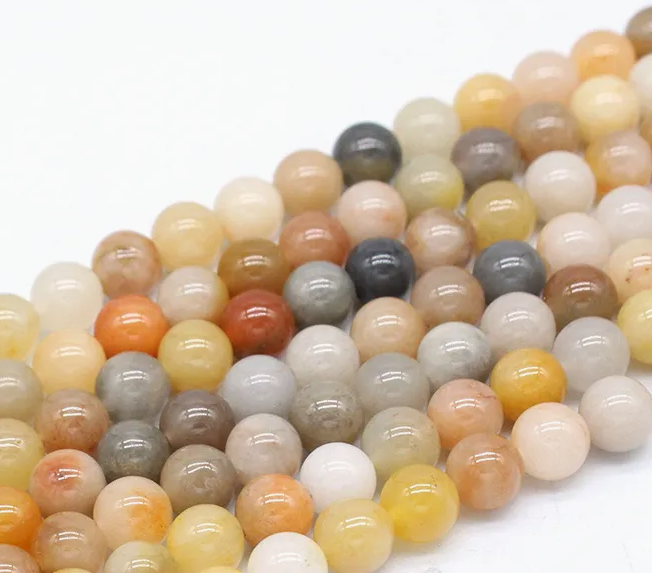
Jinsi Jade (金丝玉, Jīn Sī Yù) translates directly to “Golden Thread Jade” or “Gold Silk Jade.” Renowned for its silky internal texture and delicate, luminous bands that resemble spun filaments of gold, this gemstone has captured the attention of mineral collectors, lapidaries, and spiritual practitioners worldwide.
Historically revered in East Asia as an emblem of imperial dignity, prosperity, and spiritual refinement, the stone occupies a unique place in gemology. While traditional Chinese lapidary culture categorises it under the umbrella of ornamental jade (yù), modern mineralogical studies reveal it as an interplay of cryptocrystalline quartz, chalcedony, and tremolitic nephrite varieties coloured by iron oxide seams. Its warm, sunlit visual appeal and structural resilience make it a staple for talismanic carvings, wearable cabochons, and ceremonial objects.
Alternate Names
In mineralogical literature, trade markets, and historical records, Jinsi Jade appears under several monikers:
- Jin Si Yu / Jinsiyu: The standard Pinyin romanisation widely used across international trade.
- Golden Silk Jade / Gold Thread Jade: The literal English trade translation, referencing its fine, web-like fibrous inclusions.
- Xinjiang Golden Silk Jade: Designates primary origin material harvested from the Junggar Basin.
- Karamay Jade (克拉玛依玉): Named after the Karamay district of northern Xinjiang, adjacent to extensive Gobi Desert placer deposits.
- Gobi Coloured Jade (戈壁彩玉): A broad regional market term covering vibrant desert wind-eroded cryptocrystalline silicates from the ancient Silk Road corridors.
- Silk Thread Nephrite: Used selectively in the antique trade when referring specifically to tremolitic, amphibole-rich varieties bearing oriented gold-toned filaments.
The Stone’s Science and Composition
From a geological standpoint, materials traded as Jinsi Jade fall into two primary mineralogical groups, unified by their characteristic golden fibrous textures:
- Cryptocrystalline Silica/Chalcedony Complex: The vast majority of modern desert Jinsi Jade from the Gobi region is composed primarily of silicon dioxide ($\text{SiO}_2$). It consists of dense, interlocking microcrystalline quartz and fibrous chalcedony aggregates.
- Tremolite-Actinolite Solid Solution: Traditional and metamorphic varieties belong to the amphibole mineral group, formulated as $\text{Ca}_2(\text{Mg}, \text{Fe}^{2+})_5\text{Si}_8\text{O}_{22}(\text{OH})_2$. Here, the interlocking felted microstructure (nematoblastic texture) yields the legendary toughness characteristic of true nephrite.
The hallmark “golden threads” arise from secondary infiltration. Microscopic fissures and inter-crystalline boundaries are permeated by iron oxides and hydroxides—predominantly goethite, limonite, and fine haematite particles. Over geologic epochs, high-temperature fluid circulation and weathering oxidise these iron elements, preserving radiant, thread-like filament patterns suspended within the translucent host matrix.
Key Physical Characteristics
| Physical Property | Tremolite/Nephrite Variety | Cryptocrystalline Silica / Chalcedony Variety |
| Chemical Formula | $\text{Ca}_2(\text{Mg}, \text{Fe})_5\text{Si}_8\text{O}_{22}(\text{OH})_2$ | $\text{SiO}_2$ |
| Mohs Hardness | 6.0 – 6.5 | 6.5 – 7.0 |
| Crystal System | Monoclinic | Trigonal (Cryptocrystalline aggregate) |
| Specific Gravity | 2.90 – 3.05 | 2.58 – 2.65 |
| Refractive Index | 1.600 – 1.627 | 1.530 – 1.540 |
| Lustre | Greasy to sub-vitreous | Waxy, resinous, to vitreous |
| Tenacity | Exceptional (highly resistant to fracturing) | Tough to brittle |
| Transparency | Semi-translucent to opaque | Translucent to semi-opaque |
| Fracture | Splintery to uneven | Conchoidal to uneven |
Common Geologic Varieties
Jinsi Jade displays distinct aesthetic presentations based on base colour, distribution of inclusions, and degree of environmental polish:
- Mutton-Fat Golden Thread: A milky-white, highly translucent base shot through with hairline golden and saffron threads. This variety commands the highest valuation due to its resemblance to elite white nephrite.
- Imperial Yellow Jinsi: Saturated in honey-gold, amber, or rich tangerine tones throughout the matrix, with deeper golden-brown filament veins running parallel to the shear planes.
- Sunburst / Red Ribbon Jade: Features crimson and vermilion bands interspersed with yellow filaments, created by concentrated haematite integration.
- Desert Ventifact Jinsi (“Gobi Wind Jade”): Uncut nodules gathered from desert plains that have undergone centuries of natural sandblasting, resulting in a naturally polished, waxy exterior (“desert varnish”) that reveals interior golden fibres under direct light.
- Emerald-Gold Blend: Pale celadon to apple-green nephrite varieties that host contrasting warm golden ribbons, balancing both green and gold aesthetic profiles.
Global Mining and Volcanic Sources
The formation of Jinsi Jade is intimately tied to palaeo-volcanic hydrothermal activity followed by intense mechanical weathering.
- Xinjiang Uyghur Autonomous Region, China: The global epicentre of Jinsi Jade lies in northern Xinjiang, specifically spanning the Junggar Basin, the Karamay Gobi Desert, Urho, and the Altay mountain corridors. During the Late Paleozoic era, submarine volcanic eruptions and magmatic hydrothermal events deposited silica-rich fluids and tremolitic skarns into tectonic fracture zones. Millions of years of continental uplift, glacial shifts, and severe aeolian (wind-blown) erosion washed these fragments into desert plains and dry alluvial riverbeds.
- Secondary Domestic Localities: Related microcrystalline varieties and vein deposits have been recorded across Henan Province and peripheral mountain belts in Qinghai.
- International Occurrences: While Xinjiang accounts for the authentic commercial source, comparable chalcedonic and tremolitic materials exhibiting iron-stained dendritic or fibrous structures occur in the Kachin State of Myanmar, the Lake Baikal region of Russia, and scattered alluvial beds in Western Australia. However, these global occurrences are typically classified under local jasper or nephrite denominations rather than the historical Jinsi designation.
Crystal Pairings: What to Combine and Avoid
Understanding how Jinsi Jade interacts with other stones ensures harmonic vibrational resonance, whether for lapidary styling or energetic practices.
Optimal Crystal Pairings
- Pyrite: Known as “Fool’s Gold,” Pyrite’s metallic brass-yellow sheen and cubic matrix amplify Jinsi Jade’s natural golden filaments. Combining them unifies Solar Plexus stimulation with grounded manifestation.
- Clear Quartz: Acting as a master amplifier, Clear Quartz elevates the light-refracting quality of the golden threads, focusing intention and mental clarity.
- Citrine: A natural companion in colour and vibration, natural Citrine reinforces joy, abundance, and commercial success when paired with Jinsi Jade.
- Green Nephrite or Jadeite: Blending green jade with Jinsi Jade creates a classical Chinese dual-energy talisman, bridging the Heart and Solar Plexus chakras to balance emotional generosity with personal boundary-setting.
- Tiger’s Eye: The chatoyant bands of Tiger’s Eye complement the silky fibrous threads of Jinsi Jade, creating a potent grounding shield against negative external influences.
Crystal Pairings to Avoid
- Black Obsidian: The abrupt, razor-sharp energetic severance of volcanic Obsidian can overpower the gentle, nourishing, and slow-building frequency of Jinsi Jade.
- Moldavite: As a high-frequency tektite born of meteoric impact, Moldavite’s erratic, transformative energy frequently clashes with Jinsi Jade’s terrestrial, stabilising, and peaceful nature, leading to emotional disorientation.
- High-Hardness Abrasive Minerals (Physical Care): From a physical handling standpoint, avoid storing or mounting soft tremolitic Jinsi Jade alongside Corundum (Ruby and Sapphire, Mohs 9) or Diamond (Mohs 10), which will abrade its waxy polish.
Archaeology, Art and Ancient History
The cultural trajectory of Jinsi Jade is woven into the broader tapestry of Chinese lapidary civilisation. While nephrite use began along the Yangtze and Yellow River valleys during the Neolithic Liangzhu and Hongshan cultures (c. 5000–2000 BCE), ancient lapidaries regularly traded along northern routes through the Hexi Corridor into the western territories of Xinjiang.
Nodules of golden-threaded stones gathered from alluvial gravels were reserved for talismanic status symbols:
- Ritual Bi Discs and Cong Tubes: Archaeologists have uncovered ceremonial jade discs displaying distinct mineral banding, utilised by ancient rulers to mediate between Earth and Heaven (Tian).
- Han Dynasty Talismans: During the Han Dynasty (202 BCE – 220 CE), the formalisation of the Silk Road brought nomadic desert stones directly to the imperial capitals of Chang’an and Luoyang. Golden-threaded stones were carved into protective cicadas and burial shrouds, symbolising resurrection and incorruptibility.
- Qing Dynasty Resurgence: Under the Qianlong Emperor (1735–1796)—an ardent jade connoisseur—tribute jade from Xinjiang flowed steadily into the Forbidden City. Master carvers of the Imperial Workshops (Zaobanchu) utilised the contrasting golden veins of Jinsi Jade to execute qiaodiao (clever carving), transforming natural gold seams into dragons’ whiskers, sunbeams, or golden carp fins in intricate snuff bottles, brush washers, and hairpins.
Folklore, Legends and Sacred Tales
Centuries of desert trade across the Taklamakan and Junggar gave rise to rich mythological lore:
- The Breath of the Celestial Dragon: One popular northwestern legend tells of a golden celestial dragon charged with guarding the heavenly gates. During a war against chthonic shadow spirits, the dragon unleashed scorching golden breath across the Gobi to dispel the darkness. As the divine heat touched the cold desert stones, its golden light solidified within the rocks, forming the eternal threads of Jinsi Jade.
- The Compass of the Wandering Merchant: Silk Road caravaneers carried unworked pebbles of Jinsi Jade inside their silk pouches. Folklore held that the golden threads within the stone were microscopic arrows woven by earth spirits, capable of shifting light under the desert sun to guide stranded merchants safely out of sandstorms.
- The Elixir of Immortality: In Taoist alchemical philosophy, jade was viewed as the physical crystallisation of cosmic Yang energy. Ancient texts recorded that morning dew gathered from a carved Jinsi Jade cup could cleanse the organs, preserve youth, and harmonise the three treasures of life: Jing (essence), Qi (vital energy), and Shen (spirit).
Metaphysical and Mystical Healing Properties
In modern holistic and crystal healing disciplines, Jinsi Jade is regarded as a premier stone of solar alignment, resilience, and sovereign empowerment.
- Emotional Healing: The warm, woven appearance of the internal threads serves as a psychological anchor for individuals recovering from emotional trauma or chronic fatigue. It replaces stagnant grief with optimistic vitality, helping dissolve internal self-doubt.
- Abundance and Good Fortune: Rooted in its long-standing cultural association with gold, Jinsi Jade is used by practitioners as a wealth magnet. Rather than sudden luck, it encourages sustainable wealth creation by promoting self-discipline, clear decision-making, and strategic focus.
- Physical Vitality (Holistic Beliefs): Energy workers associate the stone with supporting the digestive tract, spleen, and adrenal system. Its soothing waxy texture makes it a favourite tool for facial Gua Sha and acupressure, thought to enhance lymphatic circulation and cool systemic inflammation.
Astrological Connections
Jinsi Jade shares profound astrological synergy with earth and water signs, balancing pragmatic structure with intuitive flow:
- Taurus (April 20 – May 20): Ruled by Venus, Taurus resonates with Jinsi Jade’s tangible luxury, tactile waxy finish, and earthy stability. The stone supports the Taurean desire for material security while tempering stubbornness with adaptability.
- Leo (July 23 – August 22): Ruled by the Sun, Leo aligns directly with the golden, radiant iron inclusions within the stone. Jinsi Jade anchors Leo’s natural leadership qualities, balancing ego-driven pride with wise, compassionate governance.
- Pisces (February 19 – March 20): For watery Pisces, who often struggles with energetic grounding, Jinsi Jade acts as a buoyant life-raft. Its dual composition of fluid-like golden patterns locked inside a durable silicate frame helps dreamers anchor creative visions into tangible reality.
The Chakra System
Jinsi Jade is uniquely configured to clear energetic channels between the foundational, active, and heart energy centres:
- Solar Plexus Chakra (Manipura): The primary energetic seat of Jinsi Jade. The bright golden seams resonate with the digestive fire (Agni), restoring confidence, personal autonomy, and personal power.
- Heart Chakra (Anahata): In pale green-and-gold varieties, the stone bridges the heart and the gut instinct, aligning one’s personal ambitions with empathy, generosity, and ethical integrity.
- Sacral Chakra (Svadhisthana): The warm amber, orange, and russet varieties stimulate creative expression, passionate drive, and emotional resilience.
Interesting Facts
- Natural Sandblasting: True Gobi Jinsi Jade is one of the few gemstones collected as complete, naturally polished geological ventifacts. Thousands of years of exposure to wind and high-velocity quartz sand in the desert leave many nodules with a soft, natural satin finish that requires no artificial tumbling.
- A Modern Gemological Gold Rush: While historically known along northern trade corridors, Jinsi Jade experienced a domestic market resurgence between 2005 and 2013 in China, with collectors scouring the Karamay deserts and dramatically driving up the value of top-grade pieces.
- The “Silk vs. Thread” Distinction: Jinsi Jade is frequently confused with “Silk Jade.” Silk Jade generally refers to marble-based or serpentine stones exhibiting broad, parallel chatoyant bands, whereas Jinsi Jade features delicate, non-uniform filaments of iron micro-inclusions set within chalcedonic quartz or nephrite.
- Ancient Thermal Properties: Owing to its dense crystalline aggregation, Jinsi Jade exhibits notable thermal inertia. It remains cool to the touch long after handling, which led ancient northern artisans to carve it into soothing eye stones, pillow blocks, and summer tea cups.
Modern Milestones: Birthstones and Anniversaries
While not listed on the standard Western modern birthstone chart established in 1912, Jinsi Jade has established key roles in contemporary artisanal fine jewellery:
- Zodiac Birthstone: Celebrated as an alternative May birthstone for Taurus and an August birthstone for Leo, bridging spring’s fertility with late summer’s solar radiance.
- The 12th Wedding Anniversary: While jade is traditionally given on the 12th wedding anniversary, Jinsi Jade offers a nuanced alternative to standard green nephrite. The interlaced golden threads are presented to symbolise the enduring, golden fabric of a marriage that has weathered life’s trials without breaking.
- The 35th Wedding Anniversary (The Jade Jubilee): Utilised as an accent stone alongside emeralds, Jinsi Jade carvings commemorate 35 continuous years of partnership, expressing wisdom, longevity, and mutual wealth.
Jinsi Jade Frequently Asked Questions
Is Jinsi Jade considered a “true jade”?
In classical gemology, “true jade” strictly refers to two distinct minerals: nephrite (an amphibole) and jadeite (a pyroxene). In Chinese gem culture, the term Yù (玉) e
ncompasses a broader aesthetic philosophy of “beautiful stones with virtue.” Commercial Jinsi Jade consists of two varieties: genuine tremolite nephrite with golden iron-rich inclusions, and cryptocrystalline quartz/chalcedony from the Gobi region. High-end gemological labs classify the latter as Golden Thread Quartz/Chalcedony, though it retains the cultural and trade designation of Jinsi Jade.
How can I identify genuine Jinsi Jade from treated or synthetic imitations?
- Thermal Feel: Genuine stone feels cool against the skin and takes noticeable time to warm up. Plastic imitations warm almost instantly.
- Internal Inclusions: Under a 10x jeweller’s loupe, authentic golden threads show natural irregularity, branching, and micro-particulate clusters of iron oxide. Synthetic resin or glass fakes often show air bubbles, uniform extruded wire designs, or dye pooling in external micro-cracks.
- Hardness Test: Jinsi Jade ranges between 6.0 and 7.0 on the Mohs scale; it easily scratches glass and cannot be scratched by an ordinary steel knife point.
How should I cleanse and physically care for Jinsi Jade?
Cleanse the stone with lukewarm water, mild chemical-free soap, and a soft microfibre cloth. Avoid ultrasonic cleaners, steam treatments, and harsh acidic or chemical cleaners, as these can strip its waxy surface finish or leach iron-bearing inclusions. Energetically, recharge it through gentle morning sunlight (avoid prolonged mid-day UV exposure to prevent fading), smoke smudging with cedar or sandalwood, or resting it atop a selenite charging plate.
Why does Jinsi Jade vary so dramatically in price?
Pricing is dictated by translucency, purity of colour, matrix texture, and the distribution of the golden threads. Muddy, highly fractured, or opaque stones collected en masse are affordable, while semi-translucent, “mutton-fat” white nodules bearing crisp, symmetrical, brightly saturated golden ribbons without internal structural fractures command premium collector prices.