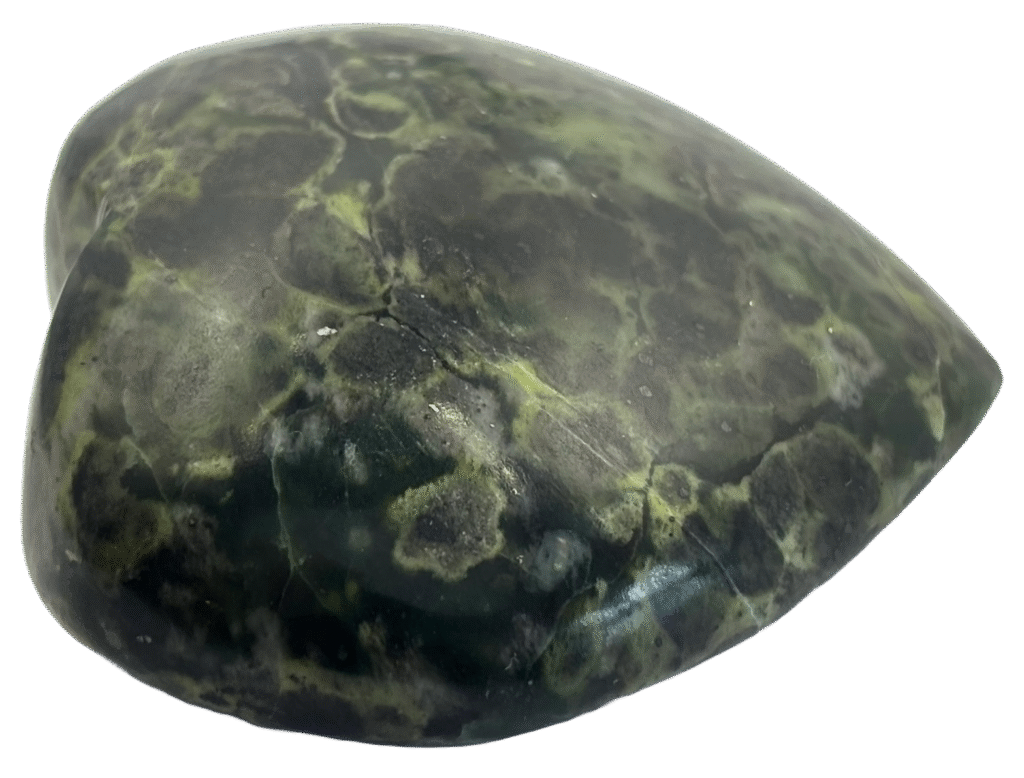
Kambaba Jasper is an exotic, dark olive-to-forest green stone characterised by swirling patterns and concentric orbicular markings resembling reptilian scales or gazing eyes. Revered across contemporary mineralogy and lapidary arts for its primordial aesthetic, the stone carries an aura of ancient earthen grounding.
While long marketed in the gemstone trade under the moniker “jasper,” modern petrological testing demonstrates that Kambaba Jasper is a volcanic or fossilised matrix rather than a simple microcrystalline chalcedony. It bridges deep geological history, volcanic transformations, and metaphysical lore into a single dense, tactile stone.
Alternate names
Throughout the gemstone and metaphysical trades, Kambaba Jasper is marketed under a variety of regional and descriptive names:
- Crocodile Jasper / Crocodile Rock: Named for its reptilian coloration, mottled olive tones, and concentric scales.
- Green Stromatolite Jasper: A commercial name derived from the trade theory that the orbicular structures represent fossilised microbial mats.
- Camba Jasper / Kambamba Stone: Phonetic spelling variations derived from Malagasy trading vernacular.
- Eldarite: A petrologically related dark volcanic rock often used interchangeably with Kambaba-type materials in trade circles.
The stones Science and Composition
From a scientific standpoint, Kambaba Jasper has been the subject of petrological debate. The trade historically branded it as a fossilised stromatolite—a biogenic sedimentary rock formed by layers of primordial cyanobacteria dating back over 3 billion years. While some stromatolitic jasper deposits do exist globally, modern mineralogical and spectroscopic analyses of standard commercial Madagascar Kambaba Jasper reveal a volcanic origin:
- Petrological Classification: Kambaba Jasper is predominantly a devitrified, orbicular volcanic rock (often categorised as a rhyolitic or volcanic tuff matrix).
- Mineral Composition: The primary matrix consists of microcrystalline Quartz and fine-grained alkali Feldspar (notably Albite), along with Cristobalite.
- The Dark Orbs and Green Groundmass: The characteristic concentric eyes and dark swirls are composed of sodic amphiboles (such as riebeckite or arfvedsonite) and aegirine pyroxene aggregates, rather than preserved cellular biological walls.
- Chemical Family: Silicate matrix dominated by $\text{SiO}_2$ with intergrown sodium, iron, and aluminium silicate minerals.
Key Physical Characteristics
| Property | Measurement / Characteristic |
| Chemical Formula | $\text{SiO}_2$ (Quartz matrix) + $(\text{Na, Fe, Al})$-silicate mineral phases |
| Mohs Hardness | 6.5 – 7.0 (durable for lapidary work and cabochons) |
| Crystal System | Trigonal (microcrystalline quartz matrix) / Monoclinic aggregates |
| Lustre | Vitreous to dull; takes a high, glossy waxy polish |
| Transparency | Completely opaque |
| Specific Gravity | 2.60 – 2.75 (varies slightly with amphibole concentration) |
| Fracture | Conchoidal to uneven |
| Colour Spectrum | Deep olive green, forest green, grey-green, with midnight-black orbs |
Common Geologic Varieties
While standard Madagascar Kambaba exhibits olive-green and black eye-like structures, several related materials are frequently compared or conflated with it:
- Madagascar Orbicular Kambaba: The benchmark variety, displaying defined spherical rosettes and swirling deep moss tones.
- Eldarite (Nebula Stone comparisons): A similar dark green-to-black igneous rock featuring lighter green to yellow circular inclusions of quartz, anorthoclase, riebeckite, and aegirine.
- True Chert/Stromatolitic Jasper: True sedimentary cyanobacterial fossils (such as those from the Pilbara Craton in Australia or the Barberton Greenstone Belt), which typically feature planar, wavy laminar banding rather than isolated concentric spherical orbs.
Global Mining and Volcanic Sources
- Madagascar (Bongolava Region): The primary commercial source of authentic Kambaba Jasper. It occurs within localised volcanic and metamorphic belts in the central-western plateaus.
- South Africa: Sources older Precambrian banded iron and fossil formations, occasionally yielding related green microcrystalline silica stones.
- India & Brazil: Minor occurrences of green orbicular jasper-like rocks and patterned silicified tuffs are recovered in regional silica quarries, though true Kambaba remains almost entirely endemic to Madagascar.
Crystal Pairings: What to Combine and Avoid
Combining stones in energy work relies on harmonising elemental correspondences, mineral hardness, and vibrational intent. Because Kambaba Jasper is a heavy, slow-releasing Earth-element stone, companion choices dictate whether energy is anchored or scattered.
Optimal Crystal Pairings
- Black Tourmaline or Smoky Quartz: Amplifies root chakra grounding, creating an anchored shield against psychic strain or environmental overstimulation.
- Malachite: Pairs with Kambaba’s heart-chakra frequencies to encourage deep emotional clearing, cellular renewal, and resilience during life transitions.
- Moss Agate or Tree Agate: Synthesises botanical and nature-based energies, making this pairing effective for gardening, grounding, and earth meditation.
- Clear Quartz: Acts as an amplifier to sharpen the slower, dense vibrational pulse of Kambaba Jasper.
Crystal Pairings to Avoid
- High-Frequency Crown/Cosmic Stones (e.g., Moldavite, Phenakite): The rapid, ungrounded transformational surge of high-vibration tektites can clash with Kambaba’s slow, anchored resonance, potentially causing mental fog or energetic restlessness.
- Overly Aggressive Fire Stones (e.g., Fiery Carnelian, High-Grade Realgar): Intense, outward-directed kinetic fire energy conflicts with Kambaba’s introspective, calming equilibrium.
- Fragile Carbonates (Physical care): Avoid storing or tumbling Kambaba Jasper (Mohs 6.5–7) with soft minerals like Selenite (Mohs 2) or Calcite (Mohs 3), which scratch easily upon contact.
Archaeology, Art and Ancient History
Stromatolites and green siliceous minerals hold an enduring place in human material culture:
- Lapidary Artifacts: Ancient cultures throughout Africa and the Mediterranean prized opaque green stones for cylinder seals, amulets, and beads, associating the deep hue of fertile flora with survival and longevity.
- Carving Medium: Because Kambaba Jasper takes a durable polish without easily cleaving, modern and historic Malagasy artisans have carved it into ceremonial animal fetishes, spheres, and ornamental bowls.
- The “Cheitharol Kambaba” Distinction: Popular folklore attempts to connect the stone to the Cheitharol Kumbaba (the royal chronicle of Manipur, India). However, this is an etymological coincidence; the gemstone was commercially named in late-20th-century trade, whereas the Manipuri court chronicle is an ancient literary text with no geological connection to the African stone.
Folklore, Legends and Sacred Tales
- The Guardian of Primordial Waters: Myth holders describe Kambaba as an energetic bridge to Earth’s earliest aquatic biospheres, believed to hold the resonance of the planet’s primeval waters.
- The Warrior’s Respite: Regional tales credit the stone with restoring emotional equilibrium to returning hunters or warriors, absorbing the residue of conflict and renewing clarity.
- The Crocodile Totem: Rooted in its trade title “Crocodile Jasper,” Malagasy mythos attributes to the stone the stealth, patience, and unyielding evolutionary adaptability of the Nile crocodile.
Metaphysical and Mystical Healing Properties
- Emotional Equilibrium: Kambaba Jasper is widely utilised by holistic practitioners to soothe lingering grief, temper catastrophic thinking, and ground overactive nervous systems.
- Cellular Regeneration Support: Metaphysically associated with cyclic renewal, practitioners use the stone during convalescence to symbolically encourage physical stamina.
- Environmental Connection: Known as a premier “Stone of Gaia,” it is often placed in plant beds, gardens, and terrariums to balance ambient environmental frequencies.
Astrological Connections
- Taurus: The quintessential Earth sign aligns naturally with Kambaba’s steady, unyielding, nature-based vibration, supporting Taurean desires for security and calm perseverance.
- Scorpio & Pisces: Resonates with water signs by steadying intense emotional depths and transmuting turbulent feelings into grounded inner strength.
- Capricorn: Complements Capricorn’s discipline and ambition, providing a grounding buffer against burnout and occupational exhaustion.
- Planetary Rulers: Earth (anchoring, material stability) and Saturn (longevity, structure, enduring patience).
The Chakra System
Kambaba Jasper serves as a dual-action conduit, linking primal survival centres directly to higher emotional nodes:
- Root Chakra (Muladhara): Situated at the base of the spine, the root chakra governs safety, physical stability, and foundational survival. Kambaba clears blockages related to dread, instability, and alienation by firmly rooting individual awareness into the physical present.
- Heart Chakra (Anahata): The deep green shades resonate with the heart centre. Unlike higher-frequency pink heart stones that focus on romantic or ethereal love, Kambaba fosters primal compassion, self-forgiveness, and resilience after deep emotional betrayal.
Interesting facts
- Not a True Jasper: Technically, Kambaba is a devitrified volcanic rock containing amphiboles and quartz, rather than a classic microcrystalline sedimentary jasper.
- Oxygen Pioneers: Whether interpreted petrologically as fossilised or volcanic, the stone’s trade lore remains tied to cyanobacteria—the microscopic organisms responsible for the Great Oxidation Event ~2.4 billion years ago.
- Natural Optical Illusion: When cut and polished into spheres, the concentric orbs appear to track onlookers, earning them the nickname “the eyes of the earth.”
Modern Milestones: Birthstones and Anniversaries
- Alternative Birthstone: Kambaba Jasper serves as an untraditional alternative birthstone for March (representing the thawing and re-greening of the earth) and October (aligning with autumn grounding).
- Anniversary Association: Informally gifted on the 8th or 10th wedding anniversary as a symbol of deep-rooted endurance, patience, and unbreakable commitments.
Extensive FAQ Section
Is Kambaba Jasper safe to put in drinking water for crystal elixirs?
No. Because Kambaba Jasper contains amphibole inclusions (which may include iron and trace fibrous silicates like riebeckite), it should never be placed directly into drinking water. Always use the indirect method (placing the dry stone inside a glass container suspended within the water).
How can I clean and cleanse my Kambaba Jasper?
Clean it physically using lukewarm water, mild dish soap, and a soft microfibre cloth. Avoid harsh acids, ultrasonic cleaners, or steam. For energetic cleansing, smudge with dried botanicals, place on a bed of raw brown rice, or set on a charging plate of Selenite.
How do I distinguish Kambaba Jasper from Nebula Stone or Malachite?
Malachite is a copper carbonate that displays distinct parallel bands of bright emerald to mint green, effervesces in mild acids, and is far softer (Mohs 3.5–4.0). Nebula Stone is typically blacker with luminous apple-green orbicular flecks. Kambaba features an earthy, deep olive-green background with matte-to-vitreous black spherical eyes and a Mohs hardness of 6.5–7.0.
Can Kambaba Jasper go in the sun or salt water?
Short sun exposure is safe, but prolonged direct UV light can dull its dark matrix over time. Avoid prolonged submersion in salt water, as mineral salts can settle into micro-fissures and damage the polish.