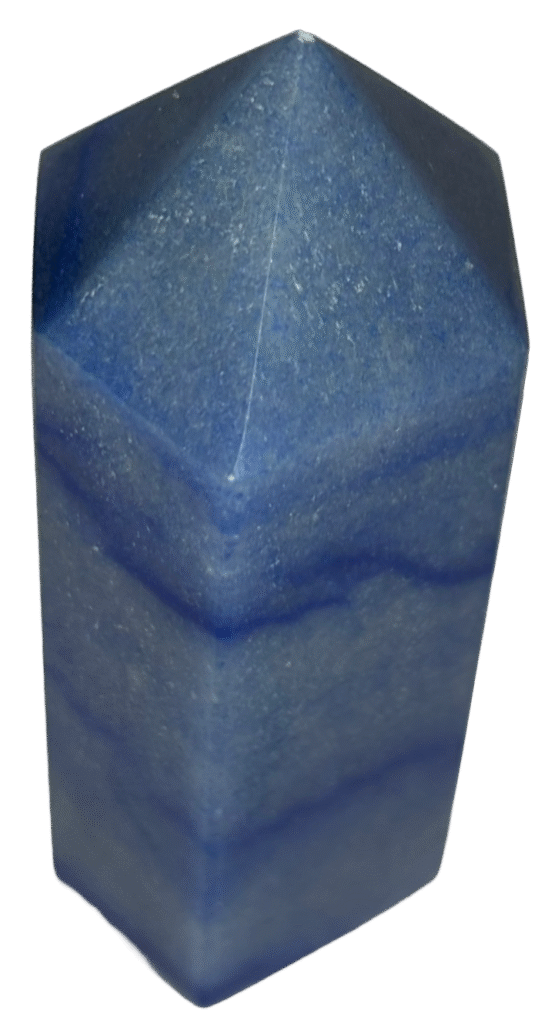
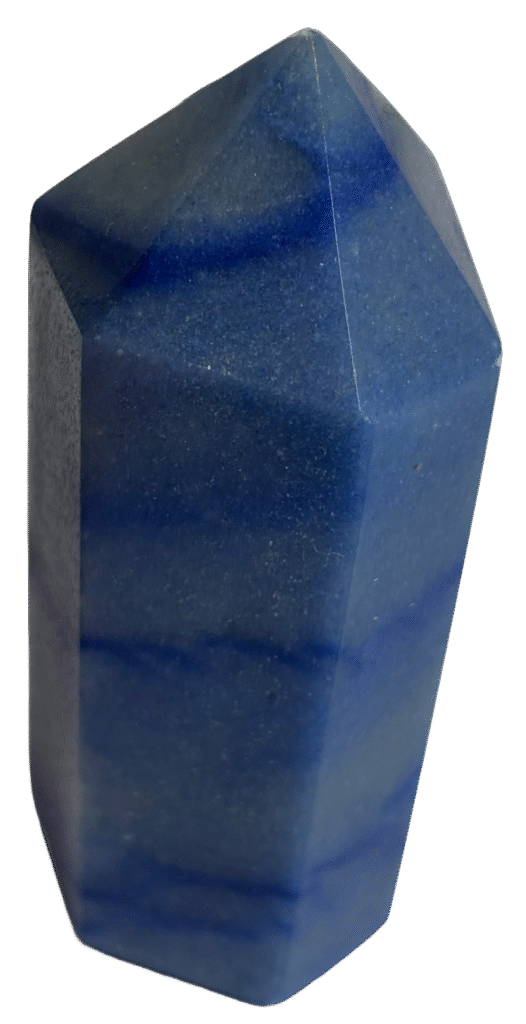
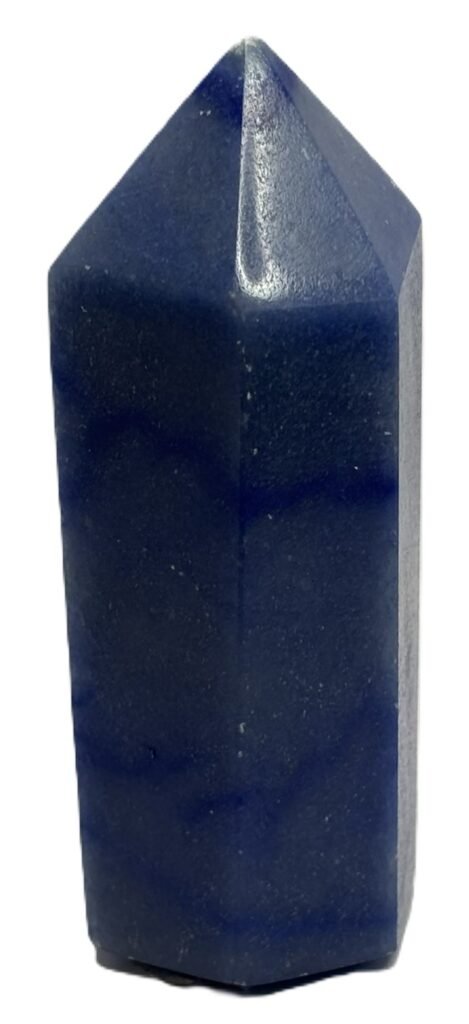
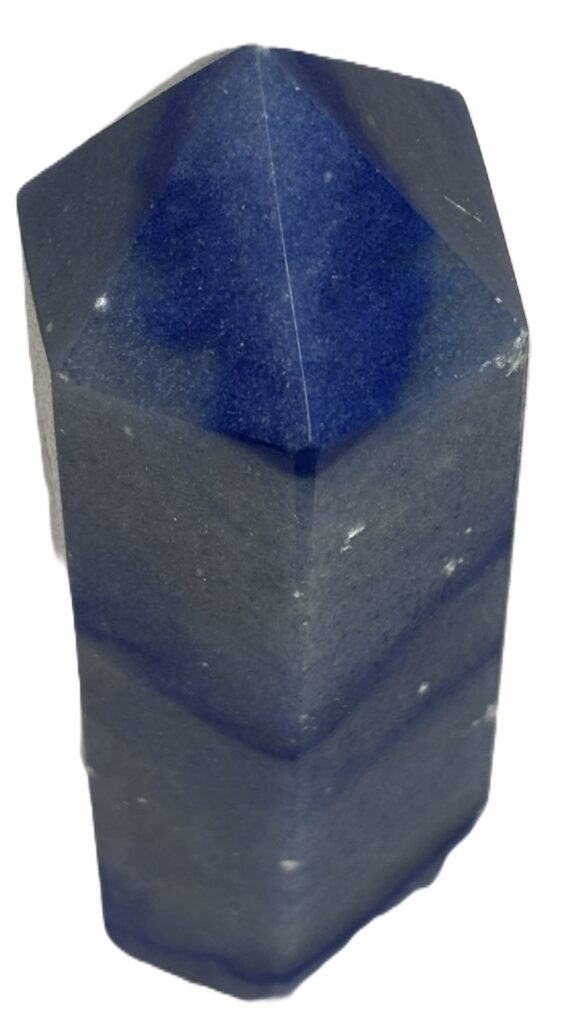
Dumortierite is a striking, aluminium borosilicate mineral celebrated for its deep blue to violet hues, fibrous crystalline structure, and versatile history. Highly valued in industrial settings for its exceptional thermal resistance in high-tech ceramics, it is equally cherished by collectors and lapidaries for its smooth, silky lustre when polished. Known metaphysically as the “Stone of Order,” dumortierite is believed to dramatically enhance mental clarity, cognitive discipline, and self-expression. This comprehensive guide explores the fascinating intersection of its rigid geologic science, profound archaeological history, astrological connections, and strategic crystal pairings for modern energetic practices.
Alternate names
In gemological, industrial, and spiritual circles, dumortierite has acquired several descriptive synonyms:
- Blue Fibre / Blue Denim Stone: References its common, deep indigo-blue colouration combined with a visually apparent fibrous growth pattern.
- Fibre Stone: Highlights its characteristic aggregate mass structure composed of tightly packed, interlocking fibrous crystals.
- The Stone of Order: A widely recognised metaphysical moniker celebrating its purported ability to organise chaotic thoughts and instil intellectual discipline.
The stones Science and Composition
Dumortierite is a sophisticated heavy-mineral borosilicate with the official chemical formula $\text{Al}_7\text{BO}_3(\text{SiO}_4)_3\text{O}_3$. Geologically, it forms as an accessory mineral within aluminium rich regional or contact metamorphic rocks, such as pelitic schists and gneisses, as well as within boron-bearing pegmatites.
The mineral crystallises within the orthorhombic crystal system. While it occasionally develops as distinct, prismatic crystals, it is far more commonly discovered as massive, compact, or columnar aggregates featuring fine, needle-like fibrous structures. The striking blue-to-violet colouration that defines its most popular specimens is caused by trace elements of iron ($\text{Fe}$) and titanium ($\text{Ti}$) substituting for aluminium within the crystal matrix.
Key Physical Characteristics
To successfully identify authentic dumortierite and differentiate it from similar minerals like sodalite or lapis lazuli, pay close attention to its primary physical profiles:
- Mohs Hardness: 7.0 to 8.5. This makes it exceptionally durable, scratching glass easily and proving far harder than sodalite (5.5–6) or lapis lazuli (5–5.5).
- Lustre: Vitreous (glass-like) to dull or silky when present in compact fibrous masses.
- Diapaneity: Opaque to semi-translucent; thin edges of high-quality specimens frequently let soft light pass through.
- Specific Gravity: 3.26 to 3.41, giving it a dense, substantial feel in the hand.
- Pleochroism: Exceptionally strong. When rotated under polarised light, a single crystal can shift dramatically from deep blue to reddish-violet or colourless.
Common Geologic Varieties
While classic blue dumortierite dominates the commercial market, regional geochemistry introduces highly sought-after structural and tonal variations:
- Dumortierite Quartz: A spectacular lapidary variety where needle-like inclusions of bright blue dumortierite grow inside clear crystalline quartz. This produces an aesthetic effect resembling frozen blue fireworks or underwater coral reefs.
- Pink/Violet Dumortierite: A rarer variant rich in manganese ($\text{Mn}$) impurities, creating soft pastel pinks, deep magentas, and rich violets rather than traditional blues.
- Desert Dumortierite: Often mixed with intergrown quartz and feldspar matrix, yielding a mottled, denim-like appearance with swirled grey, brown, and cream accents.
Global Mining and Volcanic Sources
Dumortierite is extracted from metamorphic zones across several major global repositories:
- Minas Gerais, Brazil: Renowned for producing massive, premium-grade dumortierite quartz clusters coveted by international collectors.
- Maharashtra and Karnataka, India: Yields dense, highly uniform, deep indigo-blue specimens that are ideal for fine carvings, spheres, and cabochons.
- Nevada and California, USA: Historically significant deposits mined extensively for industrial-grade ceramics, as well as producing unique blue-grey lapidary materials.
- Madagascar: A prolific modern source supplying both the rich violet-blue massive forms and fine-quality manganese-rich pink varieties.
- France: The original type locality where the mineral was structurally analysed and formalised near the Lyon region.
Crystal Pairings: What to Combine and Avoid
Optimal Crystal Pairings
- Clear Quartz: Because Clear Quartz is the ultimate energetic amplifier, combining it with dumortierite supercharges mental focus and sharpens intentional manifestation goals.
- Selenite: Placing your dumortierite on a Selenite charging plate helps sweep away stagnant mental fog, keeping the stone’s communicative energy clean, elevated, and unburdened.
- Sodalite or Lapis Lazuli: Pairing dumortierite with fellow throat-chakra stones creates a powerful resonance for public speakers, writers, and students, dynamically enhancing both the organisation of thought and the eloquence of vocal delivery.
Crystal Pairings to Avoid
- Black Tourmaline or Shungite: While these dense, carbon- and iron-rich stones are elite defensive shields for grounding or blocking EMF radiation, their heavy, down-to-earth energetic profile can sometimes smother or restrict the high-vibrational, intellectually expansive mental flow of dumortierite.
- Copal or Amber: Organic, unrefined resins possess an incredibly low Mohs hardness (2–2.5) and a warm, instinctual, solar-plexus energy that physically and energetically clashes with the cold, rigid, intellectual geometry of durable dumortierite.
Archaeology, Art and Ancient History
Though officially categorised by modern science in the late 19th century, archaeological investigations reveal that ancient artisans recognised this resilient blue stone. In pre-Columbian Mesoamerica and parts of ancient Asia, naturally occurring dumortierite aggregates were occasionally misidentified as high-grade lapis lazuli or turquoise and worked into intricate decorative inlays, small amulets, and ceremonial objects.
In modern industrial history, dumortierite played a pivotal role during the mid-20th century. Due to its remarkable ability to withstand extreme thermal shock without expanding, it was mined extensively to produce the high-grade porcelain formulations required for spark plug insulators, laboratory crucibles, and specialised electrical linings.
Folklore, Legends and Sacred Tales
Across various cultural lore systems, blue stones have long been regarded as physical fragments of the celestial heavens dropped to Earth. Legends surrounding dumortierite state that it was an underground ally to ancient scholars, hermits, and mystics. Tales whisper that keeping a piece of “fibre stone” in a study room or sacred space allowed active thinkers to receive continuous cosmic insights, preventing mental fatigue during long hours of translation or scriptural contemplation. It was viewed as an energetic anchor that tethered flying, abstract thoughts into organised, actionable reality.
Metaphysical and Mystical Healing Properties
Within the framework of modern holistic crystal healing, dumortierite is revered as an unmatched tool for cognitive discipline, patience, and emotional equilibrium. Practitioners utilise its stabilising energetic signature to help individuals break free from patterns of panic, chronic stress, or hyper-reactivity. It is said to cool fiery tempers, dismantle stubborn ego blocks, and foster a state of calm determination. By introducing an energetic sense of internal order, it assists professionals, creatives, and students in overcoming procrastination, mastering complex new subjects, and executing disorganised projects with systematic precision.
Astrological Connections
Astrologically, dumortierite resonates powerfully with the Air Signs (Gemini and Aquarius) and the analytical Earth Sign (Virgo):
- Gemini & Aquarius: The stone acts as an energetic filter for these signs’ naturally rapid, highly intellectual, and sometimes scattered thought processes. It helps stabilise mercurial minds and structure visionary, futuristic concepts into coherent plans.
- Virgo: Dumortierite perfectly complements Virgo’s intrinsic love for order, deep analysis, and organisational structure, providing a soothing influence that tempers Virgo’s tendency toward perfectionist anxiety.
The Chakra System
Dumortierite operates primarily across two foundational upper energy centres:
- The Throat Chakra (Vishuddha): By aligning this zone, the stone assists the user in verbalising internal truths clearly, logically, and without raw emotional distortion. It bridges the gap between intellect and expression.
- The Third Eye Chakra (Ajna): The deep blue vibrations stimulate latent intuition, mental visualisation, and spiritual insight. It allows the practitioner to see underlying patterns in their life experiences, cultivating deep psychic clarity and strategic foresight.
Interesting facts
- Naming Honours: The mineral was officially named in 1881 by French mineralogist François Ernest Mallard in honour of the legendary 19th-century Belgian palaeontologist Eugène Dumortier.
- A Unique Spark: When crushed into a fine powder and heated, dumortierite permanently converts into mullite ($\text{Al}_6\text{Si}_2\text{O}_{13}$), a material highly prized in the manufacturing of space-shuttle thermal tiles.
- The Look-Alike: Dumortierite is frequently used as a durable, budget-friendly stimulant or alternative for rare lapis lazuli, though it completely lacks the golden pyrite inclusions characteristic of authentic lapis.
Modern Milestones: Birthstones and Anniversaries
While dumortierite does not reside on the traditional, commercial monthly birthstone charts, it has emerged as a beloved modern planetary birthstone alternative for those born under the signs of Virgo and Gemini during May, June, and September.
Q1: How can I visually tell the difference between Dumortierite, Sodalite, and Lapis Lazuli?
The easiest method is examining hardness and inclusions. Dumortierite is significantly harder (Mohs 7–8.5) and will easily scratch a copper penny or glass plate, whereas sodalite (5.5) will not. Visually, Lapis Lazuli almost always features glittering golden flecks of pyrite and white calcite veins. Sodalite typically features distinct, swirled white calcite streaks and possesses a slightly greasy lustre. Dumortierite has a much more uniform, fibrous, or denim-like appearance with a silky to vitreous lustre.
How can I visually tell the difference between Dumortierite, Sodalite, and Lapis Lazuli?
The easiest method is examining hardness and inclusions. Dumortierite is significantly harder (Mohs 7–8.5) and will easily scratch a copper penny or glass plate, whereas sodalite (5.5) will not. Visually, Lapis Lazuli almost always features glittering golden flecks of pyrite and white calcite veins. Sodalite typically features distinct, swirled white calcite streaks and possesses a slightly greasy lustre. Dumortierite has a much more uniform, fibrous, or denim-like appearance with a silky to vitreous lustre.
Is Dumortierite safe to cleanse in water?
Yes. Because dumortierite boasts a high Mohs hardness of 7 to 8.5 and is chemically stable, it is entirely water-safe. It will not dissolve, crack, or release dangerous compounds in plain water. You can safely physically clean your specimen using warm, soapy water and a soft micro fibre cloth. Avoid industrial acids or abrasive scrub brushes that could mar a high lapidary polish.
Can I leave my Dumortierite crystal out in direct sunlight
You should exercise caution regarding extended exposure. While raw, high-grade dumortierite is highly structurally resilient against heat, prolonged exposure to intense, concentrated UV rays over many months near a window can slowly dull its rich titanium-iron blue or violet colouration. Furthermore, if your specimen is a Dumortierite Quartz cluster or sphere, the transparent quartz can act as a powerful magnifying glass, focusing solar rays into a dangerous heat beam that poses a legitimate household fire hazard. Always display transparent spheres away from direct, hot window sills.
How should I energetically cleanse and recharge this stone?
To clear away accumulated stagnant energies, you can pass your dumortierite through the smoke of sacred herbs like sage, cedar, or dried lavender. Alternatively, you can leave it out under the gentle light of a full moon overnight or place it directly on a raw Selenite charging plate for a few hours to safely reset its vibrational field.
Why is my Dumortierite showing brown or grey patches
This is a completely natural geologic occurrence. Massive dumortierite aggregates frequently grow alongside or engulf neighbouring minerals during metamorphic activity. The brown, grey, or cream patches are typically safe inclusions of quartz, feldspar, mica, or iron oxides native to the specific host rock environment where the crystal formed millions of years ago. These variations add unique character and prove the raw authenticity of the gemstone.
These are my personally selected and curated Dumortierite products
Products by Category