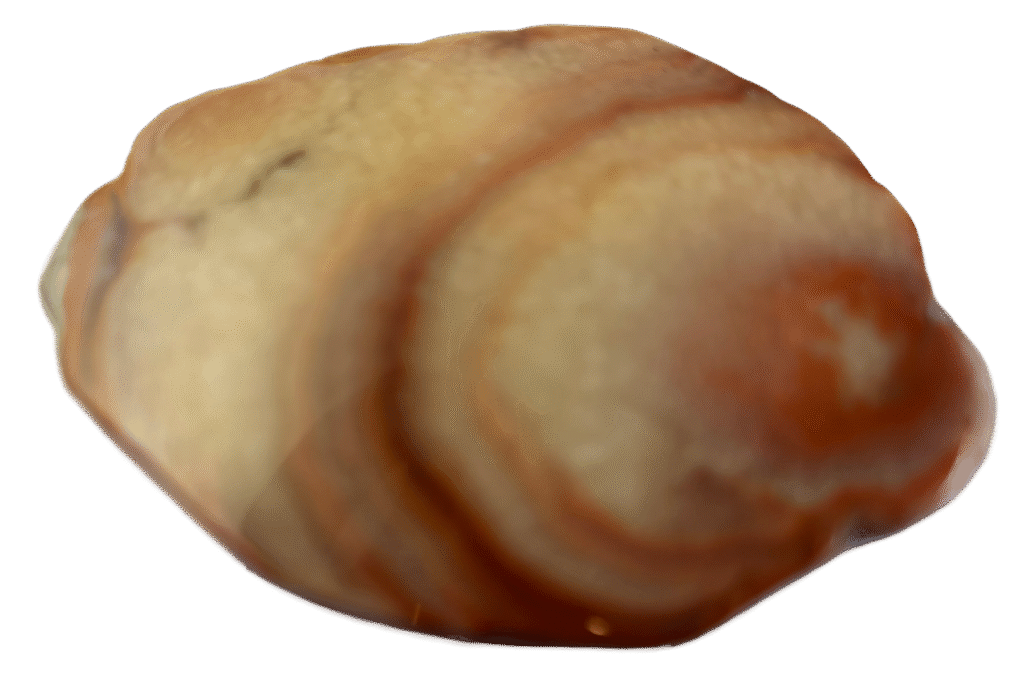
Dulcote Agate is a highly coveted, ultra-rare variety of microcrystalline quartz natively found in Somerset, England. Famous for its exquisite, layered bands that naturally mirror the rolling hills of the British countryside, this gemstone is widely celebrated by collectors as English Landscape Agate. Formed within ancient volcanic cavities, it balances lasting physical durability with a profound geological history. Historically extracted from the now-silent Dulcote Quarry, this finite British treasure is highly sought after by lapidaries and crystal practitioners alike, serving as a powerful metaphysical tool for grounding, emotional equilibrium, and enduring spiritual stability.
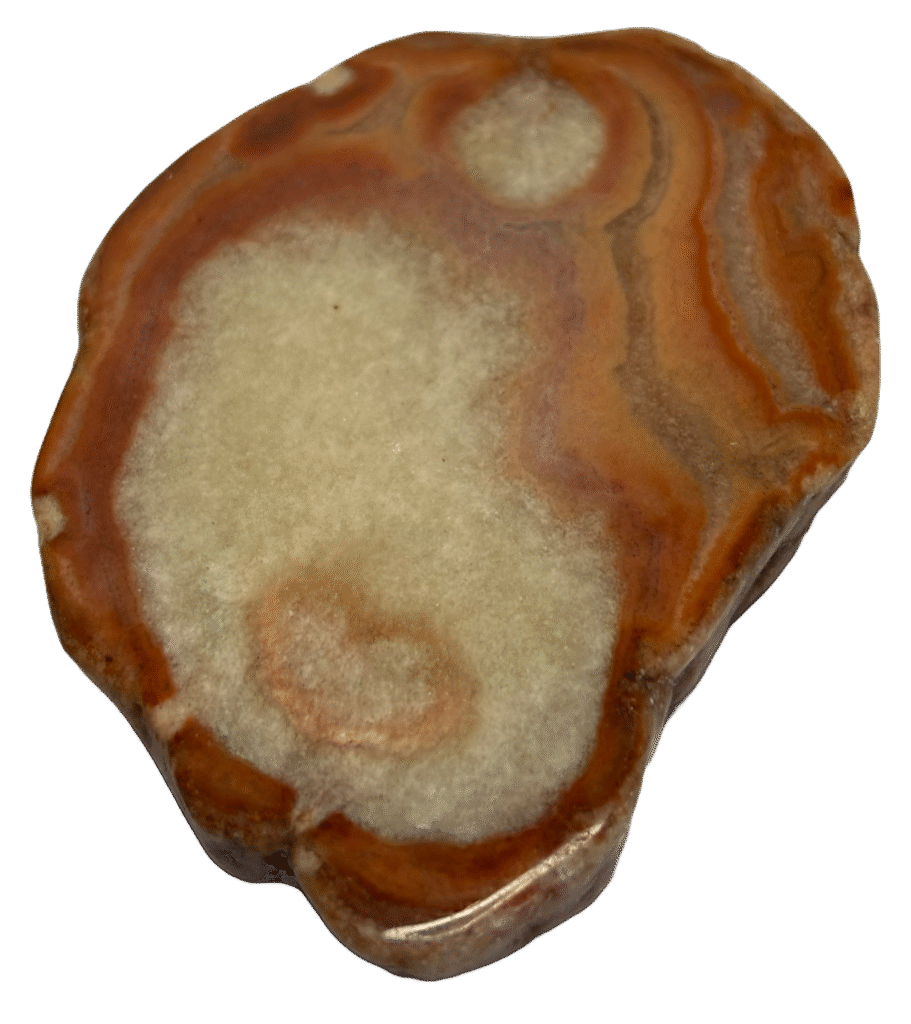
Alternate names
Throughout its history in lapidary circles, geology groups, and metaphysical communities, Dulcote Agate has been identified by several descriptive monikers, including:
- Somerset Agate: A regional geographic name highlighting its exclusive origin in the Mendip Hills.
- English Landscape Agate: A collector’s term inspired by internal patterns that dramatically mimic scenic countryside vistas, valleys, and horizons.
- Dulcote Stone / Potato Stone: Historically, rough geodes and nodules extracted from the local limestone strata were colloquially referred to by miners as “potato stones” due to their unremarkable, lumpy outer appearances before being cracked open to reveal the gemstone interior.
The stones Science and Composition
Geologically, Dulcote Agate is classified as a microcrystalline variety of Chalcedony, which is a sub-category of the Quartz family. Structurally, it is composed primarily of Silicon Dioxide ($SiO_2$).
The stone developed millions of years ago during the Triassic period. Hydrothermal, silica-rich fluids percolated through the cavities and fissures of the local Carboniferous Limestone strata at Dulcote Hill. As these fluids cooled over vast geological spans, they precipitated out microscopic quartz crystals layer by layer, starting from the outer walls of the rock cavities and working inward.
The signature colouration of Dulcote Agate is determined by trace mineral inclusions present during its formation. The rich, deep brick-reds, ochres, and warm chocolate browns are the direct result of iron oxide (haematite and goethite) variations within the silica solution. The alternating milk-white, cream, and soft grey bands represent periods of pure silica deposition devoid of heavy mineral staining.
Key Physical Characteristics
To successfully identify authentic Dulcote Agate from other global agates, collectors evaluate several distinct physical and mineralogical properties:
- Chemical Formula: $SiO_2$ (Silicon Dioxide) with Iron Oxide inclusions.
- Crystal System: Trigonal / Microcrystalline (no visible external crystal faces in the chalcedony bands).
- Mohs Hardness Scale: 6.5 to 7. This makes it structurally resilient, resistant to scratching, and highly capable of taking a mirror-like polish.
- Lustre: Waxy to vitreous when cut and polished; dull and earthy in its raw state.
- Diaphaneity: Translucent to opaque. The lighter bands often let soft light pass through, while the heavily iron-stained dark bands remain completely opaque.
- Fracture: Conchoidal, typical of quartz minerals, breaking with smooth, curved surfaces.
Common Geologic Varieties
While every single nodule sliced open reveals an entirely unique natural artwork, Dulcote Agate typically displays three primary geological expressions:
- Classic Dulcote Agate: Recognised by bold, contrasting bands of deep brick-red, dark chocolate brown, and translucent cream layers.
- Grey-Banded Dulcote: A more muted, highly elegant variety presenting complex concentric rings of ash-grey, dove-grey, and off-white chalcedony.
- Iron-Rich Dulcote Agate: Specimens that feature sweeping, un-banded plumes or solid patches of rich, vibrant red jasper-like material interspersed with crystalline quartz pockets.
Global Mining and Volcanic Sources
Unlike commercially abundant agates sourced from Brazil, Madagascar, or India, Dulcote Agate features an exceptionally localised geographic footprint.
Its sole primary source is the Dulcote Quarry, situated at Dulcote Hill near Wells in Somerset, England. For generations, this site was actively quarried for limestone, which continuously brought these prized agate-bearing nodules to the surface.
However, commercial quarrying operations at Dulcote have entirely ceased, and the site has been closed and repurposed. Because the primary volcanic and hydrothermal deposits are no longer actively excavated, Dulcote Agate is finite and officially considered a extinct mining classic. Today, new specimens are never mined at scale; instead, pieces must be carefully sourced from historic lapidary collections, estate sales, or through rare, authorised field-walking along historic riverbeds and scree slopes in the immediate Mendip Hills area.
Crystal Pairings: What to Combine and Avoid
Optimal Crystal Pairings
When integrating Dulcote Agate into energy grids or jewellery layouts, it synergises best with stones that mirror its grounding frequency or gently elevate its creative undertones:
- Smoky Quartz: As a fellow silicate mineral with a dense, grounding energy profile, Smoky Quartz anchors the protective qualities of Dulcote Agate, creating an impenetrable shield against negative environmental energies.
- Carnelian: The fiery, iron-driven vitality of Carnelian beautifully complements the rich red haematite inclusions within Dulcote Agate. Together, they act as a catalyst for passion, physical stamina, and artistic manifestation.
- Tiger’s Eye: This golden-brown chatoyant stone works hand-in-hand with Dulcote Agate to reinforce personal boundaries, promote clear decision-making, and instils steady, quiet confidence.
Crystal Pairings to Avoid
Because Dulcote Agate possesses an intense, slow, and highly stabilising earth frequency, it can conflict with stones that possess excessively volatile or ethereal properties:
- Selenite: Selenite operates on a high-vibrational, cosmic, and rapidly moving frequency. Combining it directly with Dulcote Agate can create an energetic disconnect, dulling the focused grounding strength of the agate while muddying the pristine clarity of the Selenite.
- Blue Kyanite: Known for its immediate alignment of the upper chakras and its soaring, high-frequency energetic pathways, Blue Kyanite’s vibrations can scatter the concentrated, stabilising, and practical earth-bound focus that Dulcote Agate provides.
Archaeology, Art and Ancient History
During the height of the British lapidary movement in the 18th and 19th centuries, Dulcote Agate was highly prized by local English artisans. When sliced thinly, its striking “landscape patterns” were celebrated as natural marvels.
Wealthy aristocrats commissioned lapidary workshops to cut the stone into highly polished decorative cabochons, ornamental snuff boxes, paperweights, and intricate cameos. Fine examples of these historic Somerset Agate carvings are preserved today in regional British museums and private mineral cabinets, serving as testament to the historical craftsmanship of England’s early gem cutters.
Folklore, Legends and Sacred Tales
Local legends surrounding the Mendip Hills have long associated Dulcote Agate with the deep spirits of the British soil. Ancient folklore tells that the stone absorbs the literal history and quiet wisdom of the landscape over millions of years.
Early travellers through Somerset carried raw “potato stones” in their pockets as talismans of protection. It was believed that the stone could anchor a traveller’s equilibrium, ensuring they would never lose their footing on slick hill trails or become disoriented in dense evening mists. Furthermore, it was viewed as a stone of agricultural harmony, buried by early farmers in the corners of fields to bless the soil with stability and protect crops from seasonal blight.
Metaphysical and Mystical Healing Properties
In modern crystal healing circles, Dulcote Agate is revered as an ultimate anchor for the emotional body. Its slow, steady vibrational resonance provides deep comfort during periods of intense life transitions, grief, or stress.
- Emotional Equilibrium: It assists in neutralising erratic, anxious thoughts by pulling scattered energy back down into a calm centre, acting as an emotional ballast.
- Mental Fortitude: By encouraging objective, pragmatic thinking, it helps individuals cut through illusions and approach complex problems with a patient, structured mindset.
- Energetic Protection: The iron-dense red bands create an organic energetic filter within the aura, quietly deflecting ambient negativity and chaotic environmental influences.
Astrological Connections
Dulcote Agate holds a powerful affinity with the Earth signs of the zodiac, seamlessly matching their practical, enduring, and grounded characteristics:
- Taurus: It directly enhances the Taurean desire for security, comfort, and a deep connection to the natural world, while mitigating the sign’s tendency toward rigid stubbornness by introducing smooth emotional flow.
- Virgo: It quiets the overactive, analytical Virgo mind, turning frantic mental processing into clear, organized, and tranquil productivity.
- Capricorn: It bolsters Capricorn’s relentless drive, providing the deep physical endurance and emotional perseverance required to scale their metaphorical mountains and achieve long-term goals.
The Chakra System
Dulcote Agate is a multi-chakra gemstone that works systematically to establish an unbroken line of personal security:
- The Root Chakra (Muladhara): Located at the base of the spine, this is the primary energetic home of Dulcote Agate. The stone stimulates this center, dissolving survival-based fears, promoting a feeling of absolute safety, and keeping the user firmly anchored to the nurturing energy of the earth.
- The Sacral Chakra (Svadhisthana): The warm, iron-rich orange and red bands extend their influence upward into the pelvic region. Here, Dulcote Agate stimulates latent creativity, balances emotional expressions, and helps heal blockages tied to personal vitality and passion.
Interesting facts
- A Rare Native Gem: While the UK has abundant deposits of minerals like fluorite and baryte, true banded landscape agate is extremely rare on the island, making Dulcote Agate one of England’s few native agate icons.
- Geode Surprises: Raw Dulcote Agate nodules often form as hollow geodes; when cracked open, the inner bands of red and grey chalcedony are frequently topped with a sparkling layer of tiny, glittering clear quartz or amethyst druzy crystals.
- Collector Premium: Because the exact locality is permanently closed to commercial mining, the market value of pristine, well-banded Dulcote Agate has steadily risen, making it a premier investment stone for global mineral collectors.
Modern Milestones: Birthstones and Anniversaries
- Alternative Birthstone: While not a traditional modern birthstone, Dulcote Agate serves as an elite, deeply customised spiritual birthstone for individuals born under the Earth signs of Taurus and Capricorn.
- 22nd Wedding Anniversary: Dulcote Agate is highly celebrated as a meaningful gemstone gift for the 22nd year of marriage. Just as the stone takes millions of years to patiently form its beautiful, resilient layers under intense geological pressure, a 22-year marriage represents enduring strength, unbreakable bonding, and a beautifully structured life built together.
Dulcote agate Frequently Asked Questions
Is Dulcote Agate water-safe?
Yes, Dulcote Agate is completely safe to clean in water. Ranking at a 6.5 to 7 on the Mohs scale, it is a non-porous silicate mineral that will not dissolve, crack, or release any harmful chemicals when exposed to plain water. You can safely physically clean it using warm water, a drop of mild dish soap, and a soft microfibre cloth to remove dust and oils. However, avoid exposing it to extreme thermal shock (moving it rapidly from ice water to boiling water), which can cause microscopic fractures within any quartz mineral.
Why is it called “Landscape Agate” if it doesn’t contain actual fossilised plants?
The term “Landscape Agate” is purely visual and descriptive. It does not mean the stone contains fossilised moss, trees, or ancient plant matter. Instead, it refers to the uncanny, artistic way the concentric, undulating bands of red iron oxide, cream chalcedony, and grey quartz naturally settle within the rock cavities. When the stone is sliced into flat slabs, these lines create a natural optical illusion that perfectly resembles rolling horizons, valleys, mountain ridges, and misty skies.
How can I tell real Dulcote Agate apart from standard dyed agate imports?
Real Dulcote Agate features very specific, organic colour gradients—predominantly brick-red, chocolate brown, soft ash-grey, and cream. The colours transition smoothly and organically. The vast majority of cheap “bright red” or “neon pink” agates found in commercial souvenir shops are mass-produced imports (often from Brazil) that have been artificially boiled in chemical dyes. If an agate looks unnaturally neon, features dye concentrated heavily inside its tiny outer cracks, or feels suspiciously cheap, it is artificially dyed. True Dulcote Agate will always possess an earthy, sophisticated British colour profile.
Can I leave my Dulcote Agate out in direct sunlight?
You should exercise mild caution with long-term display. While the core silicate structure of chalcedony is incredibly resilient against standard daylight, extended exposure to highly concentrated, intense UV rays over several consecutive years can cause the rich, dark iron oxide inclusions to slowly dull or take on a slightly muted, dry appearance. Furthermore, if your Dulcote Agate nodule contains an open geode centre filled with transparent, clear quartz crystals, it should never be placed on a sunny window sill. The clear crystal points can act as a powerful magnifying glass, focusing solar rays into a dangerous heat beam that poses a legitimate domestic fire hazard.
How do I energetically cleanse and charge my Dulcote Agate?
Because Dulcote Agate is structurally durable, it can be cleansed using almost any traditional method. To remove stagnant energy, you can rinse it under cool running natural water for a few minutes, pass it through the cleansing smoke of sacred herbs like sage or cedar, or bury it in the dry earth of a potted plant or garden overnight to let it reconnect with its foundational element. To recharge its energy field, place it under the direct light of a full moon, or let it rest on a Selenite charging plate for several hours.
These are my personally selected and curated Dulcote agate products
Products by Category

Dulcote Agate slice C
£10.00
Dulcote Agate slice DAA
£24.50Dulcote Agate slice DAB
£24.50
Dulcote Agate slice G
£20.00