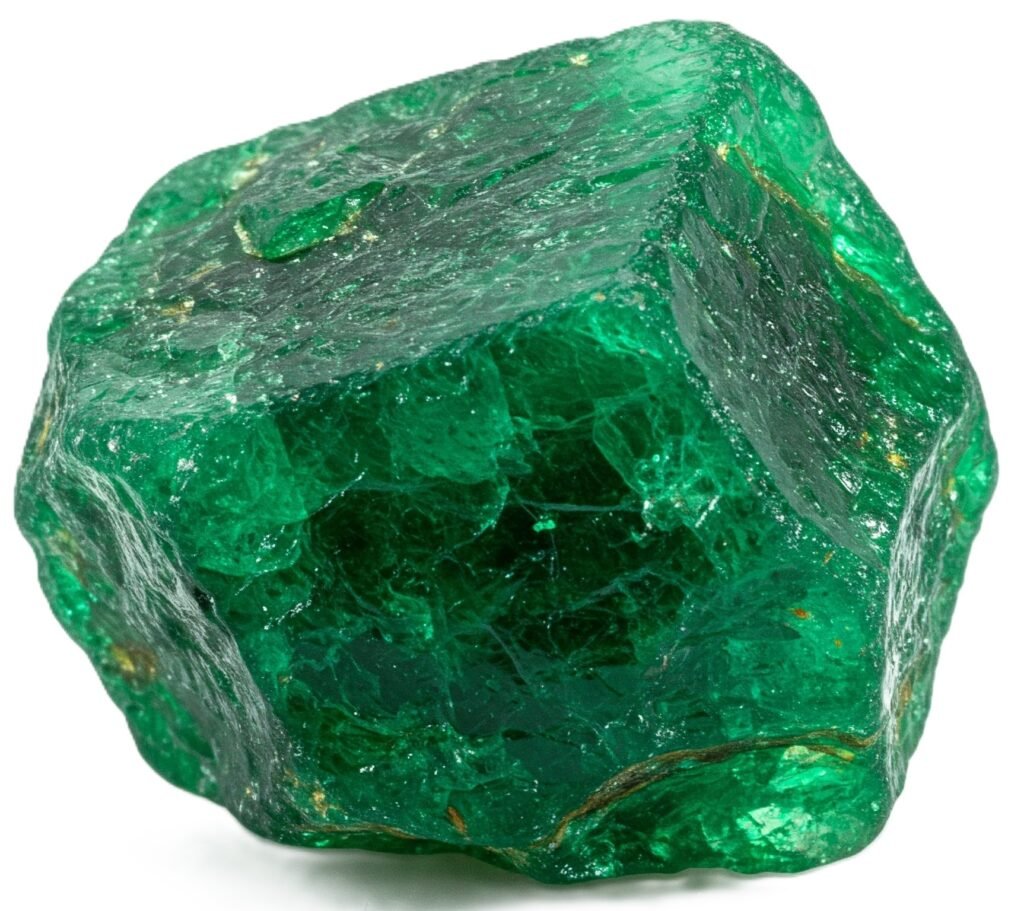
Emerald is a premier, highly coveted gemstone renowned for its unparalleled, vivid green hue and deep historical pedigree. As a precious variety of the mineral beryl, this mesmerising crystal has captured the human imagination for millennia, serving as an ultimate symbol of rebirth, fertility, and divine foresight. Treasured by ancient royalty, revered in diverse mythological traditions, and championed by modern crystal healing practitioners, emerald is much more than a luxury status symbol. This comprehensive guide explores the fascinating physical properties, geological origins, sacred lore, and metaphysical dynamics of this legendary “Stone of Successful Love.”
Alternate Names
Throughout history and across different linguistic and cultural traditions, emerald has been known by several distinct names:
- Smaragdos – The ancient Greek term translating directly to “green gem,” which laid the etymological foundation for the stone’s modern name.
- Smaragdus – The classical Latin adaptation of the Greek name.
- Esmeraude – The Old French variant from which the English word “emerald” eventually evolved.
- Marakata – The ancient Sanskrit name used in Vedic texts, meaning “the green growing thing” or “the gemstone of spring.”
- The Stone of Successful Love – A popular modern metaphysical moniker highlighting its capacity to nurture domestic bliss, loyalty, and heart centred harmony.
The Stones’ Science and Composition
At the atomic and chemical level, emerald is a beryllium aluminium silicate mineral with the chemical formula:
$$\text{Be}_3\text{Al}_2\text{Si}_6\text{O}_{18}$$
It is the most prestigious member of the silicate-based beryl family, which also includes aquamarine, morganite, and heliodor. While pure beryl is entirely colourless, emeralds obtain their signature green colour from trace amounts of chromium ($\text{Cr}^{3+}$) and vanadium ($\text{V}^{3+}$) replacing aluminium atoms in the crystal lattice.
If the trace iron content is high, the emerald’s green can become more opaque or yellowish; however, the most prized specimens maintain a delicate balance where low iron concentrations allow a highly saturated, vibrant bluish-green colour to emerge. Emeralds typically grow in hydrothermal veins or pegmatitic environments where beryllium-rich fluids escape from granitic magmas and interact with surrounding chromium-bearing metamorphic rocks (such as schists or shales).
Key Physical Characteristics
- Mohs Hardness: 7.5 to 8. While emerald is highly scratch-resistant on paper, its real-world durability is compromised by a characteristic called “toughness” (resistance to chipping and breaking).
- Fracture & Cleavage: It exhibits an uneven to conchoidal fracture and poor (imperfect) basal cleavage.
- Fragility and Inclusions: Natural emeralds are notorious for carrying complex internal liquid, gas, and mineral fractures known collectively as jardin (French for “garden”). These inclusions create structural weak points, making natural emeralds brittle and prone to chipping or cracking if subjected to sudden impacts.
- Transparency: Ranges from transparent to translucent.
- Luster: Vitreous (glass-like) when polished.
- The “Emerald Cut”: Because of the stone’s high internal stress and structural fragility, lapidaries developed the specialised “emerald cut”—a rectangular step-cut with truncated (bevelled) corners. This design minimises mechanical stress during the cutting process, protects the vulnerable corners, and maximises the deep saturation of the green colour.
Common Geologic Varieties
While emerald is itself a variety of beryl, gemologists categorise these stones based on their physical traits, unique inclusions, and optical phenomena:
- Classic Colombian Emeralds: Universally regarded as the gold standard, these stones are famous for their warm, intensely saturated, pure “grassy” green colour, often containing distinctive three-phase inclusions (cavities filled with a liquid, a gas bubble, and a tiny rock salt crystal).
- Trapiche Emeralds: An incredibly rare and highly prized variety found almost exclusively in Colombia. These stones showcase a wheel-like pattern of six black carbon spoke-like arms radiating from a central hexagonal core, caused by shale impurities trapped during growth.
- Brazilian Emeralds: Typically lighter green or displaying a slightly yellowish-green hue, often featuring fewer internal inclusions and higher clarity.
- Zambian Emeralds: Notable for their exceptional clarity and deep, rich green hues with a distinct bluish undertone, resulting from a slightly higher iron content in the mineral matrix.
Global Mining and Volcanic Sources
Rather than being concentrated in a single volcanic zone, emerald deposits are scattered globally, forming under unique regional metamorphic and hydrothermal conditions:
- Colombia: The undisputed epicentre of high-quality emeralds. The world’s most famous historic mines;’ Muzo, Chivor, Coscuez, and the high-altitude mines of Gachalá—produce stones of unparalleled saturation and clarity.
- Zambia: Located in the Kafubu area, Zambian mines are renowned for yielding deeply saturated, bluish-green emeralds that command premium prices due to their excellent clarity.
- Brazil: Significant deposits in the states of Bahia and Minas Gerais supply a consistent volume of beautiful, bright, and highly transparent jewellery grade specimens.
- Zimbabwe: The ancient Sandawana mines yield small but extraordinarily intense, deep-green emerald crystals.
- Afghanistan and Pakistan: The rugged Panjshir Valley (Afghanistan) and Swat Valley (Pakistan) yield exceptional, high-grade emeralds from deep metamorphic deposits within the Himalayan foothills.
Crystal Pairings: What to Combine and Avoid
Optimal Crystal Pairings
Emerald’s high-vibrational, heart centred energy can be beautifully amplified or directed when paired with complementary stones:
- Rose Quartz: Combining Emerald with Rose Quartz creates the ultimate heart chakra synergy. While Rose Quartz fosters gentle self-love and emotional healing, Emerald introduces a vibrant wave of abundance, domestic harmony, and long-term loyalty, making this pair ideal for attracting and maintaining deep relationships.
- Clear Quartz: As the “Master Healer,” Clear Quartz acts as a natural amplifier. Placing a Clear Quartz point facing towards an emerald will magnify its green ray, intensifying your capacity for mental clarity, wisdom, and manifestation.
- Selenite (or Satin Spar): Since emerald absorbs emotional debris during deep healing work, placing it on a Selenite charging plate safely purifies its energetic field without exposing its delicate, fracture-filled structure to physical hazards like coarse salt.
Crystal Pairings to Avoid
- Black Tourmaline or Obsidian: These are highly dense, ultra-grounding stones designed to pull energy down toward the root chakra to deflect negativity. Pairing them with the light, elevating, heart centred expansion of Emerald can create a clashing, “frenetic” energetic signature. This can leave you feeling split between feeling anchored and wanting to spiritually soar, diluting the unique focus of both stones.
- Haematite: Much like Obsidian, the high-iron grounding force of Haematite can stifle the gentle emotional flow and intellectual expansion that Emerald naturally encourages.
Archaeology, Art and Ancient History
Emeralds have held an esteemed place in human archaeology and art for thousands of years:
- The Ptolemaic Kingdom & Cleopatra: The first known emerald mines were located in Egypt, dating from at least 330 BC. No historical figure is more famously intertwined with this gem than Queen Cleopatra. She claimed personal ownership of all Egyptian emerald mines, using these vibrant green crystals to adorn her royal regalia, decorate her palace, and present as lavish diplomatic gifts to foreign dignitaries to assert her supreme wealth and divine authority.
- The Roman Empire: High-ranking Roman nobility wore emeralds as coveted symbols of fertility, status, and foresight. Pliny the Elder famously documented that Roman gem cutters would rest their eyes by looking at emeralds after long hours of tedious work, as the soothing green color relieved optical strain.
- Mogul India: During the Mughal era, royals carved sacred Islamic prayers and ornate floral patterns directly into massive emeralds. These pieces, such as the famous Mughal Emerald (weighing 217.80 carats), were worn as sacred protective talismans.
- The New World: Centuries before Spanish conquistadors arrived in South America, indigenous civilizations, including the Incas, utilized emeralds in religious ceremonies and high-status jewelry. In New Granada (modern-day Colombia), indigenous populations burned offerings of emeralds to their sun and moon gods, believing that deities must enjoy looking upon these magnificent green treasures as much as mortals did.
Folklore, Legends and Sacred Tales
Over the centuries, countless mystical beliefs and myths have grown around the emerald:
- The Visionary Stone & The Serpent’s Sight: In medieval European folklore, placing a raw emerald under one’s tongue was believed to grant the wearer the power of prophecy and the ability to foresee future events. Additionally, a bizarre legend written as early as 1242 claimed that a snake could not look upon an authentic emerald without instantly losing its eyesight.
- King Solomon’s Rings of Power: According to biblical legend, emerald was one of the four precious stones given by God to King Solomon. These four stones were said to have endowed the legendary king with absolute power over all of creation.
- The Emerald Tablets of Thoth: In the realms of alchemy, the highly secretive hermetic teachings and oldest secrets of the universe were said to have been carved directly onto a massive, singular slab of emerald—the legendary Emerald Tablet.
- Muisca and Muzo Mythology: The indigenous Muzo people of Colombia explained the creation of their local emerald mines through the tragic legend of Fura and Tena, the first woman and man created by the god Are. After Fura broke their vow of fidelity, Tena died of a broken heart. Fura’s centuries of weeping over her husband’s body moved the god to turn her tears of deep sorrow into mountains of solid green emeralds.
- Revealer of Truths: In medieval times, emeralds were believed to cut through illusions and spells. It was said that an emerald would change color, fade, or even shatter if a lover’s vow of fidelity was false.
Metaphysical and Mystical Healing Properties
To modern crystal healers and metaphysical practitioners, Emerald is the “Stone of Successful Love.” It is celebrated for its profound ability to bring positive energy and balance to all areas of one’s life:
- Emotional Harmony: Emerald acts as an emotional stabiliser. It clears away heavy, stagnant blockages, calms the mind, and heals old emotional wounds, allowing the user to experience unconditional love and self-compassion.
- Mental Clarity and Memory: Historically utilised by ancient physicians to sharpen the mind, modern practitioners still use emerald to improve focus, strengthen the memory, and encourage eloquent, honest communication.
- Manifestation and Abundance: By aligning the heart’s desires with the frequency of natural growth, emerald acts as a powerful magnet for financial prosperity, luck, and domestic abundance.
Astrological Connections
- Zodiac Signs: Emerald is primarily aligned with Taurus (representing stability, natural abundance, and Venusian beauty) and Gemini (representing intellect, communication, and adaptability).
- Ruling Planet: In both Western and Vedic astrology, Emerald is ruled by Mercury, the celestial messenger of intellect, wit, and trade. Wearing an emerald is believed to enhance eloquence, sharpen commercial acumen, and bring immense financial prosperity to those with a strong Mercurial placement.
The Chakra System
Emerald resonates directly with the Heart Chakra (Anahata), located at the centre of the chest.
- The Green Ray: Its brilliant green colour acts as a direct infusion of life-force energy (Prana) into the heart space.
- Relationship Harmony: By opening and clearing the heart chakra, Emerald encourages relationship harmony, heals trust issues, and helps align the heart’s emotional desires with the mind’s logical wisdom.
- Healing Grid Tip: To clear away heavy, tech-induced anxiety or emotional stress, lie down and place an Emerald specimen directly over your sternum, visualizing a soothing green light expanding to fill your entire aura.
Here is a simple table representing the chakra alignment from your code:
| Chakra | Colour | Associated Crystals & Notes |
| Crown Chakra | Purple / White | Clear Quartz / Selenite |
| Heart Chakra | Green | Emerald (Compassion, Unconditional Love) |
| Root Chakra | Black / Red | Tourmaline / Haematite (Keep Separated!) |
Interesting Facts
- The Bahia Emerald: Weighing an astonishing 752 pounds (341 kg), this massive, raw rock cluster is one of the largest single emerald specimens ever unearthed, extracted from Bahia, Brazil.
- The Gachalá Emerald: Discovered in 1967 in Gachalá, Colombia, this magnificent uncut crystal weighs 858 carats (approximately 172 grams). It was donated to the Smithsonian Institution in 1969 by the legendary New York jeweller Harry Winston, where it remains on public display today.
- The Mughal Emerald: Dating back to 1695, this 217.80-carat rectangular gemstone is engraved with sacred Shi’a prayers on one side and delicate poppy carvings on the other, representing an exquisite fusion of historic art and gemology.
- Carat-for-Carat Volume: Because emerald has a lower density than diamond, a one-carat emerald will actually appear physically larger to the eye than a one-carat diamond.
Modern Milestones: Birthstones and Anniversaries
- The Month of May: Reflecting the lush, vibrant growth of spring, emerald is the official traditional and modern birthstone for the month of May.
- Milestone Anniversaries: Emerald is the designated celebratory gemstone gifted on the twentieth (20th) and thirty-fifth (35th) wedding anniversaries, serving as an enduring symbol of loyalty, devotion, and successful love.
Emerald Frequently Asked Questions (FAQ)
Why are natural emeralds almost always treated with oil?
Because natural emeralds grow under intense metamorphic pressure, nearly 90% or more contain microscopic fissures and internal fractures. To improve their clarity and protect their structural integrity, the jewellery trade widely accepts the practice of bathing emeralds in natural cedarwood oil or clear resins. These liquids seep into the microscopic surface fractures, making the inclusions less visible and enhancing the gemstone’s overall color and shine.
Can I clean my emerald specimen in an ultrasonic jewellery cleaner?
Absolutely not. You must never place an emerald in an ultrasonic or steam jewellery cleaner. The high-frequency vibrations and hot steam will strip away the protective oils and resins from the stone’s internal fractures. This can cause the emerald to instantly cloud over, lose its vibrant colour, or even shatter along its natural fracture lines.
How should I physically clean and energetically cleanse my emerald?
- Physical Cleaning: Wash your emerald gently using only lukewarm water and a single drop of mild dish soap. Use a very soft microfibre cloth or an ultra-soft toothbrush to wipe away dust, and dry it immediately. Avoid harsh chemical cleaners or abrasive brushes.
- Energetic Cleansing: Because emeralds can absorb emotional energies, they require regular resetting. To avoid physical damage, do not submerge them in saltwater. Instead, pass your emerald through the smoke of sacred herbs like sage or cedar, or place it on a Selenite charging plate overnight.
Is it safe to leave my emerald crystal in direct sunlight?
While short periods of daylight will not fade the natural chromium-based green of an emerald, you should avoid displaying transparent emerald points or spheres in direct, intense sunlight near a window. Like all transparent crystals, a rounded emerald can act as a powerful magnifying glass, focusing hot solar rays into a concentrated heat beam that poses a legitimate household fire hazard.
Can I wear an emerald ring every day?
Yes, but with caution. Because emerald has a Mohs hardness of 7.5 to 8, it resists everyday dust scratches easily. However, due to its low toughness and abundant internal inclusions, it can chip or crack easily if knocked against a hard surface like a counter top or door frame. For daily wear, it is highly recommended to set emeralds in protective bezel or low-profile jewellery settings rather than high, exposed prongs.
There are my personally selected and curated Emerald products