
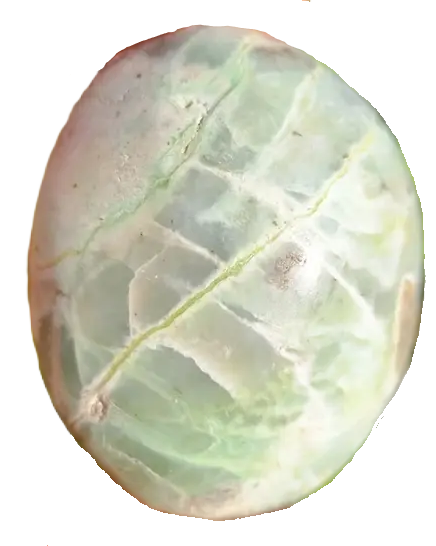
Green Moonstone is an enchanting variety of potassium feldspar celebrated for its pale mint to deep olive hues and its ethereal internal glow. Unlike traditional white or blue moonstones, this gem marries the watery, reflective mystery of lunar energy with the grounded vitality of the Earth. Its signature visual shimmer, known scientifically as adularescence, creates a soft light that appears to glide across the surface as the gem turns. Balancing emotional equilibrium with intuitive clarity, Green Moonstone is prized by mineral collectors, artisanal jewellers, and crystal practitioners as a stone of renewal and calm.
Alternate Names
Green Moonstone is known by several commercial, trade, and mineralogical labels:
- Green Adularia: Named after the Adula Mountains in Switzerland, referencing its high-grade orthoclase structure.
- Green Feldspar: A broad mineralogical descriptor denoting its place in the feldspar mineral family.
- Garnierite in Moonstone / Green Orthoclase: Often used when nickel-bearing serpentine inclusions give the feldspar matrix its vivid mint or lime colouration.
- New Moon Stone: A metaphysical trade moniker highlighting its symbolic resonance with new beginnings, planting seeds, and cyclical renewal.
The Stone’s Science and Composition
Green Moonstone belongs to the feldspar mineral group—the most abundant rock-forming mineral group in the Earth’s crust. It is primarily an orthoclase feldspar composed of potassium aluminium silicate:
$$\text{KAlSi}_3\text{O}_8$$
The stone’s signature optical phenomenon adularescence originates deep within its microcrystalline architecture. As magma cools slowly at depth, two distinct feldspar species (potassium rich orthoclase and sodium rich albite) unmix and segregate into alternating, microscopic planar layers (lamellae).
When ambient light strikes these sub-microscopic layers, it scatters via interference and diffraction (often termed Rayleigh scattering). This scatters the shorter wavelengths of light, producing a rolling, billowy sheen that appears suspended within the stone. In Green Moonstone, trace minerals—predominantly iron silicates or microscopic inclusions of nickel-bearing phyllosilicates (such as garnierite) infuse the host matrix with soft celadon, mint, or rich mossy hues.
Key Physical Characteristics
| Property | Value / Description |
| Chemical Formula | $\text{KAlSi}_3\text{O}_8$ (Potassium Aluminium Silicate) |
| Crystal System | Monoclinic |
| Mohs Hardness | 6.0 – 6.5 |
| Lustre | Vitreous to pearly on cleavage planes |
| Transparency | Semi-translucent to opaque |
| Refractive Index | 1.518 – 1.526 |
| Birefringence | 0.005 – 0.008 |
| Specific Gravity | 2.56 – 2.60 |
| Cleavage | Perfect in two directions intersecting at approximately 90° |
| Fracture | Conchoidal to uneven; brittle |
| Optical Phenomenon | Adularescence (surface sheen), rarely chatoyancy (cat’s-eye effect) |
Common Geologic Varieties
- Mint Adularia Moonstone: Highly translucent with thin, refined lamellae producing a silvery-white or pale blue adularescent flash across a pale sea foam ground.
- Garnierite-Rich Moonstone: Characterised by swirling patterns of sage, olive, or vibrant pistachio green, caused by intergrowths of nickel silicate serpentine.
- Cat’s-Eye Green Moonstone: When needle-like inclusions align parallel to the crystal c-axis, skilled lapidaries cut the cabochon to display chatoyancy—a distinct line of light slicing across the green dome.
- Green Peach / Multi colour Moonstone: Zoned crystals showing banded layers of pale chlorite-tinted green alongside oxidised, iron-tinted peach or champagne feldspar.
Global Mining and Volcanic Sources
Green Moonstone forms primarily inside granitic pegmatites, syenites, and hydrothermal veins where cooling rates allow lamellar unmixing:
- Sri Lanka (Meetiyagoda): The historic global epicentre for gem-grade adularia. Yields exceptionally translucent pale green specimens with delicate, floating sheen.
- India (Southern States / Tamil Nadu): The primary source of rich, earthy green and olive moonstone varieties, frequently showing high density and distinct colour zoning.
- Madagascar: Renowned for producing pastel-green to garnierite-heavy feldspar rough characterised by complex mineral matrix intergrowths.
- Myanmar (Burma – Mogok Stone Tract): Yields rare, high-clarity green orthoclase displaying fine adularescence.
- Australia & Brazil: Smaller pegmatitic deposits yielding collector-grade cabochon rough with unique structural inclusions.
Crystal Pairings: What to Combine and Avoid
Combining crystals involves balancing energetic intensity, elemental associations, and underlying mineral vibration.
Optimal Crystal Pairings
- Rose Quartz: Unites the heart-centred frequencies of unconditional love with Green Moonstone’s emotional balance, softening emotional trauma.
- Amethyst: Connects the Heart with the Third Eye and Crown chakras, enhancing intuitive downloads while keeping nervous energy soothed.
- Black Tourmaline: Provides an essential energetic anchor, grounding the expansive, ethereal lunar energy into practical daily action.
- Labradorite: As a fellow plagioclase feldspar displaying labradorescence, it shares a mineral kinship that deepens psychic protection and synchronicities.
- Clear Quartz (in Moderation): Clarifies and focuses the soft, receptive lunar current of Green Moonstone without distorting its subtleties.
Crystal Pairings to Avoid
- Excessive High-Grade Clear Quartz: An overabundance of high-vibration quartz amplifiers can over-stimulate receptive feldspars, leading to emotional restlessness.
- Almandine or Pyrope Garnet: The sharp, aggressive fire energy of red garnets clashes directly with the cool, reflective water-and-earth nature of Green Moonstone.
- Red Jasper / Carnelian: Highly stimulating root- and sacral-activating stones can overpower the gentle, restorative quietude required to access Green Moonstone’s heart-led resonance.
Archaeology, Art and Ancient History
Feldspar minerals with optical sheens have been gathered and revered since the Bronze Age. In classical antiquity, both Pliny the Elder and ancient Greek writers recorded stones that seemed to trap and reflect the phases of the moon within their crystalline skins.
In ancient Rome, moonstones were embedded into signet rings and ceremonial pectorals, held as talismans that protected travellers across nighttime waters. In ancient India, moonstone (Chandrakanta) was held as a holy stone formed directly from frozen lunar rays. It was traditionally mounted on yellow silk or woven into priest garments to assist in celestial divinations.
During the late 19th and early 20th centuries, moonstone experienced a major artistic renaissance through the Art Nouveau movement. Master jewellers like René Lalique and Louis Comfort Tiffany turned away from ostentatious faceted diamonds to embrace the mystical, sculptural subtleties of moonstone and adularia, carving them into delicate flora, insect wings, and ethereal feminine figures.
Folklore, Legends and Sacred Tales
Centuries of maritime lore identify Green Moonstone as the quintessential “Traveller’s Talisman.” Sailors carried polished pebbles in pouches at sea, believing the stone’s lunar attunement governed ocean tides and ensured a safe return under starry skies.
Across Eastern European folklore, holding a moonstone in the mouth beneath the waxing or full moon was said to unveil the future and grant prophetic visions. In ancient agricultural rites, farmers buried fragments of green-tinted adularia in newly ploughed fields during the spring new moon, invoking the stone’s elemental earth-water synergy to protect crops against frost and encourage abundant harvests.
Metaphysical and Mystical Healing Properties
- Emotional Restoration: Acts as an emotional ballast, dispelling erratic mood swings and soothing the subtle nervous system during times of acute distress.
- Heart-centred Intuition: Merges visceral heart impulses with inner knowing, helping individuals discern genuine instinct from fear-based reactions.
- Cyclical Living & New Beginnings: Attuned to the energy of the new moon, it encourages release of stagnant habits, supporting transitions and personal development.
- Nurturing Vitality: Aligns with rejuvenating, regenerative energies, easing tension around hormonal fluctuations and restoring vitality after chronic burnout.
Astrological Connections
Green Moonstone’s planetary ruler is the Moon, complemented by secondary alignments with Venus due to its soothing, heart-attuned green ray.
- Cancer (Primary): As a cardinal water sign ruled entirely by the Moon, Cancerians find an immediate emotional equilibrium in Green Moonstone, which grounds their intense affective tides.
- Scorpio: Helps soften Scorpio’s protective emotional walls, allowing vulnerability, forgiveness, and transformative regeneration without loss of personal power.
- Pisces: Grounds the hyper-receptive Piscean aura, shielding empathic boundaries while fine-tuning creative intuition.
- Taurus (Earth Cross-Resonance): Taurus benefits from the stone’s grounding green frequency, which supports flexibility, patience, and ease through life transitions.
The Chakra System
Green Moonstone operates as an energetic bridge between two primary energy centres:
- Heart Chakra (Anahata): The mineral’s green ray clears energetic blockages around grief, vulnerability, and self-compassion, replacing defensive reactions with openness.
- Third Eye Chakra (Ajna): The stone’s adularescent flash stimulates spiritual sight, psychic sensitivity, and dream recall, translating abstract intuitive flashes into emotionally grounded wisdom.
Interesting Facts
- A Mineralogical Relative of Labradorite: Moonstone and Labradorite are both members of the vast feldspar family, sharing similar lamellar unmixing processes.
- Sub-Surface “Centipedes”: Under gemmological microscopic inspection, natural orthoclase moonstones display characteristic inclusion fissures resembling multi-legged centipedes, a reliable indicator of authentic origin.
- State Gem of Florida: In 1970, Florida adopted the moonstone as its state gemstone to honour the Apollo moon landings, which launched from Cape Canaveral—despite moonstone not being naturally found in the state.
- Distinct from Green Calcite or Fluorite: Green Moonstone is frequently confused with green calcite or fluorite, yet its Mohs hardness (6.0–6.5) and lamellar adularescence quickly separate it from these softer minerals.
Modern Milestones: Birthstones and Anniversaries
While traditional modern birthstone charts designate Moonstone (alongside Alexandrite and Pearl) as the birthstone for June, Green Moonstone serves as a popular alternative for those drawn to earthy palettes.
In anniversary traditions, Green Moonstone is celebrated as the gift for the third wedding anniversary. It symbolises emotional renewal, patience, and mutual growth, making it a meaningful talisman for couples deepening their bond through life’s changing seasons.
Green Moonstone Frequently Asked Questions
How do I clean and care for Green Moonstone jewellery?
Green Moonstone ranks 6.0 to 6.5 on the Mohs scale and exhibits perfect cleavage in two directions, meaning it can chip or fracture under sudden impact. Clean it using warm, mild soapy water and a soft-bristled brush. Never use ultrasonic cleaners, steam units, or harsh chemicals. Remove rings before rigorous physical activity or household cleaning.
How can I verify if my Green Moonstone is genuine?
Authentic Green Moonstone exhibits a soft, shifting adularescent sheen that appears to sit under the surface of the stone rather than painted on top. Genuine stones often contain microscopic structural inclusions (such as tension cracks or “centipedes”). Imitation stones—often made of opaline glass (“opalite”) or dyed synthetic minerals—feel overly warm to the touch, display air bubbles, or show a uniform, unnatural glow.
What is the difference between Green Moonstone and Rainbow Moonstone?
Mineralogically, they belong to different branches of the feldspar family:
- Green Moonstone is primarily orthoclase (potassium feldspar) containing trace minerals that create green tones and a silvery-white or soft blue adularescent flash.
- Rainbow Moonstone is actually a trade name for white labradorite (plagioclase feldspar), which displays multi-hued labradorescence across blue, yellow, and violet wavelengths.
Can Green Moonstone be cleansed in water or sunlight?
While a brief rinse under cool running water is safe, prolonged soaking can weaken the structural cleavage planes of feldspars over time. Avoid extended exposure to direct, harsh sunlight, which can alter the delicate trace minerals responsible for its pastel colours. Instead, cleanse Green Moonstone using gentle smoke (such as cedar or sandalwood), sound frequencies, or under the light of the waxing and full moon.
Are there any rituals using Green Moonstone
Yes, Since the Moon and hence Moonstone is associated with transition through phases, there are several associated with New Moon, Lunar Scrying and cleansing. If you want to find out more, see my post on Green Moonstone Ritual Guide and Cleansing
These are my personally selected and curated Green Moonstone products
