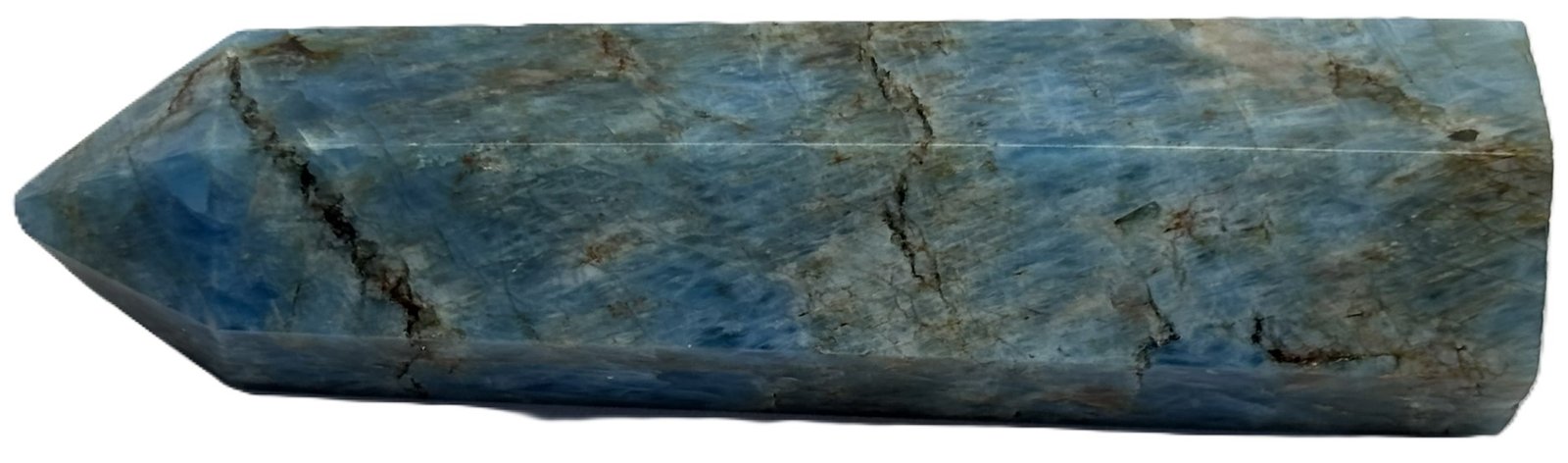
Green apatite is an alluring calcium phosphate mineral celebrated for its rich palette of colours, spanning subtle sea foam to intense, velvety forest green. Deriving its name from the Greek apatein, meaning “to deceive,” it frequently misled early gemologists by masquerading as beryl, peridot, or tourmaline. Beyond its deceptive visual beauty, the mineral serves as an indispensable bridge between geology and biology, mirroring the primary mineral constituent of vertebrate bones and teeth. Today, green apatite captivates collectors, lapidaries, and crystal practitioners alike, prized equally as a rare collector’s gemstone and as a powerful talisman for clarity, physical vitality, and renewal.
Alternate names
Throughout history and across various specialised trades, green apatite has earned several descriptive, scientific, and vernacular trade names:
- Asparagus Stone (Spargelstein): A classic historic trade name, originally coined in Germany during the 18th century, referring to translucent, yellowish-green apatite crystals reminiscent of young asparagus spears.
- Moroxite: An antiquated mineralogical name applied to deep bluish-green to dark emerald-green varieties of apatite, historically sourced from Arendal, Norway.
- Green Phosphate: A descriptive trade and industrial label emphasising its chemical classification as a phosphate group mineral.
- The Deceiver Stone: A direct nod to its etymological root (apatein), noting its habit of visually mimicking precious stones like emerald, chrysoberyl, and olivine.
- Chlorapatite / Fluorapatite (variety-specific): Scientific end-member designations applied when chlorine or fluorine dominates the crystal lattice.
The stones Science and Composition
Scientifically, “apatite” does not denote a single mineral species; rather, it represents an isomorphic group of phosphate minerals sharing identical structural frameworks. Green apatite is chemically characterised as a basic calcium phosphate containing variable amounts of fluorine, chlorine, or hydroxyl ions. Its generalised empirical formula is:
Ca5(PO4)3(F,Cl,OH)
Depending on the dominant halide or anion occupant within its hexagonal crystal lattice, it is classified into distinct mineral species:
- Fluorapatite: Ca5(PO4)3F (by far the most common gem-grade green variety)
- Chlorapatite: Ca5(PO4)3Cl
- Hydroxylapatite: Ca5(PO4)3(OH)
The characteristic green colouration is typically induced by natural trace element substitutions within the crystal lattice. Trace quantities of iron (Fe2+ and Fe3+), praseodymium, or other rare-earth elements (REEs) substitute for calcium ions, selectively absorbing specific wavelengths of light and transmitting brilliant shades of yellow-green, mint, olive, or deep forest green. Furthermore, hydroxylapatite shares an identical structural composition with bio-apatite, the foundational compound synthesised by nature to form mammalian bone architecture and tooth enamel.
Key Physical Characteristics
Green apatite possesses distinct gemological and diagnostic properties that differentiate it from other green minerals.
| Physical Property | Diagnostic Metric / Description |
|---|---|
| Chemical Classification | Phosphate mineral group |
| Crystal System | Hexagonal (dipyramidal class 6/m) |
| Mohs Hardness | Exactly 5.0 (the standard benchmark mineral on the Mohs scale) |
| Lustre | Vitreous (glass-like) to sub-resinous on fracture surfaces |
| Refractive Index (RI) | 1.628−1.649 (typically with a birefringence of 0.003−0.005, uniaxial negative) |
| Specific Gravity (Density) | 3.16−3.23 g/cm3 |
| Cleavage | Poor/indistinct parallel to basal plane {0001}; parting rarely observed |
| Fracture | Conchoidal to uneven; brittle tenacity |
| Diaphaneity | Transparent to translucent |
| Streak | White |
| Fluorescence | Weak to moderate mustard-yellow, greenish-yellow, or lilac under LW-UV and SW-UV |
Because it sits at 5 on the Mohs scale, green apatite is delicate compared to beryl or quartz. It is sensitive to thermal shock, abrasions, and acidic substances, requiring protective settings when set in fine jewellery.
Common Geologic Varieties
Variations in trace elements, internal inclusions, and crystal morphology produce several notable geologic and gemological varieties of green apatite:
- Gem-Grade Fluorapatite: Transparent, prism-terminated crystals displaying high optical clarity. These are faceted into collector gems ranging from soft mint to vivid grass green.
- Cat’s Eye Green Apatite (Chatoyant Apatite): Specimens containing dense, parallel bundles of fibrous rutile or hollow microscopic growth tubes. When cut en cabochon, these stones exhibit a sharp, silky band of light across the dome, known as chatoyancy.
- Asparagus Stone: Translucent to semi-transparent prismatic crystals marked by a distinctive yellowish-green hue, frequently discovered in skarns and marble contact metamorphic zones.
- Massive / Granular Apatite: Non-gem, microcrystalline aggregate formations often associated with phosphorite rock strata and carbonatites, vital for industrial phosphate extraction.
Global Mining and Volcanic Sources
Apatite crystallises across a diverse spectrum of geological environments, including granitic pegmatites, hydrothermal veins, carbonatite intrusions, and contact metamorphic skarns.
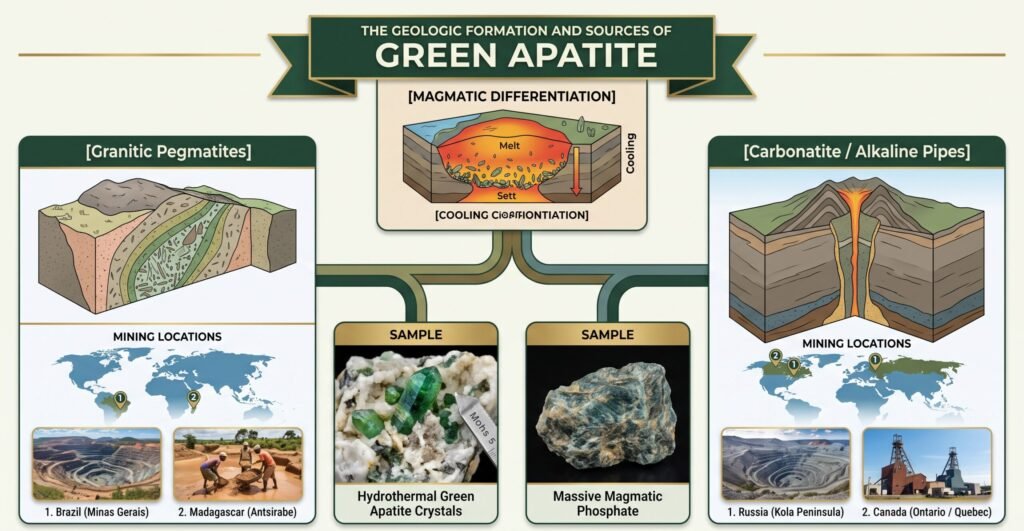
- Madagascar: Renowned for producing some of the world’s most vibrant neon-green, sea foam, and chatoyant cat’s eye apatite cabochons, predominantly extracted from alluvial gravels and pegmatites around Antsirabe.
- Brazil (Minas Gerais & Paraíba): A prolific producer of large, transparent, collector-grade green crystals formed within granitic pegmatite veins.
- Russia (Kola Peninsula – Khibiny Massif): The globe’s largest igneous phosphate deposit, hosted in alkaline nepheline syenites and carbonatites. While mined primarily for agricultural phosphate, it yields exceptional mineral specimens of green fluorapatite.
- Canada (Ontario and Quebec): Famous for massive metamorphic skarn deposits, producing giant, well-formed, dark green “moroxite” prisms embedded in orange calcite.
- Mexico (Durango – Cerro de Mercado): While globally recognised for golden-yellow crystals, associated hydrothermal deposits yield fine yellow-green apatite specimens.
- India and Myanmar: Sourced primarily from alluvial gem gravels, yielding top-tier cat’s eye green apatite.
Crystal Pairings: What to Combine and Avoid
When working with minerals in energetic or meditative frameworks, pairing stones based on complementary vibrational frequencies and elemental attributes is essential.
Optimal Crystal Pairings
- Green Tourmaline (Verdelite) or Moldavite: Green apatite acts as an activator of ambition and physical renewal; pairing it with green tourmaline grounds that vitality into steady, disciplined progress. Moldavite dramatically amplifies green apatite’s transformational energy.
- Clear Quartz: Functions as an all-purpose energetic amplifier. Because green apatite’s frequency centres on mental clarity and manifestation, clear quartz intensifies its focus.
- Rose Quartz or Rhodonite: Green apatite revitalises the heart centre. Pairing it with the soothing, nurturing energy of rose quartz or rhodonite balances intellectual drive with emotional compassion.
- Citrine: An ideal companion for manifestation grids. Citrine targets the solar plexus (willpower and abundance), while green apatite clarifies intent, helping translate abstract concepts into tangible reality.
Crystal Pairings to Avoid
- Black Obsidian: The raw, intense, and destabilising purge of shadow energy triggered by black obsidian can clash with the delicate, rejuvenating, and forward-looking current of green apatite, leading to emotional restlessness.
- Carnelian (in high-stress environments): Highly stimulating sacral stones like carnelian, when paired with the motivating current of green apatite, can cause energetic over stimulation or scatter mental concentration.
- Haematite: While grounding stones are useful, dense haematite can occasionally suppress or mute the airy, intellectually uplifting qualities of green apatite.
Archaeology, Art and Ancient History
Because green apatite shares optical properties, colours, and crystal habits with stones such as peridot, beryl, and tourmaline, its archaeological presence was long obscured. Ancient lapidaries and jewellers frequently worked apatite into beads, carved talismans, and decorative inlays under mistaken identities.
- Mediterranean and Near Eastern Antiquity: Hellenistic and Roman carvers utilised vibrant green stones from regional metamorphic belts. Mineralogical retrospective assays on regional beads and intaglios have identified specimens made of fluorapatite rather than the previously catalogued chrysoberyl or emerald.
- Pre-Columbian Inlays: Archaeological digs in Central and South America have uncovered mosaic earspools and funerary masks where green apatite tiles were set alongside jadeite, turquoise, and shell, honouring agrarian renewal and rainfall.
- 18th-Century Mineralogical Re-evaluation: It was not until German geologist Abraham Gottlob Werner systematically categorised the mineral in 1786 that science acknowledged the widespread confusion apatite had caused across centuries of gem trading, formally naming it after its deceptive legacy.
Folklore, Legends and Sacred Tales
Centuries of oral traditions, alchemical lore, and cultural folklore surround green minerals possessing the colour of spring growth:
- The Stone of Forest Spirits: In European woodland folklore, pale green crystalline stones found near mountain streams were believed to be condensed tears of forest nymphs, left behind to ensure flora would awaken following winter freezes.
- Alchemical Regeneration: Medieval alchemists associated light-green translucent crystals with the preliminary stages of the Great Work (Opus Magnum), specifically viewing the stone as a signature of viriditas—the divine greening power that animates nature.
- Talismans of Abundance: Historic Mediterranean traders kept smooth, sea-green apatite pebbles concealed in money pouches, maintaining that the stone cleared poor business judgement and warded off deceptive competitors.
Metaphysical and Mystical Healing Properties
In modern holistic and crystal healing traditions, green apatite is regarded as a primary stone of revitalised life force, mental focus, and emotional renewal:
- Intellectual Clarity & Manifestation: Apatite is renowned as an ideation stone. The green variety harmonies mental concepts with heart centred purpose, dissolving lethargy, cynicism, and confusion to support decisive, practical action.
- Emotional Balancing: By clearing stagnant energy from the subtle body, it assists in processing grief, heartbreak, and emotional burnout. It replaces persistent negative thought loops with optimism and healthy self-acceptance.
- Physical Vitality (Energetic/Spiritual): Due to its chemical connection to human bones and teeth, holistic practitioners frequently incorporate green apatite into crystal layouts aimed at supporting skeletal alignment, cellular regeneration, and joint mobility.
Disclaimer: Metaphysical and crystal healing properties are spiritual beliefs and do not substitute for professional medical advice, diagnosis, or treatment.
Astrological Connections
Green apatite aligns closely with zodiac signs centred around balance, creative intellect, and grounded growth:
- Taurus (The Bull): As an Earth sign ruled by Venus, Taurus resonates deeply with the verdant, grounding hues of green apatite. The stone helps stubborn Taureans break through mental rigidity, promoting flexibility, abundance, and organic self-renewal.
- Libra (The Scales): Also ruled by Venus, Libra continuously seeks equilibrium. Green apatite sharpens decision-making capabilities, assisting Librans in overcoming analysis paralysis while anchoring their interpersonal relationships in clarity.
- Gemini (The Twins): Because apatite governs communication, intellect, and curiosity, it provides dual-natured Geminis with an anchoring, heart centred focus, preventing intellectual exhaustion.
The Chakra System
Within subtle energy anatomy, green apatite is primarily aligned with the Heart Chakra (Anahata), with secondary connections to the Third Eye (Ajna) and Throat (Vishuddha) chakras.
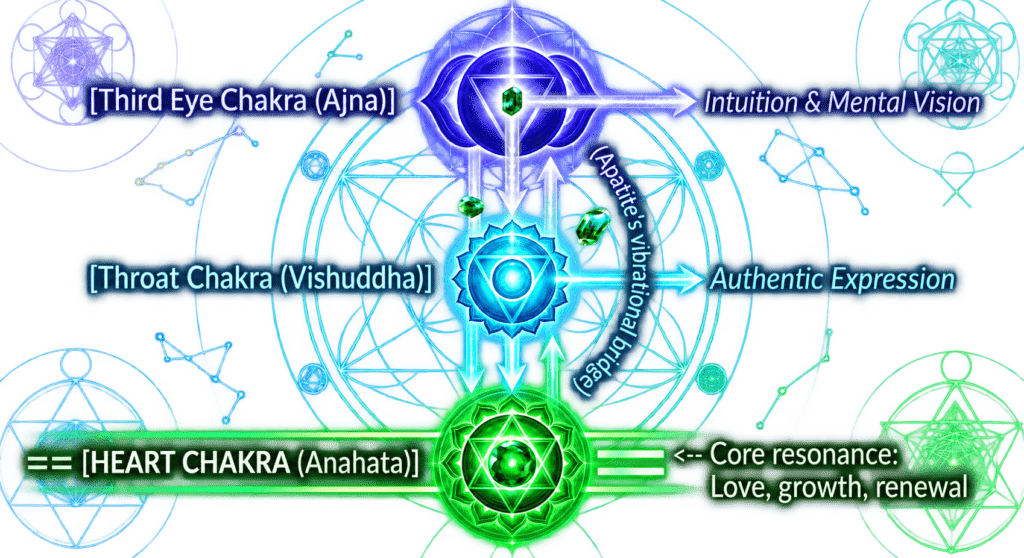
- Heart Chakra Activation: Located at the centre of the chest, the Heart Chakra governs emotional balance, compassion, and acceptance. Placing green apatite over the sternum dissolves energetic blocks caused by grief or mistrust, clearing the pathway for unconditional self-love and empathy.
- Bridging Mind and Heart: Green apatite creates a resonant circuit between the Heart, Throat, and Third Eye chakras. This connection enables practitioners to articulate emotionally vulnerable truths clearly and pursue intellectual ambitions grounded in integrity.
Interesting facts
- The Mineral Inside You: Apatite is one of the few minerals actively produced by the human body. Your bones are roughly 70% hydroxylapatite by weight, and your dental enamel is approximately 96% crystalline apatite—the hardest biological substance in mammals.
- Lunar and Meteoritic Presence: Apatite crystals were identified in lunar rock samples retrieved during NASA’s Apollo missions. The volatile elements (like water and chlorine) trapped within lunar apatite provide scientists with vital clues regarding the volcanic history of the Moon.
- Industrial Backbone: Aside from its use as an attractive collector’s gem, apatite is the world’s chief commercial source of phosphorus, refined globally into high-grade agricultural fertilisers that sustain modern food crops.
- Chatoyant Rarity: While emeralds rarely display sharp cat’s-eye effects, green apatite regularly forms exceptional chatoyant stones with striking luminous eyes due to its fine parallel growth tubes.
- Scale Standard: Green apatite holds a permanent place in Earth science laboratories worldwide as the definitive standard mineral representing a rating of 5 on Friedrich Mohs’ 1812 hardness scale.
Modern Milestones: Birthstones and Anniversaries
While not listed on the traditional or modern National Association of Jewellers birthstone registers, green apatite has earned a loyal modern following:
- Alternative Birthstone: It serves as a popular alternative birthstone for May (celebrating spring renewal in place of emerald) and August (alongside peridot).
- Zodiac Birthstone: Embraced by astrologers as an energetic birth stone for those born under Taurus (April 20 – May 20) and Gemini (May 21 – June 20).
- Anniversary Celebrations: Green apatite is frequently selected as an alternative gemstone for the 16th and 33rd wedding anniversaries. In this context, its verdant brilliance symbolises enduring physical harmony, mutual emotional reinvention, and a relationship that remains fresh and vibrant over decades.
Frequently Asked Questions
How can I distinguish genuine green apatite from green tourmaline or peridot?
Apatite can be distinguished using diagnostic gemological testing:
- Hardness: Apatite sits at 5 on the Mohs scale and is easily scratched by a steel file or quartz crystal (hardness 7). Tourmaline (7–7.5) and peridot (6.5–7) will resist steel scratches.
- Refractive Index & Doubling: Peridot displays strong internal birefringence (0.036), producing obvious visual doubling of its rear facet junctions when viewed through a loupe; green apatite’s birefringence is much lower (0.003–0.005).
- Spectroscopy: Green apatite frequently displays diagnostic rare earth absorption lines under a spectroscope, particularly in the yellow and green wavelengths.
Can green apatite be worn as an everyday ring stone?
Because it has a hardness of 5 and distinct brittleness, green apatite is susceptible to scuffs, facet abrasion, and impact damage. While unsuitable for high-contact, unprotected daily prong rings, it performs reliably in earrings, brooches, pendants, and occasionally in protective bezel-set rings intended for mindful, occasional wear.
How should I clean and care for green apatite jewellery?
Clean green apatite using warm water, a mild dish soap, and a soft micro fibre cloth. Never clean apatite using ultrasonic cleaners or steam machines, as thermal shock and vibration can fracture the stone along internal cleavage lines. Keep it away from household chemicals, bleach, and harsh acids (including vinegar and citrus juices), which can chemically etch its surface.
Is green apatite routinely treated or enhanced?
Most green apatite on the market is completely natural and untreated. While some blue and teal apatites undergo low-temperature heat treatments to lighten or enhance their colouration, green apatite typically exhibits its authentic colour straight from the earth. When buying, request confirmation from reputable gemological laboratories.
What is the best method to energetically cleanse green apatite?
Due to its delicate surface and sensitivity to acids, avoid using abrasive salt baths or prolonged direct sunlight (which can fade certain pale green specimens over time). The safest and most effective cleansing methods include smudging with sage or palo santo, resting the stone on a selenite charging plate, sound cleansing with brass singing bowls, or bathing it in overnight moonlight.