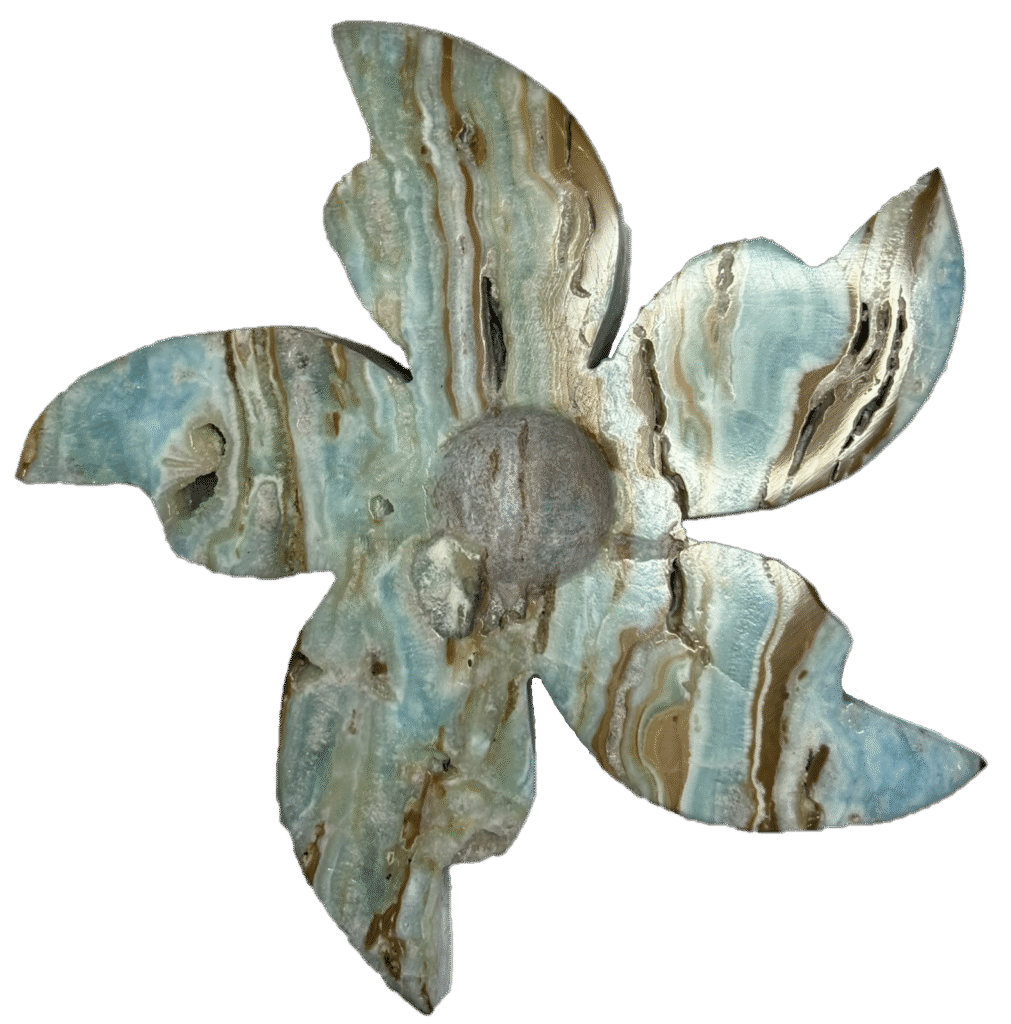
Aragonite is a mesmerising carbonate mineral celebrated for its delicate, radiating crystal formations and deep mystical allure. From ancient folklore to modern crystal healing, this versatile gemstone is highly sought after for its ability to anchor energy, soothe stress, and promote emotional renewal.
Whether you are drawn to its unique “Sputnik” star clusters or its beautiful array of natural colours, this comprehensive guide explores the rich history, geological origins, and powerful metaphysical benefits of Aragonite.
What is Aragonite? Composition and Key Characteristics
Chemically speaking, Aragonite is a calcium carbonate mineral (CaCO3) that crystallises in the orthorhombic system. It is a polymorph of calcite—meaning they share the exact same chemical makeup but possess completely different internal crystal structures.
- The “Ever Young” Stone: Aragonite is metastable at standard temperatures and pressures. When exposed to high heat, it alters its internal structure and converts into calcite. Because of this transformative trait, ancient stonecutters dubbed it the “ever young stone,” viewing its physical shift as a symbol of eternal youth and renewal.
- The Iron Flower: High-quality Aragonite can form intricate, branching structures that resemble delicate white coral. These rare specimens are highly prized in the jewellery industry and are known as Flos Ferri (the “Iron Flower”).
- Physical Properties: With a Mohs hardness rating of 3.5 to 4, Aragonite is relatively soft and requires gentle handling. It features a vitreous (glass-like) to pearly lustre.
The Spectrum of Aragonite Colours
While pure Aragonite is white or completely colourless, trace mineral impurities create a beautiful spectrum of hues:
- Red and Golden Brown: Commonly found in the famous star clusters or “Sputniks” from Morocco.
- Blue Aragonite: Recently discovered in spectacular stalactitic formations in China, this rare blue variety is heavily used by crystal practitioners to restore self-confidence and enhance communication.
- Yellow, Green, and Violet: Less common but highly prized by collectors for their soft, soothing aesthetics.
Global Origins: Where is Aragonite Found?
Aragonite forms in a variety of low-temperature geological environments, particularly in hot springs, sedimentary beds, and deep caves.
- Spain: The mineral was named after the Spanish region of Aragon, where the very first benchmark specimens were officially discovered.
- Morocco: The primary global source for the distinct, interlocking hexagonal prisms known commercially as “Sputnik Aragonite” or “Golf Ball Aragonite.”
- China: Famous for producing stunning, light-blue stalactitic varieties.
- Worldwide Deposits: Significant sedimentary and cave deposits are also actively mined across Italy, Greece, Florida (USA), India, Namibia, and parts of South America.
Historical Usage and Ecological Power
Archaeological discoveries reveal that ancient civilisations routinely carved Aragonite into decorative ornaments, ritual artefacts, and fine artistic pigments.
Beyond its beauty on land, Aragonite plays a vital ecological role in our oceans. It is the exact structural material secreted by marine invertebrates to build coral reefs and mollusc shells. When a biological pearl forms inside an oyster, it is primarily made of alternating layers of Aragonite and organic proteins, giving natural pearls their signature iridescent sheen.
Myths, Folklore, and Feng Shui
The Tears of Aragon
According to romantic Spanish folklore, the rigid, radiating spikes of Aragonite star clusters are actually the petrified tears of a young girl who was forcefully separated from the love of her life. Because of this legend, the stone is traditionally kept in Spanish households to guard the family hearth and welcome prosperity.
The Seal of Solomon
In medieval times, mystics and wizards believed that the naturally occurring hexagonal patterns in Aragonite closely mirrored the legendary Seal of Solomon. It was highly sought after as a magical talisman, believed to grant the wearer the unique power to command genies and speak directly with animals.
Aragonite in Feng Shui
In modern Feng Shui practices, Aragonite is a vital tool for cultivating a peaceful, harmonious living space. Placing an Aragonite cluster on a prominent windowsill is thought to capture natural daylight, transforming it into positive, grounding vibrations that attract happiness and wealth to the household.
Metaphysical Meaning and Healing Properties
In the realm of crystal healing, Aragonite is celebrated as a master stabilise. It possesses a gentle yet deeply transformative energy that helps individuals navigate periods of intense personal growth.
- Emotional Stress Relief: It acts as an emotional anchor, absorbing stray, anxious thoughts and instilling a deep sense of internal calm and patience.
- Physical Wellness Support: Holistic practitioners often use Aragonite to assist with physical recovery, citing its high calcium composition as a beneficial frequency for bone health, posture, and general vitality.
- Chakra and Astrology: Aragonite is strongly tied to the Heart Chakra (fostering compassion and emotional healing) and the Third-Eye Chakra (enhancing inner vision). Astrologically, it serves as a powerful transformative talisman for the deep, intuitive water signs of Scorpio and Pisces. It is also frequently chosen as a modern alternative birthstone or a meaningful wedding anniversary gift to symbolise enduring love and shared evolution.
The Aragonite Crystal Pairing Guide
To maximise your crystal work, combining stones with complementary vibrational frequencies is key. Because Aragonite is an earth-heavy, stabilise force, it interacts uniquely with other minerals.
Stones to Pair With Aragonite (The Perfect Matches)
- Black Tourmaline or Smoky Quartz: If you need ultimate grounding, this is the premier combination. Black Tourmaline acts as an external shield against negative energy, while Aragonite processes your internal stress, resulting in a total energetic reset.
- Malachite or Rhodonite: For intense emotional healing. Malachite is a powerful stone that aggressively unearths buried traumas. Pairing it with Aragonite ensures you remain perfectly calm, supported, and emotionally balanced while processing those heavy breakthrough moments.
- Selenite or Clear Quartz: High-frequency, spiritual stones can sometimes leave you feeling “spacey” or disconnected from the physical world. Aragonite acts as a grounding anchor line, pulling those cosmic, high-vibrational insights down into your daily reality where you can actually apply them.
Stones to Avoid Pairing With Aragonite (The Clashing Frequencies)
While crystal combinations are never dangerous, opposing energies can cancel each other out, leaving your intentions feeling entirely stagnant.
- Moldavite: triggers rapid, chaotic, cosmic transformation. Forcing its volatile, sky-high frequency to sit alongside Aragonite’s slow, deep-rooted earth energy creates an energetic tug-of-war that can leave you feeling disoriented or anxious.
- Carnelian: is a fiery stone designed to ignite passion, physical action, and fast-paced creativity. The cool, patient, centering vibe of Aragonite can inadvertently dampen that creative fire before it even gets going.
- Citrine is all about outward expansion and outward manifestation. Because Aragonite works via centripetal pulling—drawing energy inward to stabilize your core—these two stones pull in opposite directions, neutralising the specific focus of your meditation.
Aragonite Frequently Asked Questions (FAQs)
Can Aragonite go in water?
No, you should avoid submerging Aragonite in water. With a low Mohs hardness of 3.5 to 4, it is a relatively soft calcium carbonate mineral. Prolonged exposure to water can dull its natural pearly lustre, degrade its structure, or cause the crystal to dissolve over time.
What chakra is Aragonite best for?
Aragonite is highly versatile but is primarily associated with the Heart Chakra (for emotional healing and compassion) and the Third-Eye Chakra (for spiritual insight and intuition). Additionally, due to its deep connection to the earth, red and brown Aragonite star clusters are highly effective for clearing and stabilising the Root Chakra.
How do I safely cleanse and charge my Aragonite crystal?
Because it cannot tolerate water, the safest way to cleanse Aragonite is by placing it on a Selenite charging plate, passing it through the smoke of natural incense (like sage or palo santo), or using sound healing frequencies. To recharge its energetic reserves, leave it out overnight under the gentle light of a full moon.
Is Aragonite the same thing as Calcite?
They are chemical twins, but physical cousins. Both share the exact chemical formula of calcium carbonate (CaCO3). However, Aragonite crystallises in an orthorhombic structure, whereas Calcite forms in a trigonal system. This structural difference makes Aragonite slightly harder and more dense than Calcite.
These are my personally selected and curated Aragonite products