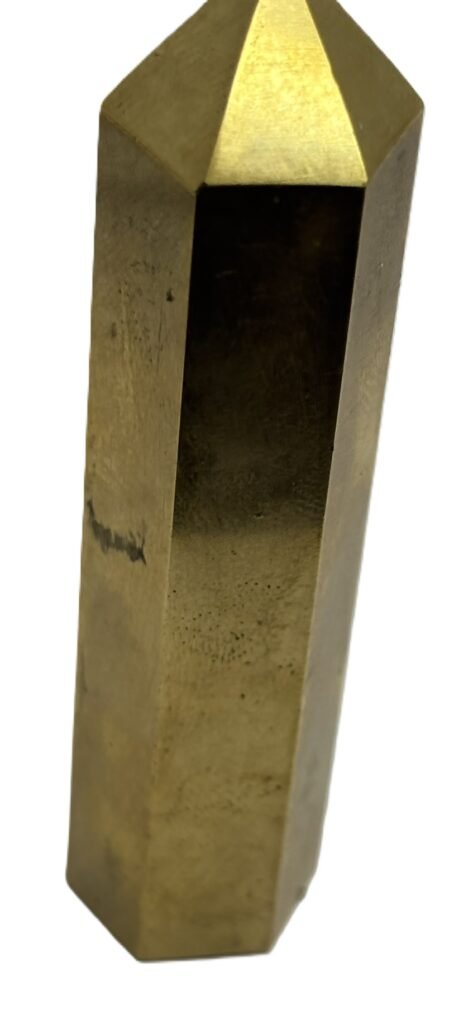
Epitomising timeless durability, domestic warmth, and profound metaphysical utility, brass stands as one of the most revered and versatile copper alloys in human history. Celebrated for its bright, golden-yellow sheen and exceptional workability, this non-ferrous metal combines structural strength with acoustic brilliance.
From the architectural elements of ancient empires to the complex components of modern instrumentation and spiritual energy work, brass seamlessly bridges the gap between raw industry and fine art. Whether sought for its highly hygienic, antimicrobial properties or its unique capability to conduct and amplify spiritual vibrations, brass remains an indispensable cornerstone of material culture and esoteric practices worldwide.
Alternate names
Throughout history and across various global industries, brass has been known by several alternative names, classification terms, and colloquial titles:
- Yellow Metal: A common commercial and maritime term highlighting its distinctive bright yellow appearance, frequently used to distinguish it from red copper or bronze.
- Orichalcum (historical): The mythical golden metal referenced in classical texts, often closely associated with early, high-purity Roman calamine brass.
- Calamine Brass: An archaeological term for brass produced via the ancient cementation process using zinc carbonate ores.
- Cartridge Brass: A specific technical grade (70% copper, 30% zinc) widely known in industrial manufacturing for its supreme malleability.
- Prince’s Metal (or Prince Rupert’s Metal): A historical, high-copper alpha brass variety displaying a rich, gold-like lustre.
The stones Science and Composition
From a scientific perspective, brass is not a single mineral or element, but a substitutional metal alloy composed primarily of copper ($\text{Cu}$) and zinc ($\text{Zn}$). The atom positions within the crystal structure of the two host elements swap places with one another inside the face-centred cubic lattice.
The base material properties are profoundly dictated by the exact ratio of these two primary components:
- Alpha Brass (less than 37% zinc): Features a homogenous crystal structure. It is highly malleable at room temperature, making it ideal for cold working, pressing, and drawing into wire or sheets.
- Alpha-Beta / Duplex Brass (37% to 45% zinc): Contains both alpha and beta crystalline phases. This composition is much harder, has high high-temperature strength, and is typically hot-worked, extruded, or cast into complex structural shapes.
To enhance specific industrial profiles, minor trace elements are frequently introduced into the chemical blend. Lead ($\text{Pb}$) is added to improve machinability; aluminium ($\text{Al}$) increases corrosion resistance by forming a self-healing protective oxide layer; and tin ($\text{Sn}$) is incorporated to fortify the metal against dezincification in marine environments.
Key Physical Characteristics
- Chemical Base: Copper-Zinc Alloy ($\text{Cu-Zn}$)
- Crystal System: Face-centred cubic (Alpha phase) / Body-centred cubic (Beta phase)
- Hardness: Typically 3 to 4 on the Mohs scale (varying widely based on mechanical cold work and tempering)
- Lustre: Highly bright, metallic, and smooth
- Colour: Ranges from rich reddish-gold to pale sky-yellow, depending on zinc content
- Melting Point: Roughly $900^\circ\text{C}$ to $940^\circ\text{C}$ ($1,650^\circ\text{F}$ to $1,724^\circ\text{F}$)
- Density: $8.4$ to $8.73\text{ g/cm}^3$
- Acoustic Profile: Resonant, bright, and highly clear with long tonal sustain
Common Varieties
While manufactured synthetically by smelting elemental components, brass grades are historically categorised by metallurgical varieties that mirror the mineralogical designations of raw gemstones:
- Red Brass (Gilding Metal): Formulated with high copper levels (typically 85% to 95%). This variety boasts a deep, warm bronze-like appearance and possesses immense natural resistance to corrosion.
- Yellow Brass: The classic aesthetic standard, containing 60% to 70% copper and 30% to 40% zinc. It is renowned for its signature golden colour and excellent tensile properties.
- Muntz Metal: A distinct alpha-beta alloy containing 60% copper and 40% zinc. It is highly prized for its exceptional corrosion resistance and was historically applied to protect wooden ship hulls.
- Naval Brass: An upgraded version of Muntz metal containing roughly 60% copper, 39.2% zinc, and 0.8% tin, specifically engineered to withstand harsh seawater environments.
Crystal Pairings: What to Combine and Avoid
Optimal Crystal Pairings
When integrating brass into metaphysical practices, crystal layouts, or holistic jewellery design, its high electrical and spiritual conductivity serves as a powerful energetic amplifier.
- For Grounding, Protection & Shielding: Combine brass with Black Onyx, Black Tourmaline, or Pyrite. Because brass harmonises the fiery energy of copper with the protective nature of zinc, pairing it with deep root chakra anchors like Black Onyx constructs a barrier against ambient negativity while rooting the wearer’s personal biofield.
- For Amplified Communication & Intellect: Pair brass with Blue Lace Agate, Lapis Lazuli, or Amazonite. The alloy’s deep connection to the Throat Chakra and Mercurial energy matches the soft, high-vibrational frequencies of Blue Lace Agate, enabling calm, articulate, and honest self-expression.
- For Abundance & Manifestation: Combine brass with Citrine, Tiger’s Eye, or Amber. The solar-gold resonance of brass acts as a magnifying lens for the financial and personal empowerment frequencies emitted by solar plexus stones.
Crystal Pairings to Avoid
While brass is highly adaptable, its high conductivity and solar alignment can clash with specific crystal configurations:
- High-Vibrational Dream Crystals (e.g., Moldavite or Phenakite): The intense solar, action-oriented energy of brass can disrupt the deep astral and subconscious work facilitated by these third eye or crown chakra stones, sometimes leading to restless sleep or spiritual overstimulation.
- Deep Water Element Crystals (e.g., Larimar or Aquamarine): Combining the warm, active, Venusian-Solar energy of brass with the cooling, deeply passive energy of Larimar can occasionally dull the crystal’s emotional qualities, as the metals stimulate movement while the stone encourages stillness.
Archaeology, Art and Ancient History
The archaeological record of brass highlights its profound value to early civilisations. The earliest brass-like alloys appeared in the Mediterranean and the Levant around the 3rd millennium BCE, emerging from the accidental smelting of copper with zinc-rich ores.
By the classical period, the Greeks and Romans had masterfully industrialised the metal through the “cementation process”. This technique involved heating granulated copper alongside charcoal and calamine ore (zinc carbonate) inside closed clay crucibles.
The Romans used this radiant metal to produce their highly valued orichalcum coinage (such as the sestertius) and to craft heavy military helmets, fibulae, and parade armour. In ancient India and China, specialised metallurgical guilds refined high-purity brass castings by the medieval period, long before Europe mastered identical distillation techniques. This resulted in intricate religious statuary, astrolabes, and elaborate temple implements.
Folklore, Legends and Sacred Tales
In historical folklore and legendary texts, brass is universally celebrated for its defensive properties and its deep association with cosmic order. Plato’s famous descriptions of Atlantis heavily feature the legendary metal orichalcum, which flashed with a “fiery light” and was used to clad the walls of Poseidon’s royal temple.
In biblical lore, the “Brazen Serpent” (Nehushtan) was erected by Moses upon a staff to provide miraculous healing to all who gazed upon its surface. Throughout medieval alchemical traditions, European mystics viewed brass as a supreme material of elemental transformation. They saw it as the marriage of copper’s feminine Venusian energy with zinc’s logical Mercurial intellect.
Furthermore, across ancient Celtic and Western European folk traditions, domestic brass hearth decorations, horseshoes, and door knockers were routinely polished bright to trap negative entities, deflect curses, and draw solar luck to the home.
Metaphysical and Mystical Healing Properties
Metaphysically, brass serves as a powerful spiritual conductor, energy cleanser, and biofield balancer. Because it contains high percentages of copper, it stimulates the continuous flow of stagnant prana or chi throughout the subtle energy body, clearing deep blockages and warming the spirit.
It is widely utilised in modern crystal healing as a shield against electromagnetic smog and environmental stress, reflecting external negativity back to its source. Mystics value brass for its defensive properties, believing it boosts mental stamina, dispels self-doubt, and encourages inner resilience.
When cast into sonic tools like gongs, singing bowls, or bells, the vibration of brass produces a highly resonant sound that clears heavy, stagnant energy from rooms and restores peace to chaotic environments.
Astrological Connections
Due to its unique binary elemental composition and bright golden finish, brass links deeply to multiple celestial forces and zodiac signs:
- The Sun (Leo): Its metallic sheen reflects the core essence of the Sun, imbuing Leo natives with confidence, leadership, and personal illumination.
- Venus (Taurus & Libra): The high copper base links brass to Venus, the planet governing beauty, romance, aesthetic luxury, and emotional harmony.
- Mercury (Gemini & Virgo): The zinc content connects brass directly to Mercury, strengthening the intellect, encouraging rapid communication, and boosting mental flexibility.
The Chakra System
Brass works to balance and unify the lower and upper energy centres, acting as a bridge across the central column:
- Solar Plexus Chakra (Manipura): Its solar gold hue stimulates personal power, motivation, and inner drive.
- Throat Chakra (Vishuddha): Through its Mercurial zinc component, brass assists in clearing communication blocks, allowing the wearer to speak their truth clearly.
- Heart Chakra (Anahata): The underlying copper matrix supports emotional balance, encouraging self-love, compassion, and the release of old emotional wounds.
Interesting facts
- Antimicrobial Power: Brass exhibits a potent oligodynamic effect. It naturally destroys harmful microbes, bacteria, and viruses on its surface within hours, making it an excellent material for doorknobs and handrails.
- Zero Sparking: Unlike iron or steel, brass will not strike a spark when struck against hard objects. Because of this, it is used to manufacture specialised safety tools for explosive environments.
- Supreme Recyclability: Brass is highly sustainable. Foundries worldwide rely heavily on recycling scrap brass, as the metal can be melted down repeatedly without losing its structural integrity.
- Musical Master: The acoustic resonance of brass is so distinct that it defines an entire family of orchestral instruments, including trumpets, trombones, and French horns.
Modern Milestones: Birthstones and Anniversaries
- Zodiac Association: While not linked to a single calendar month as a traditional birthstone, brass is embraced as a modern gemstone alternative for Leos, Librans, and Geminis.
- Wedding Anniversary: Brass is the traditional milestone gift for the 21st Wedding Anniversary, symbolising a resilient bond built on domestic warmth, flexibility, and enduring strength.
Extensive FAQ Section
Is brass safe to wear directly against sensitive skin?
Generally, yes. High-quality brass is comfortable for everyday wear. However, because it contains copper, it can react with the moisture and natural acids of your skin, producing a harmless green copper carbonate deposit. This is not an allergic reaction, but a natural surface response that washes off easily with soap. Individuals with specific metal allergies should ensure their brass jewelry is free from trace nickel elements.
Will brass react or fizz if exposed to vinegar?
No. Unlike calcium carbonate minerals such as Blue Calcite or Blue Aragonite, brass is a resilient copper-zinc metal alloy. When exposed to an acid like vinegar, it will not fizz or dissolve. Instead, a mixture of vinegar and salt is a popular home remedy used to chemically strip heavy tarnish and restore the metal’s bright golden shine.
Why has my shiny brass item turned dark brown or dull black?
This is due to natural oxidation. Over time, exposure to oxygen, ambient humidity, and natural oils causes the copper within the alloy to develop a protective outer layer known as a patina. While some collectors appreciate this antique look, you can easily restore the original bright gold surface using a soft microfibre cloth and a mild polishing compound.
How can I tell if my item is solid brass or merely brass-plated iron?
The simplest way to test your item is with a standard magnet. Solid brass is completely non-ferrous and will not attract a magnet. If a magnet sticks firmly to the surface, the object is made of iron or steel with a very thin layer of brass electroplated over it.
How should I safely clean and energetically charge my brass items?
A: To physically clean your brass, wash it gently with lukewarm soapy water and a soft cloth, drying it immediately to prevent water spots. Energetically, you can cleanse its vibration by passing it through the smoke of a sacred incense (like frankincense or sandalwood) or placing it near a sound-healing instrument like a singing bowl. To recharge its solar energy, leave it in warm, direct sunlight for an hour.
These are my personally selected and curated Brass products