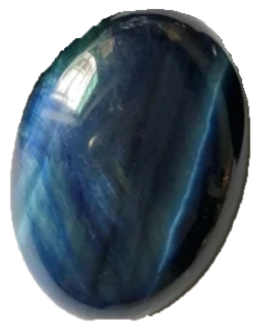
Enigmatic, deeply soothing, and physically striking, Blue Tigers Eye is a captivating gemstone that has fascinated crystal enthusiasts, geologists, and spiritual practitioners for centuries. Visually distinguished by its dark, moody shades of midnight blue,
While known globally in modern retail circles as Blue Tiger’s Eye, this optical gemstone is recognised by several distinct historical and mineralogical terms:
- Hawk’s Eye (or Hawk-Eye): The most common and accurate alternative name, widely favoured by mineralogists in the UK and Europe.
- Falcon’s Eye: A variation commonly used across continental gem markets, highlighting the stone’s predatory, soaring avian association.
- Pseudomorphous Crocidolite Quartz: The formal scientific classification reflecting its unique metamorphic replacement origin.
The Stone’s Science and Composition
To understand Blue Tiger’s Eye, one must examine its complex geological evolution, as it is a textbook example of a mineralogical pseudomorph (literally meaning “false form”).
Unlike traditional crystals that grow freely in subterranean cavities, Blue Tiger’s Eye begins its life as crocidolite, an asbestiform iron silicate mineral belonging to the riebeckite family of amphiboles. Over millions of years, silica-rich hydrothermal fluids seep through the host rock, slowly dissolving the crocidolite. As the original mineral is stripped away, it is atom-by-atom replaced by chalcedony quartz.
Crucially, the quartz perfectly inherits and preserves the parallel, tightly packed, hair-like fibrous structure of the old crocidolite. Because the underlying iron fibres have not yet undergone oxidation, the mineral retains its original, un-weathered midnight-blue to greenish-grey pigmentation.
Key Physical Characteristics
- Chemical Formula: SiO2 (Silicon Dioxide replacing variable Amphibole asbestos fibres).
- Crystal System: Trigonal (occurring as fibrous aggregates).
- Mohs Scale Hardness: 6.5 to 7. It is durable, scratch-resistant, and lacks a distinct cleavage plane, making it excellent for everyday jewellery fabrication.
- Lustre: Silky when raw; brilliantly vitreous and highly reflective once cut and expertly polished.
- Chatoyancy (The Cat’s Eye Effect): This is the defining optical hallmark of the gem. When polished en cabochon or into tumble stones, light reflects directly off the embedded parallel layers of needle-like inclusions. As you rotate the stone beneath a light source, a shimmering, silky band of luminescence appears to slide dynamically across its surface, reminiscent of a nocturnal predator’s iris.
Common Geologic Varieties
- Pure Hawk’s Eye: A uniform, dark slate-blue to deep navy gemstone showing pristine blue or teal chatoyant bands.
- Mixed Tiger’s Eye (Matrix/Variegated): Striking transitional specimens where partial oxidation has occurred. These stones display swirling ribbons of classic golden-bronze Tiger’s Eye side-by-side with bands of deep midnight-blue Hawk’s Eye.
- Marra Mamba Tiger’s Eye: A highly prized, ultra-rare Australian variant featuring multi-coloured chatoyancy with deep blue, red, gold, and green tones intermingled with specular haematite bands.
Global Mining and Volcanic Sources
Blue Tiger’s Eye is not a product of active volcanic eruptions, but rather forms inside ancient, highly compressed Precambrian sedimentary iron formations and metamorphic belts.
- The Northern Cape (South Africa): The primary and highest-quality commercial source of Hawk’s Eye on earth. Massive deposits are found near Griquatown, where ancient asbestos veins have been safely and thoroughly silicified over deep time.
- The Pilbara Region (Western Australia): Famous for producing incredibly dense, heavy specimens containing rich iron stone and haematite bands.
- Secondary Locations: Small, localised alluvial and vein deposits are occasionally extracted in India, Myanmar (Burma), and parts of Western USA.
Crystal Pairings: What to Combine and Avoid
Optimal Crystal Pairings
- For Grounding and Psychic Shielding: Combine with Black Onyx, Black Tourmaline, or Haematite. While Blue Tiger’s Eye elevates your upper chakra perception, these heavy iron-bearing minerals drop your root anchors deep into the earth, preventing spacey detachment.
- For Amplified Intuition & Clarity: Pair with Clear Quartz or Lapis Lazuli. Clear Quartz acts as a natural megaphone, amplifying the subtle, protective vibrations of the Hawk’s Eye.
- For Overcoming Fear and Taking Action: Pair with traditional Golden Tiger’s Eye or Malachite. This creates a powerful energetic bridge between your mental intention (throat/third eye) and your physical willpower (solar plexus).
Crystal Pairings to Avoid
- High-Vibrational Chaotic Combinations: Avoid pairing Blue Tiger’s Eye with highly volatile, rapidly manifesting crystals like Moldavite or Phenakite unless you are very well-grounded. The intense, otherworldly push of these cosmic glasses can clash with the steady, introspective focus of Hawk’s Eye, leading to mental fatigue or dizziness.
- Conflicting Calming Elements: Avoid pairing it with ultra-passive, water-element stones like Larimar or Blue Lace Agate if your intention is focused strategic action. The intense passive energy of these stones can dull the sharp focus of your Hawk’s Eye.
Archaeology, Art and Ancient History
While historical texts from antiquity frequently group all chatoyant stones under general catch-all classifications like Beli Oculus (Eye of Belus) or Oculus Cati (Cat’s Eye), archaeological findings show that fibrous quartz variants were used for protection.
In ancient Egyptian funerary art, polished chatoyant eye stones were highly sought after to depict the eyes of divine statues. They were explicitly chosen to represent the ever-watching, omnipotent eyes of Ra (the sun god) and Horus (the sky god), providing an unblinking gaze that could pierce through earthly illusion.
Folklore, Legends and Sacred Tales
In traditional folklore, Blue Tiger’s Eye has always been designated as the ultimate talisman against the “Evil Eye” (Mal de Ojo). Ancient travellers, soldiers, and merchants wore the stone as a hidden protective amulet.
It was believed that the shifting, reflective sheen of the stone would catch the negative gaze, psychic curses, or jealous intentions of an enemy and bounce the energy directly back to its source. It was also considered a stone of “all-knowing sight,” granting the wearer the ability to spot hidden plots, deceit, and approaching danger before they manifested.
Metaphysical and Mystical Healing Properties
Metaphysically, Blue Tiger’s Eye is revered as a stone of deep emotional perspective and mental mastery.
- Emotional Regulation: It acts as an energetic cooling agent for hyperactive minds. If you suffer from sudden bursts of temper, chronic anxiety, or panic attacks, its gentle energy pacifies the nervous system, helping you view chaotic situations with detached neutrality.
- Breaking Mental Blockages: It encourages cognitive flexibility, helping you step back from deep-seated negative thought loops, phobias, and rigid, dogmatic mindsets.
Astrological Connections
- Primary Signs: CapCapricorn (December 22–January 1)ricorn and Leo.
- Astrological Influence: Traditional Golden Tiger’s Eye is heavily ruled by the Sun, whereas Blue Tiger’s Eye answers to the cool, disciplined, and structured vibrations of Saturn, alongside the fast-moving, air-dominant traits of Mercury. It provides impulsive Leos with much-needed caution, emotional restraint, and foresight, while granting overly serious Capricorns the higher perspective needed to reduce workplace stress.
The Chakra System
Blue Tiger’s Eye bridges the upper channels of communication and inner perception:
- The Throat Chakra (Vishuddha): By aligning here, it assists you in speaking your absolute truth with absolute calm. It eliminates public speaking anxiety and helps you articulate intricate, complex thoughts logically.
- The Third Eye Chakra (Ajna): It clears internal psychic debris, heightens astral travel safety, sharpens intuition, and assists in vivid, clear dream recall.
Interesting Facts
- Safe Asbestos: Even though it contains crocidolite (blue asbestos), the stone is entirely safe to handle. The hazardous fibres have been completely entombed, sealed, and petrified within solid quartz crystal.
- Camouflaged Look: Indoors or under dim household lighting, high-quality Blue Tiger’s Eye looks like a solid, jet-black stone. It only reveals its brilliant navy ribbons when exposed to direct sunlight.
- Natural Thermometer: If subjected to extreme artificial heat, the iron inclusions within the stone oxidise, permanently transforming it into Red Tiger’s Eye.
Modern Milestones: Birthstones and Anniversaries
While not an official modern birthstone on the standard UK or US charts, Blue Tiger’s Eye is widely embraced as an alternate planetary birthstone for mid-summer signs. In contemporary gemstone milestone traditions, jewellery featuring Tiger’s Eye variations is traditionally gifted to celebrate the 9th Wedding Anniversary, symbolising resilience and clarity.
Blue Tigers Eye Frequently Asked Questions
Can Blue Tiger’s Eye go in water?
With a solid hardness rating of 6.5 to 7 on the Mohs scale, Blue Tiger’s Eye can safely withstand brief contact with fresh water. However, you should avoid submerging it in acidic or salty solutions for extended periods, as these harsh minerals can erode the stone’s polished surface and dull its silky lustre.
Why does my Blue Tiger’s Eye look almost entirely black?
Because of its high density of un-oxidized iron fibres, the stone is naturally dark. In dim, ambient indoor lighting, it frequently appears pitch black. To enjoy its signature blue chatoyancy, hold it directly under the midday sun or shine a bright smartphone torch directly across its surface.
How can I tell if my Blue Tiger’s Eye is natural or fake?
Natural Blue Tiger’s Eye will feel cool to the touch when first picked up and will have a substantial weight. When you slowly rotate a real stone under direct light, the glowing bands will glide smoothly across the surface. Plastic or glass imitations usually feel warm almost instantly, have repeating, uniform lines, or contain tiny circular air bubbles trapped inside.
How should I safely clean and energetically charge my stone?
To physically clean it, wipe it down using a soft, damp micro fibre cloth. Energetically, you can safely cleanse its vibration by passing it through the smoke of sacred incense (like frankincense or sandalwood) or placing it on a Selenite charging plate. To recharge its properties, leave it out overnight under the cooling light of a full moon.
These are my personally selected and curated Blue Tigers Eye products
Products by Category