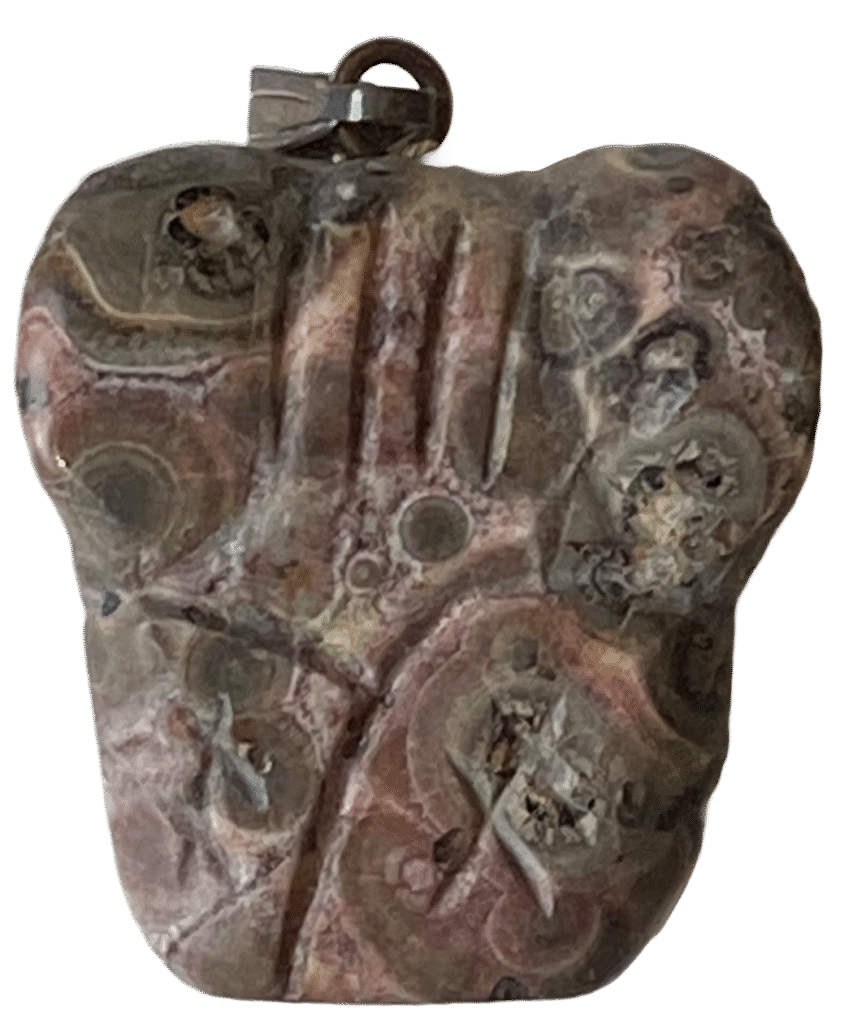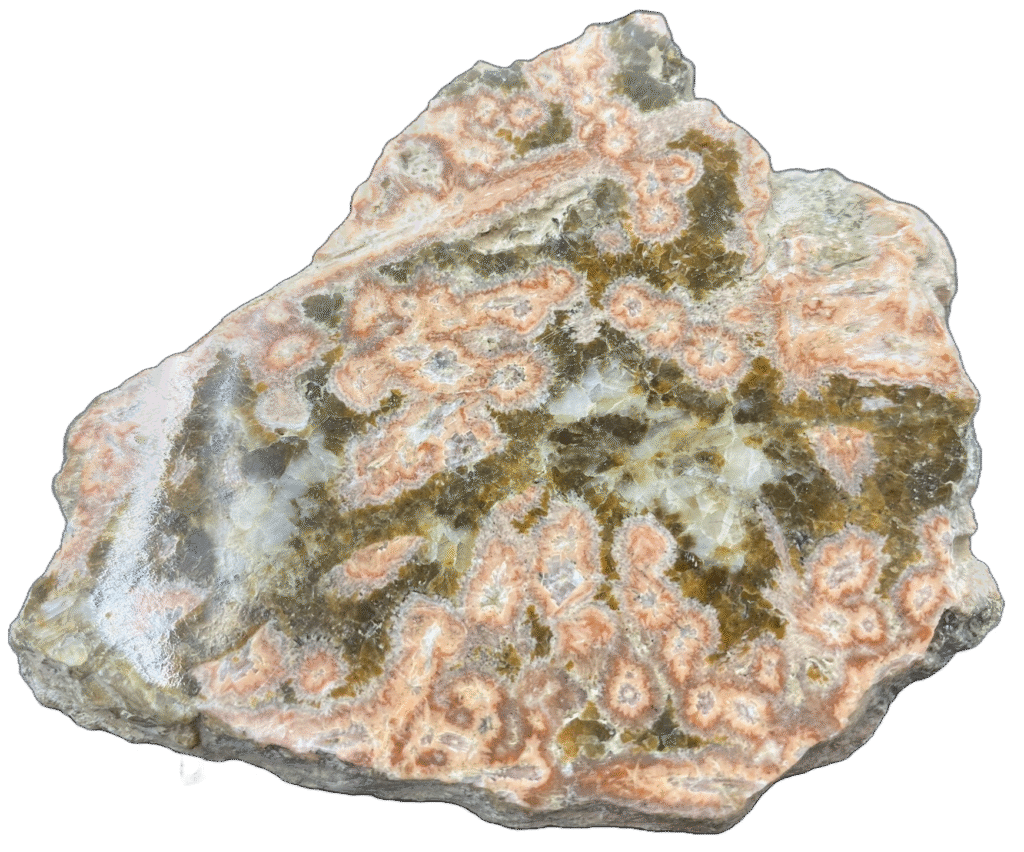
Ocean Jasper is one of the rarest, visually arresting chalcedonies on Earth. Renowned for its intricate patterns of concentric, eye-like spheres, wavy banding, and pockets of sparkling quartz druzy, this mineral offers an extraordinary spectrum of pastel pinks, deep moss greens, mustard yellows, and creamy whites. Mined exclusively along the littoral coast of northwestern Madagascar, true Ocean Jasper is defined by its dramatic relationship with the sea: early deposits could only be reached and quarried by boat during low tide. Today, its finite geological occurrence, captivating orbicular patterns, and uplifting energy make it a cornerstone collector gem and lapidary treasure.
Alternate Names
The commercial name “Ocean Jasper” is a registered trademark originally coined by Paul Obeniche of Madagascar Minerals to describe the orbicular material harvested directly off the littoral shoreline. In academic, gemological, and metaphysical communities, the stone appears under several designations:
- Orbicular Jasper: The broad mineralogical trade term describing quartz or chalcedony containing sphere-shaped orb inclusions.
- Orbicular Chalcedony: The scientifically accurate name, reflecting that the translucent, agate-like body of the material is chalcedony rather than true, fully opaque jasper.
- Cellular Jasper: A historic lapidary reference to the microscopic and visible concentric rings that mimic biological cells under magnification.
- Maritime Jasper / Atlantis Stone: Metaphysical trade aliases highlighting its littoral harvesting environment and esoteric lore linking it to ancient aquatic civilisations.
The Stone’s Science and Composition
Despite its commercial label as a “jasper,” Ocean Jasper is primarily a spherulitic microcrystalline quartz (chalcedony) intergrown with macrocrystalline quartz and accessory minerals.
- Chemical Formula: $\text{SiO}_2$ (Silicon Dioxide).
- Crystal System: Trigonal (microcrystalline aggregate).
- Orb Formation (Spherulites): The distinguishing “eyes” or orbs are radial aggregates of microscopic fibrous needle-like crystals of quartz and feldspar known as spherulites. During post-volcanic hydrothermal cooling, silica-rich solutions precipitated inside cavities of altered rhyolitic tuff. Nucleation points began precipitating silica outwards in concentric needles, producing spherical, radial structures.
- Colour Chemistry: Trace elemental impurities create its diverse palette:
- Iron oxides (Haematite and Goethite): Generate saturated reds, rusts, ochres, and warm yellows.
- Chlorite and Amphibole silicates: Impart soft moss greens, olive hues, and celadon shades.
- Pure microcrystalline silica: Provides translucent white, milky grey, and translucent chalcedonic zones.
- Druzy Vugs: Unlike uniform sedimentary jaspers, Ocean Jasper frequently features hollow cavities (vugs) lined with sparkling micro-drusy quartz crystals.
Key Physical Characteristics
| Property | Value / Measurement |
| Mohs Hardness | 6.5 – 7.0 (resists household scratches; excellent durability) |
| Specific Gravity | 2.58 – 2.64 |
| Refractive Index | 1.530 – 1.540 |
| Fracture | Conchoidal to uneven |
| Lustre | Vitreous to waxy when finely polished |
| Transparency | Translucent to completely opaque (often within a single specimen) |
| Cleavage | None (tough, interlocking cryptocrystalline matrix) |
Common Geologic Varieties
Ocean Jasper deposits in Madagascar are categorised by quarrying phases and distinct geographic horizons.
- Vein 1 (Marovato Low-Tide Shore): Discovered near Marovato, this original deposit yielded the most sought-after collector grade: translucent chalcedony matrices peppered with multi-coloured, highly delineated 2D and 3D orbs in shades of emerald green, bright pink, and golden yellow, often punctuated with druzy pockets.
- Vein 2 (Inland Quarry): Located slightly further inland, this deposit produced larger, bolder concentric rings, often dominated by earthy olive greens, deep browns, and cream tones, with a denser, more opaque matrix.
- Vein 3 & 4 (Recent Formations): Later excavations revealed pastel “candy” variants—lavenders, soft roses, and minty shades—often with smaller, denser “polka dot” eyes and expansive areas of clear-to-milky chalcedony.
- The Kambamby Distinction: Kambamby (mined inland near the village of the same name) is an orbicular chalcedony featuring bold forest greens, dark blacks, and mustard yellows. It is an inland geologic cousin of Ocean Jasper, but formed under slightly different geochemical cooling conditions.
- Note on Kambaba: Frequently confused with Ocean Jasper in trade listings, Kambaba Stone (or “Crocodile Jasper”) is an ancient, completely unrelated dark green volcanic rhyolite or sedimentary stromatolite from central-eastern Madagascar featuring circular black amphibole rings—it is not part of the Marovato coastal vein system.
Global Mining and Volcanic Sources
True Ocean Jasper is geographically endemic to a single localised deposit on the globe: the Sofia Region in the Analalava District of northwestern Madagascar.
The geology originates from ancient volcanic activity where late-stage, silica-saturated hydrothermal fluids permeated volcanic rhyolite flows and tuffs. As the sea eroded the coastal cliffs around the village of Marovato, it exposed these silts and nodular veins.
The original mine was exclusively accessible by water at low tide. Miners were forced to wait for tidal retreats before hand-quarrying blocks and hauling them onto small boats. Because these coastal veins were finite and mechanically demanding to quarry, the original primary coastal deposits were exhausted around 2006. While subsequent inland digs in the surrounding hills continue to uncover smaller pockets, high-grade classic Ocean Jasper remains an increasingly scarce collector material.
Crystal Pairings: What to Combine and Avoid
Optimal Crystal Pairings
- Larimar: A volcanic pectolite that mirrors the physical and vibrational signature of moving water. Pairing Larimar with Ocean Jasper creates a potent combination for soothing chronic anxiety, emotional burnout, and throat-chakra expression.
- Rose Quartz: Amplifies the stone’s affinity with the Heart Chakra. This duo softens grief, encourages compassion, and helps process stored emotional trauma with tenderness.
- Clear Quartz: Functions as a natural energetic amplifier, bringing out the crisp focus and crystalline clarity of Ocean Jasper’s druzy quartz vugs.
- Black Tourmaline: While Ocean Jasper encourages emotional fluidity, Black Tourmaline provides the energetic anchor needed to prevent feelings of being overwhelmed by intense emotions.
Crystal Pairings to Avoid
- Raw Fire Agate or Red Jasper: Intensely activating, martial, and heat-oriented stones can clash with Ocean Jasper’s tranquil, lunar-water frequencies, leaving highly sensitive wearers feeling ungrounded or restless.
- Moldavite: Moldavite induces rapid, catalytic spiritual upheavals. Combining it with Ocean Jasper’s slow, rhythmic, tide-like balancing energy can feel contradictory, counteracting the serene pacing Ocean Jasper naturally provides.
Archaeology, Art, and Ancient History
Although Ocean Jasper is a modern discovery, orbicular quartz, chalcedonies, and jaspers have been mined and worked since antiquity:
- Minoan & Mycenaean Seals: Bronze Age Aegean lapidaries carved intaglios and personal signets out of banded chalcedonies and orbicular agates, using their concentric circles as symbolic representations of protective eyes.
- Ancient Egypt: Pendants and scarabs sculpted from patterned jaspers served as talismans of protection and life force, frequently embedded into pectoral ornaments to guide souls safely across the underworld.
- Victorian Lapidary Art: During the 19th-century boom of Scottish agate jewellery and mineral collecting, concentric and spherulitic chalcedonies were cut into intricate cabochons and mounted in ornate silver brooches.
When Ocean Jasper was unveiled at the 2000 Tucson Gem and Mineral Show, it made an instant impact on the modern lapidary world. Master carvers and jewellers quickly recognised its high Mohs hardness, exceptional polish, and intricate patterns, transforming it into high-end decorative vessels, freeform sculptures, and one-of-a-kind art jewellery.
Folklore, Legends, and Sacred Tales
Because of its littoral discovery beneath pounding ocean waves, modern esoteric lore quickly linked Ocean Jasper to the mythical drowned kingdom of Atlantis. Practitioners view the stone as an ancient storage vessel holding the forgotten, oceanic wisdom of pre-flood civilisations.
Local Malagasy folklore surrounding the coastal cliffs weaves tales of the sea spirits (toko) depositing jewels along the shoreline during moonlit tides to calm tempestuous waters. Ocean Jasper’s spherical, concentric eyes are often called “Eyes of the Sea,” historically revered as protective talismans against the evil eye, treacherous marine currents, and sudden misfortune while navigating open waters.
Metaphysical and Mystical Healing Properties
In holistic and metaphysical energy practices, Ocean Jasper is celebrated as the premier “Stone of Joy and Emotional Renewal.”
- Stress Dissolution: Much like rhythmic waves breaking on sand, the stone’s energy is believed to dissolve stagnant emotional patterns, panic responses, and pent-up resentment, replacing tension with circular, uninterrupted calm.
- Encouraging Optimism: Its pastel palettes and circular motifs encourage one to see life as an interconnected, cyclical journey, inspiring an uplifted outlook and playful spontaneity.
- Breath and Respiratory Flow: Crystal energy practitioners frequently place Ocean Jasper over the upper chest and lungs during meditation, utilising its oceanic symbolism to promote deep, rhythmic diaphragmatic breathing.
Astrological Connections
Ocean Jasper resonates with signs navigating the elements of Water and Air:
- Cancer (Primary): As a cardinal water sign ruled by the Moon, Cancer deeply connects with the stone’s ebb-and-flow qualities. It acts as an emotional stabiliser during intense lunar shifts.
- Pisces: The stone’s dreamy, aquatic coloration supports Pisces’ innate mysticism and artistic drives while offering a gentle boundary against absorbing the emotional baggage of others.
- Gemini: The multi-coloured, highly varied matrix mirrors Gemini’s dual, adaptable nature, helping quiet an overactive mind and channel mental energy productively.
The Chakra System
- Heart Chakra (Anahata): Ocean Jasper primarily harmonises the centre of the chest. Green and pink zones help clear deep-seated emotional pain, unblock compassion, and restore self-love.
- Solar Plexus Chakra (Manipura): Yellow and golden-ochre bands within the stone stimulate personal empowerment, healthy boundary-setting, and positive willpower without aggression.
- Throat Chakra (Vishuddha): Specimens exhibiting aqua, translucent seafoam, and pale blue chalcedony help users voice their feelings peacefully and authentically.
Interesting Facts
- Found Only at Low Tide: The original Marovato mine could only be accessed on foot and worked for roughly two to three hours a day during extreme low tides.
- Not a True Jasper: Technically, pure jasper is completely opaque, dense microcrystalline quartz. Because Ocean Jasper contains substantial translucent chalcedony and crystalline druzy quartz, it is scientifically an orbicular chalcedony.
- Unique Spheres Under the Microscope: Under cross-polarized light microscopy, each orb exhibits a distinct Brewster cross (extinction cross), revealing perfectly radial growth from a central nucleation point.
- A “Closed” Classic Mine: The original littoral marine veins (Vein 1) were completely worked out and reclaimed by the Mozambique Channel by 2006, making classic early-harvest specimens true museum-grade rarities.
Modern Milestones: Birthstones and Anniversaries
While not listed on the official modern jewellers’ birthstone calendar, Ocean Jasper is widely embraced as an alternative birthstone for May and June, capturing the lush greens of late spring and the oceanic blues of early summer.
As an anniversary gemstone, it is frequently gifted for the 14th and 18th wedding anniversaries. Its swirling patterns of interdependent rings serve as a metaphor for long-term relationships: two distinct journeys weathered by tides, growing stronger, more colourful, and seamlessly unified over time.
Ocean Jasper Frequently Asked Questions
Is Ocean Jasper rare?
Yes. True Ocean Jasper comes from only one small coastal region in northwestern Madagascar. Because the original littoral deposits were worked out by 2006, top-grade material exhibiting crisp, colourful orbs and high translucency is difficult to source and commands premium collector prices.
How do I clean and care for Ocean Jasper?
Ocean Jasper has a Mohs hardness of 6.5 to 7.0, making it quite durable. Clean it using warm water, a mild pH-neutral soap, and a soft microfiber cloth or soft-bristled toothbrush. Avoid harsh chemicals, steam cleaners, and ultrasonic baths, especially if your specimen features open crystal druzy pockets or subtle internal fractures.
Can Ocean Jasper go in water?
es. Because it consists of tough, insoluble silicon dioxide ($\text{SiO}_2$), it is safe for quick rinsing in freshwater. However, avoid soaking rough stones or pieces with open druzy vugs in saltwater or tap water for extended periods, as trace mineral deposits can dull the polish and degrade natural host cavities.
How can I tell real Ocean Jasper from fakes?
Authentic Ocean Jasper displays complex radial structures, imperfect circular orbs with fine concentric banding, natural druzy pockets, and irregular colour zoning. Manually dyed agates, resin imitations, and synthetic glass lack micro-spherulites and usually exhibit unnaturally uniform, saturated neon colours along drill holes or surface cracks.
What is the difference between Ocean Jasper and Kambaba Jasper?
Ocean Jasper is a colourful, translucent-to-opaque orbicular chalcedony mined on Madagascar’s northwestern coast. Kambaba Jasper (often called Crocodile Jasper) is an opaque, olive-green and black volcanic/sedimentary rock with amphibole rings mined inland in central Madagascar; geologically and structurally, they are entirely separate stones.
These are my personally selected and curated Ocean Jasper products