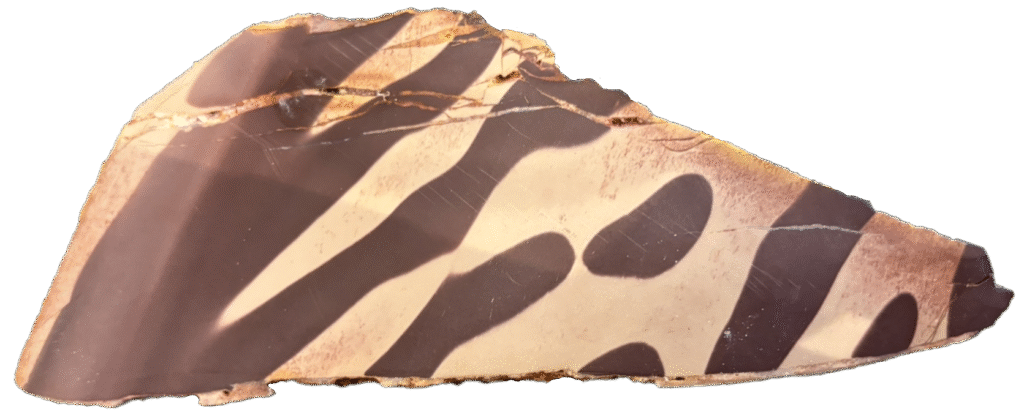
Zebra Rock, renowned for its dramatic streaks of cream and reddish-brown or black, is a unique sedimentary stone that has captivated geologists, collectors, and artisans for its rare beauty. With a history that stretches back over a billion years, Zebra Rock is celebrated for its striking patterns, symbolic meanings, and versatility. This comprehensive article explores its origins, composition, cultural significance, and spiritual connections.
Origins of Its Name and Alternate Names
The name “Zebra Rock” comes from its distinctive banding patterns, reminiscent of the stripes on a zebra. The term captures the natural artistry of the stone’s contrasting colours, which have become its signature.
Alternate names include “Zebra Stone,” “Striped Jasper,” and “Ribbon Stone,” though some of these names might refer to different stones with similar appearances. In Australia, where it is prominently found, it is simply referred to as Zebra Rock.
Composition and Physical Characteristics
Zebra Rock is a sedimentary stone composed primarily of fine-grained quartz and clay minerals, with the characteristic banding caused by alternating iron oxide-rich layers. These unique patterns formed over millions of years due to variations in mineral deposition during sedimentation.
Physical Characteristics and Varieties
- Appearance: Cream or light-grey background with reddish-brown or black stripes or spots, creating a zebra-like pattern.
- Lustre: Matte to slightly polished when worked, depending on the finish.
- Hardness: Measures about 5 on the Mohs scale, making it suitable for carving and ornamentation.
- Structure: Fine-grained and often compact, with intricate natural patterns.
Although Zebra Rock doesn’t have officially recognised varieties, specimens can differ in colour intensity, banding width, and complexity.
Geographical Locations
Zebra Rock is predominantly found in Australia, specifically in the East Kimberley region of Western Australia. It is often located in ancient riverbeds and sedimentary deposits. Some limited deposits of stones with zebra-like patterns have been found in other parts of the world, though the Australian variety remains the most famous.
Notable locations include:
- Lake Argyle, Australia: The primary and most renowned source of Zebra Rock.
- Mexico: Some striped jaspers are occasionally mistaken for Zebra Rock.
- India and Africa: Stones with similar banding patterns may appear, though they are geologically distinct from Australian Zebra Rock.
Historical Usage and Archaeological Finds
Zebra Rock holds a rich history connected to its Australian roots. Indigenous Australians have long appreciated the stone for its beauty and rarity, possibly using it in tools or ceremonial artefacts. While direct archaeological evidence of its ancient usage is rare, its prominence in traditional storytelling suggests a cultural connection.
In modern times, Zebra Rock has been widely used for jewellery, sculptures, and ornamental objects. Its visually striking patterns make it a favourite for artisans creating unique decorative pieces.
Interesting Facts
- Zebra Rock is estimated to be over 1.2 billion years old, making it one of the world’s most ancient stones with such intricate patterns.
- Despite its striking appearance, Zebra Rock is relatively soft compared to other stones, allowing for intricate carving and polishing.
- The Kimberley region in Australia hosts an annual Zebra Rock festival, celebrating this unique gemstone and its local significance.
Folklore, Superstition, Legends, and Tales
Indigenous legends surrounding Zebra Rock often regard it as a gift from the Dreamtime, the spiritual belief system of Australia’s Aboriginal peoples. Its patterns are thought to symbolise the interconnectedness of life, representing unity and balance.
In modern metaphysical lore, Zebra Rock is said to harmonise opposing forces, such as masculine and feminine energies or emotional and rational thinking. Some believe it serves as a grounding stone, offering stability in chaotic times and encouraging clarity in decision-making.
Its unique patterns are also seen as a reminder of individuality and personal growth, with each stripe symbolising life’s journey and experiences.
Mystical Healing Properties
Zebra Rock is valued in holistic and metaphysical practices for its grounding and balancing energy:
- Emotional Healing: Promotes inner harmony, emotional stability, and stress relief.
- Physical Healing: Believed to improve circulation, boost physical stamina, and support detoxification.
- Spiritual Healing: Encourages self-awareness, spiritual connection, and alignment of personal energy fields.
Ideal Crystal Partners
- Smoky Quartz (Deep Grounding & Transmutation)
- Why it works: Zebra Rock anchors erratic energy, while Smoky Quartz actively neutralizes negative emotional static. Together, they create a heavy protective circuit that prevents emotional overwhelm and burnout.
- Best for: Stress relief, shadow work, and stabilizing chaotic environments.
- Black Tourmaline or Shungite (Energetic Shielding)
- Why it works: Zebra Rock works primarily on personal balance and physical stamina, but it has a receptive quality. Pairing it with a dense, non-absorbent barrier stone like Black Tourmaline seals the energetic perimeter so Zebra Rock can focus on internal equilibrium.
- Best for: Grid anchoring, boundary-setting, and workplace protection.
- Carnelian (Physical Vitality & Creative Action)
- Why it works: Carnelian shares the ferric/iron resonance found in the red-brown banding of Australian Zebra Rock. While Zebra Rock provides endurance and prevents rushing, Carnelian supplies the spark of motivation to move projects from planning into execution.
- Best for: Long-term creative projects, physical stamina, and overcoming inertia.
- Clear Quartz or White Howlite (Harmonising Duality)
- Why it works: White Howlite reinforces the calming, yin aspect of Zebra Rock’s white silicate/calcite layers, while Clear Quartz amplifies the contrast between the dark and light bands, facilitating clear perspective in decision-making.
- Best for: Meditation on conflicting choices, objective problem-solving, and emotional cool-down.
- Tiger’s Eye (Pragmatic Focus & Solar Plexus Integration)
- Why it works: Both are quintessential Earth-element companions. Tiger’s Eye brings discernment and strategic will, preventing Zebra Rock’s stabilizing weight from turning into complacency or sluggishness.
- Best for: Practical business decisions, financial planning, and task completion.
Stones to Avoid Pairing With Zebra Rock
- Moldavite & High-Vibration Tektites (Frequency Clashing)
- The conflict: Moldavite is rapid, catalytic, and ungrounding; it pushes energy upward and outward. Zebra Rock is dense, structural, and rhythmic. Combining them often feels energetically “jarring” or dizzying, diluting the steadying benefits of the Zebra Rock while dampening the cosmic reach of the tektite.
- Malachite (Amplification Overload)
- The conflict: Malachite is a forceful, unrestrained emotional amplifier that pulls repressed patterns to the surface. Zebra Rock prioritizes steady containment and equilibrium. Pairing them can trigger internal friction—creating a push-pull dynamic where one stone exposes raw emotional turbulence while the other attempts to anchor it down.
- Selenite / Satin Spar (Structural & Elemental Friction)
- The conflict: Selenite operates as a high-frequency, etheric conduit (Air/Light), dissipating density. When placed alongside Zebra Rock in personal carry or meditation, Selenite often leaves Zebra Rock feeling flat, while Zebra Rock pulls Selenite down from its higher crown-attuned vibration. (Note: Occasional cleansing on a Selenite plate is fine; simultaneous intent/grid pairing is where they counter each other).
- Blue Lace Agate / Celestite (Stagnant Calming)
- The conflict: While not dangerous, pairing Zebra Rock with ultra-gentle, passive throat/third-eye stones often produces excessive inertia. Because Zebra Rock is already steady and deliberate, combining it with heavily sedating stones can sap motivation and lead to lethargy.
Quick Reference: Pairing Matrix
| Companion Stone | Resonance / Target | Primary Function | Pairing Compatibility |
| Smoky Quartz | Root Chakra / Earth | Stabilizes aura, absorbs dense static | Ideal |
| Carnelian | Sacral & Root / Earth + Fire | Converts steady endurance into tangible action | Ideal |
| Black Tourmaline | Root Chakra / Earth | Provides the defensive barrier Zebra Rock lacks | Ideal |
| Tiger’s Eye | Root & Solar Plexus / Earth | Sharpens practical focus and strategic execution | Ideal |
| Moldavite | Heart to Crown / Cosmic Storm | Erratic, ungrounding tension; clashes with dense siltstone | Avoid |
| Malachite | Heart & Solar Plexus / Water + Fire | Agitates deep emotions; fights Zebra Rock’s containment | Avoid |
| Celestite | Crown & Throat / Air | Promotes excessive inertia and passive stagnation | Avoid |
Astrological Links and the Chakra System
Zebra Rock is connected to multiple chakras and astrological signs, making it a versatile gemstone:
- Root Chakra: Its grounding energy resonates deeply with the Root Chakra, fostering stability, security, and a sense of belonging.
- Crown Chakra: The contrasting stripes symbolise higher balance, aligning with the Crown Chakra to enhance spiritual awareness and personal growth.
- Sacral Chakra: The reddish tones found in Zebra Rock energise the Sacral Chakra, stimulating creativity and passion.
Astrologically, Zebra Rock resonates with Virgo, supporting clarity and organisation, and Capricorn, enhancing focus and determination. It also aligns with Pisces, promoting a deeper understanding of interconnectedness.
Use as a Birthstone and Wedding Anniversary Gift
Although not an official birthstone, Zebra Rock is often chosen as a symbolic stone for those seeking balance and creativity.
As a wedding anniversary gift, Zebra Rock represents the harmony and unity of opposites, making it an ideal gesture for couples celebrating their enduring partnership.
Zebra Rock Frequently Asked Questions
What is Zebra Rock and why does it have its characteristic zebra-like pattern?
Zebra Rock is a sedimentary stone made mainly of fine-grained quartz and clay minerals. Its stripes come from alternating iron oxide–rich layers that formed over millions of years during sediment deposition.
Where is Zebra Rock commonly found and are there other places with similar stones?
Zebra Rock is predominantly found in Australia, especially in the East Kimberley region of Western Australia, with Lake Argyle being the primary source. Other places, like Mexico, India, and Africa, have stones with similar banding but they are geologically distinct from Australian Zebra Rock.
What are the typical physical characteristics and how hard is Zebra Rock?
Zebra Rock typically has a cream or light-grey background with reddish-brown or black stripes. It has a matte to slightly polished lustre and a hardness of about 5 on the Mohs scale, making it suitable for carving and ornamentation.
What are the metaphysical and healing properties associated with Zebra Rock?
In holistic practices, Zebra Rock is believed to promote emotional balance, reduce stress, support circulation and stamina physically, and aid in self-awareness and spiritual connection.
Can Zebra Rock be used as a birthstone or wedding anniversary gift, and what does it symbolise?
Although not an official birthstone, Zebra Rock is used as a symbolic stone for balance and creativity. As a wedding anniversary gift, it represents harmony and the unity of opposites.
These are my personally selected and curated Zebra Rock products