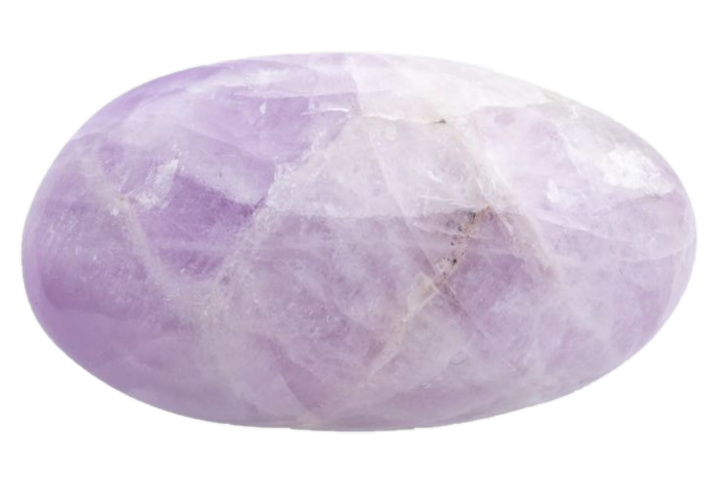
Kunzite is an enchanting gemstone celebrated for its soft lilac, lavender, and pastel-pink palette, accompanied by glassy transparency and vitreous lustre. Discovered in Southern California at the dawn of the 20th century, it quickly captured the attention of fine jewellers and mineral collectors worldwide.
Beyond its aesthetic appeal, kunzite holds a notable place in mineralogy as the gem-quality pink variety of spodumene. It exhibits strong optical pleochroism—revealing deep orchid tones down its crystallographic axis and paler or near-colourless shades from the sides—alongside pronounced fluorescence and phosphorescence under ultraviolet light.
Alternate names
While most commonly marketed under its primary name, kunzite is referenced by several mineralogical and informal designations:
- Pink Spodumene: Its official, descriptive mineralogical label.
- California Iris: An early trade name coined shortly after its discovery in San Diego County to celebrate its violet and lavender flashes.
- The Evening Stone: A widely used jewellery epithet referencing the stone’s photosensitivity; prolonged exposure to direct sunlight causes its pink coloration to fade, making it best worn during twilight or evening events.
- Lilac Spodumene: A descriptor often applied to deeper-toned specimens exhibiting stronger violet-purple overtones.
The stones Science and Composition
Kunzite is a lithium aluminium pyroxene silicate with the chemical formula $\text{LiAl(SiO}_3)_2$ or $\text{LiAlSi}_2\text{O}_6$. It forms within lithium-rich granitic pegmatites during late-stage hydrothermal crystallisation.
- Coloration Chemistry: The delicate pink-to-violet hues are produced by trace substitutions of trivalent manganese ($\text{Mn}^{3+}$) substituting for aluminium ($\text{Al}^{3+}$) in octahedral coordination sites within the crystal lattice.
- Luminescence & Phosphorescence: Kunzite typically displays strong orange-to-magenta fluorescence under long-wave ultraviolet (LWUV) radiation and weaker emission under short-wave UV (SWUV). When irradiated with X-rays or exposed to intense UV, some specimens exhibit notable phosphorescence, continuing to glow with an orange-red light in the dark after the source is removed.
- Photochemical Instability: The chromophoric charge state of $\text{Mn}^{3+}$ is relatively unstable. Continued exposure to heat or UV radiation (such as direct sunlight) can induce photo-reduction or electron transfer that bleaches the crystal to an off-white or clear state.
Key Physical Characteristics
| Property | Mineralogical Specification |
| Chemical Formula | $\text{LiAlSi}_2\text{O}_6$ |
| Crystal System | Monoclinic ($2/m$) |
| Mohs Hardness | 6.5 – 7.0 |
| Cleavage | Perfect in two directions intersecting at approximately 87° and 93° ($[110]$ planes) |
| Fracture | Uneven to subconchoidal; splintery |
| Tenacity | Brittle |
| Refractive Index (RI) | $n_\alpha = 1.653 – 1.660$, $n_\beta = 1.660 – 1.666$, $n_\gamma = 1.668 – 1.679$ |
| Birefringence | +0.014 to +0.016 (biaxial positive) |
| Specific Gravity | 3.16 – 3.20 |
| Lustre | Vitreous; pearly on cleavage planes |
| Pleochroism | Strong trichroism: Deep pink/lilac $\leftrightarrow$ pale rose $\leftrightarrow$ colourless |
Common Geologic Varieties
Spodumene occurs in several distinct varieties governed by trace element substitutions:
- Kunzite: Manganese-bearing ($\text{Mn}^{3+}$), yielding pale pink, rose, orchid, and rich lilac tones.
- Hiddenite: Chromium-bearing ($\text{Cr}^{3+}$) spodumene that displays light-to-deep emerald and bottle green hues. Originally discovered in Alexander County, North Carolina.
- Triphane: An overarching trade name for yellow, yellow-green, or colourless spodumene devoid of significant manganese or chromium activation.
- Patrokeite (Non-standard / Trade): An informal designation sometimes used by gem traders for vibrant bluish-green spodumene varieties discovered in Afghanistan.
Global Mining and Volcanic Sources
Kunzite does not form in volcanic surface flows (extrusive igneous rocks); instead, it develops within deep-seated granitic pegmatites—coarse-grained intrusive formations rich in rare, volatile-compatible elements like lithium, beryllium, boron, and fluorine.
Major Geographic Localities
- Afghanistan (Nuristan & Laghman Provinces): Currently the premier source of gem-quality kunzite. Localities such as the Dara-i-Pech and Mawi pegmatite fields yield large, deeply saturated lilac crystals.
- Brazil (Minas Gerais): Renowned for the Urucum and Barra de Salinas pegmatites, producing sizeable, transparent, pastel-pink prisms often associated with tourmaline and morganite.
- United States (San Diego County, California): The historical type locality, centred around the Pala District (notably the Oceanview and Elizabeth R mines).
- Madagascar: Known for deposits in the Antsirabe and Sahatany valleys, yielding transparent, pale lilac-to-pink rough.
- Pakistan & Mozambique: Additional sources producing collector-grade transparent crystals in localised lithium pegmatite zones.
Crystal Pairings: What to Combine and Avoid
Optimal Crystal Pairings
- Morganite: Both stones originate in granitic pegmatites and share a complementary high-vibrational heart focus. Combining them amplifies themes of unconditional compassion and emotional soothing.
- Rose Quartz: While kunzite addresses higher spiritual love and emotional clearing, rose quartz provides a steady, grounding baseline of self-acceptance and gentle comfort.
- Moldavite: When pairing the high-frequency clearing of kunzite with moldavite, practitioners use kunzite’s soothing pink aura to cushion the intense transformational surge associated with tektites.
- Lepidolite: A lithium-mica mineral frequently found in the exact same pegmatite cavities as kunzite. Energetically, their shared lithium content makes them a natural pairing for stress alleviation and nervous system calm.
Crystal Pairings to Avoid
- Intense Fire Stones (Carnelian, Red Jasper, Pyrite): High-drive, fiery stones that stimulate the lower chakras can overwhelm or clash with kunzite’s delicate, receptive frequency.
- Dense Grounding Minerals (Haematite, Black Tourmaline): While useful for balance, excessively heavy, inward-drawing stones can mute the subtle, expansive emotional qualities of kunzite if used without an intermediary stone.
Archaeology, Art and Ancient History
Because kunzite was only formally identified in 1902, it lacks an ancient archaeological footprint. In antiquity, spodumene in general was occasionally encountered alongside quartz and feldspar, but was not singled out or catalogued as a distinct gem.
The material first came to prominence when specimens from Pala, California, were sent to George Frederick Kunz, Tiffany & Co.’s chief gemologist. Kunz recognised the crystals as a previously unclassified, gem-quality variety of spodumene. Tiffany & Co. introduced the lilac gem to the fine jewellery market, rapidly integrating it into Edwardian and Art Deco brooches, rings, and high-society parures.
Folklore, Legends and Sacred Tales
Because of its modern emergence, kunzite does not possess centuries-old mythological texts. Instead, a modern romantic lore has formed around it:
- The Talisman of Vulnerability: Contemporary folklore describes kunzite as a protective shield for the sensitive heart, asserting that it allows wearers to remain open and emotionally expressive without taking on external negativity.
- The “Sunset Stone” Legends: Mineral folklore attributes kunzite’s fading tendency to an energetic bond with evening light, leading to tales that it absorbs twilight energy and must rest away from the harsh light of the day to protect its core harmony.
Metaphysical and Mystical Healing Properties
In alternative healing and crystal therapy traditions, kunzite is regarded as a primary master of the emotional realm:
- Emotional Reconditioning: Practitioners employ kunzite to dissolve deep-seated emotional trauma, grief, and anxiety, helping release patterns of emotional resistance.
- Heart-Mind Integration: It is said to act as a energetic conduit between the heart and intellect, encouraging compassionate communication and thoughtful action.
- Stress Dissipation: Believed by crystal practitioners to resonate with the physical heart, vagus nerve, and circulation, serving as an energetic stabiliser during panic or sensory overload.
Astrological Connections
Kunzite aligns with the following signs:
- Taurus & Libra (Governed by Venus): Connects with Venusian principles of harmony, artistic appreciation, partnership, and emotional equilibrium. It grounds Taurus’s affections and elevates Libra’s diplomacy.
- Scorpio: Acts as a softening agent for Scorpio’s intense emotional undercurrents, providing emotional ease and forgiveness.
- Pisces: Enhances Neptune-ruled intuition and spiritual sensitivity while shielding empathetic boundaries.
The Chakra System
Kunzite works primarily across two focal energy centres:
- Heart Chakra (Anahata): Opens the emotional core, encouraging the release of protective walls, fear, and sorrow.
- High Heart / Thymus Chakra: Positioned between the heart and throat, this cent er governs transpersonal compassion and unconditional acceptance. Kunzite is considered one of the premier activating stones for this nexus.
- Crown Chakra (Sahasrara): Pale lilac and violet varieties help align heart-centred love with higher consciousness and meditative focus.
Interesting facts
- Named for a Legend: Named after George F. Kunz, who served as Tiffany & Co.’s resident gem genius and was instrumental in popularising morganite and benitoite as well.
- The Lapidary’s Nightmare: Cutting kunzite is notoriously challenging. Its two-directional, perfect prismatic cleavage means an unintended tap or incorrect blade angle along the cleavage axis will split the rough instantly.
- Strong Pleochroism: Cutters must orient the table of the gem perpendicular to the crystal’s c-axis to display the deepest pink or violet hue face-up, otherwise the stone will look washed-out or colourless.
- Reversible Colour: Some kunzite treated with gamma or neutron irradiation turns a vibrant emerald green (resembling hiddenite), though this artificially induced green typically fades back to pink or clear upon exposure to heat or UV light.
Modern Milestones: Birthstones and Anniversaries
- Alternative Birthstone: Kunzite serves as a modern alternate birthstone for September (sharing pastel violet tones with purple sapphire) and February (as a gentle companion to amethyst).
- Anniversary Associations: While not in the historical traditional lists, contemporary fine jewellers offer kunzite for the 11th and 18th wedding anniversaries, symbolising enduring devotion, emotional renewal, and mutual empathy.
Extensive FAQ Section
Is kunzite safe for everyday ring wear?
Kunzite has a Mohs hardness of 6.5 to 7, but its perfect cleavage and brittleness make it vulnerable to damage from accidental impacts. Rings should use protective bezel or halo settings and are best reserved for occasional or evening wear. Pendants, earrings, and brooches carry far less risk of impact.
Will my kunzite fade if worn outside?
Yes, prolonged exposure to bright sunlight or intense ultraviolet light can fade kunzite’s pink hue to near-colourless. For everyday activities, avoid wearing it to the beach, pool, or during extended daytime sun exposure. Store it in a closed, dark jewellery box when not in use.
How should I clean and care for kunzite jewellery?
Clean with lukewarm water, mild dish soap, and a soft-bristled brush. Never clean kunzite in an ultrasonic or steam cleaner; thermal shock and acoustic vibrations can easily cleave the stone along its internal planes.
How can I distinguish natural kunzite from pink glass or synthetic cubic zirconia?
Natural kunzite feels cold to the touch and demonstrates distinct pleochroism (shifting from deep pink to pale or colourless as it is rotated under light). Glass and cubic zirconia are singly refractive and show zero pleochroism. Synthetic cubic zirconia is also noticeably heavier (specific gravity ~5.6–6.0 vs. kunzite’s 3.18).
Does kunzite undergo gemstone treatments?
Yes. Much of the commercial kunzite on the market is heated or irradiated to enhance its pink-to-violet saturation. Pale brownish-pink or greenish-violet rough from pegmatites is often heated gently to around 150°C–200°C to drive out yellowish or brownish undertones, yielding pure pastel pink.
These are my personally selected and curated Kunzite products