Iolite is a magnesium aluminium silicate gemstone celebrated for its rich, twilight-violet hues and optical properties. Deriving its name from the Greek ios, meaning violet, this silicate mineral has long captured human imagination—from Norse navigators using thin mineral plates as daylight polarising filters to modern gemmologists studying trichroic colour shifts. Operating under the mineralogical name cordierite, fine-grade iolite serves as a natural, untreated alternative to sapphire and tanzanite. Blending structural durability with delicate directional cleavage, iolite acts as a premier focal point for gem cutters, mineral collectors, and holistic energy practitioners alike.
Alternate Names
- Cordierite: The mineralogical and geological designation, named in honour of French engineer and geologist Pierre Louis Antoine Cordier in 1813.
- Viking’s Compass / Sunstone (Sólarsteinn): Rooted in maritime history, referencing its historical function as an atmospheric light-polarising navigational tool.
- Water Sapphire (Sapphire d’eau): An archaic trade misnomer historically used by jewellers due to its sapphire-like blue face-up tone when viewed along a specific crystal axis.
- Dichroite: An early mineralogical term coined by Jean-Claude Delamétherie in 1796, referencing its distinct optical pleochroism (“two-coloured stone”).
- Steinheilite: A regional variant named after Count Fabian Steinheil, a former Governor-General of Finland, used to describe specimens found in Finnish pegmatites.
The Stone’s Science and Composition
Iolite is a cyclosilicate mineral with an ideal chemical formula of:
$$\text{Mg}_2\text{Al}_4\text{Si}_5\text{O}_{18}$$
It forms a solid solution series with sekaninaite, its iron-rich counterpart where divalent iron ($\text{Fe}^{2+}$) replaces magnesium ($\text{Mg}^{2+}$). The structural backbone of iolite consists of interconnected six-membered rings of silicate $(\text{SiO}_4)$ and aluminate $(\text{AlO}_4)$ tetrahedra aligned parallel to the $c$-axis.
These ring structures create open channels that run through the crystal lattice, commonly hosting variable amounts of water $(\text{H}_2\text{O})$, carbon dioxide $(\text{CO}_2)$, and volatile alkali ions such as sodium $(\text{Na}^+)$ or potassium $(\text{K}^+)$.
The violet-blue colouration is driven primarily by intervalence charge transfer between iron ions ($\text{Fe}^{2+} \rightarrow \text{Fe}^{3+}$) situated in edge-sharing octahedral and tetrahedral sites.
Key Physical Characteristics
| Property | Specification / Value |
| Mohs Hardness | 7.0 – 7.5 |
| Crystal System | Orthorhombic (often pseudo-hexagonal twinning) |
| Refractive Index | $n_\alpha = 1.527–1.560$, $n_\beta = 1.532–1.574$, $n_\gamma = 1.537–1.578$ |
| Birefringence | $\delta = 0.008 – 0.011$ (Biaxial Negative or Positive) |
| Specific Gravity | 2.53 – 2.78 (increases with iron content) |
| Cleavage | Distinct/fair on $\{010\}$; poor on $\{100\}$ and $\{001\}$ |
| Fracture | Subconchoidal to uneven; brittle |
| Lustre | Vitreous to sub-vitreous; greasy on fracture surfaces |
| Streak | White |
| Pleochroism | Extreme (Trichroic): Deep violet-blue / Pale blue / Pale yellow to brownish-grey |
Common Geologic Varieties
- Bloodshot Iolite: Characterised by oriented, plate like inclusions of haematite ($\text{Fe}_2\text{O}_3$) or goethite. When light hits these inclusions, the gem displays a shimmering red aventurescence or iridescent glitter contrasting against the blue matrix.
- Cat’s Eye Iolite (Chatoyant): Formed when the stone contains parallel, needle-like inclusions (often sillimanite or rutile). When cut en cabochon parallel to these structures, a distinct light band moves across the dome.
- Star Iolite (Asteriated): A rare variety featuring intersecting sets of oriented inclusions, resulting in a 4-ray or weak 6-ray asterism under direct, point-source lighting.
- Gem-Grade Violet Iolite: Transparent, inclusion-free material showcasing the classic deep blue-violet tone along its primary optical axis.
- Indialite: The high-temperature hexagonal polymorph of cordierite, typically discovered in thermally metamorphosed, melted sediments (buchites).
Global Mining and Volcanic Sources
Iolite is primarily a metamorphic mineral, developing under medium- to high-grade regional and contact metamorphism in pelitic (argillaceous) rocks. It frequently occurs in cordierite-gneisses, schists, hornfels, and granitic pegmatites. It is also found in some volcanic environments, such as contaminated aluminous volcanic ejecta and calc-alkaline lavas.
- Madagascar: Produces rich violet, gem-quality rough from alluvial gravels and pegmatitic zones around Ihosy and Antsirabe.
- India: Extensive alluvial deposits in Orissa (Odisha), Tamil Nadu, and Karnataka provide a large portion of commercial-grade faceting material and bloodshot specimens.
- Sri Lanka (Ratnapura District): Mined alongside sapphires and spinels in water-worn “gem gravel” (illam) placers, producing transparent water-sapphire stones.
- Myanmar (Mogok Stone Tract): Yields high-clarity rough from secondary metamorphic alluvial beds.
- Tanzania & Kenya: Significant finds in the Umba Valley and artisanal pits within the Mozambique Orogenic Belt.
- Northern Europe (Norway & Finland): Historic hard-rock localities (e.g., Kragerø and Orijärvi) produce large crystals embedded in gneissic matrix, primarily sought by mineralogists.
- North America: Notable regional deposits exist in Wyoming (pelitic gneisses of the Laramie Range) and pegmatite dikes across Connecticut and Canada.
Crystal Pairings: What to Combine and Avoid
Optimal Crystal Pairings
- Clear Quartz: Acts as an amplifier. Because iolite’s optical clarity reflects its internal structural channels, quartz bolsters the transmission of focused vibrational light during meditation.
- Amethyst: Sharing common colourimetric triggers and crown-associated vibrations, amethyst deepens emotional introspection and relieves mental strain.
- Lapis Lazuli & Sodalite: These minerals enhance third-eye resonance, creating a synergistic frequency that sharpens logic, speech, and mental acuity.
- Labradorite: Complements iolite’s navigational energy, combining high-frequency intuitive insight with protective grounding fields.
- Rose Quartz: Soothes the sometimes sharp mental clarity induced by iolite, integrating intellectual insight with heart-centred emotional healing.
Crystal Pairings to Avoid
- Carnelian & Red Jasper: The aggressive, fire-element vitality of these stones can disrupt the cooling, introspective stillness fostered by iolite’s wind/water profile.
- High-Density Ferrous Anchors (e.g., Raw Haematite): While mild grounding stones work well, overly dense iron oxides can overwhelm iolite’s delicate pleochroic frequency, anchoring consciousness too heavily into the physical realm.
- Black Obsidian: The rapid, raw emotional purge initiated by obsidian often clashes with iolite’s steady, introspective discernment, creating emotional discord during energy work.
Archaeology, Art and Ancient History
Iolite’s most celebrated historical chapter is its association with medieval Norse seafarers. Navigating open, fog-laden waters in the North Atlantic without a magnetic compass, Norse navigators relied on “sunstones” (sólarsteinn).
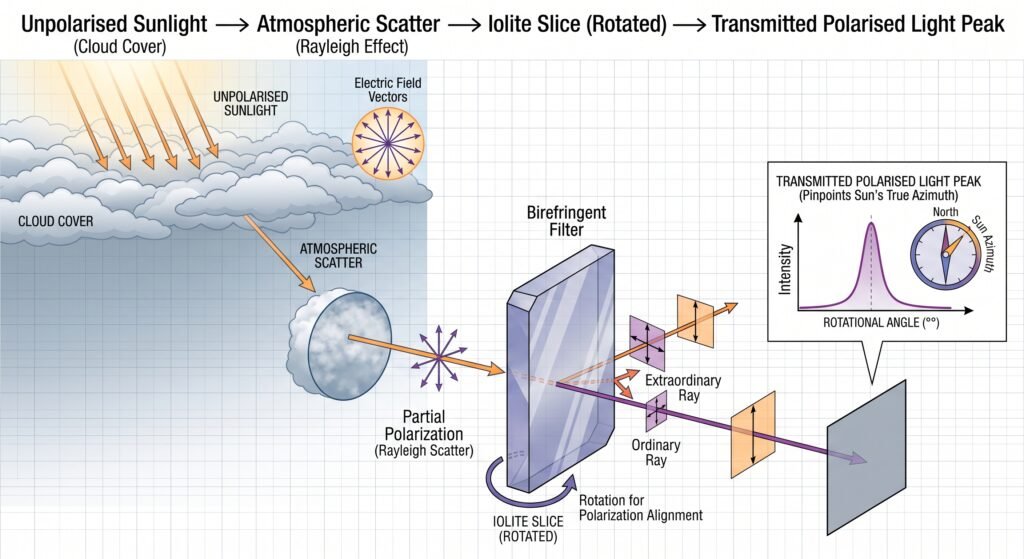
Because iolite possesses strong pleochroism, a thin, cleaved slice acts as an atmospheric polarising filter. By rotating the crystal across an overcast sky, mariners could identify the sun’s hidden coordinates through the polarisation rings of Rayleigh sky scattering:
Outside Norse maritime lore, iolite historically served as an ornamental surrogate for sapphire along Central Asian trade networks. In 18th- and 19th-century Europe, jewel cutters fashioned it into intaglios and rings under the name saphir d’eau, though its directional cleavage presented challenges for intricate carving.
Folklore, Legends and Sacred Tales
Ancient maritime lore held that iolite contained the essence of the ocean’s twilight hours, calming waters and protecting travellers during long sea voyages. Shamanic traditions across early Eurasian communities viewed the stone as an inner key capable of untangling psychological knots and revealing the true self.
Legend held that wearing iolite under a crescent moon unlocked prophetic visions, shielding the wearer from illusion, deception, and mental fog. It was commonly termed the “Gem of the Clear Horizon,” believed to attune wandering souls to their destiny when they lost their moral or physical direction.
Metaphysical and Mystical Healing Properties
- Emotional Rebalancing: Dismantles patterns of emotional codependency, replaces victimhood narratives with self-responsibility, and calms discordant thoughts.
- Intellectual Focus: Bridges logical analysis with intuitive leaps, making it valuable for study, strategic planning, and complex problem-solving.
- Subtle Body Detoxification: Energy medicine practitioners associate iolite with the energetic clearing of metabolic debris, especially regarding liver and digestive meridian pathways.
- Sleep Architecture: Placing iolite near the bedside is said to balance circadian sleep rhythms, ease insomnia, and encourage vivid, coherent dream recall.
- Visionary Exploration: Serves as an energetic anchor during astral projection, shamanic breathwork, and targeted visualisation.
Astrological Connections
- Sagittarius: As a sign driven by exploration and philosophical truth, Sagittarius finds an intellectual and spiritual compass in iolite, grounding excessive fire into focused vision.
- Libra: Iolite helps Libras move past analysis paralysis, aligning the scales of balance with intuitive decisiveness.
- Pisces: Enhances the water sign’s intuitive flow while providing the structural mental clarity needed to prevent emotional overwhelm.
- Elemental Association:Wind/Air (intellect, intuition, perception) supplemented by a subordinate Water frequency (calm, emotional depth).
The Chakra System
- The Third Eye Chakra (Ajna): Iolite’s primary energy centre. By stimulating the pineal region, it clears energetic blockages that cloud intuition, spiritual insight, and dream interpretation.
- The Crown Chakra (Sahasrara): Connects mundane thoughts with higher philosophical planes, allowing cosmic concepts to be understood in practical, daily life.
- The Throat Chakra (Vishuddha): Through its soft blue pleochroic axis, iolite encourages the articulation of inner visions, ensuring intuitive perceptions are communicated with clarity and truth.
Interesting Facts
- Extreme Optical Shift: Iolite is among the most intensely trichroic minerals on Earth. A single gem shifts from cornflower-blue to water-clear yellow and deep violet-grey simply by turning the crystal in the hand.
- Untreated Nature: Unlike sapphire (heat-treated) or tanzanite (nearly always heated), iolite reacts poorly to thermal stress. As a result, the gem material on the market is almost entirely 100% natural and unheated.
- The Lapidary’s Challenge: Gem cutters must orient the rough stone precisely. If the table facet is misaligned by even a few degrees, the finished gem displays an unattractive yellowish-grey tone rather than its signature violet-blue.
- Industrial Application: Synthetic cordierite ceramic exhibits an extremely low coefficient of thermal expansion, making it a key component in catalytic converter substrates for modern automobile exhaust systems.
Modern Milestones: Birthstones and Anniversaries
- Alternative September Birthstone: Serves as a budget-friendly, natural substitute for blue sapphire, celebrated for its unique violet undertones.
- 21st Wedding Anniversary Gemstone: Traditionally exchanged to mark 21 years of marriage, symbolising sustained harmony, emotional independence, shared direction, and mutual vision.
Frequently Asked Questions
How can I identify genuine iolite from blue sapphire or tanzanite?
The simplest method is observing pleochroism. Tanzanite shifts between blue, purple, and burgundy, whereas iolite shifts between deep violet-blue, light blue, and a distinctive pale yellow or brownish-grey. Sapphire shows much less visible colour shift under rotation. Iolite also possesses a lower refractive index ($1.53–1.55$) and lower specific gravity ($2.58$) than both alternatives.
Is iolite durable enough for everyday ring wear?
While iolite rates at a respectable 7–7.5 on the Mohs hardness scale, it features distinct cleavage in one direction. A direct blow along this cleavage plane can cause fractures. It is best set in protective bezel rings, pendants, or earrings, and kept away from rough impact
How should I clean and care for my iolite jewellery?
Clean using warm water, mild soap, and a soft-bristled brush. Never expose iolite to ultrasonic baths or steam cleaners, as high-frequency vibrations and rapid temperature changes can split the crystal along its cleavage planes.
Why is iolite so affordable compared to other blue stones?
Despite its beauty, iolite remains undervalued due to historically modest marketing and lapidary challenges—misaligned cutting ruins the stone’s colour. This creates an advantage for collectors who want a pure, untreated blue-violet gem at a accessible price point.
Can iolite fade in the sun?
No. Because iolite’s colour comes from internal iron-transfer chemistry rather than unstable colour centres or superficial radiation, it will not fade under prolonged exposure to natural sunlight.
These are my personally selected and curated Iolite products