Fluorite stands as one of the most visually captivating and structurally organised minerals on Earth. Celebrated as “the most colourful mineral in the world,” this calcium halide stone forms in vibrant, translucent bands of green, purple, blue, yellow, and rare pink. Beyond its striking aesthetic, fluorite is highly valued across industrial manufacturing, optical engineering, and metaphysical practices. It serves as a premier tool for mental clarity, psychic protection, and structural order, bridging the gap between rigid physical geometry and fluid spiritual alignment.
Alternate names
- Fluorspar: The primary industrial and bulk trading term for the mineral.
- Ore Flower: A poetic designation coined by miners during the Middle Ages.
- Murra / Vasa Murrina: The ancient Roman terms for fluorite-bearing vessels and materials.
- Derbyshire Spar: A local geographical name for varieties mined in England.
- Blue John: A rare, highly prized variety featuring distinct purple, blue, and yellow banding.
The stones Science and Composition
Chemically classified as calcium fluoride, fluorite has the molecular formula $CaF_2$. It crystallised within the isometric system, commonly manifesting as pristine cubes, octahedrons, and interpenetrating twins.
Fluorite is the structural origin of the term fluorescence. When exposed to ultraviolet light, it typically glows a vivid blue-violet, though some specimens emit cream or white tones, and others display no reaction. This optical phenomenon is triggered by trace elements—such as yttrium, europium, and samarium—substituting for calcium within the crystal lattice.
The mineral features distinct chemical anomalies across its sub-varieties:
- Antozonite (Fetid Fluorite): Contains free elemental fluorine clusters. When crushed, the mechanical stress releases these clusters, reacting with atmospheric oxygen and water vapour to produce an unmistakable, unpleasant ozone odour.
- Chlorophane: Displays thermoluminescence, a property causing the mineral to emit a bright green visible light when heated, which can be triggered by the simple warmth of a human hand.
Key Physical Characteristics
- Mohs Hardness: 4 (the definitive index mineral for this rank).
- Cleavage: Perfect octahedral cleavage in four directions, meaning it fractures easily into geometric octahedrons.
- Luster: Vitreous (glass-like).
- Specific Gravity: 3.175 to 3.56.
- Transparency: Transparent to translucent.
- Color Phenomena: Prone to colour-zoning due to fluctuating trace elements during growth, alongside strong colour-change properties when transitioned between daylight and incandescent illumination.
Common Geologic Varieties
- Blue John: Found exclusively in a single, localised hydrothermal vein system in Castleton, Derbyshire, UK. It features iconic concentric bands of deep blue, purple, and cream-yellow.
- Antozonite: Recognised by its dark violet to black hue and chemical odour upon fracturing.
- Chlorophane: A rare variety that reacts to thermal energy with luminous green emissions.
- Yttrofluorite: A variety where trivalent yttrium partially replaces the calcium ions, altering its structural density and optical traits.
Global Mining and Volcanic Sources
Fluorite deposits form predominantly in low-temperature hydrothermal veins, frequently acting as a gangue mineral alongside metallic ores like lead, zinc, and silver. It also occurs in sedimentary carbonate rocks and certain volcanic environments. China stands as the world’s leading industrial supplier. Major deposits are also mined in Mexico, South Africa, Namibia, Germany, and the United States (where it is the state mineral of Illinois). The unique Blue John variety remains strictly confined to the Treak Cliff and Blue John caverns in Derbyshire, England.
Crystal Pairings: What to Combine and Avoid
Blending fluorite with other minerals can either stabilise its structural mental energy or create vibrational interference.
Optimal Crystal Pairings
- Clear Quartz or Amethyst: Amplifies fluorite’s innate focus, heightening psychic development and clearing cognitive clutter.
- Black Tourmaline or Smoky Quartz: Restrains fluorite’s high-vibrational mental energy, grounding it into the physical body and reinforcing an energetic shield against negativity.
- Citrine: Synergies perfectly with yellow fluorite to activate the solar plexus, boosting creative drive and manifestation practices.
Crystal Pairings to Avoid
- High-Intensity Tektites (e.g., Moldavite): The chaotic, rapid transformational energies of tektites clash with fluorite’s fundamental purpose of bringing order, structure, and calm organisation to the mind.
- Malachite: While green fluorite balances emotions, malachite forcefully pulls deep-seated emotional trauma to the surface, which can overwhelm the stabilising framework fluorite tries to build.
Archaeology, Art and Ancient History
Fluorite holds an elite status in ancient lapidary arts. In ancient Egypt, craftsmen carved it into ornate beads, sacred scarabs, and religious artifacts. In ancient China, green fluorite was highly prized as an accessible, elegant substitute for jade in monumental stone sculptures.
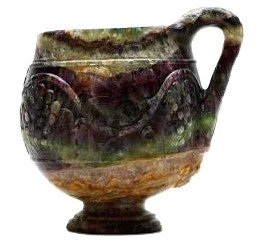
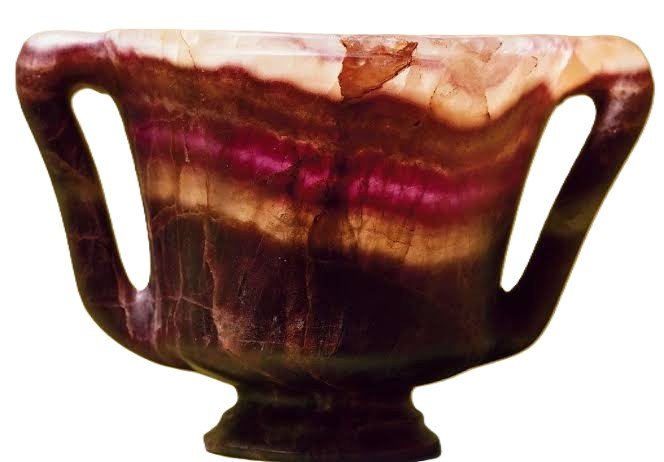
The Roman Empire held a profound obsession with fluorite vessels, which they called vasa murrina (Murrine cups). These luxury items first flooded Rome under Pompey the Great in 62–1 BCE following his Eastern conquests. Because raw fluorite is highly fragile and prone to shattering along its perfect cleavage lines, Persian and Roman artisans applied a specialised myrrh resin to the stone during the carving process. When used to drink wine, the residual resin imparted a strange, sweet, and highly celebrated flavour to the vintage.
Historical demand for these items was staggering. The Roman historian Pliny the Elder documented that Emperor Nero paid 1,000,000 sesterces for a single fluorspar cup, while a former consul spent 70,000 sesterces on another, becoming so fiercely attached to the vessel that he reportedly gnawed its rim. Archaeologists have confirmed this Roman obsession by discovering fluorine-based artifacts among the volcanic ruins of Pompeii. Today, the British Museum preserves two of the finest surviving Roman fluorite vessels: the Barber Cup and the Crawford Cup.
Folklore, Legends and Sacred Tales
Throughout history, fluorite has been steeped in protective lore. Ancient Chinese practitioners utilised deep scarlet fluorite as a powerful talisman to ward off malevolent spirits and negative entities. During the Middle Ages, European miners dubbed it the “ore flower,” believing its presence underground signalled nearby wealth and rich veins of precious metals. The Romans also harboured a widespread belief that drinking wine from a vessel carved of fluorite acted as a preventative shield against intoxication, keeping the mind clear.
Metaphysical and Mystical Healing Properties
Metaphysically, fluorite operates as an exceptional aura cleanser and stabiliser. It actively absorbs and neutralises environmental stress, electromagnetic smog, and localised negative energies. Known colloquially as the “Genius Stone,” it coordinates thoughts, making it an essential asset for students, researchers, and creative professionals who struggle with structural chaos or executive dysfunction. It enhances memory retention, accelerates decision-making, and builds deep self-confidence by allowing thoughts to flow freely without dissolving into anxiety.
Astrological Connections
Fluorite shares its primary astrological affinity with the sign of Libra. Librans, who naturally seek equilibrium but frequently succumb to indecisiveness and choice paralysis, benefit from fluorite’s structural clarity. The stone strengthens their confidence when navigating monumental, future-altering decisions. It also aligns well with Capricorn by reinforcing their natural affinity for discipline and orderly progress, and Pisces by offering a grounding anchor for their fluid, intuitive minds.
The Chakra System
Fluorite’s diverse colour spectrum allows it to align across multiple energetic points within the body:
- Pink Fluorite: Opens and repairs the Heart Chakra, facilitating radical self-love and deep emotional recovery.
- Black Fluorite: Roots into the Base Chakra, functioning as a premier purifier that seals the emotional body against toxic environments.
- Purple Fluorite: Stimulates the Third Eye and Crown Chakras, aligning the conscious mind with higher vibrational frequencies to aid spiritual ascension.
- Blue Fluorite: Resonates with the Throat Chakra, pacifying intense emotions and providing teachers, public speakers, and artists with clear, articulate communication.
- Colourless Fluorite: Directs pure light straight into the Third Eye Chakra, amplifying intuitive insights and latent psychic faculties.
- Green Fluorite: Bridges the Heart and Mind, harmonising the entire chakra system while bringing emotional impulses and rational thoughts into balance.
- Yellow Fluorite: Connects the Solar Plexus directly to the Third Eye, creating a powerful pathway for authentic self-expression, enhanced creativity, and intellectual confidence.
Interesting facts
- The word fluorite is derived from the Latin root fluere, meaning “to flow,” referencing its common use as a flux to lower the melting point of metals during smelting.
- When fluorite is treated with sulphuric acid, it produces hydrofluoric acid—a compound so corrosive it is used commercially to etch intricate designs directly into glass.
- Industrial-grade fluorite (fluorspar) is traded globally in three distinct purity tiers: acid grade, ceramic grade, and metallurgical grade.
Modern Milestones: Birthstones and Anniversaries
While fluorite is not recognised as a traditional or modern birthstone on standard commercial monthly charts, it is globally embraced as an alternate zodiac stone for those born under Libra and Pisces. In modern metaphysical anniversary traditions, it is an ideal gift for the 19th year of marriage, celebrating the enduring clarity, flexibility, and vibrant, multi-layered growth of a long-term partnership.
Fluorite Frequently Asked Questions FAQ
Can fluorite be cleansed in water?
No, fluorite should not be submerged in water for extended periods. Because it has a low score of 4 on the Mohs hardness scale and contains water-soluble fluorine ions, prolonged exposure can degrade its vitreous polish, dull its surface, and leach out trace elements over time. Use smoke cleansing, sound, or selenite plates instead.
Why does some fluorite smell like sulphur or chemicals when broken?
This occurs exclusively in the Antozonite variety. The mineral matrix contains trapped pockets of elemental fluorine gas. When the crystal is crushed, cleaved, or damaged, the gas escapes and instantly reacts with ambient oxygen and moisture to generate ozone, which produces a sharp, pungent, chemically distinct odour.
Is fluorite safe to handle if it contains fluorine?
Yes, polished and intact rough specimens of fluorite are completely safe to handle and display. The calcium-fluorine bond is highly stable. The only caution lies in avoiding the inhalation of dust from cutting or drilling raw specimens, and avoiding raw Antozonite if it is cracked open in unventilated spaces. Do not use fluorite in direct elixirs.
What makes Blue John fluorite so valuable?
Blue John is valued for its extreme geological scarcity and unique aesthetic. It is found in only one specific hillside cave network in Derbyshire, UK. The mining yield is strictly regulated and highly finite, making authentic antique pieces and modern jewellery carvings highly collectible.
How do I tell if my fluorite is real or synthetic glass?
Real fluorite will feel significantly cooler to the touch than glass, will possess distinct four-directional cleavage lines under magnification, and can be easily scratched by a steel blade or pocket knife (which has a hardness of around 5.5). Most genuine specimens will also reveal vibrant, sharp colour zoning bands rather than perfectly uniform dye saturation.