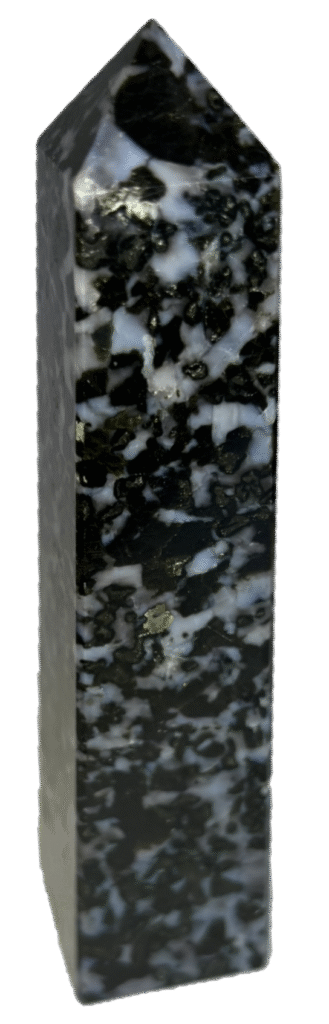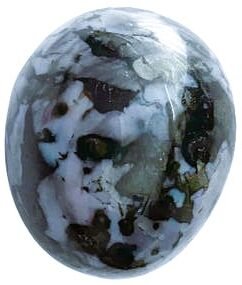
Gabbro Indigo Merlinite is a captivating, multi-mineral stone celebrated for its striking aesthetic and profound spiritual resonance. Primarily composed of gabbro—a coarse-grained, intrusive igneous rock—interwoven with distinct mineral inclusions, this stone features dramatic, swirling patterns of deep black, charcoal, and shimmering indigo. Named after the legendary wizard Merlin, it symbolises hidden knowledge, spiritual awakening, and the delicate duality between light and shadow. Today, it is highly sought after by collectors for its geological complexity and by metaphysical practitioners who utilise its grounding yet expansive energy for deep meditation, shadow work, and personal transformation.
Alternate Names
To navigate the gemstone market effectively, it helps to know the various trade and colloquial names for this mineral combination. It is frequently marketed under the following titles:
- Mystic Merlinite (The most common commercial trade name)
- Indigo Merlinite
- Merlinite Gabbro
- Black Gabbro (Though this often refers to the base rock without the specific indigo inclusions)
The Stone’s Science and Composition
Geologically, the foundation of this stone is gabbro, a plutonic rock formed when molten magma is trapped beneath the Earth’s surface and cools slowly into a deeply crystalline structure.
Chemically and mineralogically, it is low in silica and rich in iron and magnesium (mafic). The composition primarily consists of calcium-rich plagioclase feldspar (such as anorthite or labradorite) and pyroxene (clinopyroxene). The mesmerising “indigo” and “merlinite” effects are created by inclusions of accessory minerals—such as magnetite, ilmenite, quartz, and occasional dendritic manganese oxides—which create the swirling, high-contrast aesthetics.
Key Physical Characteristics
Understanding the physical properties of Gabbro Indigo Merlinite helps in identifying genuine specimens and ensuring their proper care:
- Mohs Hardness: 6 to 7. This makes the stone relatively durable, scratch-resistant, and excellent for lapidary work, though it should still be protected from harsher minerals like quartz or topaz.
- Lustre: Vitreous (glass-like) to sub-metallic on polished surfaces, depending on the concentration of iron-titanium oxides.
- Colour Palette: A mottled matrix of deep black, dark grey, and smoky white, highlighted by flashes of midnight blue and rich indigo.
- Texture: Coarse-grained and phaneritic, meaning the individual mineral crystals are visible to the naked eye.
Common Geologic Varieties
While all Gabbro Indigo Merlinite shares a similar volcanic origin, specimens generally fall into three visual and structural varieties:
- Classic Indigo Merlinite: Characterised by a dominant, deep black gabbro matrix interrupted by fluid, flowing veins of indigo and dark blue.
- High-Contrast Mystic Merlinite: Displays stark, bold patterns featuring sharp delineations between light grey or white feldspar patches and pitch-black pyroxene.
- Polished Merlinite Gabbro: Specially selected cuts that are tumbled or carved. The polishing process brings out the sub-surface chatoyancy and depth of the indigo minerals, optimising the stone’s tactile feel.
Global Mining and Volcanic Sources
Gabbro itself is found worldwide, but the specific, high-quality aesthetic variety known as Indigo Merlinite is highly localised.
- Madagascar: The premier global source. The island’s unique tectonic history yields specimens with the highest contrast and most vibrant indigo colouration.
- Other Notable Deposits: Smaller, variant deposits are mined in Australia, Canada, and the United States (particularly in the American Southwest). However, Madagascar remains the gold standard for commercial gemstone trade.
Crystal Pairings: What to Combine and Avoid
In metaphysical practices, pairing crystals can either amplify a specific intention or create an energetic mismatch.
Optimal Crystal Pairings
- Labradorite: Because labradorite is a plagioclase feldspar (sharing a genetic link to gabbro), this pairing heavily amplifies mystical vision, psychic insight, and auric protection.
- Black Obsidian: A powerful grounding stone. When paired with Merlinite, obsidian acts as an anchor, ensuring you remain safe and grounded during deep shadow work or past-life regression.
- Amethyst: Connects seamlessly with the stone’s indigo frequencies to enhance dream recall, lucid dreaming, and high-vibrational spiritual awareness.
Crystal Pairings to Avoid
- Carnelian: The fiery, highly externalised, and action-oriented energy of carnelian directly clashes with the quiet, introspective, and subterranean nature of Indigo Merlinite.
- Citrine: Citrine projects a bright, solar, and light-hearted frequency. This can muddy or overpower the deep, transformative, “shadow-integration” energy required when working with Merlinite.
Archaeology, Art, and Ancient History
From an archaeological standpoint, “Gabbro Indigo Merlinite” as a distinct trade name is a modern convention. Ancient civilisations did not distinguish this specific variety from standard black stones. However, basic gabbro was widely utilised. In ancient Egypt and Mesopotamia, its durability made it a prized material for carving heavy statuary, cylinder seals, and durable temple thresholds. In art history, polished gabbro variants have occasionally been used as architectural trim and ornamental facades due to their deep, cosmic appearance when polished.
Folklore, Legends, and Sacred Tales
The folklore surrounding this stone is heavily intertwined with Western esoteric traditions. Named in Honor of the archetypal wizard Merlin, modern legends claim the stone holds the elemental memories of the Earth, alchemy, and wizardry.
Lore dictates that Indigo Merlinite acts as a bridge between the seen and unseen worlds. It is spoken of in pagan traditions as a stone of the “Hedge Rider”—someone who can walk the boundary between the physical realm and the spiritual ether. It is believed to help the user face their inner “shadow self” to achieve true spiritual alchemy.
Metaphysical and Mystical Healing Properties
In contemporary crystal healing, Gabbro Indigo Merlinite is considered a master stone of duality. It teaches that light and dark, wisdom and mystery, are complementary forces.
- Emotional Integration: It is highly prized for “shadow work”—the process of uncovering and healing buried emotional traumas, secrets, and repressed traits.
- Spiritual Expansion: Practitioners use it to access the Akashic Records, unlock past-life memories, and accelerate the development of clairvoyant gifts.
- Grounding Transformation: Unlike other high-vibration spiritual stones that can leave a user feeling spaced out, the gabbro base ensures that spiritual growth is firmly rooted in physical reality.
Astrological Connections
While anyone can benefit from the stone, it shares a profound resonance with three specific zodiac signs:
- Scorpio: As a sign governed by Pluto and deeply tied to rebirth, secrets, and transformation, Scorpio finds a perfect ally in Merlinite’s capacity for shadow work.
- Pisces: This water sign benefits from the stone’s ability to anchor their vast, sometimes overwhelming intuitive and psychic sensitivities.
- Sagittarius: Complements the centaur’s quest for higher philosophical truth, expanding spiritual awareness and magical exploration.
The Chakra System
Gabbro Indigo Merlinite works primarily as a bridge between the lower and upper chakras:
- The Root Chakra (Muladhara): The heavy, iron-rich gabbro anchors your physical body to the Earth, providing safety, stability, and presence.
- The Third Eye Chakra (Ajna): The indigo minerals stimulate the pineal gland, opening the gateway to intuition, inner vision, and higher consciousness.
Interesting Facts
- Space Ties: Gabbro is not just an earthly rock; analyses of lunar samples brought back by the Apollo missions revealed that gabbro is a major component of the Moon’s maria (the dark plains we see from Earth).
- Optical Illusion: The deep indigo flashes in the stone are often an optical effect caused by the interference of light within the microscopic layers of its feldspar crystals.
- Shamanic Tool: Due to its split black-and-white/indigo appearance, it is globally utilised as a balancing tool to harmonise masculine (yin) and feminine (yang) energies.
Modern Milestones: Birthstones and Anniversaries
- Alternative Birthstone: While not found on the traditional birthstone charts, it has emerged as a popular modern alternative birthstone for those born under the signs of Scorpio and Pisces.
- Wedding Anniversary: It is an ideal, meaningful gift for the 14th wedding anniversary. At this milestone, relationships often transition from foundational stability to deeper spiritual partnership, mirroring the transformative nature of the stone.
Gabbro Indigo Merlinite FAQ
How do I cleanse and charge my Gabbro Indigo Merlinite?
Because it contains iron-bearing minerals like pyroxene and magnetite, avoid prolonged exposure to water or salt, which can degrade the stone over time. Instead, cleanse it using smoke (sage, Palo Santo), sound therapy (singing bowls), or by placing it on a selenite charging plate. To recharge its energy, place it under the light of a Full Moon.
Is Gabbro Indigo Merlinite the same as Dendritic Agate?
No. While Dendritic Agate is sometimes colloquially referred to as “Merlinite” in the crystal trade due to its black-and-white contrast, it is a completely different mineral (chalcedony/quartz with manganese dendrites). Gabbro Indigo Merlinite is an igneous, plutonic rock with a completely different crystalline structure, hardness, and mineral makeup.
Can I wear Indigo Merlinite every day?
Yes. With a Mohs hardness of 6 to 7, it is durable enough for daily wear in rings, pendants, or bracelets. However, because it actively stirs up deep emotional processing, pay attention to your mood; if you feel emotionally overwhelmed, take a break from wearing it for a few days.
How can I tell if my specimen is real?
Genuine Gabbro Indigo Merlinite should feel heavy in the hand due to its iron and magnesium content, and it will feel cool to the touch. Look for a coarse, interlocking crystalline texture under a magnifying glass. Fake versions made of resin or glass will feel warm, light, and will often show tiny air bubbles under the surface.
These are my personally selected and curated Gabbro Indigo Merlinite products