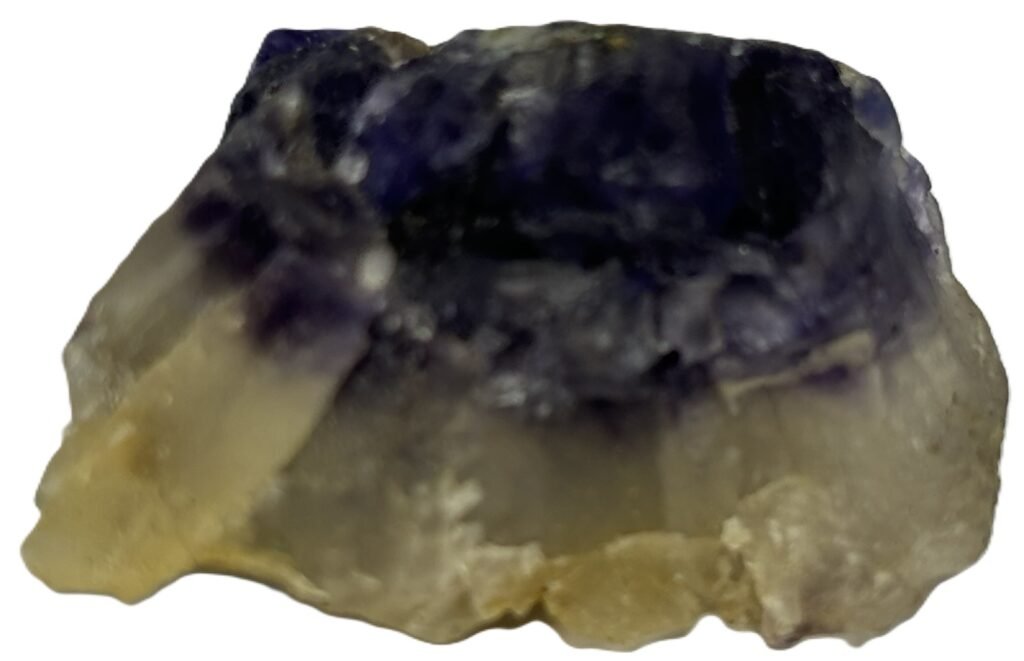
Blue John, also famously known as Derbyshire Spar, is one of the rarest and most visually captivating gemstones in the world. Characterised by its exquisite, banded veins of deep purple-blue, lavender, and creamy yellow, this unique variety of fluorite is highly prized by collectors, jewellers, and mineral enthusiasts alike.
Steeped in rich British history, Blue John is celebrated not only for its ornamental grandeur but also for its profound grounding and balancing metaphysical properties.
Composition and Physical Characteristics
Chemically, Blue John is a mineral form of calcium fluoride ($\text{CaF}_2$), falling under the fluorite family. However, unlike standard single-colour fluorite, Blue John is defined by its striking, concentric banded layers.
Physical Properties:
- Chemical Formula: $\text{CaF}_2$ (Calcium Fluoride)
- Crystal System: Cubic (though typically found in massive, banded crystalline aggregates)
- Hardness: 4 on the Mohs scale
- Lustre: Vitreous (glassy) to dull
- Transparency: Translucent to nearly opaque
- Colour Palette: Deep royal purple, violet, violet-blue, honey yellow, and creamy white bands.
The signature banding is widely believed to be the result of periodic disruptions during crystal growth, where trace inclusions of hydrocarbons, organic matter, or colloidal calcium were trapped within the lattice, combined with natural irradiation. Because it is a soft mineral (Mohs 4) with perfect octahedral cleavage, it is highly fragile and challenging to carve. Traditional artisans must treat the raw stone by soaking it in hot resin to stabilize it before cutting or polishing.
Origins and the Etymology of Blue John
The most extraordinary fact about Blue John is its extreme geographic rarity. In the entire world, genuine Blue John is found only in a single location: the limestone hills surrounding Castleton in Derbyshire, England, specifically within Blue John Cavern and Treak Cliff Cavern. Because these deposits are strictly protected and heavily depleted, only limited, artisanal amounts are mined each year.
Where Does the Name Come From?
There are several fascinating theories regarding how the stone earned its name:
- The French Connection (Bleu-Jaune): The most common explanation is that the name derives from the French words bleu-jaune, meaning ‘blue-yellow’. During the reign of Louis XVI (1774–1791), large quantities of the stone were exported to France, where master ormolu craftsmen used it to create luxury gilt-bronze urns, vases, and clock cases.
- The Miners’ “Black Jack”: Another theory stems from old English lead miners. They colloquially referred to the zinc ore sphalerite as “Black Jack”. When they discovered this beautiful blue-banded fluorite in the same caverns, it is highly plausible they dubbed it “Blue John” as a contrast.
- Cornish Language Roots: A third version points to Cornish miners who moved to the Derbyshire lead mines in the 1740s. The word “Blue John” was used for various colourful fluorspars in Cornwall and may derive from the Cornish word bleujenn (or blodon in Old Cornish), which translates to a flower, bloom, or blossom—a nod to the stone’s vibrant, blooming patterns.
Historical Significance & Archaeological Finds
Blue John has a long and illustrious history as a luxury decorative material. While it is often associated with Georgian and Victorian splendour, archaeological evidence suggests it was appreciated much earlier.
- Roman Antiquity: Local legends and archaeological theories suggest that the Romans discovered the Castleton deposits during their occupation of Britain. Some historians believe that two famous vessels found at Pompeii were actually carved from Derbyshire Blue John.
- The Medieval & Georgian Eras: In medieval times, small ornamental objects and decorative inlays featured the stone. By the 18th and 19th centuries, Blue John mining reached its zenith. It graced the grandest stately homes of the British nobility—including Chatsworth House, Buckingham Palace, and Kedleston Hall—in the form of massive chalices, monolithic columns, fireplaces, and bespoke jewellery.
Metaphysical and Mystical Healing Properties
In holistic and crystal healing practices, Blue John is revered as a stone of peace, alignment, and intellectual clarity. It carries the ancient, grounded energy of the Derbyshire landscape, bridging the physical world with spiritual wisdom.
Emotional & Mental Healing
- Promotes Emotional Balance: As a stabilizing stone, Blue John absorbs ambient stress, anxiety, and chaotic thoughts. It encourages emotional resilience, helping you remain calm under pressure.
- Enhances Cognitive Focus: Like all fluorites, it acts as a “mental vacuum cleaner,” sorting through cluttered thoughts, improving concentration, and helping structure disorganized ideas.
Spiritual & Astrological Links
- Chakra Connections: Blue John mainly supports the Throat Chakra (Vishuddha), facilitating honest, clear self-expression and diplomatic communication. It also gently activates the Third Eye Chakra (Ajna), which deepens intuition, enhances meditation, and unlocks inner spiritual insights.
- Astrology & Zodiac: It aligns beautifully with Capricorn, supporting their disciplined, grounded nature while offering emotional relief. It also resonates with Pisces, providing structure to their profound emotional depth and enhancing their natural psychic intuition. Its soothing aesthetic is historically mirrored by the gentle, harmonious energies of the planet Venus.
- Birthstone & Anniversaries: While not a traditional birthstone, its scarcity makes it a treasured, symbolic gift for those born in the winter months. It is also an ideal alternative gift for a 12th wedding anniversary, representing enduring, rare beauty and a timeless connection to natural heritage.
Crystal and Stone Pairings
When working with Blue John, choosing the right companion stones can amplify its properties, while incorrect pairings can clash with its delicate, orderly energy.
Best Crystals to Pair with Blue John
- For Enhanced Wisdom & Insight (Third Eye Activation):
- Lapis Lazuli: Combining Lapis Lazuli with Blue John creates a powerhouse for intellectual and spiritual growth. Lapis Lazuli expands the mind, while Blue John organises these higher insights into actionable wisdom.
- Amethyst: Amethyst beautifully complements the purple hues of Blue John. Together, they create a deeply tranquil aura, perfect for entering deep meditative states and enhancing dream recall.
- For Grounding & Manifestation:
- Black Tourmaline or Black Onyx: Because Blue John stimulates high-vibrational mental and spiritual energy, pairing it with a strong grounding stone like Black Onyx or Black Tourmaline helps anchor that insight into physical reality, keeping you protected and stable.
- For Calming Communication (Throat Chakra):
- Blue Lace Agate: This gentle stone introduces a soft, soothing energy. When paired with Blue John, it helps alleviate public speaking anxiety and allows you to articulate complex thoughts with absolute grace.
Pairings to Avoid
- High-Energy Amplifiers (e.g., Carnelian, Sunstone, Clear Quartz): Blue John operates on a frequency of structure, calm, and mental order. High-vibrational, fiery stones like Carnelian or Sunstone can introduce chaotic, overly stimulating energies that disrupt Blue John’s peaceful, balancing nature.
- Aggressive Grounding Stones (e.g., Hematite): While mild grounding stones work well, heavy, metallic stones like Hematite can overpower the delicate, subtle energies of this rare fluorite, rendering its spiritual benefits less effective.
Extensive Frequently Asked Questions (FAQ)
Is Blue John real fluorite?
Yes. Blue John is a specific, rare variety of calcium fluoride ($\text{CaF}_2$), making it chemically a fluorite. What sets it apart from standard fluorite is its unique banded structure, geographical exclusivity, and historical method of resin stabilization.
Can Blue John get wet?
No, it is highly advised to avoid exposing Blue John to water. Because it is a soft mineral (Mohs 4) with natural internal fractures, water can seep into its micro-cracks. Worse still, historically or modernly worked pieces are stabilized using resins or glues which can degrade, turn cloudy, or dissolve when soaked, permanently ruining the stone’s lustre.
How can I tell if my Blue John is genuine?
Genuine Blue John will always exhibit distinct, irregular banded patterns of purple, yellow, and white, with natural imperfections or tiny crystalline growth variations visible under magnification. Because it is strictly mined in Castleton, Derbyshire, authentic pieces will typically come with a certificate of origin from reputable local British lapidaries. Beware of cheap imitations made of dyed glass, plastic, or standard banded fluorite from China or Africa being falsely marketed as Derbyshire Spar.
Can Blue John fade in the sun?
Yes. Like many fluorites, prolonged exposure to direct, harsh sunlight or intense UV rays can cause the vibrant purple and blue bands within Blue John to fade over time. Keep your jewelry or ornamental pieces away from sunny windowsills.
How should I clean and energetically charge Blue John?
- Physical Cleaning: Never use ultrasonic cleaners, steam, or chemical solvents. Instead, simply wipe the stone gently with a dry, soft microfibre cloth.
- Energetic Cleansing: Because water and salt are unsafe for this mineral, cleanse it using safe methods such as passing it through the smoke of sacred incense (like sandalwood or frankincense) or placing it near a sound healing bowl.
- Charging: To recharge its calming energies, leave it out overnight under the gentle light of a full moon. Avoid charging it in the sun.
These are my personally selected and curated Blue John products