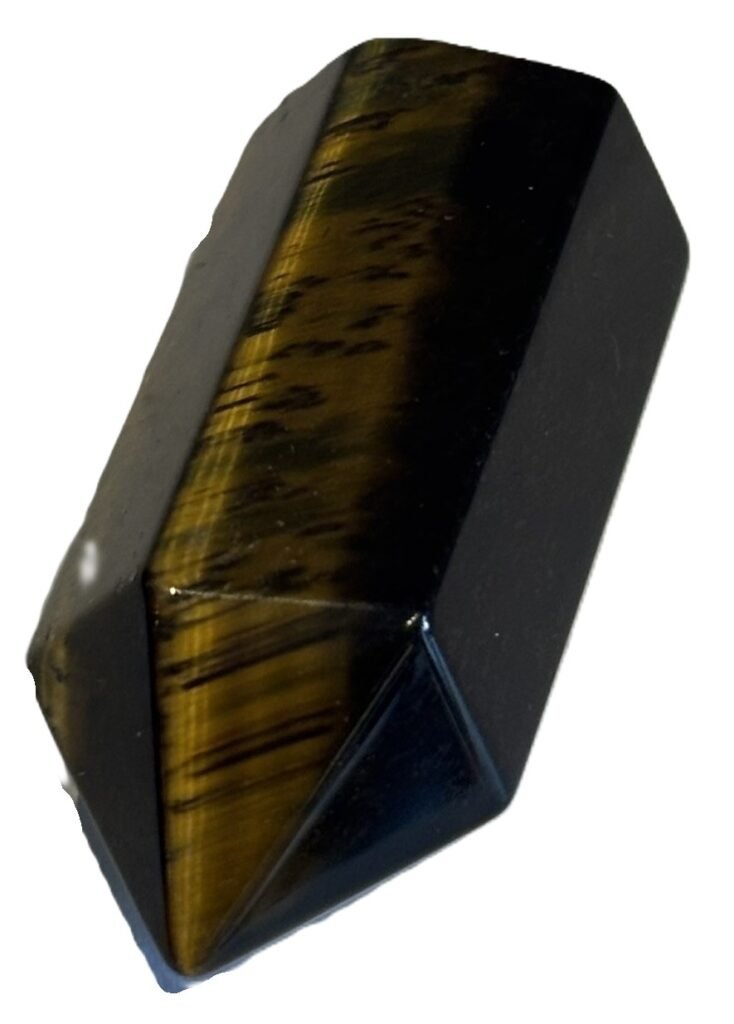
Blue Gold Tiger’s Eye is an exceptional dual-phase gemstone that captures the intermediate stage of a profound geological transformation. Featuring deep indigo and steel-blue ribbons seamlessly interwoven with radiant amber and golden-yellow bands, the stone displays striking natural contrast. This composite variety bridges classic golden Tiger’s Eye and unoxidised blue Hawk’s Eye within a single, highly chatoyant quartz matrix. Coveted by mineral collectors, lapidaries, and energy practitioners alike, Blue Gold Tiger’s Eye unites the grounding, proactive vitality of the golden mineral with the perceptive, calming lucidity of its blue precursor, creating a visually dramatic and versatile mineral specimen.
Alternate Names
Depending on commercial labeling, geological literature, and metaphysical traditions, Blue Gold Tiger’s Eye is recognised by several titles:
- Hawk’s Eye / Falcon’s Eye: Primarily used for the pure blue variety, but frequently applied to specimens showing blue-dominant dual-colour banding.
- Bicolor Tiger’s Eye / Variegated Tiger’s Eye: Lapidary trade names denoting pieces that exhibit both blue and golden hues.
- Zebra Tiger’s Eye: A colloquial commercial term referring to sharply defined, alternating blue and gold striping.
- Silicified Crocidolite: The classical petrological term describing the mineral precursor and its silica-rich replacement.
The Stone’s Science and Composition
Blue Gold Tiger’s Eye belongs to the macrocrystalline quartz family, classified chemically as silicon dioxide ($\text{SiO}_2$). Its characteristic colouration and visual phenomena stem from its formation history.
The Genesis of Chatoyancy
Historically, Tiger’s Eye was described purely as a classic pseudomorph—a complete replacement of fibrous crocidolite (an amphibole mineral of the riebeckite series) by quartz. Modern mineralogical analyses (notably by Heaney and Fisher) demonstrate that it primarily forms via a crack-seal vein mechanism. Quartz and fibrous amphibole crystals precipitate synchronously from hydrothermal fluids in fracturing rock strata. Dense, parallel arrays of microfibers become locked within columnar quartz crystals, creating the optical phenomenon known as chatoyancy (the cat’s-eye effect). Light reflects off these internal fibrous filaments, producing a shimmering, silky sheen perpendicular to the fibre orientation.
The Blue-to-Gold Transition
The distinction between the blue and gold sections lies in the oxidation state of iron:
- The Blue Phase (Hawk’s Eye): Represents original, unoxidized or minimally altered crocidolite ($\text{Na}_2(\text{Fe}^{2+}_3\text{Fe}^{3+}_2)\text{Si}_8\text{O}_{22}(\text{OH})_2$), retaining its natural bluish-gray to deep indigo color.
- The Gold Phase (Tiger’s Eye): Occurs where hydrothermal fluids, oxygen, and weathering break down the crocidolite, converting the ferrous iron into hydrated iron oxides—chiefly limonite and goethite ($\text{FeO(OH)}$). This stains the encapsulating quartz rich amber, yellow, and golden-brown.
- Blue Gold Specimens: Form when this oxidative alteration is arrested mid-process, freezing the specimen in an intermediate state where unaltered blue veins lie adjacent to fully oxidized golden bands.
Key Physical Characteristics
| Property | Value / Characteristic |
| Chemical Formula | $\text{SiO}_2$ (Quartz) with inclusions of amphibole (crocidolite) and goethite/limonite |
| Crystal System | Trigonal (Quartz matrix) |
| Mohs Hardness | 6.5 – 7.0 |
| Luster | Silky on fibrous planes; vitreous when polished |
| Diaphaneity | Opaque to sub-translucent on thin edges |
| Refractive Index | 1.544 – 1.553 |
| Specific Gravity | 2.64 – 2.71 (slightly denser than pure quartz due to iron content) |
| Cleavage | None; possesses a splintery, fibrous fracture along inclusion lines |
| Tenacity | Tough to brittle |
Common Geologic Varieties
- Hawk’s Eye (Blue Tiger’s Eye): The unoxidized, fibrous variety showing dark blue-gray, greenish-blue, or midnight-blue chatoyant bands without yellow staining.
- Golden/Brown Tiger’s Eye: The fully oxidized phase where iron oxide weathering produces warm amber, caramel, and honey-yellow ribbons.
- Red Tiger’s Eye (Dragon’s Eye): Characterized by reddish-brown hues, almost always produced through thermal treatment (natural or artificial) that converts goethite/limonite into hematite ($\text{Fe}_2\text{O}_3$).
- Tiger Iron: A metamorphosed, banded rock composed of alternating layers of golden Tiger’s Eye, deep red jasper, and metallic black/silver hematite.
- Pietersite (Tempest Stone): A brecciated chalcedony containing chaotic, swirl-patterned fragments of both blue Hawk’s Eye and golden Tiger’s Eye cemented by secondary silica.
Global Mining and Volcanic Sources
Contrary to common misconception, Tiger’s Eye does not originate directly within volcanic lava pipes or igneous vents; it forms primarily within banded iron formations (BIFs) subjected to low-grade regional metamorphism and hydrothermal fluid infiltration.
- South Africa (Northern Cape): The world’s primary commercial source. The deposits near Griquatown, Prieska, and the Asbestos Mountains host expansive seams where geological weathering yields both classic gold, blue, and mixed-phase material.
- Western Australia (Pilbara Region): Vast deposits in the Hamersley Range yield high-grade Tiger’s Eye and Tiger Iron, formed within ancient Precambrian sedimentary basins.
- Brazil (Minas Gerais): Produces fine specimens displaying vivid chatoyancy and distinct dual-color zones.
- Namibia: Known for transitional deposits that intergrade between stratified seams and brecciated Pietersite.
- Other Notable Localities: India, the United States (California and Arizona, though some regional types are chrysotile-serpentine pseudomorphs), Canada, and Myanmar.
Crystal Pairings: What to Combine and Avoid
Combining minerals in metaphysical work or jewelry design requires evaluating vibrational intentions, elemental associations, and physical durability.
Optimal Crystal Pairings
- Clear Quartz: Acts as an amplifier. Its neutral, high-frequency energy enhances the dual focus of Blue Gold Tiger’s Eye without skewing the balance between grounded action and mental clarity.
- Black Tourmaline or Smoky Quartz: Pairs well with the stone’s grounding aspects, reinforcing psychic boundaries and energetic anchoring.
- Lapis Lazuli or Sodalite: Resonates with the blue Hawk’s Eye fraction, enhancing upper-chakra alignment, deliberate vocal communication, and introspective depth.
- Citrine or Pyrite: Complements the golden limonite bands, stimulating the Solar Plexus, manifestation drive, and personal empowerment.
- Labradorite: Complements the shifting optical flash of chatoyancy while providing balanced energetic shielding.
Crystal Pairings to Avoid
- Overly Sedative Stones (e.g., Lepidolite, Selenite, Blue Lace Agate): When seeking high motivation and decisiveness, soft, intensely calming stones can dampen the driven, assertive Solar Plexus energy of the golden phase.
- High-Volatility Stones (e.g., Moldavite): The intense, rapid, ungrounding vibration of tektites can clash with the steady, rhythmically stabilizing nature of Tiger’s Eye, leading to mental overstimulation.
- Physical Pairing Considerations: Avoid mounting softer minerals (e.g., Calcite, Fluorite, Selenite—Mohs 3 to 4) alongside Tiger’s Eye (Mohs 7) in tumbling batches or loose jewellery settings, as the harder quartz will scratch softer surfaces.
Archaeology, Art, and Ancient History
Chatoyant stones have drawn human fascination across civilizations:
- Ancient Rome: Roman soldiers wore talismans and amulets of chatoyant quartz carved with symbols into battle, trusting the shifting “eye” to deflect weapons, preserve courage, and sharpen tactical awareness.
- Ancient Egypt: Highly revered as a physical manifestation of divine vision. Tiger’s Eye was frequently incorporated into sacred amulets, scarabs, and the eyes of deity statues (most notably the falcon-headed Horus and the sun deity Ra), symbolizing all-seeing perception and solar authority.
- Decorative Arts: During the Victorian and Edwardian eras, following the discovery of major South African deposits in the 19th century, Tiger’s Eye transitioned into a luxury ornamental stone. European lapidaries carved it into intricate cameos, signet rings, snuffboxes, and ornate cane handles.
Folklore, Legends, and Sacred Tales
- The All-Seeing Gaze: Across Eastern and Mediterranean traditions, chatoyant minerals were viewed as protective talismans against the “Evil Eye” (mati or mal de ojo). The dynamic light line across the stone was believed to act as an unblinking sentinel that reflected curses back to their source.
- The Falcon and the Predator: Folk legends in Africa and the Near East drew symbolic connections between the stone’s dual colors and predatory birds. The blue hue (Hawk’s Eye) was thought to bestow the aerial perspective and foresight of a raptor, while the gold represented the terrestrial stealth and patience of hunting big cats.
- Merchant Lore: In regional trading lore, keeping a dual-toned blue and gold stone within a cash box was said to prevent rash spending (the cooling blue phase) while actively drawing profitable business ventures (the golden solar phase).
Metaphysical and Mystical Healing Properties
Disclaimer: Metaphysical attributes are based on spiritual traditions and modern holistic practices and are not intended as medical advice.
- Mental Clarity & Decisiveness: Uniting calming blue and assertive gold, this stone helps clear mental fog and emotional turbulence, allowing for methodical, confident decision-making.
- Perspective Integration: Hawk’s Eye encourages “the view from 30,000 feet,” helping individuals see broad patterns, while Tiger’s Eye provides the practical focus needed to execute day-to-day steps.
- Emotional Equilibrium: Helps quell impulsive anger, anxiety, and panic by moderating runaway emotional spikes with steady, grounded presence.
- Energetic Protection: Operates as a dynamic shield, deflecting unwanted energetic projections while keeping the aura anchored.
Astrological Connections
- Capricorn: Provides Capricorn with flexible perspective, softening rigid workaholic tendencies via the blue phase while feeding their practical ambitions through the gold.
- Leo: Naturally aligned with the golden, sun-governed Tiger’s Eye. The inclusion of blue crocidolite adds a cooling counterweight, curbing vanity and impulsive drama in favor of measured leadership.
- Gemini: The dual-color banding mirrors Gemini’s dual nature, helping focus erratic thoughts, sharpen concentration, and support clear communication.
- Planetary Rulers: Governed jointly by the Sun (representing the conscious self, vitality, and gold bands) and Saturn/Mercury (reflecting discipline, mental clarity, and deep blue bands).
The Chakra System
Blue Gold Tiger’s Eye works across multiple energy centers simultaneously, creating an energetic bridge between the upper communicative centers and the lower grounding foundations:
- Third Eye Chakra (Ajna): Stimulated by the indigo crocidolite bands, enhancing intuition, discernment, and cognitive clarity.
- Throat Chakra (Vishuddha): Aided by the blue hue, facilitating measured, honest, and diplomatic self-expression.
- Solar Plexus Chakra (Manipura): Activated by the golden limonite bands, fortifying willpower, self-worth, and decisive action.
- Root Chakra (Muladhara): Supported by the stone’s high silica density and iron grounding properties, anchoring spiritual insights into physical reality.
Interesting Facts
- A Natural Time Capsule: Every Blue Gold Tiger’s Eye specimen captures an unfinished chemical reaction preserved under millions of years of geological pressure.
- Asbestos Origins, Completely Safe: Although crocidolite is a member of the hazardous amphibole asbestos family, finished Tiger’s Eye presents zero inhalation hazard. The fibers are completely silicified and sealed within impermeable quartz crystal structures. (Standard respiratory safety measures are required only during dry lapidary cutting or grinding).
- Optical Orientation: Lapidaries must cut Tiger’s Eye with the cabochon base strictly parallel to the fiber alignment. If cut at an angle, the chatoyant “eye” appears dull, washed out, or entirely absent.
Modern Milestones: Birthstones and Anniversaries
- Alternative Birthstone: While not part of the standard modern Western birthstone chart, Tiger’s Eye is recognized as an alternative planetary birthstone for Gemini and an accepted talismanic birthstone for mid-summer births.
- Wedding Anniversaries: Tiger’s Eye is the traditional gemstone associated with the 9th Wedding Anniversary, symbolizing wisdom, mutual protection, and enduring resilience across time.
Frequently Asked Questions
Is Blue Gold Tiger’s Eye naturally occurring?
Yes. Natural Blue Gold Tiger’s Eye occurs when the silicification and oxidation of crocidolite fibers into limonite-stained quartz is interrupted by geological shifts, leaving distinct blue (unoxidized) and gold (oxidized) bands in the same stone.
How can I tell if my Blue Gold Tiger’s Eye is dyed?
Natural blue Tiger’s Eye displays a muted, grayish-blue, midnight-blue, or steel-teal hue alongside warm golden-amber. If the blue sections appear neon, bright royal blue, or purple, or if concentrated dye pools in surface fractures, the stone has likely been artificially dyed or acid-bleached and tinted.
Is Blue Gold Tiger’s Eye safe to put in water?
Brief rinsing under cool, clean water is completely safe due to its quartz hardness (Mohs 6.5–7). However, avoid soaking the stone for extended periods, especially in saltwater, which can dull polished finishes and degrade micro-fractures containing porous iron oxides.
Is the crocidolite asbestos content dangerous?
In its rough, polished, or tumbled form, it is entirely safe to handle, wear, and display. The microfibers are fully embedded inside solid, non-porous crystalline quartz. Lapidaries cutting or grinding rough material must use wet saws and appropriate particulate respirators to avoid inhaling airborne mineral dust.
How do I cleanse and charge Blue Gold Tiger’s Eye?
Cleanse the stone using smoke (cedar, sage, or incense), sound vibrations, or a bed of hematite or clear quartz. Because it carries both solar (gold) and lunar/aerial (blue) associations, charge it under early morning sunlight for active drive or overnight under the light of a full moon for intuitive clarity. Avoid prolonged midday sun exposure, which can slowly alter delicate iron coloration over time.
These are my personally selected and curated Blue Gold tiger’s Eye
Products by Category