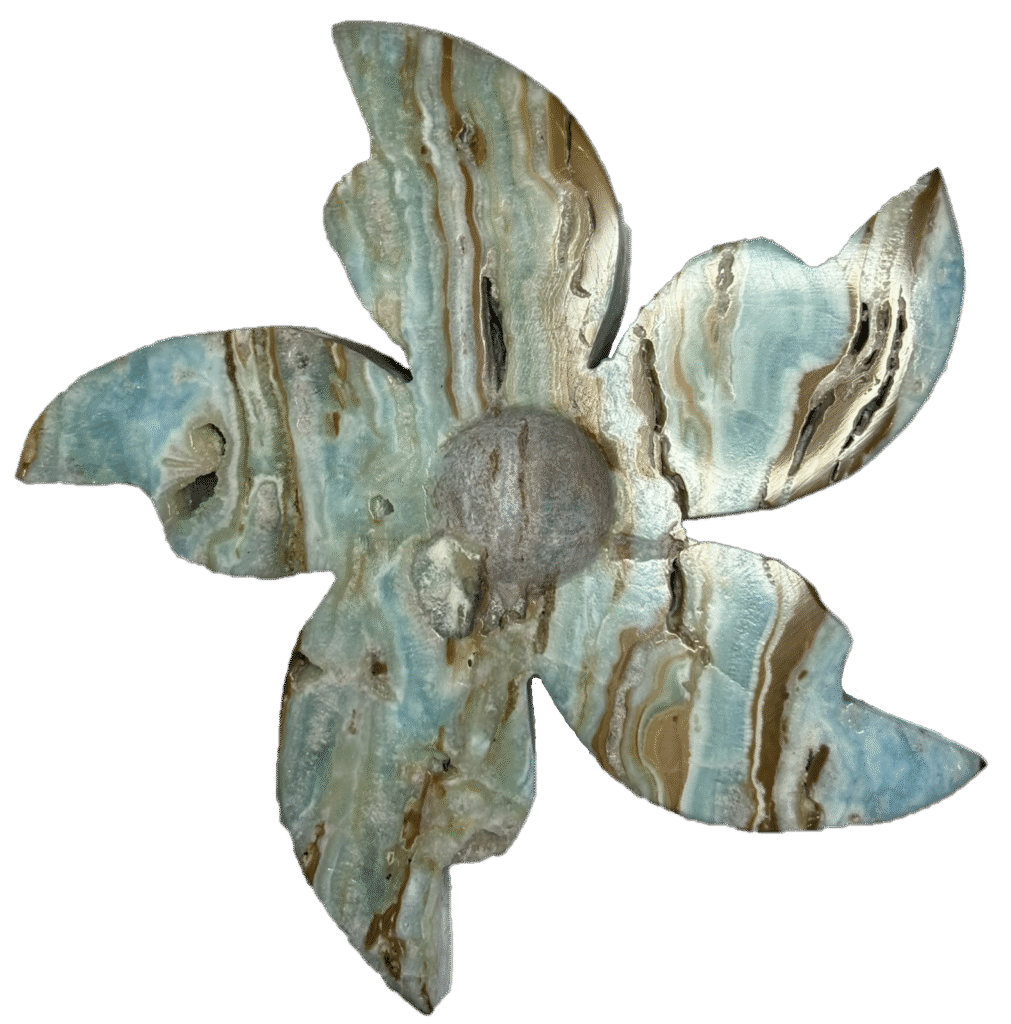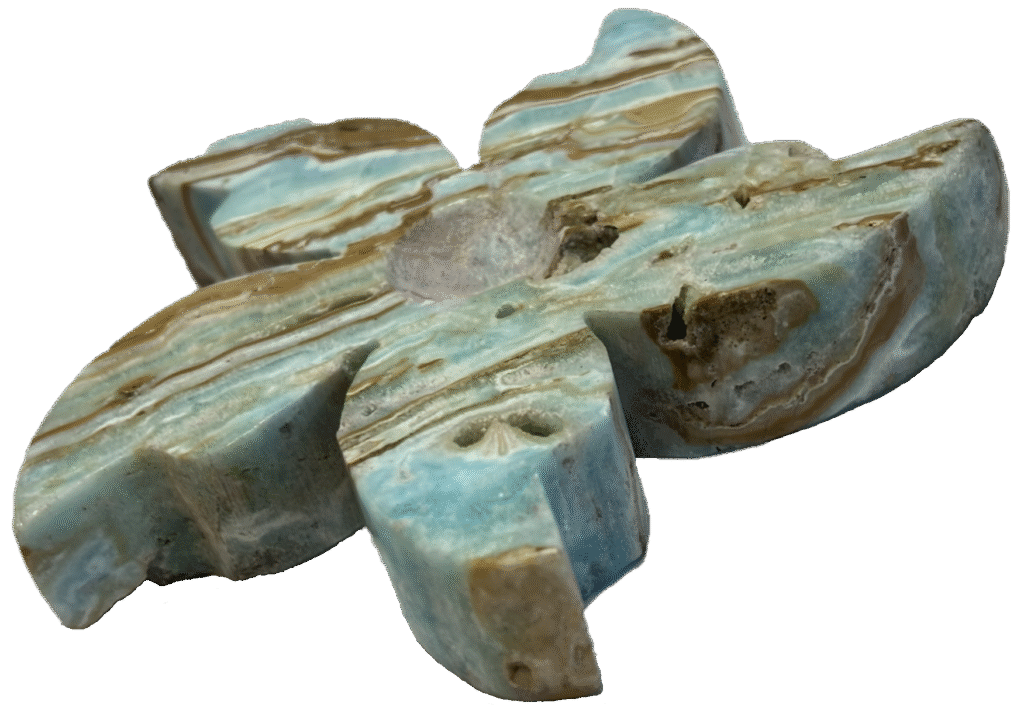
Blue Aragonite is a captivating and tranquil mineral that instantly draws attention with its soothing, tropical-sea hues. Renowned for its beautiful visual appeal and its profound metaphysical reputation, this gemstone is highly prized by collectors, jewellers, and spiritual practitioners alike. As a stone deeply tied to personal growth, emotional expression, and inner peace, it serves as a powerful catalyst for expanding communication and soothing an overactive mind.
Origins of the Name and Alternate Names
Blue Aragonite derives its name from the Aragon region of Spain, where it was first discovered and documented in the 18th century. The mineral group was officially named by Abbé René Just Haüy, a celebrated French mineralogist, in recognition of its geographic roots.
Depending on its precise shades and patterns, it is known by several evocative alternate names across the gemstone industry:
- Ocean Aragonite: A trade name inspired by its striking resemblance to the shifting blues and greens of tropical waters.
- Aqua Aragonite: Highlighting its soft, premium aquamarine to turquoise shades.
- Sky Aragonite: A lyrical name inspired by its pastel, sky-like hues.
Composition and Physical Characteristics
Blue Aragonite is a calcium carbonate mineral ($\text{CaCO}_3$) that primarily forms in sedimentary and hydrothermal environments, often developing in hot springs or cave systems over thousands of years. Interestingly, it is chemically identical to calcite, but it crystallises within the orthorhombic system, giving it entirely distinct physical and structural properties.
Physical Properties:
- Chemical Formula: $\text{CaCO}_3$ (Calcium Carbonate)
- Crystal System: Orthorhombic (forming acicular, prismatic, or radiating clusters)
- Hardness: 3.5 – 4 on the Mohs scale
- Lustre: Vitreous (glass-like) to silky
- Transparency: Transparent to translucent
- Streak: White
- Fracture: Brittle, conchoidal
- Cleavage: Distinct
Varieties of Blue Aragonite
The appearance of Blue Aragonite varies beautifully depending on local mineral inclusions, trace elements (such as copper), and how the crystal structures aggregate:
- Pure Blue Aragonite: Found in delicate, uniform pastel blue tones, typically displaying a high level of translucency.
- Blue-Green Aragonite: Exhibits subtle ocean-green undertones, heavily influenced by underlying trace copper impurities.
- Botryoidal Blue Aragonite: Forms in rounded, bubble-like clusters that closely resemble exotic coral formations.
- Fibrous Blue Aragonite: Displays radiating, needle-like structures that showcase a highly reflective, silky sheen.
Global Sources: Where is Blue Aragonite Found?
Blue Aragonite is relatively rare compared to its white or orange counterparts. Major global deposits of high-quality specimens are located in:
- Spain: The historical homeland of the mineral group, yielding important geological type-specimens in the Aragon region.
- China: A primary modern source for spectacular botryoidal and fibrous formations prized by collectors.
- Pakistan: Produces deep, highly saturated blue specimens with distinct parallel layering.
- Morocco: Renowned for beautiful, structurally robust blue specimens featuring a striking silky, fibrous matrix.
- Peru: Yields magnificent, highly translucent sky-blue formations ideal for lapidary work and carvings.
Historical Significance and Archaeological Finds
While soft minerals like Aragonite were rarely used for heavy utilitarian tools, archaeological excavations and historical records reveal that ancient civilisations valued the stone for its intense, sky-like colour:
- Ancient Egyptian Jewellery: Small protective amulets, scarabs, and ornamental beads carved from aragonite have been recovered from early dynastic tombs.
- Roman and Greek Art: The Romans and Greeks occasionally integrated translucent varieties of the stone into decorative mosaics, statuettes, and luxury household ornaments.
- Medieval Europe: Powdered and carved specimens were occasionally utilized in religious relics, sacred carvings, and cathedral mosaics to symbolise celestial purity.
Historical and Modern Usage
Historical Uses:
- Talismans and Amulets: Carried by ancient travellers and healers as a protective stone to ward off panic and promote clear thought.
- Sculptures and Beads: Fashioned by ancient artisans into delicate decorative objects and ornamental jewellery pieces.
Modern Uses:
- Holistic Crystal Healing: Extensively utilized in alternative wellness routines to ground emotional distress and facilitate meditation.
- Jewellery: Crafted into premium polished cabochons, tumbles, beads, and wire-wrapped pendants.
- Interior Décor: Large botryoidal clusters and carved spheres are popular choices for home staging and gemstone collections due to their calming aesthetic.
Fascinating Facts about Blue Aragonite
- Ultraviolet Fluorescence: Many Blue Aragonite specimens are highly reactive under ultraviolet light, emitting a soft, ethereal neon glow.
- The Polymorph Trio: It is one of the three primary naturally occurring crystalline forms of calcium carbonate, alongside calcite and the exceptionally rare mineral vaterite.
- Ancient Seabeds: Some of the most pristine deposits found today are millions of years old, formed through the slow compression of ancient marine beds and prehistoric shells.
- Structural Fragility: Due to its low Mohs hardness rating, the stone is naturally fragile and is frequently stabilised with a clear polymer resin before being cut into commercial jewellery.
Folklore, Legends, and Tales
- The Ocean’s Voice: Early maritime folklore suggests that ancient sailors carried pieces of the stone, believing it trapped the calming whispers of the sea to protect them from violent oceanic storms.
- Stone of the Sky Gods: In several ancient mountain communities, its pastel blue shades led elders to believe the stone was a gift sent directly from celestial deities to foster peace among warring tribes.
- The Soothing Gem: During the medieval era, wise women integrated the crystal into healing rituals, placing it over the chest to ease profound heartache, grief, and emotional trauma.
Mystical Healing and Metaphysical Properties
In modern metaphysical and holistic wellness circles, Blue Aragonite is treated as a master stone of emotional restoration, open communication, and absolute inner peace.
Key Benefits:
- Soothing Stress and Anxiety: Its gentle frequency helps quiet an overactive ego, defuses panic attacks, and introduces a deep sense of tranquil energy.
- Enhancing Authentic Communication: Empowers individuals to articulate difficult, deeply buried emotional truths with absolute clarity and compassion.
- Supporting Spiritual Growth: Acts as an exceptional aid during deep meditation, enhancing intuition, calming mental chatter, and facilitating connection with higher guidance.
- Promoting Self-Compassion: Dissolves harsh self-judgement and old emotional blockages, encouraging self-acceptance and emotional resilience.
- Holistic Physical Support: Traditionally placed on the throat area by alternative practitioners to energetically soothe throat-related tension and vocal strain.
Astrological and Zodiac Connections
Blue Aragonite acts as a profound cosmic anchor, coordinating beautifully with the energetic needs of three specific zodiac signs:
- Pisces: Enhances their natural emotional depth and vivid intuition while ensuring their highly sensitive energy fields remain calm and grounded.
- Cancer: Promotes inner peace, self-nurturing, and a sense of emotional security, helping them process deep feelings without withdrawing.
- Capricorn: Introduces a balancing counterweight of patience, flexibility, and emotional release to support their ambitious, structured lifestyles.
Chakra System Connections
Blue Aragonite is primarily and deeply linked to the Throat Chakra (Vishuddha), the energetic centre that governs communication, honesty, and self-expression.
- Clears expression blockages: Dissolves the fear of public speaking or judgment, allowing you to speak your truth confidently.
- Bridges the Upper Chakras: When placed during meditation, it links the Throat Chakra with the Third Eye Chakra (Ajna), sharpening intuitive awareness and mental clarity.
- Facilitates Emotional Release: Helps transmute suppressed, unexpressed pain out of the energy body via peaceful verbal release.
Birthstone and Wedding Anniversary Links
- Alternative Birthstone: While not a traditional birthstone, modern gemology celebrates Blue Aragonite as a wonderful alternative stone for the month of March (alongside Aquamarine), symbolising mental clarity and emotional equilibrium.
- 19th Wedding Anniversary: It is the traditional milestone gemstone used to commemorate the 19th wedding anniversary, symbolising enduring harmony, open communication, and deep emotional alignment between partners.
Crystal Pairings: Combinations to Choose and Avoid
To get the absolute best out of your spiritual work, it is important to know which crystals complement Blue Aragonite’s soft, throat-opening frequency—and which ones cause energetic friction.
Best Crystals to Pair with Blue Aragonite:
- Clear Quartz (The Amplifier): Clear Quartz acts as a natural megaphone for other crystals. Pairing it with Blue Aragonite amplifies the stone’s soothing properties and introduces immense mental clarity.
- Lapis Lazuli or Sodalite (The Communication Team): If you are preparing for public speaking, a performance, or a difficult conversation, this combination creates an unbeatable field of authentic expression and vocal confidence.
- Amethyst (The Intuition Booster): Together, Blue Aragonite and Amethyst bridge the connection between the Throat and Third Eye chakras, creating an ideal, tranquil frequency for deep meditation, lucid dreaming, and spiritual insight.
- Black Tourmaline or Smoke Quartz (The Grounding Shield): Because Blue Aragonite functions on a high, mentally calming frequency, pairing it with a heavy root-chakra stone like Black Tourmaline keeps you safely anchored to the Earth, preventing you from feeling “spaced out”.
Crystal Pairings to Avoid:
- Black Onyx or Obsidian: Black Onyx carries an incredibly dense, slow, and aggressive lower-chakra protective vibration. Pairing it simultaneously with Blue Aragonite can result in an energetic stalemate—Onyx works to pull your energy down to the earth, while Aragonite tries to lift your consciousness to higher, airy plains.
- Carnelian or Sunstone: Avoid pairing Blue Aragonite with high-vitality stones like Carnelian if you are looking to rest or unwind. Carnelian injects a fiery, physical, and creative adrenaline that directly conflicts with Aragonite’s desire to settle your energy into a state of calm peace.
- Moldavite: Moldavite is a high-frequency meteoric stone of rapid, chaotic, and disruptive spiritual transformation. Pairing it with the ultra-soothing, stabilising earth-frequency of Blue Aragonite creates an intense tug-of-war that can leave you feeling dizzy or scattered.
Frequently Asked Questions (FAQ)
Is Blue Aragonite a real stone?
Yes, Blue Aragonite is a 100% natural and authentic mineral variety of calcium carbonate. While white, orange, and brown aragonites are more common globally, the pale blue to turquoise varieties are rarer and highly sought after by mineral collectors and holistic practitioners.
Can Blue Aragonite go in water?
No, it is highly recommended to keep Blue Aragonite completely out of water. Because it ranks at a modest 3.5 to 4 on the Mohs scale, it is a soft, porous calcium carbonate mineral. Prolonged exposure to water, saltwater, or acid cleansers can permanently dissolve its protective finish, dull its silky lustre, or cause the crystal matrix to fracture and crumble.
How do I cleanse and charge Blue Aragonite?
Since Blue Aragonite cannot be safely washed in water, you should cleanse it using dry methods. The best ways are to smudge it with the smoke of white sage, Palo Santo, or herbal incense, or to rest it on a Selenite charging plate for a few hours. To recharge its tranquil energy, place it under the light of a full moon overnight. Avoid leaving it in direct sunlight for extended periods, as intense UV rays can cause its delicate blue colour to fade over time.
Can I wear Blue Aragonite every day?
Yes, but with caution. Because it has a relatively low hardness rating, it is susceptible to scratches, chips, and structural damage if knocked against hard surfaces. It is perfectly safe for everyday earrings, necklaces, or brooches. However, if you choose to wear it as a daily ring or bracelet, ensure the gemstone is set within a highly protective, bezel-style metal casing.
Why is Blue Aragonite often compared to Calcite?
Blue Aragonite and Calcite are polymorphs—meaning they share the exact same chemical composition ($\text{CaCO}_3$), but they crystallized under different geological temperatures and pressures. Calcite forms in a trigonal crystal system, making it more stable and common, whereas Aragonite crystallizes in a more fragile orthorhombic system. Over millions of years, Aragonite can naturally alter and recrystallize into Calcite.
How can I tell if my Blue Aragonite is real or fake?
Genuine Blue Aragonite is naturally cool to the touch and will display tiny imperfections, irregular banding, internal fractures, or minor variations in colour density under a magnifying lens. Counterfeit versions made of cheap plastic or resin will feel warm to the touch almost instantly, feel suspiciously lightweight, or contain perfectly symmetrical patterns and tiny trapped round air bubbles. Furthermore, because a real piece is quite soft, it can be easily scratched by a copper coin or a pocket knife, whereas a glass imitation will resist standard scratching.
These are my personally selected and curated Blue Aragonite products