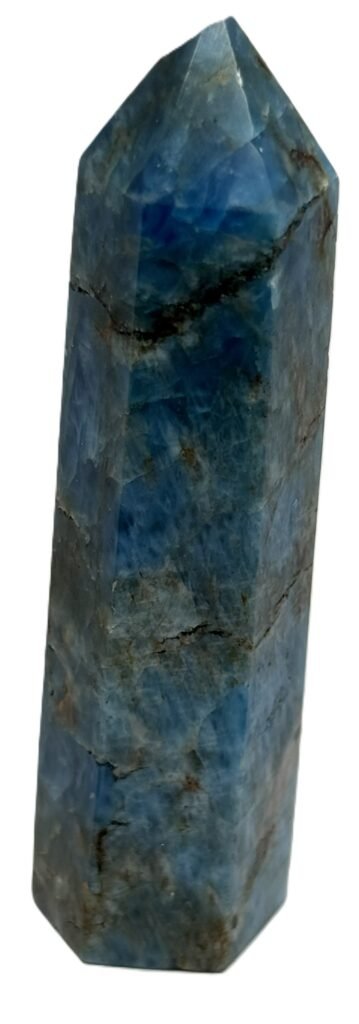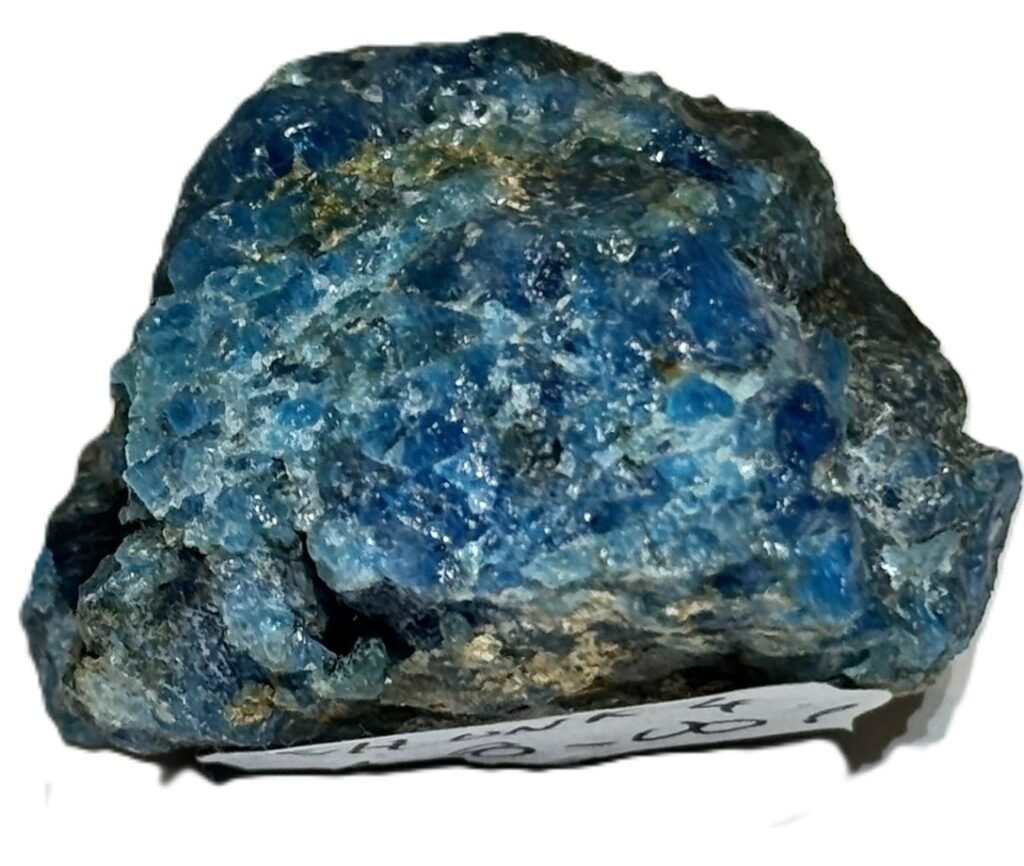
Blue Apatite is a captivating mineral that instantly draws attention with its striking hues and versatile nature. Known for its intense aesthetic appeal, this gemstone is a major favourite among collectors, jewellers, and spiritual practitioners. However, its most famous scientific trait is its deceptive nature—historically confusing gem cutters and mineralogists due to its remarkable ability to mimic other precious crystals.
Origins of the Name and Alternate Names
The term “Apatite” originates from the ancient Greek word apatein, which translates directly to “to deceive” or “to mislead”. This unique name reflects the stone’s notorious ability to closely mimic other popular minerals, such as Aquamarine, Peridot, Beryl, and Tourmaline.
In industrial and scientific contexts, Blue Apatite is sometimes referred to as “phosphate ore” or “fluorapatite”, depending on its precise mineralogical sub-category. Its distinct blue classification distinguishes it clearly from its green, yellow, or translucent counterparts in scientific literature.
Composition, Physical Characteristics, and Varieties
Scientifically, Blue Apatite is a calcium phosphate mineral with the chemical formula $\text{Ca}_5(\text{PO}_4)_3(\text{F,Cl,OH})$. Its complex internal structure allows for minor atomic variations and trace elements, which produce a stunning spectrum of hues ranging from soft, translucent pastel blue to a deep, neon electric indigo.
The mineral exhibits a lovely vitreous (glass-like) lustre when cut and polished. On the Mohs hardness scale, Blue Apatite ranks at a 5. This moderate hardness makes it the defining index mineral for a grade 5 hardness level. Because it is softer than quartz, it requires expert craftsmanship when being fashioned into decorative carvings, cabochons, and jewellery pieces.
Global Sources: Where is Blue Apatite Found?
Blue Apatite forms in a variety of geological settings, including igneous pegmatites, metamorphic rocks, and sedimentary marine deposits. Major commercial pockets of this vibrant mineral are located in:
- Madagascar: Renowned for producing the most famous, highly saturated “neon” and electric blue gemstone varieties.
- Brazil: Yields deep indigo and premium jewellery-grade specimens.
- Canada: Home to large-scale, structurally unique crystal formations.
- Africa & Europe: Notable deposits have been documented across various sedimentary and igneous terrains, aiding vital geological research.
Historical Significance and Archaeological Finds
Archaeological records reveal that Apatite, including its magnificent blue form, has been recovered in digs dating back to early human civilisations. Ancient cultures deeply valued the stone for its intense colour, integrating it into ornamental jewellery, signet rings, and sacred ritual amulets.
Historically buried alongside other hidden treasures due to misidentification, its rich legacy has directly bridged the gap between ancient lapidary art and contemporary alternative practices.
Folklore, Legends, and Tales
Rich cultural narratives have long surrounded the history of Blue Apatite:
- The Shaman’s Vision: Ancient legends claim that tribal shamans and wise elders carried Blue Apatite during complex rituals to invoke clear thought, stimulate prophetic visions, and access deep states of emotional balance.
- The Mind Calmer: Widespread European folklore attributes the stone with the power to act as a natural mental soothing agent, helping to quiet an overactive ego and dispel chaotic external energy.
- The Rainbow Bridge: In certain ancient civilisations, blue variations of Apatite were thought to be fragments of the sky that fell to Earth, acting as an energetic telephone line to cosmic guides.
Mystical Healing Properties
In modern holistic wellness and alternative healing practices, Blue Apatite is treated as a premium stone of inspiration and self-expression.
1. Mental Clarity and Focus
Blue Apatite acts as a vacuum cleaner for mental clutter and confusion. It is believed to stimulate intellect, boost personal insight, and enhance problem-solving skills, making it an excellent companion tool for students and project managers.
2. Communication and Creativity
This stone is heavily praised for its capacity to stimulate creative expression and authentic communication. It helps dissolve social anxiety, boosts self-confidence, and empowers individuals to speak their inner truths clearly.
3. Emotional Healing
Practitioners assert that Blue Apatite actively aids in stress relief. It helps dissolve heavy emotional blocks, curbs sorrow, and reduces underlying anger, transforming erratic moods into a state of calm peace.
Links with Astrology and the Zodiac
In astrological circles, Blue Apatite acts as a brilliant intellectual and celestial catalyst. It holds a powerful connection to the following signs:
- Gemini & Aquarius: As air signs heavily known for their intellectual drives, social nature, and communicative traits, Geminis and Aquarians benefit massively from Blue Apatite. The stone helps balance their occasionally scattered energies, promoting a structured flow of ideas and more effective public self-expression.
- Pisces: The fluid, water energy of Blue Apatite also coordinates beautifully with Pisces, helping them translate their deep subconscious dreams and creative visions into the physical world.
Chakra System Connections
Within the holistic chakra system, Blue Apatite is the ultimate key to the throat and third eye energy hubs:
- Throat Chakra (Vishuddha): This is the primary energy centre governed by Blue Apatite. This chakra rules communication, honesty, and self-expression. By clearing blockages in the throat, the stone assists individuals in expressing thoughts and feelings confidently without fear of judgement.
- Third Eye Chakra (Ajna): Deeper electric or indigo blue varieties resonate perfectly with the Third Eye, enhancing psychic perception, deep meditation states, and spiritual connectivity.
Use as a Birthstone and for a Wedding Anniversary
- Alternative Birthstone: While not a traditional birthstone, modern gemology celebrates Blue Apatite as an alternative birthstone for those born under the winter signs of Aquarius and Capricorn, or spring-born Geminis. It is often selected to symbolise clarity, mental inspiration, and deep personal trust.
- Wedding Anniversary Gemstone: Blue Apatite is used as a beautiful symbolic gift to mark milestones of enduring love. It is chosen to represent open, honest communication between couples, the refreshing qualities of new beginnings, and long-term faithfulness.
Crystal Pairings: Combinations to Choose and Avoid
To get the absolute best out of your Blue Apatite, it is essential to look at which stones complement its high-vibrational, throat-opening energy and which ones clash.
Best Crystals to Pair with Blue Apatite
- Clear Quartz (The Amplifier): Clear Quartz acts as a natural megaphone. Pairing it with Blue Apatite magnifies the stone’s capability to unlock creative blocks and brings immense, unclouded mental clarity.
- Lapis Lazuli or Sodalite (The Communication Team): If you are preparing for public speaking, an interview, or a difficult conversation, pairing Blue Apatite with Lapis Lazuli creates an unbeatable field of authentic communication and confidence.
- Amethyst (The Intuition Booster): Together, Blue Apatite and Amethyst bridge the connection between the Throat and Third Eye chakras, creating an ideal frequency for lucid dreaming, deep meditation, and spiritual insight.
- Black Tourmaline (The Grounding Shield): Because Blue Apatite functions on a high, mentally active frequency, pairing it with Black Tourmaline keeps you securely anchored to the Earth, preventing you from feeling spaced out.
Crystal Pairings to Avoid
- Black Onyx or Obsidian: Black Onyx carries an incredibly dense, slow, ultra-grounding, and protective lower-chakra vibration. Pairing it simultaneously with Blue Apatite can result in an energetic stalemate—Onyx works to pull your energy down to the earth, while Apatite tries to lift your consciousness to higher mental plains.
- Hematite: Much like Onyx, Hematite’s high iron content creates a heavy pull on the Root Chakra. It can easily overwhelm or choke out the subtle, airy, and high-vibrational communication frequencies of Blue Apatite.
- Carnelian (For Sleeping): Avoid pairing Blue Apatite with Carnelian if you are looking to rest or unwind. Carnelian introduces a fiery, physical vitality that conflicts heavily with Apatite’s desire to focus on calm, spiritual, and intellectual development.
Frequently Asked Questions (FAQ)
Is Blue Apatite a real stone?
Yes, Blue Apatite is a 100% natural and authentic mineral. It is a calcium phosphate crystal. While it is widely available on the market, highly saturated “neon” blue specimens from Madagascar are considered rarer and are highly sought after by global collectors.
Can Blue Apatite go in water?
No, it is highly recommended to keep Blue Apatite out of water. Because it ranks at a 5 on the Mohs scale, it is a relatively soft, porous mineral. Prolonged exposure to water, saltwater, or acid cleansers can permanently dissolve its protective finish, dull its vitreous lustre, or cause the crystal matrix to fracture.
How do I cleanse and charge Blue Apatite?
Since Blue Apatite cannot be washed safely in water, you should cleanse it using dry methods. The best ways are to smudge it with the smoke of sage, Palo Santo, or herbal incense, or to rest it on a Selenite charging plate for a few hours. To recharge its vivid energy, place it under the light of a full moon overnight. Avoid leaving it in direct sunlight for long periods, as UV rays can fade its deep blue colour.
Can I wear Blue Apatite every day?
Yes, but with caution. Because it has a moderate hardness rating of 5, it is susceptible to scratches if knocked against hard objects. It is perfectly safe for everyday earrings, necklaces, or brooches, but if worn as a daily ring or bracelet, ensure it is set in a highly protective casing.
Why is it called the “Deceiver” stone?
It earned the nickname because its chemical structure allows it to form in variations that look nearly identical to much more expensive stones like Aquamarine, Paraiba Tourmaline, and Topaz. For centuries, gem cutters accidentally bought or sold Apatite thinking it was a completely different mineral species.
How can I tell if my Blue Apatite is real or fake?
Genuine Blue Apatite is cool to the touch and will show tiny natural imperfections, internal fractures, or variations in colour density under a magnifying glass. Fake versions made of plastic or glass feel warm quickly, look perfectly flawless inside, or may contain tiny trapped air bubbles. Furthermore, because a real piece is a grade 5 mineral, it can be easily scratched by a steel pocket knife blade, whereas a glass fake usually will not scratch as easily.
These are my personally selected and curated Blue Apatite products