Black opal represents the most prized and rarest variety in the opal family, distinguished by its dark body tone that ranges from deep charcoal to pitch black. Unlike white or crystal opals, this dark underlying base acts as an organic contrast screen, amplifying spectral interference to produce an intense, multi-hued display known as “play-of-colour.” Found primarily in the subterranean Cretaceous layers of Lightning Ridge, Australia, natural black opal is formed through the slow precipitation of silica-rich groundwater. Its rarity, vivid fire, and delicate mineralogical structure make it one of the most sought-after gemstones in fine jewellery and high-end collecting.
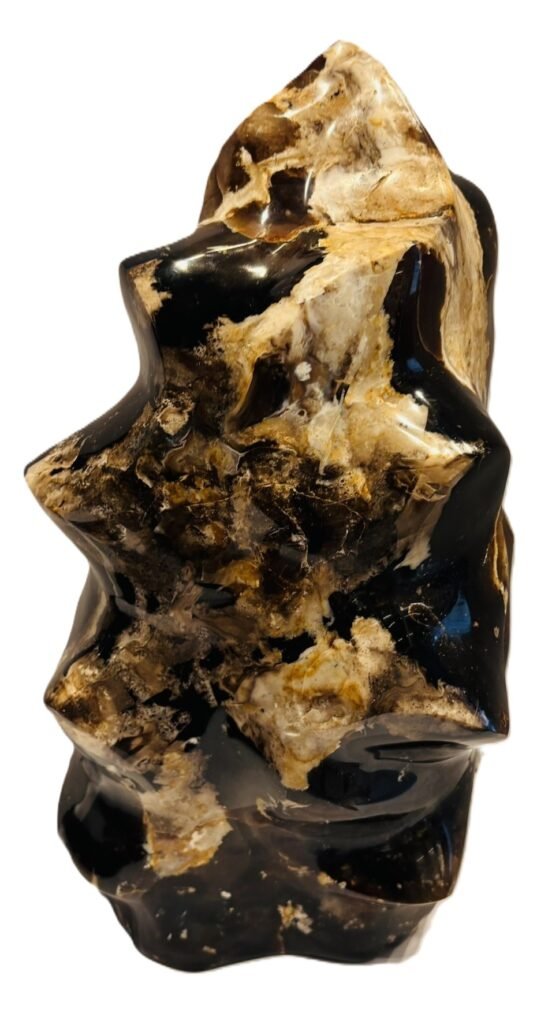
Alternate names
- Dark Opal: A trade classification frequently used for stones grading N5 to N6 on the body tone scale, displaying a dark grey rather than jet-black base.
- Lightning Ridge Opal: A geographical moniker referencing the premier mining locality in New South Wales, Australia.
- Black Nobbie: Refers specifically to nodular, rounded rough opal formations typical of Lightning Ridge deposits.
- Carbon Opal: An informal, antiquated term derived from the historic belief that elemental carbon accounted for the dark underlying colouration.
The stones’ Science and Composition
Black opal is not a true mineral; it is an amorphous hydrated silica mineraloid with the chemical formula $\text{SiO}_2 \cdot n\text{H}_2\text{O}$. Its water content typically constitutes between 3% and 10% by weight, occasionally reaching up to 21% in porous matrix material.
The gemstone’s fire originates from its internal sub-microscopic architecture:
- Colloidal Silica Spheres: The gemstone consists of closely packed, uniform spheres of amorphous silica arranged in a periodic, three-dimensional hexagonal or cubic lattice.
- Diffraction of Light: When white light passes through these regular voids and spherical planes, it diffracts into monochromatic spectral wavelengths. The diameter of the silica spheres dictates the colours produced: smaller spheres (~150 to 200 nm) diffract shorter blue and violet wavelengths, while larger spheres (~300 nm) yield orange and red flash.
- Cause of Black Body Tone: Trace inclusions of carbon, pyrite, iron oxides, and organic matter dispersed throughout the silica lattice absorb non-diffracted light, preventing backscatter and maximising colour contrast.
Key Physical Characteristics
| Property | Measurement / Characteristic |
| Chemical Formula | $\text{SiO}_2 \cdot n\text{H}_2\text{O}$ |
| Crystal System | Amorphous (non-crystalline mineraloid) |
| Mohs Hardness | 5.5 – 6.5 |
| Specific Gravity | 1.98 – 2.25 |
| Refractive Index | 1.42 – 1.47 (isotropic) |
| Lustre | Sub-vitreous to resinous |
| Cleavage / Fracture | None / Conchoidal to uneven |
| Transparency | Opaque to semi-translucent |
| Body Tone Classification | N1 to N4 (True Black); N5 to N6 (Dark Opal) |
Common Geologic Varieties
- Sedimentary Black Opal: Originates in sedimentary host basins (such as weathered sandstone and claystone). These form either as “nobbies” (nodular concretions) or “seam opal” (deposited within bedding planes and joints).
- Boulder Black Opal: Forms within cracks and cavities of ironstone boulders, primarily in Queensland, Australia. When cut with the natural dark ironstone backing intact, it delivers an N1–N4 body tone appearance.
- Volcanic / Hydrothermal Black Opal: Produced via post-volcanic hydrothermal fluid deposition within rhyolites and basalts. These tend to have higher porosity and variable stability compared to sedimentary types.
- Black Crystal Opal: Features a dark, transparent-to-semitransparent body tone through which play-of-colour flashes without completely obscuring light transmission.
- Opalised Fossils: Ancient marine or dinosaur bones, shells, wood, and pine cones whose organic material was replaced by precious black opal during the Cretaceous period.
Global Mining and Volcanic Sources
- Lightning Ridge (New South Wales, Australia): The undisputed global epicentre of sedimentary black opal. Discovered in the late 19th century, this region yields the benchmark material from the Cretaceous Griman Creek Formation.
- Mintabie (South Australia): Historically produced dense, hard black opals formed in Paleozoic sandstones; commercial mining has largely wound down.
- Stayton & Virgin Valley (Nevada, USA): A volcanic source known for high-moisture black opal replacing wood casts in volcanic ash layers. While vibrant, Nevada black opals have a tendency toward crazing (spontaneous fracturing from desiccation).
- Wollo Province (Ethiopia): Known mostly for hydrophane volcanic opals. While natural dark volcanic opals do occur in minor pockets, much of the dark Ethiopian material on the market has been artificially smoked or acid-sugar treated.
- Honduras (Erandique): Features black matrix opals formed in basaltic and volcanic ash layers, where precious opal lines thin fissures and pores within dark volcanic basalt.
Crystal Pairings: What to Combine and Avoid
Optimal Crystal Pairings
- Black Tourmaline (Schorl): Provides an anchoring energetic frequency that balances the volatile, water-heavy energy of opal, establishing a protective energetic boundary.
- Clear Quartz: Functions as an energetic amplifier. Its ordered hexagonal silicon dioxide structure stabilises and clarifies the shifting, multi-spectral currents of amorphous opal.
- Labradorite: Complements black opal’s optical diffraction with its own feldspar labradorescence, creating harmony for intuitive development and meditative focus.
Crystal Pairings to Avoid
- Carnelian & Pyrite: Aggressive, fiery solar minerals can overpower the receptive, water-aligned vibrational balance of black opal, resulting in turbulent energetic dissonance.
- Direct Contact with Harder Stones (Physical Hazard): Gemstones ranking 7.5 to 10 on the Mohs scale (such as sapphire, ruby, diamond, and topaz) will abrade, scratch, and chip the delicate surface of black opal if mounted or stored together.
Archaeology, Art and Ancient History
While classic white and water opals from the ancient deposits of Czerwenitza (modern-day Slovakia) were celebrated in classical antiquity, true black opal was practically unknown to the Mediterranean world. Pliny the Elder wrote of opals displaying the “fire of the ruby, the purple of amethyst, and the sea-green of emerald,” yet his descriptions reflect light-bodied stones.
The modern history of natural black opal commenced in the late 1880s along the outback border of New South Wales, Australia. Prospectors originally overlooked dark nobbies, dismissing them as useless, blackened chert. In 1903, Charlie Nettleton sank the first commercial shaft on the Ridge, introducing natural black opal to world markets. Early European dealers initially rejected them, claiming the stones were either fraudulent or artificially carbonised, until gemologist Percy Marks and jeweller T.C. Wollaston formally proved their natural authenticity in London.
Folklore, Legends and Sacred Tales
- Indigenous Australian Dream time: Indigenous Australian legends tell of the Creator descending to Earth on a vast rainbow to impart wisdom and peace. Wherever the rainbow touched the soil, the stones absorbed the brilliant colours, creating opal.
- The “Bad Luck” Victorian Superstition: Opal earned an undeserved reputation for bringing bad luck during the 19th century, largely fuelled by Sir Walter Scott’s 1829 novel Anne of Geierstein, in which a talismanic opal loses its fire upon contact with holy water. Black opal’s dramatic arrival in the Edwardian era defied and ultimately broke this myth due to its undeniable beauty and scarcity.
- The Fire Within Darkness: Across multiple mystical traditions, a gem that produces pure light out of absolute blackness represents illumination born from grief, transformation through adversity, and hidden knowledge.
Metaphysical and Mystical Healing Properties
- Emotional Catharsis & Shadow Work: Black opal is recognised by energetic practitioners as a stone for deep introspective work. Its dark base is believed to absorb repressed fears, bringing hidden emotional trauma to the surface for release.
- Psychic Cloaking & Protection: Practitioners use black opal to shield their aura from psychic vampirism and unwanted atmospheric projections, drawing in and neutralising negative thought forms.
- Amplification of Intent: Due to its high silica and water matrix, black opal acts as a conduit for manifesting intention, returning projected energy back to its source amplified.
Astrological Connections
- Scorpio (Primary): Resonates strongly with Scorpio’s transformative, intense, and subterranean nature. Black opal mirrors Scorpio’s themes of death, rebirth, deep intuition, and mysteries hidden beneath the surface.
- Cancer & Pisces: As a hydrated mineraloid, black opal shares a direct elemental bond with water signs, helping to soothe and clarify deep subconscious currents.
- Planetary Alignments: Black opal is ruled jointly by Pluto (the underworld, subconscious depth, cataclysmic transformation) and Neptune (illusions, dreams, fluid imagination, and spiritual perception).
The Chakra System
- Root Chakra (Muladhara): The black, charcoal body tone connects directly with the base of the spine, drawing grounding earth energies upward to anchor the physical body.
- Crown Chakra (Sahasrara): The violet, blue, and white spectral play-of-colour connects to the higher transpersonal chakras, encouraging expanded consciousness.
- Solar Plexus & Third Eye: Gold, green, and red flashes stimulate the third eye and solar plexus simultaneously, integrating intuitive foresight with sovereign personal power.
Interesting Facts
- Rarer Than Diamond: Gem-grade, unbacked black opal with full-spectrum colour is geologically rarer than gem diamonds by multiple orders of magnitude.
- The “Virgin Rainbow”: One of the most famous opals ever recovered is an opalised belemnite skeleton (an ancient cephalopod) showing an N1 black body tone and neon spectral colour.
- The Halley’s Comet Opal: Found at Lightning Ridge in 1986 (the year Halley’s Comet passed Earth), this massive nodular black opal weighed 1,982.5 carats, earning a spot in the Guinness World Records.
- Hydrophane vs. Non-Hydrophane: Australian sedimentary black opal rarely absorbs water, whereas volcanic black opals can absorb moisture like a sponge, temporarily shifting their refractive index and transparency.
Modern Milestones: Birthstones and Anniversaries
- October Birthstone: Opal serves as the primary birthstone for the month of October (alongside pink tourmaline), with black opal considered the rarest choice.
- 14th and 34th Wedding Anniversaries: Black opal is traditionally gifted for the 14th wedding anniversary (celebrating durability, colour, and passion) and the 34th anniversary, marking mature, enduring love.
- National Gemstone: In 1993, Australia officially proclaimed the opal as its national gemstone, cementing Lightning Ridge’s black opal as an iconic national treasure.
Black Opal Frequently Asked Questions
How can I differentiate between a natural black opal and a treated/synthetic one?
Natural Australian black opal possesses irregular natural patterning, random potch (colourless opal) backings, and authentic structural layers. Synthetics (such as Gilson opal) exhibit a distinct “lizard-skin” or “chicken-wire” columnar pattern under magnification. Treated stones (like smoked Ethiopian opals or sugar-acid treated matrix) often show dark carbon concentrations lodged in tiny pores, observable under 10x magnification.
Can black opal get wet?
Natural sedimentary black opal from Australia is stable and non-porous; washing it in clean, lukewarm water is safe. However, prolonged soaking, detergents, ultrasonic cleaners, and steam cleaners should be strictly avoided. Porous volcanic opals (such as Ethiopian hydrophane) should avoid water immersion entirely, as absorbed liquids can alter body colour and cause crazing.
What causes the “play-of-colour” in black opals?
Play-of-colour is an optical diffraction phenomenon. Packed microscopic spheres of amorphous silica form an ordered grid that breaks passing light rays into distinct spectral wavelengths, projecting colours across the surface.
What is the difference between a solid, doublet, and triplet?
- Solid: A natural, single-piece gemstone cut entirely from opal rough.
- Doublet: A thin slice of natural precious opal cemented to a dark backing (such as black potch, obsidian, or ironstone) to simulate the body tone of a solid black opal.
- Triplet: A thin slice of opal sandwiched between a dark backing and a clear dome (typically synthetic quartz or glass), designed to protect the opal and magnify its colour.
How should I store and care for black opal jewellery?
Store black opal away from direct heat sources, bright sunlight, and dry environments to prevent dehydration. Black opal has a Mohs hardness of 5.5 to 6.5, so store it in an individual fabric-lined pouch or box separate from diamonds and harder gems to prevent surface scratching.