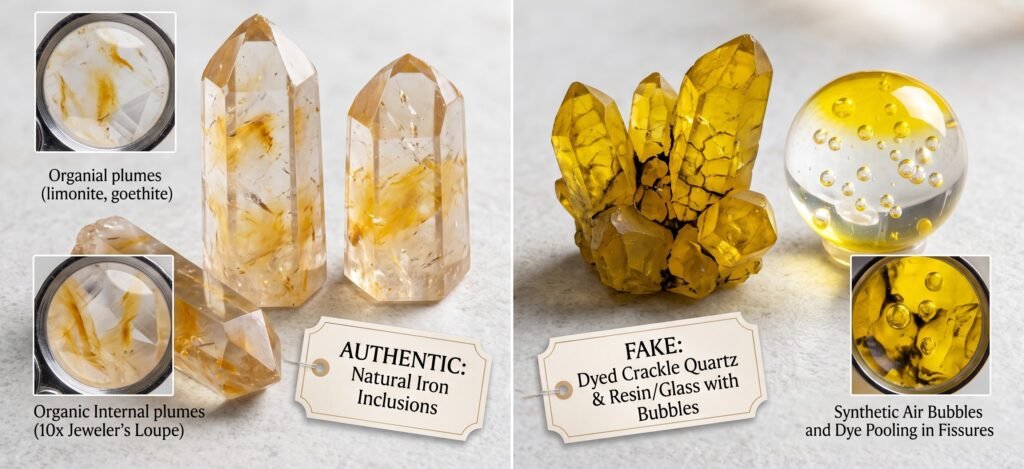
As the demand for high-vibrational and aesthetically striking minerals has surged, Golden Healer quartz has become a prime target for retail misrepresentation, synthetic substitutes, and chemically altered fakes. Geologically known as hematoid quartz or iron stained quartz, authentic specimens owe their warm, amber-to-honey glow to secondary iron oxide and limonite inclusions trapped within the crystal lattice or along natural fracture planes. It is this organic, sub surface staining, ranging from translucent sunshine yellow to deep mustard gold that defines genuine material against the Golden Healer fake stones.
Unfortunately, the market is rife with deceptive imitations designed to mimic this signature warmth at a fraction of the cost:
- Dyed Quartz: Low-grade, crackled quartz treated with synthetic yellow or orange dyes that pool visibly inside fractures and wipe away with acetone.
- Aura-Treated Glass & Quartz: Quartz or glass subjected to chemical vapour deposition (CVD), creating an unnatural, iridescent surface sheen rather than internal colour depth.
- Heat-Treated Amethyst & Citrine Simulants: Stones artificially altered through heat to produce burnt-orange or brassy shades that lack natural iron-film banding.
- Coloured Glass Imitations: Moulded glass featuring spherical air bubbles, conchoidal swirl lines, and an absolute absence of quartz crystal structure.
Distinguishing genuine iron-infused quartz from factory-dyed specimens requires understanding both mineralogical formation and the specific telltale flaws that counterfeiters cannot hide.
1. Visual Inspection & “Tells”
- Conor Distribution & “Dye Pooling”:
- Real: Natural iron inclusions produce organic shades of saffron, ochre, amber, or pale honey-gold.The golden colour follows natural crystal growth planes, wisps, or internal healed fractures.
- Fake (Dyed Quartz): Low-grade quartz is repeatedly heated and quenched in cold liquid dye (“crackle quartz”). Under a 10x jeweller’s loupe, dyed specimens display heavy pigment pooling—dark, unnaturally saturated lines of dye collected in every micro-fissure.The hue also leans toward neon or highlighter yellow.
- Spherical Air Bubbles:
- Natural quartz features microscopic liquid/gas inclusions (irregular fluid pockets, mineral veils, or needle-like rutile).
- Perfectly round, spherical air bubbles are an unmistakable signature of moulded glass or epoxy resin.
- Surface Coating vs. Titanium Aura:
- While some authentic Golden Healer crystals display a faint, natural rainbow sheen caused by optical thin-film interference on thin iron oxide layers, they do not possess an aggressive, uniform, mirror-like metallic flash. Stones with an intense all-over oily or peacock-metallic sheen are synthetic vacuum-deposited aura quartz (metal vapour bonded to clear quartz).
- Uniform Perfection:
- Genuine Golden Healer has natural variation; completely uniform, transparent yellow pieces with zero internal veiling or colour gradients are almost always coloured glass.
2. At-Home Verification Tests
| Test | Genuine Golden Healer Quartz | Common Fake (Glass / Resin / Dye) |
| Scratch / Hardness Test | Mohs 7.0: Will easily scratch ordinary window glass (Mohs ~5.5) or a steel knife blade without sustaining damage. | Glass (~5.5) and resin (2–3) cannot scratch quartz and will be scratched by a steel nail or knife. |
| Acetone / Solvent Test | Inclusions are locked beneath the silica surface or bound as mineral oxides; acetone or rubbing alcohol causes no change. | Wipe an inconspicuous crack with a cotton swab soaked in pure acetone. If yellow dye transfers to the cotton, it is artificially dyed. |
| Thermal / Temperature Feel | Feels cold against the cheek or wrist and takes noticeable time to absorb body heat. | Glass, acrylic, or resin warms to skin temperature within seconds. |
| UV Light Test (365nm / 395nm) | Inert or faint, patchy mineral response. Natural quartz does not fluoresce brightly under basic UV. | Synthetic dyes and stabilising resins frequently glow bright, neon yellow, green, or orange along fractures under UV light. |
3. Red Flags in Descriptions and Listings
- Overly Cheap Flawless Clusters:Large, flawless, intensely coloured golden points priced well below normal market rates for raw Madagascar or Arkansas specimens typically indicate moulded glass or mass-dyed material.
- Vague Misnomers: Beware of listings using conflated trade names like “Yellow Jade,” “Golden Topaz Quartz,” or “Aura Healer.” A reputable dealer will describe the piece specifically as Ferruginous Quartz / Hematoid Quartz / Limonite-included Quartz and will identify the geographic locality (e.g., Minas Gerais, Brazil or Madagascar).
These are my personally selected an curated Golden Healer