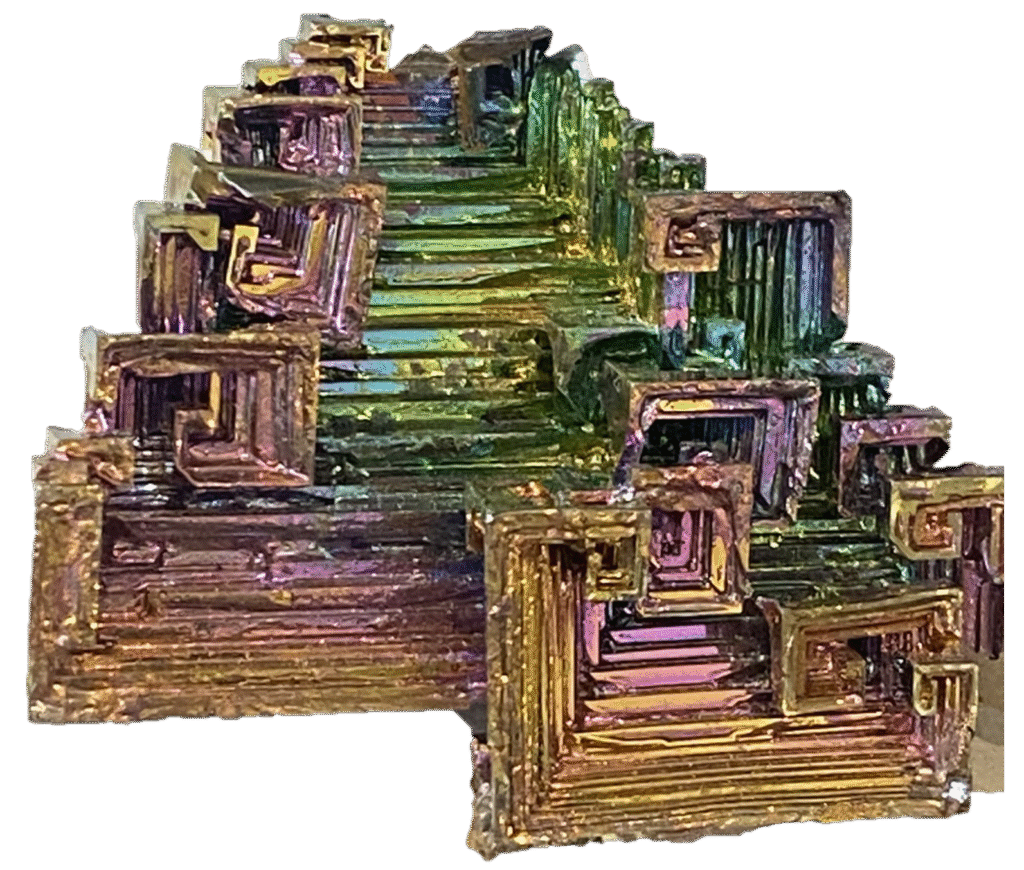
Bismuth is one of the most visually striking and geologically fascinating elements on Earth. Famous for its dazzling, rainbow-coloured iridescence and architectural, maze-like hopper crystals, this metal captures the imagination of scientists, mineral collectors, and crystal healers alike.
Whether you are drawn to its futuristic look or its powerful reputation for sparking personal transformation, this comprehensive guide explores the rich history, science, and metaphysical properties of bismuth.
What is Bismuth? Origins and Science
The word bismuth evolves from the 15th-century German word Wismut, likely derived from weiße Masse, meaning “white mass”, describing its raw, silvery-white appearance before it oxidises. Historically, early miners and alchemists often confused it with tin or lead due to its heavy weight.
In its pure, unoxidised state, bismuth is actually a brittle, silvery metal with a distinct pinkish tinge. The spectacular rainbow colours people love are not the metal itself, but a microscopic layer of bismuth oxide that forms instantly when the molten metal meets oxygen. This thin-film interference splits light into a spectrum of blues, purples, greens, and golds.
Key Physical Characteristics
- Atomic Number: 83 (Symbol: Bi)
- Crystal Structure: Trigonal (forming distinct, stepped “hopper” crystals as the edges grow faster than the interior faces)
- Density: Exceptionally heavy—roughly 86% the density of lead.
- The Expansion Quirk: Bismuth is one of the very few substances (like water) that expands as it freezes and solidifies, rather than shrinking.
- Surprisingly Safe: Despite living next to toxic heavy metals like lead, antimony, and polonium on the periodic table, bismuth is remarkably non-toxic and eco-friendly.
Natural vs Laboratory Grown Bismuth
When you see a stepped, rainbow-hued bismuth crystal in a shop, you are looking at a lab-grown specimen.
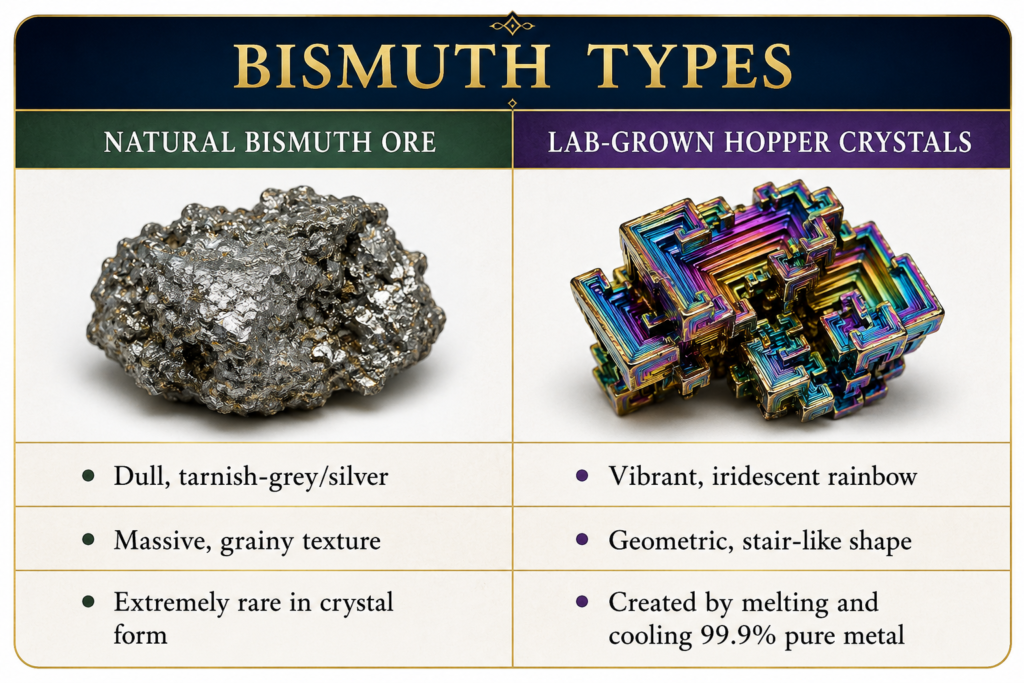
While natural bismuth ore is mined worldwide—with significant deposits in China, Peru, Mexico, Canada, and historic mining sites in the UK—it rarely forms distinct crystals in nature. The geometric treasures available today are created by melting down highly refined bismuth ore and allowing it to cool slowly under controlled conditions.
Crystal Pairings: What to Combine and Avoid
In metaphysical practices, bismuth is regarded as an element of rapid transformation, progression, and mental organization. Because its energetic pulse is structured and fast-moving, pairing it with the right stones is vital.
Optimal Crystal Pairings
- For Spiritual Grounding: Smoky Quartz or Black Obsidian. Bismuth can occasionally induce a scattered, “heady” sensation due to its complex geometry. Combining it with a strong root-chakra stone ensures you stay anchored to the earth while experiencing spiritual shifts.
- For Channelling Creativity: Labradorite or Malachite. Labradorite amplifies bismuth’s iridescent charm and unlocks cosmic inspiration, while malachite pushes for the same profound life transformations, making them an unstoppable duo for breaking bad habits.
- For Logical Clarity: Fluorite. Like bismuth’s perfectly ordered steps, fluorite reorganises a cluttered mind. Together, they are excellent for students, programmers, or anyone tackling massive technical projects.
Crystal Pairings to Avoid
- High-Vibrational Chaotic Stones: Moldavite. Moldavite brings sudden, chaotic upheaval. Combining it with the rapid geometric shifting energy of bismuth can create an overwhelming emotional storm that leaves you feeling ungrounded and anxious.
- Soothing/Sleep Crystals: Celestite, Lepidolite, or Blue Lace Agate. Bismuth is an activating, progressive metal that stimulates focus and transitions. Putting it next to deeply calming, sleep-inducing stones creates a conflicting energy current, rendering both stones less effective.
History, Alchemy, and Modern Uses
Long before it was officially isolated as its own element by French chemist Claude François Geoffroy in 1753, bismuth played a quiet but significant role in human history.
- Inca Weaponry: Archaeological excavations in South America revealed that the Incas used a unique bronze-bismuth alloy to forge exceptionally durable, glittering ceremonial daggers and knives around 1500 AD.
- Alchemical Transmutation: Medieval alchemists viewed bismuth as a mysterious, transitional material. Because of its low melting point ($271.4^\circ\text{C}$), they believed it was lead in the process of turning into silver or gold.
- Modern Applications: Because it is non-toxic, bismuth has largely replaced toxic lead in plumbing fixtures, soldering materials, and shotgun pellets. It is also a key active ingredient in stomach-soothing medicines (such as bismuth subsalicylate) and is used in pearlescent cosmetics like lipsticks and eyeshadows.
Metaphysical Meanings and Spiritual Healing
Bismuth is highly valued in energy work as a bridge between the physical world and the spiritual realm, symbolising adaptation, resilience, and transformation.
- Managing Transitions: If you are undergoing a major life shift—such as moving house, changing careers, or navigating a breakup—bismuth is believed to ease isolation and help you adapt to your new reality.
- Chakra Alignment: Its labyrinth-like structure aligns and clears all chakras, but it resonates most powerfully with the Solar Plexus Chakra (personal power and drive) and the Crown Chakra (spiritual connection).
- Zodiac Alignment: Bismuth shares an intense affinity with Scorpio. Scorpio is the sign of death, rebirth, and profound internal evolution—paralleling bismuth’s literal transformation from a dull liquid into a breathtaking rainbow structure.
- Alternative Traditions: While not a traditional birthstone, it is frequently chosen as a modern alternative gift for birthdays and wedding anniversaries to mark a long, colourful, and resilient journey shared between two people.
Extensive FAQ Section
Is bismuth a natural element or is it man-made?
Bismuth is a completely natural, fundamental element found on the periodic table (Bi, atomic number 83). However, the brightly coloured, geometric “staircase” crystals sold in shops are grown in laboratory or studio environments by melting raw bismuth and letting it cool systematically to coax out its latent crystalline geometry.
Is bismuth safe to handle?
Yes, bismuth is entirely safe to handle. Unlike its periodic table neighbours lead and thallium, bismuth possesses incredibly low toxicity. It will not leach harmful chemicals onto your skin. The only physical danger comes from its brittle nature; dropping a bismuth crystal can easily cause its delicate edges to chip or shatter.
Why does bismuth turn rainbow colours?
The rainbow hue is caused by a natural process called oxidation. When hot, liquid bismuth comes into contact with the air, it forms a microscopic layer of bismuth oxide. As the thickness of this oxide layer varies across the crystal, it refracts light waves at different angles, creating a stunning visual spectrum of pinks, blues, greens, and purples.
Can bismuth go in water?
It is best to keep your bismuth crystals completely dry. While it will not dissolve, prolonged exposure to moisture, humidity, or water can tarnish or strip away the microscopic iridescent oxide layer, leaving behind a dull, greyish-silver metal surface. Never cleanse bismuth using water or salt baths.
How do I energetically cleanse and charge bismuth?
Because bismuth cannot handle water, the best way to cleanse it is through smoke smudging (using sage, palo santo, or incense) or by placing it on a clear quartz charging plate. To recharge its transformative properties, leave it out overnight under the light of a full moon.
Is bismuth radioactive?
Scientifically speaking, bismuth is technically radioactive, but it is completely harmless. In 2003, physics researchers discovered that bismuth-209 has a half-life of $1.9 \times 10^{19}$ years—which is roughly one billion times longer than the estimated age of the entire universe! For everyday human safety, it is treated as a completely stable, non-radioactive material.
These are my personally selected and curated Bismuth Products