

If you have ever found a smooth, bullet-shaped stone on a beach or in a limestone quarry, you may well have been holding a piece of prehistoric ocean history. These fascinating objects are belemnite fossils—the hard, calcified remnants of an extinct group of marine predators that dominated our ancient seas millions of years ago.
The Prehistoric “Squid” with a Bullet-Proof Skeleton
Belemnites (Belemnitida) belonged to the cephalopod family, making them ancient relatives of modern octopuses, squids, and cuttlefish. They first appeared in the fossil record around 250 million years ago, during the Triassic period, and flourished in global oceans until they vanished alongside the dinosaurs roughly 66 million years ago.
The name “belemnite” comes from the Greek word belemnon, meaning dart or javelin. This describes the most common part of the animal to survive as a fossil: the bullet-shaped rostrum (or guard).
Internal Anatomy and Physical Structure
While they looked remarkably similar to modern squid, belemnites had distinct structural differences:
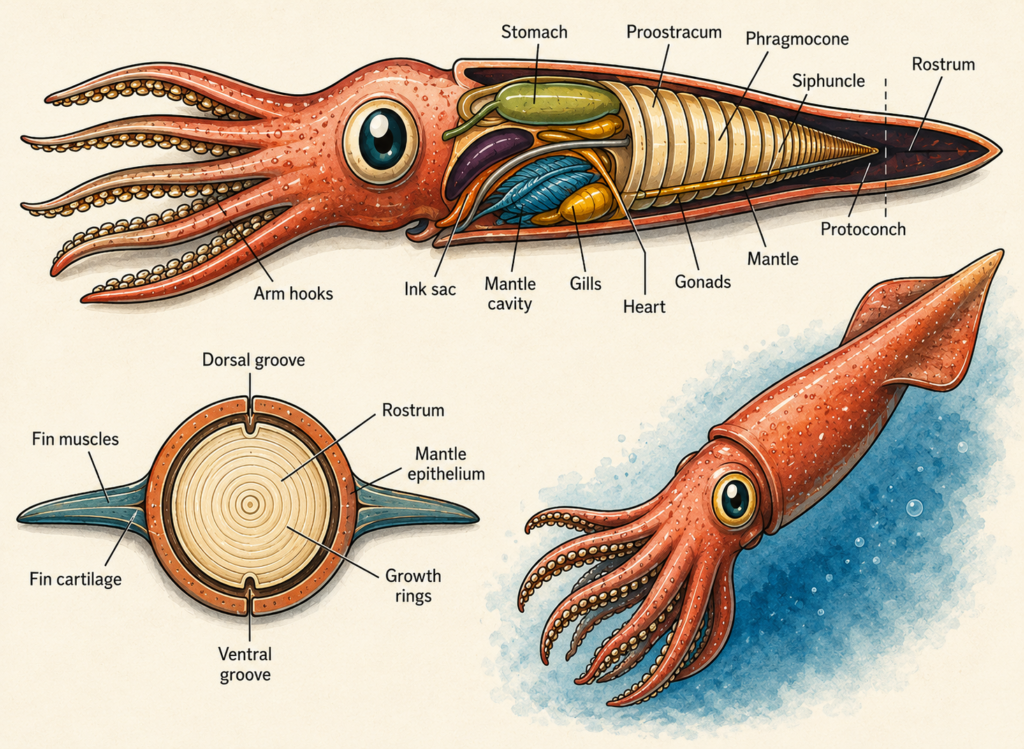
- Hooked Arms: Instead of the flexible suction cups found on modern squid, belemnites possessed ten arms lined with 30 to 50 curved, sharp hooks. These were used to snag slippery prey like small fish, crustaceans, and other molluscs.
- The Rostrum (Guard): This solid, heavy cone of calcite sat at the rear of the creature’s body. It served as a vital skeleton support and acted as a counterbalance to the heavy arms and head at the front, keeping the animal horizontal in the water.
- The Phragmocone: Situated at the base of the rostrum, this chambered, conical shell structure regulated buoyancy and balance by adjusting gas and fluid levels, much like a modern chambered nautilus.
- Massive Scale: While most belemnites were small, the largest known species—Megateuthis elliptica—boasted a massive rostrum measuring between 60 and 70 cm (24 to 28 inches) long.
If you cut a fossilised rostrum in half, you will find concentric growth rings that resemble the inside of a tree trunk. Scientists believe each distinct ring represents a few months of the animal’s life..
Fossil deposits
In certain geological layers, rock outcrops are tightly packed with hundreds of fossilised rostra. These dramatic deposits are known as “belemnite battlefields”.
The leading scientific theory suggests these locations represent mass die-offs. Much like modern squid, belemnites likely migrated in vast numbers to shallow shelf waters to spawn, dying shortly afterward to leave their hard skeletons behind on the seabed.

Myths, Magic, and Thunderstones
Long before modern palaeontology explained these marine creatures, people across the globe found their arrow-like remains and spun elaborate folklore around them:
- Lightning Stones: Because of their sleek, dart-like shapes, Europeans traditionally believed that belemnites fell from heaven during thunderstorms. They were widely called “thunderbolts” or “thunderstones” (donderstenen in the Netherland, Donar being the Thunder god)
- Storm Protection: Keeping these stones inside or on the roof of a house was believed to protect the home from being struck by lightning or affected by witchcraft. This belief dates back as far as ancient Egypt, where hieroglyphs representing belemnites were placed beside Min, the god of fertility, to symbolise lightning.
- Folk Medicine: In Lithuania, a chanted ritual involved rubbing a belemnite over a snakebite to draw out the swelling whilst chanting :
“Three times nine times comes Perkunas’ thunder from the sea. Three times nine times bullets strike the swelling under the stone..This man regains the health he enjoyed before!” - In Western Scotland, they were known as “bat stones” or “bot stones” and steeped in drinking water to cure horses of distemper. Shockingly, in Southern England, folk medicine dictated grinding the fossils into a fine dust to blow directly into the eyes of humans or horses to cure rheumatism and sore eyes.
- Mythical Arrows: Scandinavian folklore described belemnites as the candles of pixies, elves, and gnomes (vateljus). Across mainland Europe, they were frequently feared or collected as “elf-bolts”—the lethal tips of arrows shot by fairies.

Metaphysical Properties
In modern crystal healing and spiritual practices, belemnites are treasured for their intense grounding energies. Because they spent millions of years absorbing the mineral imprints of prehistoric seas, practitioners believe they hold powerful stabilizing properties that promote personal resilience and strength.
They are frequently used in meditation to enhance intuition, offer spiritual protection, and establish a profound energetic link to Earth’s ancient past.
Zodiac Connection
Belemnites are sometimes linked to Capricorn and Scorpio, resonating with themes of transformation, grounding, and deep-sea mystery.
Belemnites Frequently Asked Questions
What is the difference between a belemnite and a modern squid?
While they shared a similar streamlined body shape, ink sacs, and tail fins, modern squid do not have a hard internal calcite rostrum or chambered phragmocone. Furthermore, modern squid use tentacles with suction pads, whereas belemnites had ten arms completely lined with sharp hooks.
Are belemnites rare fossils?
No, belemnites are exceptionally common index fossils, particularly in Jurassic and Cretaceous marine rocks. Because their solid calcite guards were so dense, they fossilised much more readily than other soft-bodied prehistoric sea creatures.
Which zodiac signs are associated with belemnites?
Belemnites are traditionally linked with Capricorn and Scorpio. These stones resonate closely with themes of deep-sea mystery, grounding energy, and the profound personal transformation associated with these astrological signs.
