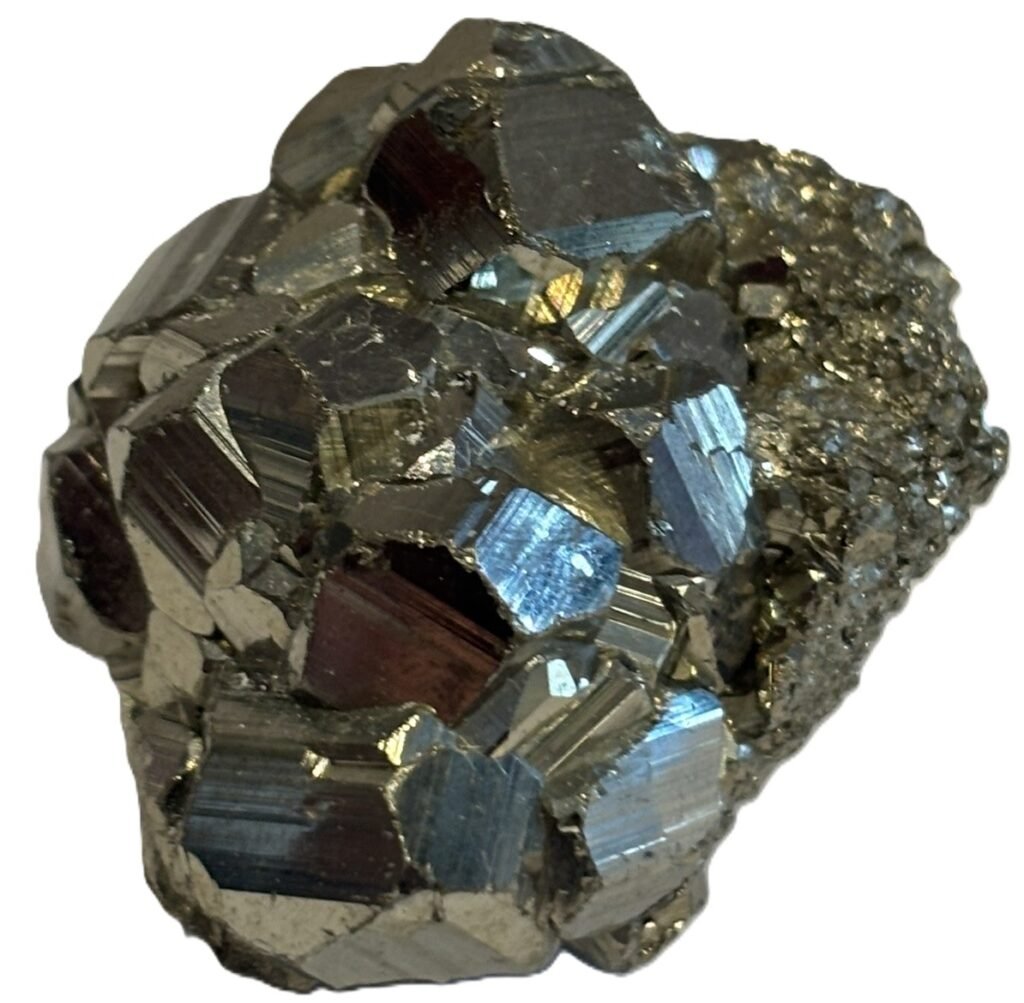
Iron pyrites is a brass-yellow mineral defined by a bright metallic lustre and isometric crystal structure. Nicknamed “Fool’s Gold” for its superficial resemblance to native gold, pyrite is an iron sulphide mineral found across sedimentary, metamorphic, and igneous formations globally. Historically prized as a spark-striking firestone and later carved into ornate Victorian “marcasite” jewellery, it has driven early chemical industries as a primary sulphur ore. Today, pyrite remains a favourite among mineral collectors for its mirror-like cubic formations, while maintaining an enduring presence in metaphysical traditions as a stone of vitality, willpower, and mental clarity.
Alternate names
- Fool’s Gold: The most famous colloquial moniker, coined during early gold rushes due to prospectors confusing its brassy sheen with native gold.
- Bravoite: A nickel-rich variety of pyrite.
- Marcasite (commercial trade name): Frequently misused in antique and vintage jewellery trade to describe faceted pyrite gems (distinct from the true, unstable mineral marcasite).
- Cat’s Gold (Katzengold): A traditional German term denoting deceptive, glittering minerals such as pyrite or golden mica flakes.
- Pierre de Feu: An archaic French term meaning “fire stone,” referencing its ability to throw sparks when struck against flint or steel.
The stones Science and Composition
Pyrite belongs to the sulphide mineral group, with the chemical formula FeS2 (iron disulphide). It crystallises in the isometric (cubic) crystal system, characterised space group Pa3ˉ.
In its crystal lattice, iron cations (Fe2+) occupy an expanded face centred cubic arrangement, while paired sulphur atoms exist as covalently bonded disulfide units ([S2]2−). This unique dumbbell-shaped pair of sulphur atoms prevents cleavage planes from shearing smoothly, giving the crystal distinct structural rigidity and making it brittle under mechanical stress. When heated or struck violently, the sulphur bonds degrade, releasing sulphur dioxide gas (SO2) and producing a characteristic sulphuric odour.
Key Physical Characteristics
- Conor: Pale brass-yellow to iridescent golden hues; often tarnishes slightly upon prolonged atmospheric exposure.
- Streak: Greenish-black to brownish-black (a critical test to differentiate it from native gold, which leaves a yellow streak).
- Lustre: Brilliant metallic.
- Mohs Hardness: 6.0 to 6.5 (significantly harder than gold, which rates at 2.5 to 3.0).
- Specific Gravity: 4.95 to 5.10 g/cm3 (much lighter and less dense than gold’s 19.3 g/cm3).
- Cleavage & Fracture: Indistinct/poor on [001]; exhibits a conchoidal to uneven fracture.
- Habit: Cubes, pyritohedrons (dodecahedrons with pentagonal faces), octahedrons, massive grains, and striated faces.
- Tenacity: Brittle.
Common Geologic Varieties
- Cubic Pyrite: The most classic form, displaying sharp 90∘ angles, mirror-like faces, and pronounced striations running perpendicular on adjacent faces.
- Pyritohedral Formations: Crystals exhibiting 12 pentagonal faces, a habit unique to isometric minerals of the pyrite group.
- Pyrite “Suns” (Pyrite Dollars): Flat, disc-shaped radial concretions formed under immense horizontal pressure between layers of shale and coal (predominantly found in Sparta, Illinois).
- Pyritised Fossils: Direct pseudomorphs where iron sulphide solution permeated organic remains—such as ammonites, brachiopods, and trilobites—replacing calcite or aragonite with shimmering brassy pyrite.
- Framboidal Pyrite: Microscopic spherical aggregates resembling raspberries, commonly formed in anoxic marine sediments by sulphate-reducing bacteria.
Global Mining and Volcanic Sources
Pyrite occurs in hydrothermal veins, contact metamorphic zones, massive sulphide deposits, and organic-rich sedimentary rocks. Notable mining regions include:
- Navajún, La Rioja, Spain: Produces the world’s most flawless, mirror-faced cubic pyrite clusters naturally embedded in marl matrix.
- Huanzala and Quiruvilca, Peru: Known for complex combinations of octahedral, cubic, and pyritohedral crystals intergrown with quartz and sphalerite.
- Rio Tinto, Spain: Ancient massive volcanogenic sulphide deposits mined since Phoenician times for copper, silver, and sulphur.
- Elba, Italy: Historic source of haematite pyrite associations with complex twinned crystals.
- Cornwall, England: Renowned Cornish tin and copper lodes yielding fine iridescent specimens and pyritohedrons.
- United States: Notable localities include the coal basins of Illinois (pyrite suns), Bingham Canyon, Utah, and Roxbury, Connecticut.
Crystal Pairings: What to Combine and Avoid
Optimal Crystal Pairings
- Clear Quartz: Amplifies pyrite’s reflective frequency, enhancing focus, memory retention, and intellectual clarity.
- Black Tourmaline: Complements pyrite’s defensive shielding by anchoring erratic thoughts, creating an energetic boundary against emotional fatigue.
- Citrine: Synergises with pyrite’s association with abundance and the Solar Plexus, fostering drive, entrepreneurial focus, and sustained optimism.
- Carnelian: Combines fire energy to spark physical vitality, stamina, and creative execution.
Crystal Pairings to Avoid
- Lepidolite / Lithium Quartz: The high-energy, stimulating fire frequencies of pyrite can overwhelm the deeply sedating, gentle emotional calming of lithium-rich stones.
- Aquamarine / Selenite: Extremely soft, watery, or receptive gems often clash with pyrite’s heavy, assertive, and metallic vibrations, producing a disjointed energetic environment.
Archaeology, Art and Ancient History
Pyrite holds an ancient connection to human survival and technology. In prehistory, flint striking against pyrite provided the sparks necessary to create fire, as confirmed by archaeological finds from Neolithic graves across Western Europe.
In Mesoamerica, the Maya, Zapotec, and Teotihuacan cultures polished flat slabs of massive pyrite into sophisticated concave and convex mirrors. Worn as pectorals by elites, these reflective stones functioned as divination tools, portals to communicate with ancestors, and badges of sacred status.
During the Victorian era in the mid-19th century, cut pyrite gained popularity across European high society under the commercial moniker “marcasite.” Faceted into tiny rose-cut stones and set into sterling silver, it provided a subtle, sophisticated alternative to diamonds.
Folklore, Legends and Sacred Tales
In Greco-Roman mythology, pyrite’s fiery nature led to its association with Hephaestus (Vulcan), the god of fire, metallurgy, and the forge. Ancient mineralogists believed the stone contained trapped subterranean lightning.
Native American legends frequently linked pyrite mirrors to solar deities, viewing the golden reflection as a snapshot of cosmic knowledge. Medieval alchemists classified pyrite as a primal manifestation of sulphur and metallic quintessence, using it in experiments intended to decipher the secrets of material transmutation.
Metaphysical and Mystical Healing Properties
- Mental Acuity & Focus: Clears brain fog, stimulates linear reasoning, and supports complex logistical planning.
- Energetic Protection: Acts as a mirror shield, deflecting toxic atmospheric energy, negative emotional projection, and digital drain.
- Manifestation & Abundance: Known as a stone of action, inspiring individuals to move beyond mere ideation into disciplined physical execution.
- Confidence & Willpower: Overcomes feelings of inadequacy, bolstering self-worth and assertiveness in professional environments.
Astrological Connections
- Leo: The primary astrological match. Pyrite shares the fiery, radiant, and assertive nature of the Sun-ruled Lion, amplifying leadership, pride, and executive drive.
- Aries: Resonates strongly with Martian initiative, courage, and stamina, encouraging calculated action over reckless impulse.
- Solar Affinity: Aligned with the Sun, reinforcing vitality, success, sovereignty, and outward self-expression.
The Chakra System
- Solar Plexus Chakra (Manipura): Pyrite’s golden ray resonates directly with the third chakra, the seat of personal willpower, autonomy, and digestive energy. It dissolves self-doubt and reignites internal motivation.
- Root Chakra (Muladhara): Because of its dense iron content, pyrite firmly anchors excessive spiritual or mental energy into the physical realm, stabilising stamina and base survival instincts.
Interesting facts
- “Pyrite Disease”: When stored in high-humidity environments, unstable pyrite can react with moisture and oxygen to form iron sulphate minerals and sulphuric acid, causing specimens to crack, crumble, and produce acidic dust.
- Fooling Sir Martin Frobisher: In the 1570s, English explorer Martin Frobisher brought hundreds of tons of glittering Arctic ore back to Queen Elizabeth I, believing he had found an Arctic gold mine. It turned out to be worthless iron-bearing mineral rock rich in pyrite and mica.
- Early Firearms: In the 16th and 17th centuries, wheellock firearms used a spring-loaded serrated steel wheel spinning against a piece of pyrite to generate ignition sparks for gunpowder.
- Semiconductor Properties: Pyrite is a naturally occurring semiconductor with a band gap of 0.95 eV, making it an active area of contemporary research for low-cost photovoltaic solar cells.
Modern Milestones: Birthstones and Anniversaries
- Alternative Birthstone: Pyrite serves as an alternative, non-traditional stone for Mid-Summer (July/August), mirroring the peak intensity of solar light.
- Modern Anniversaries: Often used as a decorative modern gift for the 9th or 18th wedding anniversaries, symbolising resilience, enduring structural strength, and sustained financial abundance.
Iron Pyrites Frequently Asked Questions
How can I tell the difference between real gold and iron pyrite?
Pyrite is much harder (Mohs 6–6.5 vs. gold’s 2.5–3), brittle, and will fracture or shatter when struck, whereas native gold is malleable and indents. Scratching unglazed porcelain with pyrite produces a greenish-black streak; gold leaves a pure yellow streak.
Can iron pyrite get wet?
No. Pyrite contains iron and sulphur; prolonged immersion in water or exposure to humid conditions causes oxidation, which dulls its lustre and triggers “pyrite decay,” forming sulphuric acid and damaging the specimen.
Is iron pyrite toxic to handle?
Handling intact specimens is completely safe. However, avoid inhaling dust when cutting or grinding pyrite, as it contains sulphur and potential trace impurities of arsenic. Always wash hands after handling raw specimens, and never use pyrite in direct-infusion gem elixirs.
Why is vintage pyrite jewellery called marcasite?
True marcasite is an orthorhombic iron sulphide that is chemically identical to pyrite (FeS2) but far more unstable and prone to disintegration. Victorian jewellers used durable, faceted pyrite gems instead, but retained “marcasite” as an appealing marketing name.
How should I cleanse and recharge my pyrite?
Because pyrite cannot tolerate water or salt, cleanse it using dry methods such as smoke smudging (sage or cedar), sound vibrations (singing bowls), or placing it on a selenite slab. Recharge it under brief morning sunlight or indirect solar rays.