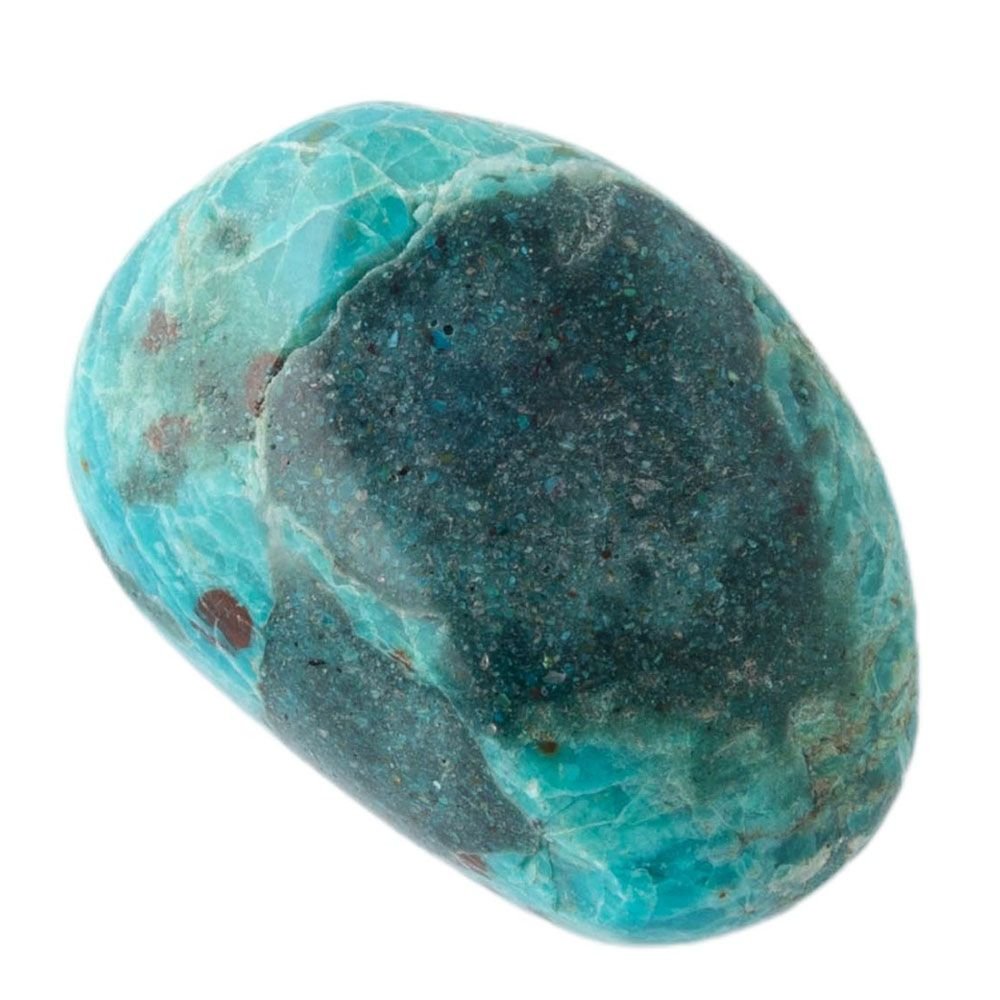
Epitomising tranquility, emotional fluidly, and the profound power of self-expression, Chrysocolla stands as one of the most visually mesmerising and spiritually revered gemstones in holistic healing. Characterized by its breathtaking, swirl-like patterns of pale sky blue, vibrant turquoise, and deep emerald green, this striking mineral mimics the appearance of a verdant, living Earth viewed from outer space.
Unlike many crystals that achieve popularity through crystalline geometry, Chrysocolla is valued for its organic, massive formations and its intimate relationship with other copper-bearing minerals. Symbolising the soothing qualities of the water element and the empowering strengths of the divine feminine, it serves as a premier tool for healers, scholars, artisans, and public speakers seeking to balance internal emotional storms and speak their absolute truth with compassion and clarity.
Alternate names
Throughout mineralogical and metaphysical history, Chrysocolla has accumulated a variety of distinct descriptors and local monickers reflecting its unique chemical combinations:
- The Stone of Communication: A cross-cultural metaphysical nickname celebrating its unparalleled resonance with vocal expression.
- Copper Lapis: An archaic trade term coined due to its rich, royal blue hues that often draw comparisons to high-grade Lapis Lazuli.
- Eilat Stone: The national stone of Israel, specifically naming a natural, regional intergrowth of Chrysocolla with Malachite, Turquoise, Azurite, and Pseudomalachite.
- Gem Silica: The absolute highest gem-quality, rare variety of quartz heavily saturated with vibrant Chrysocolla inclusions.
- Chrysame: A historically rare, specialized spelling used by early European gem cutters.
The stones Science and Composition
From a scientific perspective, Chrysocolla is classified as a hydrous copper silicate mineral with a highly complex and somewhat variable chemical formula:
(Cu,Al)2H2Si2O5(OH)4⋅nH2O
It is a secondary mineral that forms in the oxidation zones of copper ore bodies. As hydrothermal fluids rich in dissolved silica filter downwards through copper deposits, the chemical interaction causes Chrysocolla to precipitate out within rock cavities, veins, and fractures.
Unlike classic quartz or amethyst, pure Chrysocolla is amorphous or cryptocrystalline, meaning it lacks a defined, visible macro-crystalline structure. It is highly porous and lightweight, frequently containing varying levels of water molecules (nH2O) trapped within its mineral matrix, which can cause its specific gravity to fluctuate between 2.0 and 2.4.
Key Physical Characteristics
To successfully identify Chrysocolla and differentiate it from similar minerals, geologists look to several key physical properties:
- Colour: Exceptionally diverse, ranging from pale cyan, rich turquoise, and deep indigo to forest green and brownish-black (when high levels of iron or manganese are present).
- Hardness: Extremely variable. On the Mohs hardness scale, pure, unaltered Chrysocolla is quite soft, ranking at a fragile 2 to 4. However, when it naturally mixes with microcrystalline silica, its hardness can climb dramatically toward a durable 6.5 to 7.
- Lustre: Varies dramatically from vitreous (glassy) or waxy in silica-rich specimens to dull, earthy, and chalky in raw, clay-rich forms.
- Streak: White to very pale light blue.
- Fracture: Conchoidal to uneven; it is structurally brittle.
- Diaphaneity: Translucent to completely opaque.
Common Geologic Varieties
Chrysocolla rarely remains completely pure, often forming fascinating, mixed-gemstone varieties:
- Pure Chrysocolla: Soft, gelatinous, or chalky material found in rounded, bubble-like botryoidal masses. It is generally too fragile to be used in jewellery without stabilizing treatments.
- Gem Silica (Chrysocolla Chalcedony): The ultimate luxury variety. Here, chalcedony quartz absorbs massive amounts of copper solution during formation, resulting in a highly durable, beautifully translucent, vivid blue-green stone that takes a flawless polish.
- Chrysocolla in Quartz (Stellarite): A robust natural mixture where macro-quartz crystals grow alongside or completely enclose Chrysocolla, lending structural integrity while preserving the striking blue-green matrix.
- Eilat Stone: Sourced from ancient mines, this composite rock is prized for its dramatic, chaotic swirls of multi-shaded blues, greens, and browns, representing a multi-mineral combination of copper silicates and carbonates.
- Drusy Chrysocolla: A breathtaking formation where a layer of tiny, sparkling clear quartz crystals naturally forms over a rich blue-green base coat of Chrysocolla, making it look as though it has been dusted with sugar.
Global Mining and Volcanic Sources
Chrysocolla requires copper-rich environments to form and is mined in several highly prolific geological regions across the world:
- The United States: Southwest Arizona stands out globally, with famed mining districts like the Globe-Miami, Ray, and Morenci mines producing exceptional specimens. New Mexico and Utah also yield notable collector pieces.
- Peru: The Ica and Nazca regions are world-famous for yielding intensely vibrant, premium-grade neon blue Chrysocolla and high-clarity Gem Silica.
- Democratic Republic of the Congo: The Katanga copper belt produces dense, heavy massive blocks often naturally swirled with dark green Malachite.
- Israel: The Timna Valley, located near the southern tip of the country, contains the historic archaeological mines famed for producing authentic Eilat Stone.
- Other Sources: Significant, commercially viable deposits are continuously worked within the copper-rich zones of Mexico, Chile, Russia (the Ural Mountains), Australia (Queensland), and Namibia.
Crystal Pairings: What to Combine and Avoid
In holistic energy work, pairing minerals relies on a concept called energetic synergy. Combining stones that share complementary elements or chakras will amplify an intention, while pairing stones with fundamentally conflicting vibrations can mute or muddle the desired energetic outcome.
Optimal Crystal Pairings
Because Chrysocolla is an expressive Throat and Heart chakra stone deeply tied to the Water element, it pairs beautifully with the following minerals:
- For Eloquent, Soothing Communication: Pair Chrysocolla with Blue Lace Agate, Larimar, or Blue Calcite. These gentle Throat chakra stones pacify intense vocal anxieties, helping you express your boundaries and speak difficult emotional truths calmly without feeling overwhelmed.
- For Deep Heart Healing: Pair it with Rose Quartz, Amazonite, or Green Aventurine. This combination fills your immediate environment with unconditional self-love, compassion, and emotional fluidly, clearing away ancestral trauma or old relationship stagnation.
- For Divine Feminine Intuition: Pair it with Moonstone or Malachite. Together, they accelerate emotional transformation, balance hormones, and amplify inner psychic vision.
- The Ultimate Amplifier: Combine it with Clear Quartz to magnify the focal clarity of Chrysocolla’s soothing, stress-relieving properties.
Crystal Pairings to Avoid
Conversely, you generally want to avoid pairing Chrysocolla with stones that introduce a jarring elemental conflict or cancel out its calming effects:
- Extreme Fire Elements: Avoid combining Chrysocolla with highly aggressive, fiery stones like Carnelian, Sunstone, or Pyrite if your primary goal is stress relief or anxiety management. The active, adrenaline-pumping solar energy of these crystals can directly clash with Chrysocolla’s desire for cooling, passive stillness.
- High-Frequency Crown Stones: Minerals like Phenakite or intense, ungrounded Moldavite can pull the grounding, heart-centered energy of Chrysocolla too far into the upper astral planes, diminishing its ability to help you articulate your physical realities clearly.
Archaeology, Art and Ancient History
The human love affair with Chrysocolla spans millennia, carving a distinct path through ancient craftsmanship and archaeology. In ancient Egypt, Chrysocolla was highly revered as a royal stone of wisdom and diplomacy. Because it was frequently ground down alongside Malachite, it served as a primary raw material for vibrant blue-green cosmetics, eye paint, and mineral pigments used to illustrate sacred temple murals and sarcophagi.
Further across the ancient world, the Incas, Aztecs, and pre-Columbian Native American tribes prized Chrysocolla for its workable beauty, expertly carving it into intricate talismans, protective amulets, and heavy ceremonial inlay work for masks and knives. In South America, archaeological excavations of ancient elite tombs have unearthed stunning silver and gold nose rings, breastplates, and earrings set with vibrant polished discs of Chrysocolla, proving its historic status as a luxury item reserved for nobility.
Folklore, Legends and Sacred Tales
Fascinating legends weave through the historical timeline of this beautiful stone:
- The Diplomat’s Talisman: Famed historical lore suggests that Cleopatra VII of Egypt regularly wore prominent Chrysocolla jewellery wherever she travelled. She allegedly believed the stone’s calming vibrations would soften the tempers of hostile leaders, granting her superior negotiation skills and linguistic eloquence during high-stakes political meetings.
- The Speaker’s Stone: Native American folklore frequently labels Chrysocolla a sacred medicine stone capable of granting inner resistance and powerful eloquence. It was carried by tribal elders, orators, and medicine men during grand councils to ensure their spoken words carried deep ancestral weight and truth.
- The Peacemaker’s Jewel: In various medieval European legends, Chrysocolla was considered a powerful stone of reconciliation. It was believed that placing a piece of Chrysocolla in a room where an argument had occurred would absorb the toxic residue ofanger and restore absolute familial harmony.
Metaphysical and Mystical Healing Properties
Metaphysically, Chrysocolla acts as a gentle, non-invasive emotional purifier. Known profoundly as a stone of empowerment, teaching, and reconciliation, it works diligently to clear away lingering guilt, deep-seated heartache, and subconscious fears. It encourages an individual to accept sudden life changes with grace and resilience.
For those who suffer from chronic stress, hyperactivity, or sudden temper flares, meditating with Chrysocolla acts like a cooling energetic compress, gently lowering blood-pressure sensations and soothing a chaotic nervous system. It is also highly regarded as a stone for teachers, counselors, and mentors, as it assists in organizing abstract intellectual concepts into clear, compassionate spoken words that inspire others.
Astrological Connections
Chrysocolla shares an intimate connection with several specific zodiac signs within astrology:
- Gemini: As an air sign ruled by Mercury, Geminis can suffer from overactive minds and scattered speech. Chrysocolla acts as an anchor, helping them channel their brilliant intellect into cohesive, meaningful vocal communication without spinning into anxiety.
- Taurus: Ruled by Venus, Taureans appreciate beauty and stability but can struggle with stubbornness and a resistance to change. Chrysocolla introduces a fluid, adaptable energy that helps them release old grudges.
- Virgo: This analytical sign frequently harbors an intense “inner critic.” Chrysocolla opens the heart space, allowing Virgos to express their internal emotional vulnerabilities without over-analysing or judging themselves.
- Sagittarius: Aligns with the stone’s energy of higher wisdom, philosophy, and global exploration.
The Chakra System
Chrysocolla is a multi-chakra master stone that effortlessly bridges the lower and upper energy centres:
- The Throat Chakra (Vishuddha): This is the primary home of Chrysocolla. By stimulating this energetic portal, the stone dissolves communication blocks, fears of public speaking, and self-doubt, allowing you to articulate your personal boundaries calmly and confidently.
- The Heart Chakra (Anahata): With its rich green inclusions, Chrysocolla heals the heart space by flushing out emotional stagnation, grief, and heartbreak, replacing them with a warm current of compassion and inner peace.
- The Third Eye Chakra (Ajna): On a minor level, its deep blue hues stimulate inner vision, intuition, and spiritual insight, allowing an individual to see the broader tapestry of cosmic reality.
Interesting facts
- The Soldering Secret: The name Chrysocolla literally translates from the Greek words chrysos (gold) and kolla (glue), commemorating the fact that ancient goldsmiths regularly ground this mineral down into a chemical flux to safely solder precious gold filaments together.
- King Solomon’s Treasures: Authentic Eilat Stone, mined heavily in Israel, is historically romanticized as “King Solomon’s Stone,” as the ancient king’s legendary copper mines are believed to be located right where this beautiful multi-mineral material is harvested.
- The Counterfeit Shield: Due to its soft copper nature, raw Chrysocolla will completely fail to react or fizz if a drop of vinegar is applied to it, easily distinguishing it from dyed purple or blue calcium carbonates like Calcite or Aragonite.
- Varying Weight: Because its water content can naturally evaporate or change depending on the climate it is kept in, a single raw specimen can technically fluctuate in weight and density over vast periods.
Modern Milestones: Birthstones and Anniversaries
In contemporary crystal culture, Chrysocolla has carved out clear milestones:
- Alternative Birthstone: While not listed on the traditional, commercial birthstone charts, it serves as a highly popular alternative birthstone for the months of March (resonating with the fluid, intuitive traits of Pisces) and December (aligning with the philosophical energies of Sagittarius).
- 11th Wedding Anniversary: Chrysocolla is frequently selected as a meaningful, unique alternative gift to Turquoise for celebrating an 11-year marriage milestone, symbolising a decade of deep communication, understanding, and enduring, unconditional love.
Extensive FAQ Section
Can Chrysocolla be placed in water to make a crystal elixir?
Absolutely not. Because Chrysocolla is a hydrous copper silicate mineral, submerging it directly in water is highly dangerous. Copper is completely toxic when dissolved, and drinking water infused directly with raw Chrysocolla can result in heavy metal poisoning. Furthermore, water can seep into the porous structure of this soft stone, causing it to dull, turn brittle, or structurally degrade over time. To make a safe elixir, always use the indirect method, where the gemstone is placed inside a completely sealed glass container beside or within the water without ever touching the liquid itself.
Q: How can I tell if my Chrysocolla is real or a fake?
A: Look closely at the colour, texture, and temperature. True Chrysocolla possesses an irregular, organic, and highly unique pattern of swirled colours, often accompanied by dark brown/grey rock matrix lines or patches of sparkling clear quartz. Fake versions are commonly made of cheap plastic, resin, or dyed chalcedony. Plastic and resin counterfeits will look overly uniform, lack distinct internal mineral variations, feel warm to the touch almost instantly, and display tiny trapped circular air bubbles. Additionally, because genuine Chrysocolla is cool to the touch and has a low pure hardness of 2–4, a steel nail can easily scratch a raw specimen, whereas a hard glass imitation will completely resist it.
Q: Why is my Chrysocolla turning green or losing its blue colour?
Q: Why is my Chrysocolla turning green or losing its blue colour? A: This is due to natural oxidation and environmental exposure. As a copper-based mineral, Chrysocolla is chemically reactive over long periods when exposed to continuous atmospheric oxygen, skin oils, or persistent ambient humidity. This process causes the copper elements within the mineral matrix to slowly alter, accelerating its conversion into green malachite or dulling its lustre. To preserve its vibrant blue-green shades, avoid handling raw specimens excessively with sweaty or oily hands, and store your pieces in a cool, dry, low-humidity environment.
Q: Can Chrysocolla fade if left in the direct sun
Yes. Prolonged exposure to direct, harsh afternoon sunlight or intense ultraviolet (UV) rays will break down the delicate copper and chemical bonds within the stone. Over time, leaving your Chrysocolla spheres, towers, or jewellery on a sunny windowsill will cause its beautiful blue tones to permanently fade to a dull white, washed-out grey, or muddy brown. Always store your collection safely away from direct sunlight.
Q: How should I safely clean and energetically charge my Chrysocolla
Stick to completely dry physical cleaning and gentle energetic methods. Because water, salt, and commercial chemical solvents will permanently damage or etch its surface, you should physically clean your Chrysocolla simply by wiping it gently with a dry, soft microfibre cloth to remove dust and fingerprint oils. To safely cleanse its energy without risking structural damage, pass the specimen thoroughly through the smoke of a sacred incense (like sandalwood or frankincense) or place it near a sound-healing instrument like a Tibetan singing bowl. To recharge its passive, soothing qualities, leave it out overnight to bathe under the gentle, cooling light of a full moon, or place it directly onto a Selenite charging plate. Avoid solar charging completely.
These are my personally selected and curated Chrysocolla