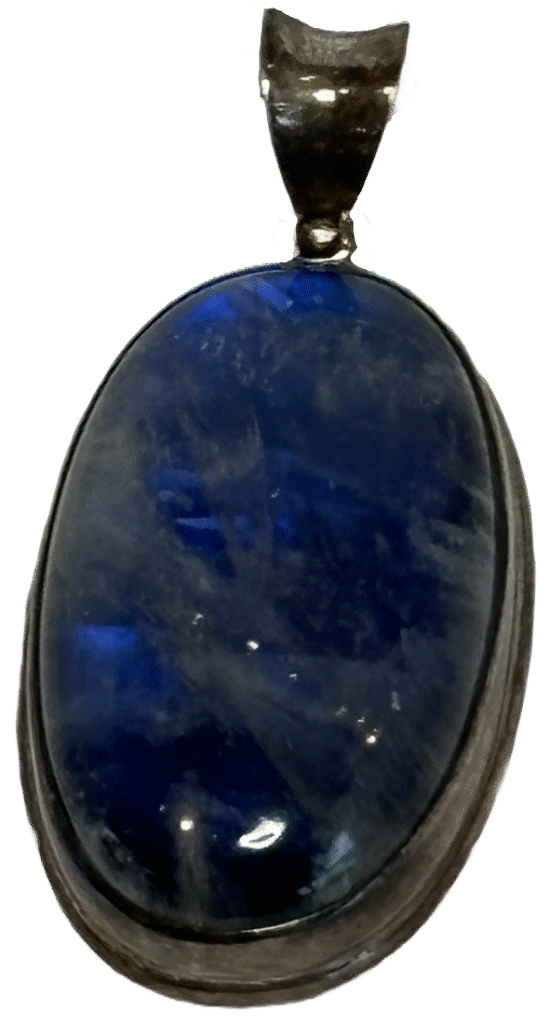
Blue Moonstone is an extraordinarily beautiful and ethereal gemstone that has enchanted human civilization for millennia. Celebrated for its fluid, undulating shimmer that mirrors the soft glow of a winter moon, this stone is highly prized by gem cutters, fine jewellers, and holistic practitioners alike. Acting as a profound anchor for emotional balance and spiritual growth, it serves as an excellent tool for navigating life’s transitions, calming volatile feelings, and welcoming a deep sense of tranquil clarity into your daily life.
Origins of the Name and Alternate Names
The name “moonstone” stems directly from the gem’s otherworldly luminescence, which beautifully mimics the soft, diffused radiance of the moon slipping behind a thin layer of cloud. The blue variety is especially coveted due to its icy, electric-blue flash. Throughout history and modern trade, it has been known by several distinct names:
- Adularia: A historical, scientific term derived from the Adula Alps in Switzerland, where premier, highly translucent specimens were extensively mined during the 18th and 19th centuries.
- The Stone of New Beginnings: A lyrical title given in metaphysical communities to honour its long-standing connection to lunar cycles, inner growth, and personal rebirth.
- Spectrolite (Clarification): While sometimes mistakenly conflated with Blue Moonstone due to its shared feldspar lineage and optical flash, Spectrolite is actually a rare, highly vibrant variety of Labradorite from Finland that exhibits a broader, intense rainbow spectrum.
Composition, Physical Characteristics, and Varieties
Blue Moonstone belongs to the vast feldspar mineral group and is primarily composed of orthoclase and albite (a sodium-rich plagioclase feldspar). Its defining hallmark is a stunning optical phenomenon known as adularescence. This moving sheen is caused by alternating microscopic layers of orthoclase and albite within the crystal structure; as light passes through these ultra-thin layers, it scatters in a fluid, billowy wave that glides gracefully across the stone’s surface.
Physical Properties:
- Chemical Formula: $\text{KAlSi}_3\text{O}_8$ (Potassium Aluminium Silicate).
- Crystal System: Monoclinic.
- Hardness: Measures 6 to 6.5 on the Mohs scale, making it moderately durable but prone to cleaving if struck sharply.
- Lustre: Displays a highly polished, pearly to vitreous lustre that highlights its liquid-like glow.
- Transparency: Ranges beautifully from semi-transparent to translucent. The most valuable stones are nearly crystal-clear with a floating, floating blue flash.
Varieties:
- Classic Blue Moonstone: Prized for its pristine, colorless or semi-translucent base body that exclusively showcases a sharp, floating electric-blue or sky-blue sheen.
- Rainbow Moonstone: Though commercially sold alongside blue moonstone, this is geologically a variety of translucent Labradorite that displays multi-coloured flashes (blues, greens, and golds) rather than a singular blue tone.
- White Moonstone: A milky, white opaque variety that features a soft, broad white or pale silvery adularescence rather than a blue hue.
Global Sources: Where is Blue Moonstone Found?
While feldspar minerals make up a large portion of the Earth’s crust, gem-quality moonstones showing pristine blue adularescence are remarkably rare and geographically isolated:
- Sri Lanka: Historically the most famous source for the finest specimens in human history. The legendary mines in the Meetiyagoda region produce exceptionally transparent stones with an exquisite, deep neon-blue flash.
- India: A prolific and vital supplier of colourful varieties. Indian deposits frequently yield beautiful green, peach, grey, and multi-banded blue moonstones.
- Madagascar: A major modern source known for producing rugged, highly translucent nodules with bright, intense blue optical flashes.
- Australia and the United States: Notable, smaller deposits exist in New Mexico and the Australian outback, highly sought after by boutique lapidaries.
Historical Significance and Archaeological Finds
Humanity’s fascination with moonstone crosses centuries and oceans, often deeply entwined with celestial worship:
- Ancient Civilisations: The ancient Romans and Greeks revered moonstone, firmly believing that the gem was formed out of actual drops of solidified moonlight. They incorporated the stone into intricate, hand-carved rings, protective amulets, and religious talismans.
- Asian Mythology: In ancient India, moonstone was considered a highly sacred “dream stone.” It was legally forbidden to display it for sale on public counters unless it was laid upon a traditional yellow cloth, which was considered an auspicious, holy colour.
- The Art Nouveau Era: Moonstone experienced a massive cultural renaissance in the late 19th and early 20th centuries. Iconic master jewellers like René Lalique and Louis Comfort Tiffany used smooth, cabochon-cut blue moonstones as the central focus of their famous, avant-garde brooches, hair combs, and pendants.
Historical and Modern Usage
- Historical Uses: Beyond personal adornment, moonstones were historically carried by maritime travellers as protective “traveller’s stones,” thought to safely guide ships through turbulent waters under dark, moonlit night skies.
- Contemporary Jewellery: Today, Blue Moonstone remains highly popular in artisanal and luxury jewellery. It is exclusively shaped into smooth, rounded cabochons or drop-shaped beads, as flat facets would ruin the stone’s fluid, rolling adularescence. It is most commonly set in protective silver or white gold mountings.
- Holistic and Spiritual Practices: Polished palm stones, spheres, and raw points are heavily utilised in modern meditation spaces, reiki rooms, and crystal grids to encourage emotional release, calm the mind, and invite peaceful energy.
Fascinating Facts about Blue Moonstone
- A Trick of the Light: The brilliant blue glow contains absolutely zero blue pigment. The colour is completely structural, born entirely from the microscopic physics of light scattering off mineral layers.
- The Clarity Premium: In the gem trade, the value of a blue moonstone spikes exponentially if the background stone is completely clear and free of tiny internal inclusions called “centipedes.”
- Centuries of Magic: Traditional folklore dictates that two people wearing blue moonstone during a full moon will fall madly and passionately in love with one another.
Folklore, Legends, and Tales
- The Gift of Prophecy: Ancient legends claimed that if a person placed a polished blue moonstone inside their mouth during a full moon, they would be granted the magical ability to foresee the future and discern the truth of any situation.
- The Goddess Amulet: Many early cultures directly dedicated the gemstone to lunar goddesses like Selene and Diana. It was treated as an energetic bridge to the divine feminine, believed to naturally ease childbirth, regulate menstrual cycles, and boost fertility.
Mystical Healing and Metaphysical Properties
In contemporary holistic wellness, Blue Moonstone is regarded as the ultimate master stone for emotional stability, intuition, and hormonal alignment.
- Soothe Emotional Turbulence: It gently cools hyper-reactive emotional bodies, acting as an excellent energetic antidote to stress, explosive anger, and heavy grief.
- Enhance Spiritual Insight: It acts as a powerful stimulant for the subconscious mind, helping individuals recall vivid dreams, access latent psychic abilities, and deepen their intuition.
- Nurture Inner Growth: By aligning your energy with natural cycles, it helps you break free from destructive emotional patterns, guiding you through major life adjustments with grace and ease.
Astrological and Zodiac Connections
Blue Moonstone coordinates flawlessly with the watery, intuitive energies of the cosmos:
- Cancer: As a water sign ruled directly by the Moon, Cancer shares an inseparable bond with this stone. It helps them ground their rapidly shifting moods and protects their deeply sensitive hearts.
- Pisces and Scorpio: Complements their natural inclination towards mysticism and emotional depth, providing safe boundaries for their intense empathetic gifts.
Chakra System Connections
- The Third Eye Chakra (Ajna): Blue Moonstone actively opens and expands the third eye. It removes mental fog and unlocks higher perception, allowing you to clearly see your true path.
- The Crown Chakra (Sahasrara): By stimulating the crown centre, it links your personal consciousness with higher spiritual realms, making your meditation routines deeply restorative.
Crystal Pairings: Combinations to Choose and Avoid
To get the most out of your crystal routines, it is highly useful to know which minerals complement Blue Moonstone’s airy, lunar frequencies—and which ones cause energetic disharmony.
Best Crystals to Pair with Blue Moonstone:
Amethyst (The Sleep Companion): If you suffer from insomnia or vivid nightmares, placing Blue Moonstone and Amethyst together on your nightstand creates a relaxing, deeply peaceful aura that invites pleasant dreams and deep sleep.
Labradorite or Rainbow Moonstone (The Magic Multipliers): Because they share a feldspar background, combining Blue Moonstone with Labradorite creates a brilliant cosmic synergy that intensely elevates your psychic insight and expands your spiritual awareness.
Rose Quartz (The Ultimate Heart Opener): Combining these two stones bridges the Third Eye and Heart chakras. This creates a beautifully soft, nurturing frequency that heals old relationship wounds and fosters genuine self-love.
Black Tourmaline (The Safety Anchor): Because Blue Moonstone carries a very dreamy, ethereal energy, pairing it with Black Tourmaline ensures your feet remain firmly anchored to the earth while your mind safely explores higher consciousness.
Crystal Pairings to Avoid:
Black Onyx or Obsidian: Black Onyx possesses a very heavy, dense, and rigid root-chakra frequency designed to bind you strictly to physical reality. Combining it with Blue Moonstone creates an energetic clash—Onyx pulls your energy heavily downward, completely dampening Moonstone’s fluid, ethereal desire to lift your consciousness.
Carnelian or Sunstone: Avoid pairing Blue Moonstone with vibrant, fiery stones like Carnelian if your goal is to rest, calm down, or meditate. Carnelian provides a fiery boost of physical adrenaline and solar motivation that directly conflicts with Moonstone’s soothing, cooling lunar imperative to unwind.
Malachite: Malachite is a highly aggressive, physical purging stone that forces buried emotional traumas to the surface with intense speed. Mixing its raw, dramatic power with the delicate, slow emotional soothing of Blue Moonstone can leave you feeling emotionally erratic, overwhelmed, or scattered.
Frequently Asked Questions (FAQ)
Is Blue Moonstone a real stone?
Yes, authentic Blue Moonstone is a completely real, natural gemstone belonging to the feldspar mineral family. Its signature moving blue shimmer is entirely natural and is not artificially created, dyed, or synthetic.
Can Blue Moonstone go in water?
Yes, Blue Moonstone can go in water, but only for very short periods. Because it holds a moderate hardness of 6 to 6.5 on the Mohs scale, brief contact with fresh water will not harm it. However, you should never submerge it in saltwater, hot water, or expose it to harsh household detergents, as this will chemically damage the stone and cause its beautiful, pearly polished finish to turn permanently dull and cloudy.
How do I safely cleanse and charge Blue Moonstone?
To physically clean your stone, use lukewarm water and a soft microfibre cloth. Energetically, you can cleanse its frequency by passing it through the smoke of your favourite sacred incense (such as sandalwood or frankincense) or placing it near a sound healing bowl. To recharge its properties, leave it outside overnight to bathe in the gentle, cooling light of a full moon—ideally resting on a patch of earth or a Selenite charging plate.
Can Blue Moonstone fade in the sun?
No, Blue Moonstone will not fade in the sun because its blue colour is caused by the structural scattering of light within the mineral layers rather than a light-sensitive chemical pigment. However, prolonged exposure to intense heat from direct sunlight can cause the stone to dry out internally, making its delicate cleavage planes brittle and highly prone to fracturing.
Can I wear Blue Moonstone every day?
You can wear Blue Moonstone daily, but you must treat it with care. Because it possesses a perfect internal mineral cleavage, it can easily split or crack if it sustains a sharp, direct impact against a hard object. It is perfectly safe for everyday earrings, necklaces, and brooches. However, if you choose to wear it as a daily ring or bracelet, ensure the gemstone is set within a highly protective bezel metal casing rather than open prongs.
How can I tell the difference between Blue Moonstone, Blue Chalcedony, and Blue Opal?
While they look visually similar at a quick glance, they can be easily identified using three physical differences:
- Adularescence: Blue Moonstone exhibits a distinct, floating blue sheen that rolls dynamically across the stone when you tilt it under the light. Blue Chalcedony and Blue Opal do not have this moving flash; they feature a completely static, uniform, and stable blue colour throughout the entire stone.
- Internal Structure: Under a magnifying glass, Blue Moonstone will show characteristic, ultra-fine parallel layer lines (often called “centipedes”). Blue Chalcedony looks completely smooth and microcrystalline inside, while common Blue Opal frequently displays a slightly milky, opalescent body without moving flash.
- Specific Gravity: Blue Moonstone is noticeably lighter in weight than Blue Chalcedony when held in the palm of your hand, allowing experienced collectors to instantly feel the structural difference.
How can I tell if my Blue Moonstone is real or fake?
Genuine Blue Moonstone will always feel notably cool to the touch when you first pick it up, exhibits a natural weight, and its blue sheen will only appear at specific viewing angles as you rotate it under a light source. Cheap imitations made of glass or opalite (a synthetic glass) feel warm to the touch almost immediately, look suspiciously flawless inside, and display an artificial, uniform blue or milky orange glow from every single angle simultaneously, regardless of how you rotate the stone.
These are my personally selected and curated Blue Moonstone products