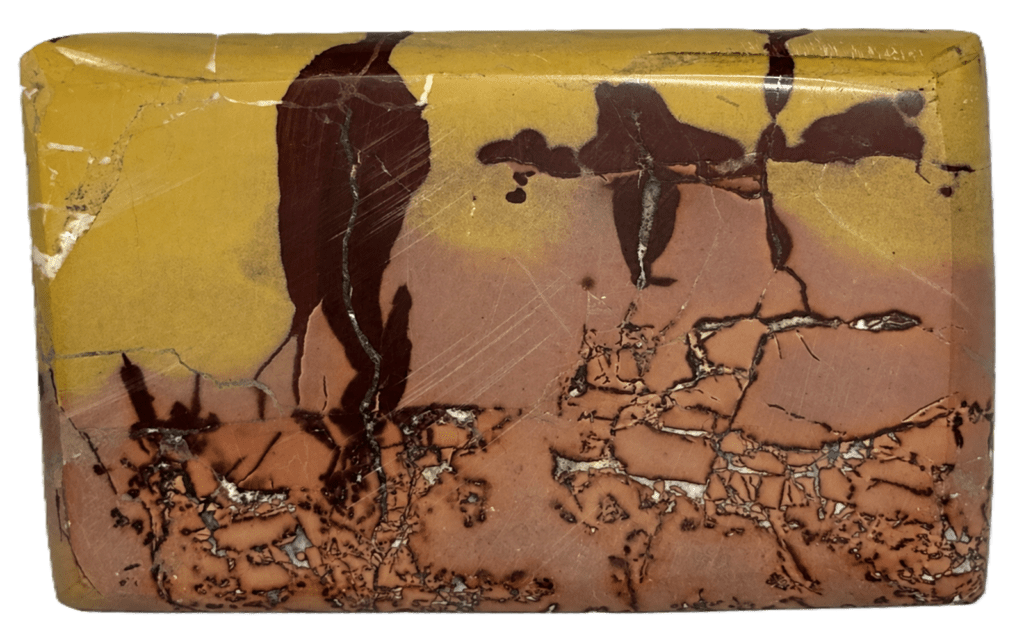
High Atlas Mountain Jasper is an earthy, microcrystalline gemstone sourced exclusively from the rugged peaks and tectonic valleys of Morocco’s High Atlas range. Forged through ancient silica-rich hydrothermal flows and heavy mineral mineralisation, it displays striking landscape patterns, brecciated bands, and orbicular motifs in terracotta, ochre, rich brown, and moss green. Prized among lapidaries for its resilience and high polish, it is equally celebrated in holistic and metaphysical communities as a cornerstone talisman of emotional stability, perseverance, and deep grounding. This distinct Moroccan treasure embodies the timeless geological grandeur and physical endurance of North Africa’s ancient mountain terrains.
Alternate Names
- Moroccan Jasper: A broad geographic trade name frequently applied to chalcedony and jasper varieties originating from Morocco’s interior deposits.
- Atlas Mountain Jasper / High Atlas Jasper: Common shortened commercial names used across gemological and mineral markets.
- Stone of Endurance: A metaphysical moniker referencing its traditional energetic association with stamina, perseverance, and emotional resilience.
- Moroccan Red / Desert Jasper: A localised lapidary term occasionally applied to iron-heavy, terracotta-dominant rough specimens.
The Stone’s Science and Composition
High Atlas Mountain Jasper is an opaque, microcrystalline variety of quartz (SiO2). Its physical matrix consists of micro granular quartz aggregates intertwined with secondary mineral inclusions that dictate its colour, opacity, and internal patterns.
- Chemical Formula: Predominantly Silicon Dioxide (SiO2) with mineral impurities (Fe2O3, FeO, MnO2, clay silicates).
- Formation Environment: Formed when low-temperature, silica-saturated hydrothermal fluids infiltrate fissures, voids, and porous sedimentary or volcanic host rocks. Over geological epochs, silica precipitates out of solution as cryptocrystalline quartz, trapping localised metal oxides.
- Colouration Agents:
- Reds and Terracotta: Finely dispersed iron oxide (haematite).
- Yellows, Creams, and Ambers: Iron oxyhydroxides (goethite, limonite).
- Darks, Greys, and Black Filaments: Manganese oxides and trace organic matter.
- Earthy Greens: Trace chlorite or silicate clay inclusions.
Key Physical Characteristics
| Property | Value / Manifestation |
|---|---|
| Chemical Classification | Silicate (Tectosilicate, Quartz Group) |
| Crystal System | Trigonal (Microcrystalline / Cryptocrystalline) |
| Mohs Hardness | 6.5 to 7.0 |
| Specific Gravity | 2.58 – 2.91 (fluctuates based on mineral inclusion density) |
| Refractive Index | 1.540 – 1.553 |
| Lustre | Vitreous to dull in rough form; waxy to vitreous when polished |
| Fracture | Conchoidal to splintery |
| Cleavage | None |
| Transparency | Fully opaque |
Common Geologic Varieties
- Classic High Atlas Jasper: Characterised by warm brick-red, rust, and umber matrix tones interlaced with creamy quartz ribbons and layered sedimentary bands.
- Golden Atlas Jasper: Dominated by mustard, honey, and amber hues resulting from hydrated iron oxides, often featuring dendritic or micro-veined patterns.
- Green-Banded Atlas Jasper: Features deep sage and mossy olive striping caused by chloritic inclusions, often alternating with pale tan or beige silica seams.
- Brecciated Atlas Jasper: A dynamic variety formed when tectonic movement fractured existing jasper beds, which were subsequently re-cemented by later-stage chalcedony and white quartz veins.
- Orbicular / Eye Atlas Jasper: Less common rough exhibiting circular, concentric orb structures formed via spherulitic crystallisation during hydrothermal cooling.
Global Mining and Volcanic Sources
High Atlas Mountain Jasper is geologically distinct to the High Atlas (Haut-Atlas) Mountain Range in central and southern Morocco. The High Atlas mountains formed through a combination of Mesozoic rifting followed by Cenozoic tectonic collision between the African and Eurasian plates.
- Mining Regions: Primary extraction occurs within remote mountain passes, alluvial dry riverbeds (oueds), and artisanal surface pits throughout the Ouarzazate, Midelt, and Al Haouz provinces.
- Extraction Methods: Largely mined by hand and local artisanal cooperatives utilising unmechanised quarrying techniques to harvest nodules, seams, and stream-tumbled boulders from rugged mountain scree.
- Global Context: While jasper is found globally (such as in Madagascar, Brazil, the United States, and Australia), the specific combination of iron-manganese brecciation, warm desert hues, and high silica density found in High Atlas Jasper is unique to this North African orogenic belt.
Crystal Pairings: What to Combine and Avoid
Combining High Atlas Mountain Jasper with complementary or counteracting stones allows practitioners to direct its intense grounding resonance toward specific intentions.
Optimal Crystal Pairings
- Tiger’s Eye: Amplifies personal courage, solar plexus vitality, and practical action while anchoring scattered thoughts.
- Black Obsidian or Black Tourmaline: Deepens root-chakra shielding, transmuting dense negative energetic patterns and creating an energetic perimeter.
- Carnelian: Blends the sustained, slow-burning endurance of jasper with the creative, decisive vitality of carnelian.
- Smoky Quartz: Helps neutralise stress and environmental disharmony, allowing High Atlas Jasper’s stabilising energy to settle the emotional body.
- Red Haematite: Structurally reinforces physical grounding, mental clarity, and somatic embodiment.
Crystal Pairings to Avoid
- Lepidolite: Lepidolite’s intensely sedative, lithium-rich energy can dampen and counter the proactive, stamina-building frequency of High Atlas Jasper.
- Selenite: Highly ethereal, high-frequency crown-chakra stones like Selenite can create an energetic disconnect if paired without a deliberate bridge stone, blunting the physical rooting properties of jasper.
- Moldavite: The rapid, destabilising, and airy transmutational surge of tektites frequently clashes with the slow, ancient, anchoring nature of dense mountain jasper.
Archaeology, Art and Ancient History
North Africa has maintained an unbroken lapidary connection with microcrystalline quartz since the Paleolithic era. While “High Atlas Mountain Jasper” is a modern commercial designation, prehistoric tools, scrapers, and points crafted from local Moroccan jaspers and cherts have been recovered across the Maghreb:
- Lithic Tools & Trade: Stone Age hunters and pastoralists utilized the hard, conchoidal-fracturing jaspers of the High Atlas for resilient arrow points, blades, and fire-striking nodules.
- Berber (Amazigh) Adornment: Historically, indigenous Amazigh craftsmen incorporated polished local pebbles, jaspers, and agates into protective amulets, trade beads, and silver-set jewellery alongside amber, carnelian, and coral.
- Classical Antiquity: During Phoenician and Roman dominance in coastal Mauretania Tingitana, regionally quarried decorative jaspers served as architectural tesserae, sealstones, and carved talismanic beads.
Folklore, Legends and Sacred Tales
Rooted in the folklore of mountain dwellers and desert traders, jasper from the high peaks was historically revered as a stone of steadfast travellers:
- The Shield of Caravans: Trans-Saharan traders and mountain nomads frequently carried dense red jasper as an amulet against dehydration, sandstorms, and sudden exhaustion, believing the stone tethered its bearer safely to the earth.
- Blood of the Earth: Early regional animist lore viewed red and ochre jasper veins running through bare limestone mountains as dried drops of primordial earth blood, imbuing the bearer with the indomitable physical strength of the mountain itself.
- Warrior’s Resolve: Regional legends suggest that warriors wore carved jasper talismans into mountain skirmishes to stop excessive bleeding and cultivate a fearless, unshakeable focus under duress.
Metaphysical and Mystical Healing Properties
- Emotional Endurance: Fosters long-term emotional perseverance, helping individuals navigate protracted legal disputes, chronic stress, or gruelling career transitions without succumbing to burnout.
- Grounded Pragmatism: Counters mental flightiness, chronic overthinking, and daydreaming by pulling wandering consciousness back into the physical body and physical reality.
- Physical Vitality: In holistic crystal healing traditions, it is used to support somatic stamina, stimulate circulation, assist sluggish metabolic systems, and ease physical fatigue.
- Energetic Shielding: Functions as an environmental buffer against stray negative intentions, psychic debris, and low-frequency emotional environments.
Astrological Connections
High Atlas Mountain Jasper interfaces directly with the earth and fire elements of the zodiac, offering stabilising resonance to determined signs:
- Aries (Fire): Tames impulsive, scattershot energy into sustained, strategic drive, ensuring projects started with fire are finished with discipline.
- Capricorn (Earth): Resonates with Capricorn’s planetary ruler, Saturn. It provides emotional nourishment and relief from excessive self-imposed pressure while supporting ambitious long-term goals.
- Virgo (Earth): Helps quiet analytical over stimulation, grounding mental worry into practical, step-by-step organisation.
The Chakra System
- Root Chakra (Muladhara): The primary energy centre for High Atlas Jasper. Placed at the base of the spine, its dense iron-silica resonance discharges excess erratic energy directly into the Earth, cultivating physical safety, stability, and survival confidence.
- Solar Plexus Chakra (Manipura): Yellow and golden-veined varieties connect with the solar plexus, stimulating personal willpower, internal authority, emotional independence, and physical vitality.
- Sacral Chakra (Svadhisthana): Terracotta and rust coloured specimens clear stagnation in the lower abdomen, stimulating creativity, resilience, and personal drive.
Interesting Facts
- Tectonic Heritage: The High Atlas Mountains contain rocks dating back to the Precambrian period; the jasper deposits were shaped and exposed during violent mountain-building events linked to the Alpine progeny.
- Natural Lapidary Allure: Because of its high silica purity and dense micro granular matrix, High Atlas Mountain Jasper accepts an exceptional, mirror-like “wet look” polish using standard cerium oxide or diamond compounds.
- Individual Patterning: Like landscape agates, rough slabs of High Atlas Jasper frequently present visual vistas reminiscent of desert sand dunes, mountain ridges, and petrified flora.
- A Fire-Striking Tool: Before modern matches, dense high-iron jasper nodules were frequently paired with high-carbon steel striking kits by mountain travellers to produce sparks.
Modern Milestones: Birthstones and Anniversaries
- Modern Birthstone Status: While not on the standardised jewellers’ birthstone calendar, it serves as an alternative mystical birthstone for March and October, aligning with the grounding needs of seasonal shifts.
- Zodiac Birthstone: An alternative astral birthstone for those born under Aries (March 21 – April 19) and Capricorn (December 22 – January 19).
- Anniversary Association: Traditionally gifted to celebrate the 31st Wedding Anniversary. Its signature metaphysical attribute—endurance—serves as an apt symbol for three decades of shared resilience, stability, and marital commitment.
Frequently Asked Questions
How do I clean and care for High Atlas Mountain Jasper?
Clean your stone using lukewarm water, mild dish soap, and a soft-bristle brush or microfibre cloth. Avoid harsh chemical cleaners, steam cleaners, or hydrofluoric acid. Because it rates 6.5 to 7 on the Mohs hardness scale, it is safe for brief water exposure, but porous raw specimens should not be soaked indefinitely.
How can I energetically cleanse and charge this stone?
Cleanse your stone by smudging it with cedar, sage, or sweetgrass, or by burying it in dry sea salt or natural earth for 24 hours. To charge the stone, place it on raw red rock or expose it to morning sunlight for one to two hours. Avoid leaving brightly coloured specimens in direct, intense midday sun for extended periods to prevent potential surface fading.
Can High Atlas Mountain Jasper go in water?
Yes. Polished High Atlas Jasper is non-porous and water-safe for routine cleaning or water-based crystal layouts. However, unpolished, heavily brecciated, or fractured rough stones should avoid prolonged immersion, as water can seep into micro-fractures containing softer clay or iron deposits.
How can I distinguish genuine High Atlas Jasper from dyed stones?
Natural High Atlas Jasper displays organic, earthy tones—terracotta red, mustard yellow, brown, and muted olive green. If a specimen features vivid magenta, neon blue, or bright purple tones pooling in its surface fractures, it has been artificially dyed. Furthermore, genuine jasper will easily scratch common glass (hardness 5.5) without sustaining damage to itself.
What is the best way to use High Atlas Mountain Jasper during meditation?
Hold a palm stone or tumbled piece in your non-dominant hand while seated comfortably on the floor or ground. Focus your attention on the base of your spine (Root Chakra), visualising roots extending from the stone down into the bedrock of the earth. Use it during times of physical exhaustion or emotional uncertainty to restore a sense of calm foundation.