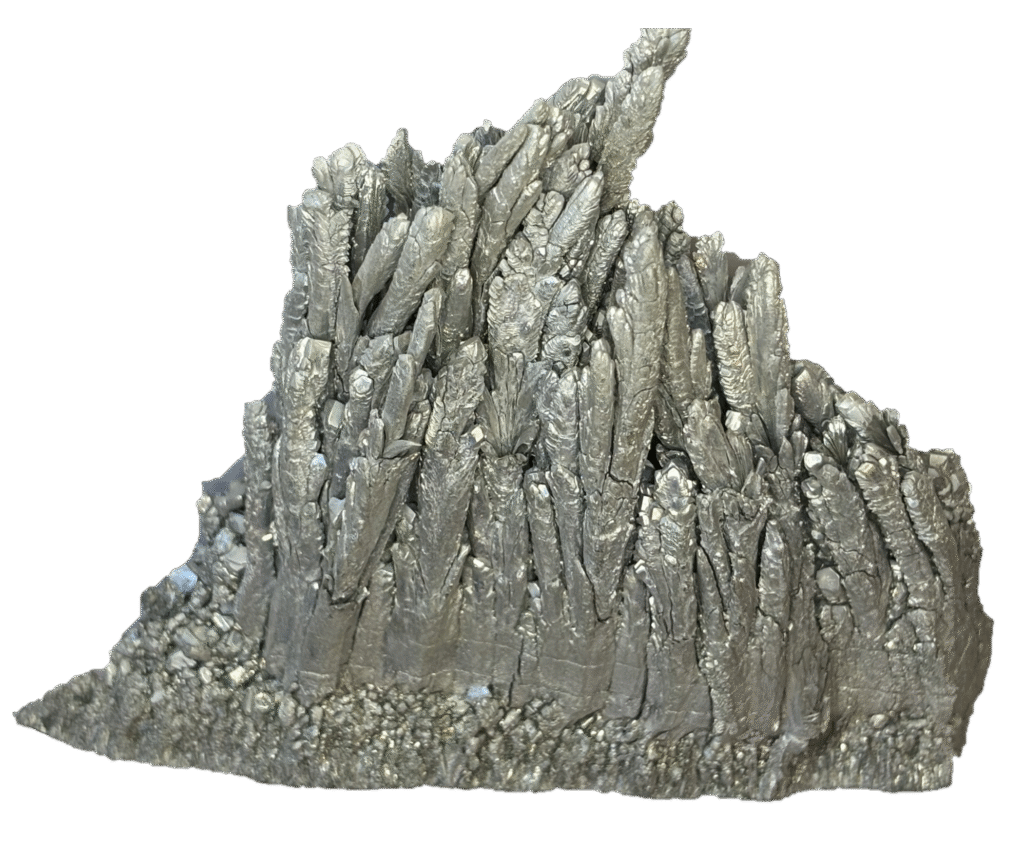
Crystalline magnesium is one of the most visually striking metallic specimens in the modern mineral and crystal trade—prized for its bright silvery-white lustre, feather-like columnar plumes, and remarkable lightness in the hand. Unlike terrestrial quartz, calcite, or pyrite, however, pure crystalline magnesium does not form naturally inside the Earth’s crust. Instead, every metallic magnesium cluster on the collector market is created through high-temperature vacuum sublimation and vapour deposition, producing ultra-pure elemental metal crystals (typically 99.95% Mg or higher) with a genuine hexagonal close-packed crystal structure.
Whether you collect rare laboratory-grown elements, study metallurgy, or work with metallic specimens in crystal grids and meditation, understanding how crystalline magnesium is made—and how to care for it safely—is essential. In this complete guide, we cover the science, physical properties, historical discovery, metaphysical symbolism, and strict dry-care rules for crystalline magnesium.
What Is Crystalline Magnesium?
Crystalline magnesium refers to elemental magnesium metal (chemical symbol Mg, atomic number 12) that has solidified directly from a metallic vapour into visible, geometric crystal clusters. Magnesium is the eighth most abundant element in the Earth’s crust and the third most abundant element dissolved in seawater, yet it never occurs in nature as a free, uncombined native metal.
Because magnesium is an alkaline earth metal with high chemical reactivity, any exposed metallic magnesium in nature rapidly reacts with oxygen, water, or carbon dioxide to form stable mineral compounds such as magnesite ($\text{MgCO}_3$), dolomite ($\text{CaMg(CO}_3)_2$), brucite ($\text{Mg(OH)}_2$), and silicate minerals like olivine (peridot) and serpentine. Consequently, viewing pure, unoxidised metallic magnesium crystals requires isolating the element in an oxygen-free industrial or laboratory environment.
How Crystalline Magnesium Specimens Are Made
The dramatic, stepped plumes seen on collector specimens are produced via vacuum sublimation and vapour deposition, closely tied to the Pidgeon process used to refine ultra-high-purity magnesium:
- Calcination and Reduction: Producers begin either with calcined dolomite ($\text{CaO}\cdot\text{MgO}$) mixed with ferrosilicon ($\text{FeSi}$) as a reducing agent, or with commercially refined magnesium ingots requiring ultra-high purification (99.95%+ purity).
- Vacuum Sublimation ($1,150^\circ\text{C}–1,200^\circ\text{C}$): The raw charge is sealed inside a steel or ceramic retort and heated under a deep vacuum. Under reduced pressure, magnesium bypasses the liquid phase altogether and sublimates directly into a pure metallic vapour.
- Vapour Condensation and Dendritic Growth ($450^\circ\text{C}–550^\circ\text{C}$): The magnesium vapour travels into a cooler, water-cooled condenser sleeve where it desublimates directly from gas back into solid metal. As atoms stack along magnesium’s hexagonal close-packed (HCP) crystal lattice, they build upward into elongated, feathery, hopper-like columnar and dendritic clusters.
- Harvesting and Passivation: After cooling under vacuum or an inert argon atmosphere to prevent ignition, the crystalline “crown” is extracted from the condenser wall and carefully divided into display specimens. Upon contact with room-temperature air, the surface immediately forms an invisible, nanometre-thin layer of magnesium oxide ($\text{MgO}$) that protects the bright metallic sheen from rapid further oxidation.
Mineralogical & Physical Properties of Magnesium Metal
Although synthetic in origin, crystalline magnesium possesses true crystalline order and distinct physical benchmarks that make it unmistakable in any collection:
| Property | Specification / Observation |
| Chemical Formula | $\text{Mg}$ (Elemental Magnesium, typically 99.95%+ purity) |
| Origin | Synthetic / Vapour-deposited in vacuum retorts |
| Crystal System | Hexagonal (Hexagonal Close-Packed / HCP lattice) |
| Crystal Habit | Columnar, dendritic, feathery, and stepped hopper-like clusters |
| Colour & Streak | Bright silvery-white; greyish-white metallic streak |
| Lustre | Bright metallic (dulls slightly if exposed to moisture or skin oils) |
| Mohs Hardness | 2.0 – 2.5 (very soft; easily scratched by a copper coin or fingernail pressure) |
| Specific Gravity | 1.74 (exceptionally lightweight—roughly 35% lighter than aluminium and far lighter than quartz at 2.65) |
| Cleavage & Fracture | No distinct cleavage; hackly to uneven metallic fracture |
| Flammability | Combustible when heated above ~$470^\circ\text{C}$ or in fine shavings/thin tips; burns with an intense white flame |
The defining physical surprise of crystalline magnesium is its specific gravity of 1.74. Picking up a palm-sized cluster that looks like heavy galena or pyrite only to find it weighs roughly the same as a block of hardwood immediately confirms its identity as magnesium rather than denser metals such as bismuth (SG 9.78) or silicon (SG 2.33).
Elemental Magnesium vs Magnesium-Bearing Minerals
In crystal shops and educational catalogues, elemental magnesium is frequently confused with natural magnesium-bearing minerals. Knowing the difference prevents misidentification and ensures proper care:
- Crystalline Magnesium ($\text{Mg}$): Pure, lab-grown elemental metal with a silvery metallic lustre, Mohs hardness of 2.0–2.5, and strict dry-only care requirements.
- Magnesite ($\text{MgCO}_3$): A natural magnesium carbonate mineral typically found in chalky white, cream, or grey nodular masses with dark veining (Mohs 3.5–4.5), widely used as a calming stone and frequently dyed blue to imitate turquoise.
- Dolomite ($\text{CaMg(CO}_3)_2$): A natural calcium-magnesium carbonate forming pearly pink, white, or tan saddle-shaped rhombohedral crystals (Mohs 3.5–4.0).
- Brucite ($\text{Mg(OH)}_2$): A natural magnesium hydroxide mineral prized by collectors in bright lemon-yellow or translucent green botryoidal clusters (Mohs 2.5–3.0).
- Peridot / Olivine ($\text{(Mg,Fe)}_2\text{SiO}_4$): A natural magnesium-iron silicate gemstone famous for its vibrant olive-green transparency (Mohs 6.5–7.0).
History & Discovery of Magnesium
Magnesium’s story begins in the ancient Greek region of Magnesia (in modern-day Thessaly), where white magnesium carbonate and magnesium oxide deposits were mined and traded under the name magnesia alba (“white magnesia”).
In 1755, Scottish physician and chemist Joseph Black demonstrated through careful weight experiments that magnesia alba was an entirely distinct substance from calcium carbonate (limestone), establishing magnesium as a separate chemical earth. Over half a century later, in 1808, English chemist Sir Humphry Davy successfully isolated pure elemental magnesium for the first time in London by electrolysing a moist mixture of magnesia and mercuric oxide. French chemist Antoine Bussy later prepared coherent metallic magnesium in 1831, paving the way for modern vacuum distillation techniques that produce today’s intricate crystalline crowns.
Metaphysical Properties & Symbolism of Crystalline Magnesium
Within modern crystal healing and holistic practice, crystalline magnesium is regarded as a stone of catalytic clarity, mental illumination, and energetic lightness. Because magnesium burns with a brilliant white light in chemistry and plays an essential biological role in cellular energy transfer, practitioners associate metallic magnesium clusters with clearing mental fog and sparking decisive forward momentum.
- Chakra Alignment: Primarily linked with the Solar Plexus Chakra (Manipura) for personal willpower, confidence, and intellectual focus, as well as the Crown Chakra (Sahasrara) for heightened perception and clarity of thought.
- Energetic Lightness: Mirroring its extraordinarily low specific gravity of 1.74, crystal workers use magnesium specimens when feeling weighed down by overthinking, sluggish routines, or creative stagnation.
- Modern Alchemy: Because these crystals are born through human ingenuity—transforming raw mineral vapour into ordered geometric plumes—many practitioners view crystalline magnesium as a symbol of conscious transformation, discipline, and bridging science with spiritual focus.
Crystal Grids & Pairings for Crystalline Magnesium
When incorporating crystalline magnesium into meditation layouts or sacred geometry grids, pair it with stones that balance its bright, high-clarity energy while respecting its soft physical surface:
- Clear Quartz: Amplifies magnesium’s focused, clarifying resonance in geometric grid centres.
- Smoky Quartz or Black Tourmaline: Anchors scattered mental energy and provides steady Root Chakra grounding during intense focus work.
- Bismuth & Elemental Silicon: Creates a striking modern alchemical triad celebrating geometric metallic and metalloid crystal structures.
- Libyan Desert Glass or Citrine Reinforces Solar Plexus confidence, creative drive, and decisive action.
Important Pairing Rule: Never allow harder quartz, tourmaline, or impactite points (Mohs 5.5–7.5) to rub directly against crystalline magnesium (Mohs 2.0–2.5). Always place each specimen on separate grid nodes or protective felt pads.
Care, Cleaning, Storage & Fire Safety Guidelines
Because crystalline magnesium is a soft, reactive metal rather than an inert silicate gemstone, standard crystal-cleansing routines can permanently ruin a specimen. Follow these strict handling rules:
- Keep Strictly Dry (No Water or Salt): Never submerge crystalline magnesium in water, salt water, or humid steam. Magnesium reacts slowly with water—and rapidly with saltwater or mild household acids like vinegar or lemon juice—to form dull white magnesium hydroxide ($\text{Mg(OH)}_2$) and release hydrogen gas, permanently etching its bright metallic lustre.
- Dry Cleansing & Dusting Only: Remove dust gently using a dry, soft-bristled artist’s paintbrush or a camera air blower. For energetic cleansing, use dry sound vibrations (singing bowls or tuning forks) or selentite/quartz proximity rather than liquid sprays or damp cloths.
- Handle by the Base: Natural skin oils and sweat contain mild salts and acids that can leave dark fingerprints on bright metallic facets over time. Hold specimens by the denser base matrix rather than the delicate upper crystal tips.
- Store in a Closed, Low-Humidity Display: Keep crystalline magnesium inside an enclosed acrylic or glass display box alongside a small silica gel desiccant packet to prevent atmospheric tarnishing and accidental knocks against harder minerals.
- Observe Fire & Heat Safety: Keep specimens well away from candles, incense embers, open flames, and high-heat lamps. While solid magnesium blocks are difficult to ignite, thin crystalline edges and fine metallic fragments can catch fire if heated above roughly $470^\circ\text{C}$, burning with an intense white light that must never be extinguished with water.
Buying Guide: Authenticity & Ethical Disclosure
When purchasing crystalline magnesium, look for transparent, accurate seller descriptions:
- Avoid “Natural Cluster” Claims: Because native metallic magnesium cannot survive exposure to Earth’s atmosphere or groundwater, any listing claiming a “100% natural mined magnesium crystal cluster” is mislabelled. Reputable mineral dealers clearly disclose specimens as vapour deposited or laboratory grown elemental magnesium crystals.
- Inspect Crystal Structure & Lustre: Genuine vapour-deposited specimens exhibit crisp, silvery-white metallic sheen, intricate stepped hopper growth along hexagonal columns, and an unmistakable lightweight feel (SG 1.74). Avoid pieces heavily coated in dull grey-white powder, which indicates prolonged moisture exposure and surface oxidation.
- Choose Protective Packaging: Verify that your supplier ships crystalline magnesium wrapped in dry, acid-free tissue or cushioned foam inside a rigid box so the soft Mohs 2.0–2.5 crystal plumes arrive intact.
Crystalline Magnesium Frequently Asked Questions
What is crystalline magnesium and how is it different from natural minerals?
Crystalline magnesium refers to elemental magnesium metal that has solidified directly from a metallic vapour into visible crystal clusters. It is synthetic, produced by vacuum sublimation and vapour deposition, and has a hexagonal close-packed structure. It is not a naturally occurring native metal in the Earth’s crust, unlike minerals such as magnesite or dolomite.
How are crystalline magnesium specimens made?
Specimens are made by a process involving calcination and reduction to obtain high-purity material, followed by vacuum sublimation at 1,150–1,200°C to vaporise magnesium, and then vapour condensation at 450–550°C to form the crystalline clusters. After cooling in an inert atmosphere, the crown-like crystals are harvested and kept dry to prevent oxidation.
What are the key physical properties of crystalline magnesium I should know?
Crystalline magnesium has the chemical symbol Mg and a hexagonal crystal system. It forms columnar, dendritic, and feathery clusters, with bright silvery-white lustre, Mohs hardness 2.0–2.5, specific gravity 1.74, and is combustible when heated or in fine shavings. It is exceptionally lightweight, roughly 35% lighter than aluminium.
How can I safely care for crystalline magnesium in a collection?
Keep it strictly dry and do not submerge it in water or salt water. Dry-clean with a soft brush to remove dust, and avoid standard crystal-cleansing methods. Protect it from moisture and direct contact with stronger reactive agents, and store it in a dry, inert environment to prevent oxidation.
How should crystalline magnesium be distinguished from magnesium-bearing minerals?
Crystalline magnesium is pure, lab-grown elemental magnesium with a silvery metallic lustre and a hardness of 2.0–2.5. Magnesium-bearing minerals like magnesite, dolomite, brucite, and olivine are natural minerals with different compositions, hues, and Mohs hardness values; they should be recognised by their mineral formulas and characteristic appearances to avoid misidentification.