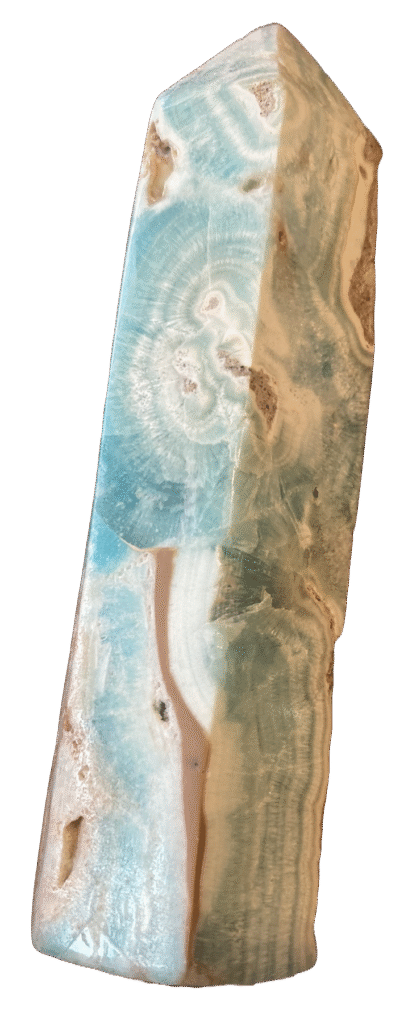
Caribbean Calcite is a breathtaking, newly discovered mineral combination that has rapidly taken the gemological and spiritual worlds by storm. Characterised by its sublime, oceanic palette, this stone instantly evokes the serene imagery of sun-drenched tropical shores, coastal tides, and pristine sandy beaches. First unearthed in 2019, Caribbean Calcite is not a singular mineral, but rather a rare, natural symbiotic growth uniting soft, pastel sky-blue Calcite, creamy white Calcite, and distinct bands or pockets of light brown to sandy aragonite.
This enchanting geological alliance balances the soothing, high-vibrational essence of Calcite with the stabilising, anchoring nature of Aragonite. Prized by collectors for its unique aesthetic and revered by crystal healers for its profound capacity to induce deep meditative states, alleviate emotional turbulence, and heighten spiritual awareness, Caribbean Calcite serves as a modern sanctuary stone in a fast-paced world.
Alternate names
Because Caribbean Calcite was discovered so recently, its nomenclature is still evolving within commercial and mineralogical markets. While it lacks centuries of traditional naming conventions, it is widely marketed under several highly descriptive trade names that highlight its beautiful seaside aesthetic:
- Ocean Blue Calcite: A name directly inspired by the mineral’s uncanny resemblance to deep-sea waves breaking against coastal shorelines.
- Aqua Calcite: Highlighting the luminous, translucent turquoise and aqua-marine hues embedded within its crystalline matrix.
- Caribbean Blue Calcite: A geographic misnomer utilised to emphasise the stone’s tropical holiday vibe, despite its actual terrestrial origin.
The stones Science and Composition
From a scientific standpoint, Caribbean Calcite is a captivating mineral aggregate comprising two distinct polymorphic forms of calcium carbonate ($\text{CaCO}_3$): Calcite and Aragonite. While they share an identical chemical formula, they crystallise in entirely different crystal systems, giving this combination its unique structural and visual complexity.
The primary blue and white matrix consists of Calcite, which belongs to the trigonal crystal system. The soothing blue coloration is primarily attributed to trace elements of copper or iron inclusions, as well as specific microscopic structural defects within the crystal lattice that scatter light similarly to the sky or ocean. Intertwined within this Calcite matrix are bands or geometric growths of Aragonite, which forms in the orthorhombic crystal system. This dual-polymorph intergrowth occurs naturally under very specific low-temperature, near-surface sedimentary conditions where calcium-rich fluids gradually deposit mineral layers over vast geological timescales.
Key Physical Characteristics
Understanding the physical parameters of Caribbean Calcite is essential for both identification and preservation. Its primary diagnostics include:
- Chemical Formula: $\text{CaCO}_3$ (Calcium Carbonate aggregate)
- Crystal System: Trigonal (Calcite component) and Orthorhombic (Aragonite component)
- Hardness: 3 to 4 on the Mohs hardness scale, classifying it as a relatively soft, delicate stone susceptible to scratching.
- Lustre: Vitreous to waxy, occasionally displaying a dull, earthy texture within unpolished aragonite bands.
- Transparency: Translucent to opaque, with light beautifully pooling within the blue Calcite sections.
- Fracture & Cleavage: Brittle conchoidal fracture with perfect rhombohedral cleavage inherent to the Calcite zones.
- Streak: White.
Common Geologic Varieties
Caribbean Calcite displays a fascinating degree of visual diversity based on the structural ratio of its component minerals. The primary geological varieties found on the market include:
- Wave-Patterned Caribbean Calcite: The most sought-after variety, featuring highly defined, alternating bands of blue, white, and brown that look exactly like aerial photographs of ocean waves crashing onto sandy beaches.
- Druzy Caribbean Calcite: Highly prized specimens that feature natural vugs, pockets, or open cavities lined with tiny, glittering, sugar-like druzy crystals of white calcite or aragonite.
- Blue-Dominant Caribbean Calcite: Varieties where the soft pastel sky-blue calcite makes up over 90% of the specimen, offering a highly minimalist, ultra-soothing aesthetic with minimal brown aragonite banding.
- Earthy/Stalactitic Aragonite Varieties: Specimens that prominently showcase the rougher, brownish-tan aragonite structures, providing a much more grounded, rustic appearance.
Global Mining and Volcanic Sources
Despite its highly evocative tropical name, Caribbean Calcite is completely absent from the Caribbean Sea and its surrounding islands. Instead, this unique mineral combination is found exclusively in one highly localised region of the world: Pakistan.
It was discovered in 2019 within the remote, rugged mountainous terrains of Balochistan, Pakistan. The stone is mined out of ancient sedimentary deposits where hydrothermal and meteoric fluids rich in calcium carbonate historically circulated through limestone host rocks. Because mining is restricted to these specific Pakistani deposits, the global supply of high-grade, beautifully banded Caribbean Calcite remains relatively finite, making premium raw specimens, polished spheres, and towers highly collectible.
Crystal Pairings: What to Combine and Avoid
Optimal Crystal Pairings
When integrating Caribbean Calcite into spiritual or meditative practices, it synergises beautifully with minerals that complement its soothing, high-vibrational, and upper-chakra frequencies:
- Lepidolite: This lithium-rich mineral pairs spectacularly with Caribbean Calcite to form an ultimate emotional first-aid kit. While the Calcite pacifies an overactive mind, Lepidolite works to systematically neutralise deep anxiety, stress, and panic attacks.
- Celestite: A magnificent pairing for spiritual expansion. Celestite elevates the gentle Third Eye and Throat Chakra energies of Caribbean Calcite, paving a smooth pathway for angelic communication, astral travel, and lucid dreaming.
- Selenite (Satin Spar): Acting as a natural energetic amplifier, Selenite continuously purifies the delicate energy of Caribbean Calcite, keeping its oceanic vibrations clear, vibrant, and operating at maximum capacity.
- Black Tourmaline or Smoky Quartz: If you wish to use Caribbean Calcite for deep meditation without feeling spaced out, pairing it with a strong grounding stone ensures your physical consciousness remains safely anchored to the Earth while your mind travels.
Crystal Pairings to Avoid
While Caribbean Calcite harmonises with many stones, it should generally not be combined with highly volatile, intensely dynamic, or aggressively fiery crystals, as their contrasting frequencies can create a jarring, chaotic environment:
- Carnelian: The raw, fiery, action-oriented, and passionate solar energy of Carnelian directly clashes with the tranquil, cooling, and deeply passive ocean vibes of Caribbean Calcite, rendering both stones energetically ineffective.
- Moldavite: The intense, rapid, and often disruptive cosmic transformation triggered by Moldavite can easily overwhelm the gentle, nurturing, and steady emotional healing pace provided by Caribbean Calcite.
- Sunstone: As a stone of radiant, outward, and highly expressive solar power, Sunstone’s frequencies can completely overshadow and drown out the delicate, introspective, and quiet lunar qualities of this blue calcium carbonate aggregate.
Archaeology, Art and Ancient History
Because Caribbean Calcite was only discovered in 2019, it possesses absolutely no ancient archaeological footprint or historical lineage. You will not find it entombed within the burial chambers of Egyptian Pharaohs, nor was it carved into talismans by ancient Mesoamerican civilisations.
Instead, its history is being written right now in the modern era. In art and contemporary sculpture, it has rapidly become a premier medium for lapidaries, interior designers, and spiritual artisans. Its striking seaside patterns make it highly coveted for high-end decorative statement pieces, such as polished spheres, monolithic towers, smooth palm stones, and intricate hand-carved depictions of marine life like dolphins, sea turtles, and waves.
Folklore, Legends and Sacred Tales
As a modern newcomer to the mineral kingdom, Caribbean Calcite does not have ancient myths or folklore tied specifically to its name. However, crystal practitioners and modern mystics have seamlessly woven it into contemporary metaphysical lore by connecting it to universal water-element folklore.
Many modern legends view Caribbean Calcite as a physical manifestation of the lost city of Atlantis, believing that the stone holds the energetic signature of ancient, peaceful marine civilisations. It is often referred to in holistic circles as the “Stone of the Living Ocean,” with sacred tales suggesting that meditating with the stone allows one to hear the gentle whispers of sea deities, offering ancient wisdom regarding emotional resilience, flow, and the natural cycles of life.
Metaphysical and Mystical Healing Properties
Metaphysically, Caribbean Calcite is revered as a profound instrument of peace, emotional transmutation, and subconscious exploration. It behaves like a spiritual sedative, instantly cooling down inflamed emotions, soothing frayed nerves, and washing away lingering energetic blockages.
- Emotional Healing: It is highly effective for those overcoming trauma, grief, or chronic stress, as it gently encourages the release of suppressed emotions, allowing them to flow away smoothly like a retreating tide.
- Mindfulness & Meditation: Placed in a quiet space, it radiates a protective barrier of serenity, making it exceptionally easy to slip into deep, thoughtless states of zen during mindfulness practices.
- Dream Work: Keeping a piece on a bedside table is believed to prevent nightmares, eliminate insomnia, and encourage vivid, insightful prophetic dreams by opening a clear conduit to the higher self.
Astrological Connections
Caribbean Calcite shares an intimate, deeply resonant relationship with the element of water, making it a powerful astrological ally for the water signs of the zodiac:
- Cancer: As a sign ruled by the Moon and prone to intense emotional waves, Cancers benefit immensely from the stone’s deeply nurturing, stabilizing, and soothing embrace, which helps them create a safe emotional sanctuary.
- Pisces: The natural mysticism, vivid imagination, and escapist tendencies of Pisces are perfectly supported by Caribbean Calcite, which enhances their innate psychic gifts while keeping their emotional bodies beautifully balanced.
- Libra: Though an air sign, Librans are constantly seeking harmony, peace, and absolute balance. The calming, diplomatic, and centering vibrations of Caribbean Calcite help Librans alleviate decision fatigue and quiet an over analytical mind.
The Chakra System
Caribbean Calcite acts primarily upon the higher energetic centres of the human subtle body, creating a luminous bridge between communication and higher consciousness:
- The Third Eye Chakra (Ajna): By placing Caribbean Calcite on the forehead during layout sessions, it stimulates the pineal gland, heightening intuition, expanding psychic visions, and allowing individuals to perceive higher truths with absolute clarity.
- The Throat Chakra (Vishuddha): The sky-blue calcite component unblocks and aligns the throat centre. It empowers individuals to speak their personal boundaries and emotional truths with absolute calm, kindness, and diplomatic grace, completely removing aggression or fear from their vocabulary.
Interesting facts
- A Geographical Illusion: Despite its highly distinct tropical name, Caribbean Calcite has never been found anywhere near the Caribbean Sea; it is mined strictly in the arid, mountainous regions of Pakistan.
- A Time Capsule: It is one of the youngest stones on the global commercial crystal market, having been completely unknown to humanity prior to its discovery in 2019.
- A Dual Polymorph: It represents a rare natural phenomenon where two different crystal structures (trigonal calcite and orthorhombic aragonite) grow seamlessly together out of the exact same chemical compound.
- Natural Cavities: It frequently forms with tiny, breathtaking hidden internal caves lined with sparkling druzy crystals, making every single specimen entirely unique.
Modern Milestones: Birthstones and Anniversaries
While Caribbean Calcite is far too new to be included in traditional Gregorian or planetary birthstone charts, it has been embraced as a modern, holistic birthstone for those born under the signs of Cancer and Pisces (spanning June–July and February–March respectively), serving to honour their deep elemental connection to water.
In modern relationships, Caribbean Calcite is rapidly gaining popularity as a meaningful milestone gift for the 5th Wedding Anniversary. While traditional lists designate wood or silverware for this milestone, contemporary crystal enthusiasts gift Caribbean Calcite to symbolise the deep emotional clarity, smooth communication, and beautiful, wave-like resilience a couple has co-created over their first five years of marriage.
Caribbean Calcite FAQ
Q: Can Caribbean Calcite go in water?
A: No, Caribbean Calcite should never be submerged in water. Because it is a calcium carbonate mineral with a low Mohs hardness of 3–4, it is highly water-soluble. Prolonged exposure to moisture, salt water, or tap water will permanently dissolve its natural waxy lustre, cause the stone to become highly brittle, widen its internal micro-fractures, and ultimately cause the specimen to degrade or split apart.
Q: Why is it called Caribbean Calcite if it comes from Pakistan?
A: The name “Caribbean Calcite” is a pure trade name created by the original gem merchants who discovered it. Because the stunning combination of pastel sky-blue calcite, seafoam white lines, and sandy tan aragonite looked exactly like an aerial view of the Caribbean shoreline, the name was chosen strictly for its visual marketing appeal.
Q: How can I tell if my Caribbean Calcite is real or fake?
A: Genuine Caribbean Calcite possesses very specific telltale signs:
- Visual Irregularity: Real specimens feature completely organic, irregular, and asymmetrical bands of blue, white, and brown. Fake glass or resin imitations will look suspiciously uniform, display repetitive patterns, or contain perfectly circular, trapped microscopic air bubbles.
- Surface Texture: Because it comprises two different minerals, even a highly polished piece will often feature tiny, natural surface pits, hairline fissures, or open druzy vugs. If a piece is absolutely flawless, cheap, and smooth like plastic, it is likely a counterfeit.
- Temperature: Natural stone feels notably cool to the touch when first picked up, whereas plastic or resin fakes warm up to your body temperature almost instantly.
Q: Will Caribbean Calcite fade if left in the sun?
A: Yes. The delicate blue color centres within the Calcite matrix are highly sensitive to intense ultraviolet (UV) radiation. If you leave your Caribbean Calcite on a bright, sunny windowsill exposed to direct sunlight for extended periods, the vibrant pastel blue will slowly but permanently photo-bleach, turning into a dull, chalky white or pale grey. Always store your specimens in a shaded area away from direct sun.
Q: How do I safely clean and energetically cleanse Caribbean Calcite?
A: * Physical Cleaning: Never use chemical solvents, ultrasonic cleaners, steam, or water. To remove dust, simply wipe the surface gently using a clean, dry, soft microfibre cloth.
- Energetic Cleansing: Since water and salt are highly destructive to this mineral, you should cleanse its energy safely by passing the stone through the smoke of sacred incense (such as frankincense, sandalwood, or dried sage) or by placing it near a sound-healing instrument like a Tibetan singing bowl.
- Energetic Charging: To safely replenish its cooling, ocean-like properties, leave your Caribbean Calcite out overnight to bathe in the gentle, cooling light of a full moon.
Q: Will Caribbean Calcite react if it comes into contact with acid?
A: Yes. Because both Calcite and Aragonite are calcium carbonates, they are highly reactive to acids. If a single drop of standard household white vinegar is applied to a raw, unpolished patch of genuine Caribbean Calcite, it will immediately begin to fizz and bubble gently as it releases carbon dioxide gas. (Note: Never perform this test on a polished specimen, as the acid will instantly etch the surface and permanently ruin the glossy finish).
These are my personally selected and curated Caribbean Calcite products