
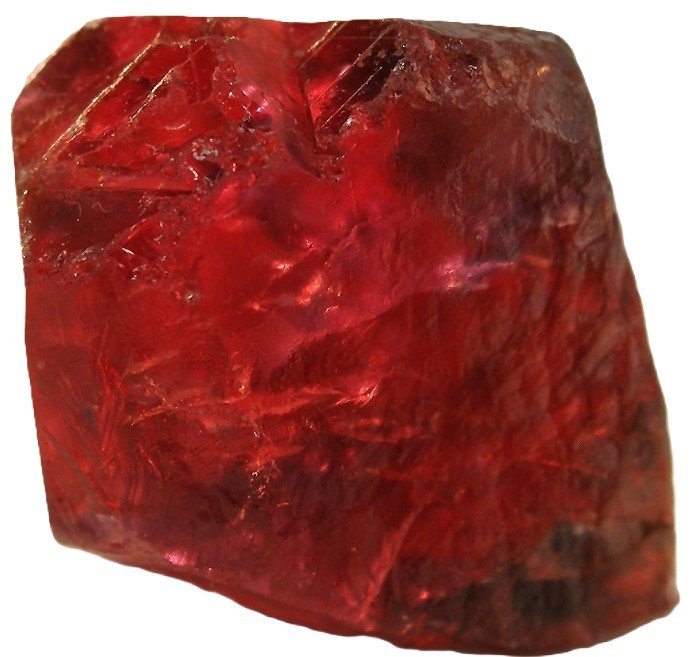
Ruby stands as one of the most revered treasures in geological history, celebrated for its vivid crimson saturation, exceptional durability, and storied past. As the red gemological variety of the mineral species corundum, ruby balances extreme physical toughness with incandescent optical beauty. For millennia, monarchs, gem collectors, and spiritual seekers have viewed this stone as an emblem of vitality, sovereign authority, and romantic passion. Ranking just beneath diamond on the Mohs hardness scale, ruby commands both industrial utility and the highest per-carat auction prices among coloured stones, cementing its enduring status across science, culture, and high jewellery.
Alternate names
- Ratnaraj / Ratnanayaka: Ancient Sanskrit designations meaning “King of Precious Stones” and “Leader of Gems.”
- Carbuncle: A Latin-derived historical descriptor (carbunculus, meaning “little ember”) used in classical antiquity and medieval Europe to denote deep-red glowing stones.
- Māṇikya: The traditional Vedic Sanskrit name used in Jyotish (Hindu astrology).
- Stone of Kings: A European honorific denoting its historical placement in imperial regalia.
- Pigeon’s Blood (Ko-Twe): A traditional trade term originating in Myanmar (Burma) describing the most coveted vivid red colour with medium-dark tone and strong red fluorescence.
The stones Science and Composition
Ruby is an allochromatic variety of corundum, an aluminium oxide mineral with the chemical formula:
$$\text{Al}_2\text{O}_3$$
In its chemically pure state, corundum is completely colourless (leucosapphire). A ruby forms when trace quantities of chromium ($\text{Cr}^{3+}$) substitute for aluminium ($\text{Al}^{3+}$) ions in the crystal lattice during crystallisation:
- Chromophore Function: The $\text{Cr}^{3+}$ ions absorb light in the yellow-green and violet segments of the visible spectrum while transmitting and reflecting red wavelengths.
- Fluorescence: Chromium triggers vivid red fluorescence under long-wave ultraviolet light. This optical property causes high-chromium stones (particularly marble-hosted specimens) to glow with an inner fire even under natural daylight.
- Trace Element Modifiers: Secondary trace elements like iron ($\text{Fe}^{3+}$) dampen this natural fluorescence and introduce brownish or dark undertones, whereas titanium ($\text{Ti}^{4+}$) interacting with iron can produce purplish hues.
Key Physical Characteristics
- Crystal System: Trigonal (hexagonal scalenohedral class), typically forming tabular hexagonal prisms, rhombohedrons, or bipyramidal crystals.
- Mohs Hardness: 9.0, making it exceptionally resistant to scratching and ideal for daily-wear jewellery.
- Specific Gravity: 3.97 – 4.05, imparting a high density noticeable in hand.
- Refractive Index (RI): 1.762 – 1.778, displaying double refraction (birefringence of 0.008).
- Pleochroism: Strong dichroism, showing purplish-red along the ordinary ray and orangey-red along the extraordinary ray.
- Lustre: Vitreous to sub-adamant on polished surfaces.
- Cleavage: None. Rubies display an uneven to conchoidal fracture, though they frequently exhibit rhombohedral or basal parting due to structural twinning.
Common Geologic Varieties
- Pigeon’s Blood Ruby: The premier trade variety exhibiting an intensely saturated, pure red colour with a subtle bluish or purplish cast, virtually devoid of iron-induced extinguishing.
- Star Ruby (Asterism): Specimens featuring microscopic, dense networks of intersecting rutile ($\text{TiO}_2$) needle inclusions—known as “silk”—oriented along the three crystallographic axes at 60-degree angles. When cut en cabochon perpendicular to the c-axis, reflected light forms a sharp six-rayed star across the dome.
- Pink-Red / Raspberry Ruby: Corundum stones that sit precisely on the boundary between ruby and pink sapphire, heavily debated in gemological grading laboratories depending on chromatic saturation standards.
- Trapiche Ruby: A rare, non-asteriated variety featuring fixed, wheel-like radial arms of dark carbonaceous inclusions dividing the gem into six distinct growth sectors.
Global Mining and Volcanic Sources
Rubies form predominantly in high-grade metamorphic environments and certain basaltic volcanic settings:
- Marble-Hosted (Low Iron):
- Myanmar (Mogok Stone Tract & Mong Hsu): The historical benchmark for world-class gems, producing stones in metamorphosed crystalline limestone with minimal iron, allowing intense UV fluorescence.
- Vietnam (Luc Yen): Marble deposits yielding vivid purplish-red to pinkish-red crystals alongside spinels.
- Amphibolite- and Metamorphic-Hosted:
- Mozambique (Montepuez): Discovered in 2009, this deposit is the single most productive modern source, yielding large, transparent, high-clarity stones with variable iron levels.
- Madagascar (Ilakaka & Didy): Metamorphic gravels and primary deposits providing rich red material.
- Greenland (Aappaluttoq): Modern rock-hosted hard-rock deposit yielding rubies and pink sapphires in anorthosite complexes.
- Basalt-Hosted (High Iron):
- Thailand (Chanthaburi) and Cambodia (Pailin): Rubies transported to the surface by alkaline basalt volcanism. These contain higher trace iron, resulting in deeper, garnet-like crimson shades with suppressed fluorescence.
- Alluvial Placer Deposits:
- Sri Lanka (Ratnapura): River gravel deposits famous for producing lighter, raspberry-hued rubies, star rubies, and fancy sapphires.
Crystal Pairings: What to Combine and Avoid
Optimal Crystal Pairings
- Clear Quartz: Amplifies ruby’s concentrated vibrational output and acts as a neutral prism, broadening the stone’s dense, physical energy outward.
- Garnet (Pyrope or Almandine): Mirrors ruby’s crimson resonance, intensifying vitality, determination, and grounding life-force energy within the lower chakras.
- Rose Quartz: Balances ruby’s assertive fire with soft, restorative emotional frequencies, harmonising passion with compassion and gentle self-love.
- Citrine: Blends the solar energy of ruby with manifestation and personal power, creating an energetic circuit for leadership, abundance, and creative drive.
- Kyanite: Facilitates energetic flow, clearing meridian blockages so ruby’s raw power circulates without causing mental or emotional friction.
Crystal Pairings to Avoid
- Haematite / Heavy Iron Stones: The dense, reflective anchoring of haematite can clash with ruby’s upward-surging, radiant heat, resulting in a stagnant, sluggish energetic state.
- Blue Lace Agate: Emits a tranquil, decelerating frequency designed to quiet expression; ruby’s vigorous dynamic directly counteracts this, muting both stones’ therapeutic properties.
- Black Tourmaline (Unguided): While occasionally used for psychic protection grids, combining strong shielding stones with intense ruby fire can feel claustrophobic or overstimulating for sensitive individuals.
Archaeology, Art and Ancient History
Rubies have been traded along the Silk Road and throughout maritime networks for over 2,500 years. Pliny the Elder documented red stones under the umbrella term carbunculus in his first-century Naturalis Historia, noting their resistance to fire and natural brilliance.
Historically, gemology did not distinguish between red corundum, red spinel, and red garnet. Consequently, many legendary historical “rubies” in imperial treasuries are actually red spinels:
- The Black Prince’s Ruby: A 170-carat uncut, irregular cabochon set in the Imperial State Crown of the United Kingdom; gemological testing confirms it is a red spinel originating from the historic Badakhshan mines.
- The Timur Ruby: A 352-carat inscribed gem in the British Royal Collection, also identified as red spinel.
- Ancient Burmese Warriors: Carried genuine Mogok rubies into battle, not merely set into talismans or armour, but surgically embedded beneath their skin to ensure total invulnerability against swords, spears, and arrows.
Folklore, Legends and Sacred Tales
- The Eternal Ember: Classical Mediterranean myths claimed that a genuine ruby contained an unquenchable inner fire capable of boiling water if dropped into a vessel or shining visibly through thick cloth.
- Vedic Rebirth: In ancient Hindu traditions documented in the Garuda Purana, offering exceptional rubies to Lord Krishna guaranteed the donor rebirth as an emperor (Chakravartin) in their next life.
- Prophetic Warnings: Medieval and Renaissance European lore held that rubies possessed precognitive sensitivity, growing cloudy, darkened, or losing their lustre to alert the wearer of impending disease, betrayal, or death, returning to their brilliant hue once danger passed.
Metaphysical and Mystical Healing Properties
- Physical Vitality: Re-energises the physical body during periods of chronic exhaustion, convalescence, or energetic depletion by invigorating circulation.
- Courage and Willpower: Clears feelings of self-doubt and replaces paralysis with resolute, decisive action, making it a cornerstone stone for leaders and innovators.
- Emotional Passion: Clears stagnant emotional patterns around intimacy, sparking playful, dedicated, and courageous romantic connection.
- Auric Shielding: Forms an energetic boundary against psychic draining, psychic vampirism, and manipulative interpersonal dynamics.
Astrological Connections
- Ruling Celestial Body: The Sun (Surya). Ruby captures the solar qualities of illumination, vitality, sovereign authority, and personal radiance.
- Primary Zodiac Sign: Leo. The stone enhances Leo’s natural magnetism, creative flair, generosity, and executive will while tempering egoic overreach.
- Secondary Resonances:
- Sagittarius: Harmonies philosophical exploration with the personal stamina required to turn ideals into tangible reality.
- Aries: Channels the Martian drive of the Ram through the steady, royal authority of the Sun, transmuting impulsive reactivity into focused leadership.
The Chakra System
- Root Chakra (Muladhara): Rubies anchor the physical vessel to terrestrial energies, dispelling survival-based anxiety and stabilizing the bio-magnetic field.
- Heart Chakra (Anahata): By working directly on the emotional heart, ruby transmutes base survival instincts into elevated passion, unconditional loyalty, and fearless emotional vulnerability.
- Kundalini Activation: Esoteric traditions view ruby as an ignition key for the dormant serpent fire (Kundalini) resting at the base of the spine, drawing vitality upward through the central energetic channel (Sushumna).
Interesting facts
- Identical Twins: Chemically and structurally, ruby and sapphire are the same mineral (corundum). Any gem-quality corundum that is not primarily red is classified as sapphire.
- Laser Pioneers: The first working laser, built by Theodore Maiman in 1960, used a synthetic pink-ruby crystal rod to produce coherent 694.3 nm red laser light.
- Record Value: The 25.59-carat Burmese “Sunrise Ruby” fetched over $30 million (£22 million) at Sotheby’s in 2015, establishing an all-time record for a coloured gemstone at over $1.18 million per carat.
- Identifying “Silk”: Gemologists look for microscopic, intersecting rutile needles (“silk”) under magnification; their presence helps differentiate unheated natural rubies from synthetics and indicates geologic origin.
Modern Milestones: Birthstones and Anniversaries
- July Birthstone: Ruby serves as the official modern birthstone for July (standardized by the American National Association of Jewelers in 1912), representing midsummer heat, vitality, and renewal.
- 40th Wedding Anniversary: Globally recognized as the signature gift for the Ruby Jubilee, honoring four decades of enduring love, inner fire, and shared perseverance.
- Capstones & Horology: Synthetic rubies are widely used inside high-end mechanical watches as low-friction, wear-resistant jewel bearings for gear pivots and escapements.
Frequently Asked Questions
How can I tell a real ruby from a fake or synthetic one?
Natural rubies typically contain microscopic natural inclusions such as rutile silk, liquid feathers, or mineral crystals. Synthetic rubies (often created via flame fusion) are chemically identical corundum but frequently display curved striae, gas bubbles, and unnaturally uniform clarity under a 10x loupe. Imitations like red glass or garnet have lower hardness, single refraction, or different specific gravities. Formal laboratory certification (GIA, SSEF, Gübelin) is essential for high-value specimens.
What causes the “Pigeon’s Blood” colour
The trade term describes an intense, richly saturated crimson with a vivid red fluorescence and minimal iron content. Geologically, it occurs when high levels of chromium ($\sim 0.5\text{–}1.0\text{ wt%}$) provide colour and fluorescence, while low iron concentrations prevent dark extinction.
Are most rubies on the market heat-treated?
Yes. Over 95% of rubies in the modern commercial market undergo high-temperature heat treatment (typically between 1200°C and 1800°C). This standard practice dissolves rutile silk, improves transparency, and enhances the red hue by removing purplish or brownish colour modifiers. Completely untreated rubies with exceptional colour and clarity command substantial premiums.
How do I clean and care for ruby jewellery?
Because ruby rates 9 on the Mohs scale with no cleavage, it is durable enough for ultrasonic and steam cleaning, provided the stone is not fracture-filled or lead-glass treated. For untreated or standard heat-treated rubies, warm water, mild dish soap, and a soft-bristled toothbrush are the safest cleaning method. Avoid exposing fracture-filled stones to acids, lemon juice, or extreme heat.
What is the difference between a ruby and a red spinel?
While both form in similar marble deposits and share a vibrant red colour, ruby is corundum (aluminium oxide) crystallising in the trigonal system with a hardness of 9. Spinel is a magnesium aluminium oxide ($\text{MgAl}_2\text{O}_4$) that crystallises in the isometric (cubic) system, rates 8 on the Mohs scale, and is singly refractive.
