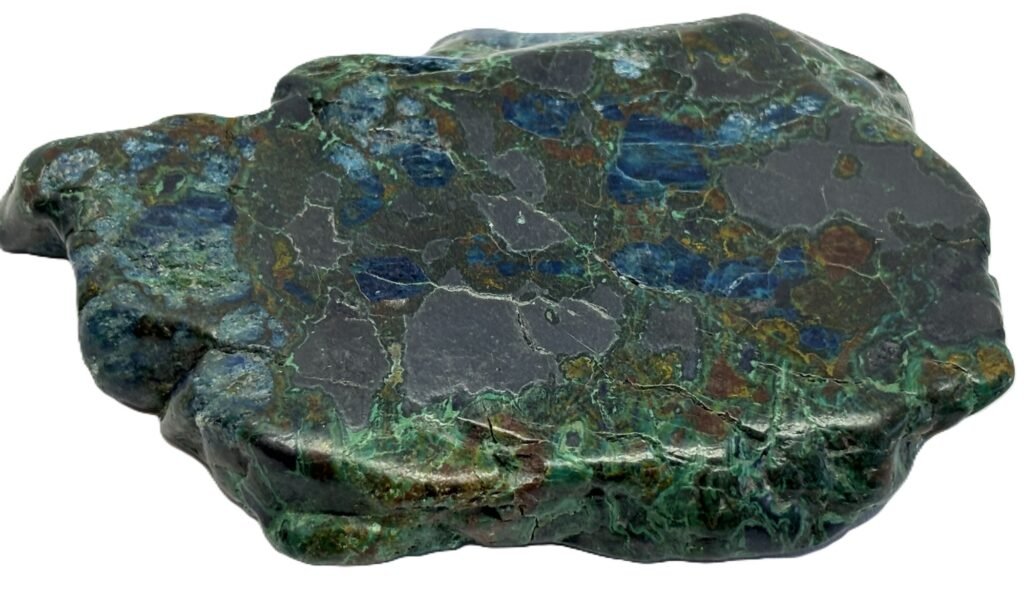
Composite specimens containing Azurite, Malachite & Shattuckite represent one of nature’s most visually striking mineral associations. These three copper-based minerals, often found together in the oxidation zones of copper deposits, offer a rare harmony of deep blues, vibrant greens, and soft turquoise hues.
Mineral Composition and Geology
The scientific fascination with this trio began in earnest in 1915, when mineralogist W.T. Schaller documented how these minerals form in close association. His research into their paragenesis (the sequence of formation) helped explain how varying conditions—such as pH levels, temperature, and the availability of carbonate and silicate ions—allow these distinct minerals to crystallise simultaneously.
The Chemical Profiles
Azurite: A copper carbonate hydroxide, $Cu_3(CO_3)_2(OH)_2$. It crystallises in the monoclinic system and is famed for its intense, deep-blue colour.
Malachite: Also a copper carbonate hydroxide, $Cu_2CO_3(OH)_2$. It is recognised by its striking green banded patterns and botryoidal (grape-like) masses.
Shattuckite: A copper silicate mineral, $Cu_5(SiO_3)_4(OH)_2$. Crystallising in the orthorhombic system, it bridges the gap between blue and green with its unique turquoise-to-teal appearance.
Because these minerals are derived from copper, they are relatively soft (ranging from 3 to 4 on the Mohs hardness scale), making them delicate but exquisite additions to any collection.
Metaphysical and Historical Significance
Throughout history, these stones have been revered for their connection to the earth and the intellect.
Azurite: Traditionally known as the “Stone of the Seer,” it is linked to clairvoyance and deep wisdom.
Malachite: Often called the “Guardian of Transformation,” it is associated with absorbing negative energy and fostering personal growth.
Shattuckite: Regarded as the “Mystic’s Muse,” this stone is believed to stimulate inner vision and clear communication.
When Azurite, Malachite & Shattuckite is found in a single matrix, they are considered a powerful, multi-purpose tool for spiritual work, balancing the Third Eye (Azurite), Heart (Malachite), and Throat (Shattuckite) chakras.
Crystal Pairings: Compatibility and Caution
When working with this trio, consider the energetic “frequency” of the stones you choose to pair with them.
Stones to Pair With
To get the most out of your composite specimen, consider stones that ground or amplify its natural properties:
Clear Quartz: An ideal partner. It acts as an amplifier, helping to clarify the often complex, layered energy of the copper trio.
Smoky Quartz or Black Tourmaline: Because this combination is highly cerebral and transformative, it can sometimes feel “ungrounded.” Adding a grounding stone helps keep your energy stable during meditation.
Selenite: Excellent for maintaining the energetic “cleanliness” of your copper composite without using water, which can damage the minerals.
Stones to Avoid Pairing With
Avoid pairing this combination with stones that are “volatile” or create chaotic energy shifts:
Moldavite: Combining the delicate, transformative energy of this trio with the high-intensity, erratic vibration of Moldavite can often lead to feelings of being overwhelmed, dizzy, or “spacey.”
High-Heat Stones (e.g., Desert Rose or intense Sunstone): Some practitioners find that the fiery, rapid-action energy of certain sun-aligned stones clashes with the cooler, receptive, and intuitive frequencies of these blue-green copper minerals.
Frequently Asked Questions (FAQ)
Are these composite specimens natural?
Yes, high-quality composite specimens are natural. They occur when copper-rich fluids permeate a rock formation, allowing azurite, malachite, and shattuckite to form in the same space. However, be cautious of dyed imitations; a genuine specimen will show natural mineral textures rather than uniform colouration.
How do I clean and care for my specimen?
Do not use water. Because these are copper carbonates and silicates, they are porous and sensitive to moisture. Prolonged exposure to water can dull the colour or damage the surface. Instead, use a soft, dry microfibre cloth to gently remove dust.
Is this stone safe to handle?
Yes, but with caution. Like all copper minerals, these are soft and can be fragile. Avoid dropping them or carrying them loosely in pockets with keys or coins, as they scratch easily. Always wash your hands after handling raw specimens, especially if you have sensitive skin or if the specimen is powdery.
Why is shattuckite rare?
Shattuckite is a copper silicate that requires very specific conditions to form—typically the alteration of other copper minerals. It was not identified as a distinct mineral species until the early 20th century in the Shattuck Mine in Arizona, making it significantly less common than malachite or azurite.
Quick Reference: Zodiac and Chakra
| Feature | Association |
| Primary Zodiacs | Aquarius (Intuition), Scorpio (Transformation), Pisces (Creativity) |
| Third Eye Chakra | Azurite – Insight and clarity |
| Heart Chakra | Malachite – Emotional balance |
| Throat Chakra | Shattuckite – Communication and expression |
Disclaimer: Metaphysical associations are based on historical and folkloric traditions and should not be used as a substitute for medical treatment.
These are my personally selected and curated Azurite, Malachite & Shattuckite products