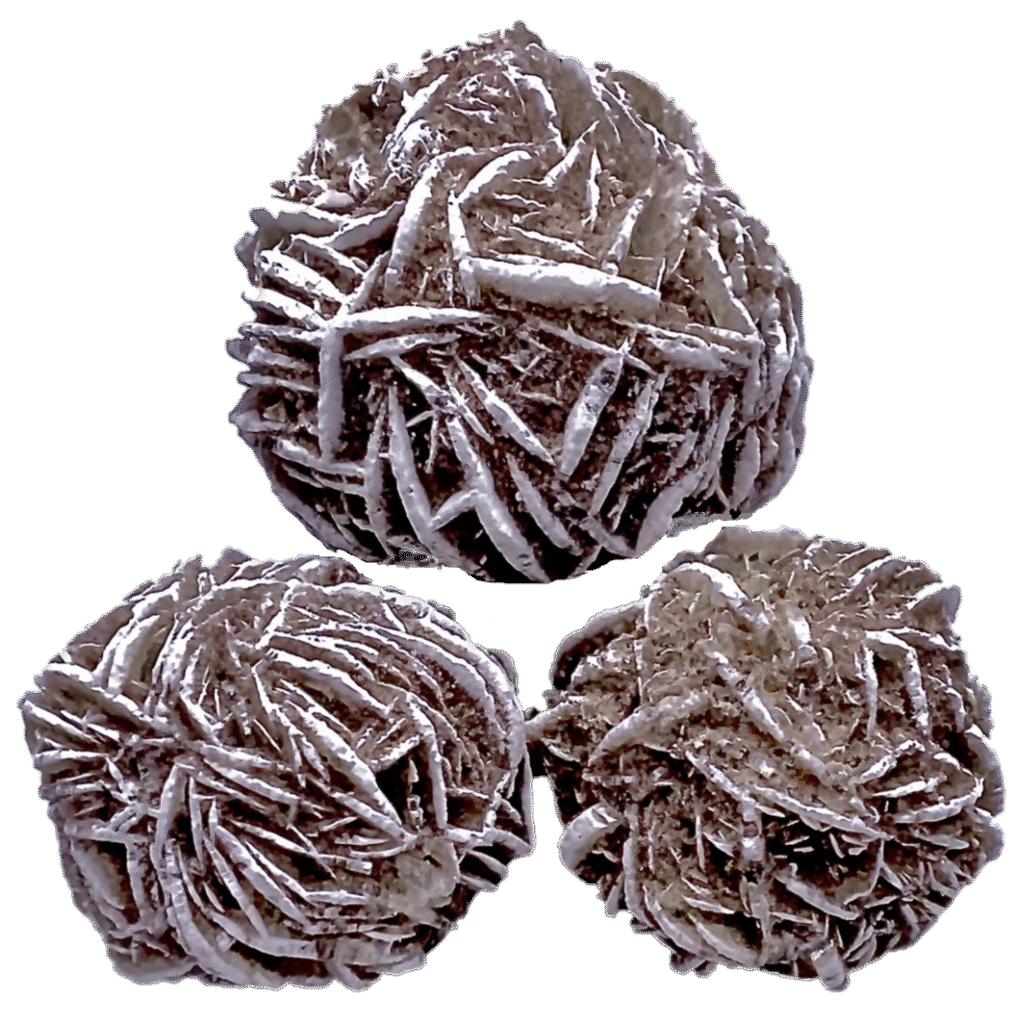
The Desert Rose cluster is a captivating geological marvel named for its striking resemblance to a blooming rosette trapped forever in stone. Formed over centuries within arid desert sands, these intricate mineral structures are shaped entirely by the elements through unique moisture evaporation cycles. Belonging to the sulfate mineral family, a Desert Rose is primarily a distinctive variety of gypsum or baryte. Beyond its crystalline beauty, metaphysical practitioners highly revere this unique specimen as the “Stone of Mental Clarity,” celebrating its profound ability to quiet a chaotic mind, dissolve stagnant behavioural loops, and unlock deep spiritual insight during meditation.
Alternate names
Depending on its geographic source, mineral ratios, and commercial trade naming, this specimen is known by several alternate titles:
- Gypsum Rose: Reflects its primary mineral baseline structure.
- Sand Rose: Highlights the rough, wind-blown sand grains naturally embedded throughout its crystal matrix.
- Selenite Rose: Named because it is composed of a specialized, blade-like crystalline configuration of selenite.
- Rose Rock: The official state rock designation popular for baryte variants found throughout Oklahoma, USA.
- Sahara Rose: Specifically refers to high-contrast, classic specimens collected across the expanse of the Sahara Desert.
The stones Science and Composition
From a technical standpoint, the formation of a Desert Rose cluster requires a precise hyper-arid environment. When seasonal rains or rising water tables introduce moisture to mineral-rich desert basins, the water dissolves surrounding calcium and sulfate ions. As the intense desert sun causes rapid evaporation, the remaining minerals crystallize in a salt flat environment.
The crystals grow outward within the damp, shifting sand, forcing the grains to become permanently trapped inside the mineral’s structural lattice. Chemically, these specimens manifest in two distinct forms:
- Gypsum-Based ($CaSO_4 \cdot 2H_2O$): The most common variety, forming delicate, light-toned clusters with thin edges.
- Baryte-Based ($BaSO_4$): Formed in heavier barium-rich solutions, resulting in denser clusters with sturdier, distinct edges.
Key Physical Characteristics
- Mohs Hardness: Extremely low. Gypsum-based varieties score a 2 out of 10 on the Mohs hardness scale, making them fragile and easily scratched by a fingernail. Baryte-based variants are slightly harder, scoring between 3 and 3.5.
- Lister: Dull, earthy, or sandy externally, with an occasional pearly or sub-vitreous shimmer exposed along the edges of internal crystal blades.
- Calor Spectrum: Ranging from pale cream, tan, and rich amber to deep, iron-stained reddish-brown, mimicking the surrounding sand matrix.
- Cleavage: Perfect cleavage planes inherent to gypsum, though obscured by the complex rosette structure.
- Tenacity: Brittle; prone to flaking sand or chipping if bumped.
Common Geologic Varieties
- Gypsum Desert Rose: Characterised by soft, pale beige, cream, or white tones. These display elegant, ultra-thin, blade-like petals that look incredibly lifelike.
- Baryte Desert Rose: Noticeably heavier and denser than its gypsum cousin due to barium weight. These exhibit sharper angles, sturdier structural ridges, and dark amber-to-rusty brown colouring.
- Large Cluster Desert Rose: A collective geological formation where dozens of individual rosettes fuse continuously over long periods, creating massive, heavy display specimens with intricate visual layers.
Global Mining and Volcanic Sources
Desert Rose clusters are strictly limited to hyper-arid geographic environments characterised by high evaporation rates. Notable global localities include:
- Mexico (Chihuahua): Produces pristine, beautifully layered, highly aesthetic gypsum specimens.
- United States (Oklahoma): Famous for iconic baryte “Rose Rocks” formed within the ancient Garber Sandstone formations.
- Morocco & Tunisia: Abundant sources of massive, high-contrast Sahara Rose clusters found throughout dry lakebeds.
- Australia & Namibia: Arid outback zones yielding deeply coloured, unique mineral-rich specimens embedded with local sand types.
Crystal Pairings: What to Combine and Avoid
Optimal Crystal Pairings
- Selenite: Because Desert Rose shares a baseline gypsum chemical signature with Selenite, this pairing creates an immediate energetic resonance. It dramatically amplifies spiritual clarity, clears away stagnant aura fields, and supercharges energy purification rituals.
- Amethyst: The calming, intuitive third-eye energy of Amethyst stabilises the fragile clarity of Desert Rose, helping to bridge the gap between conscious thought and emotional balance.
- Lapis Lazuli: Combines the throat and third-eye chakra attributes to deepen universal awareness and streamline inner truth during meditation.
Crystal Pairings to Avoid
- Haematite: A highly dense, heavy, and intensely grounding iron oxide crystal. Its heavy downward pulling frequency directly clashes with the lightweight, ethereal, and upwardly mobile mental clarity of Desert Rose.
- Carnelian: A fiery, high-vibrational stone focused on physical action, passion, and rapid energetic movement. This intense vitality completely overpowers the gentle, quiet, and introspective essence of a sand rosette.
Archaeology, Art and Ancient History
Throughout archaeological history, Desert Rose clusters have held an eccentric, mystical role due to their organic shape. While too fragile for industrial tool development, ancient nomadic tribes traversing the Sahara and Middle Eastern deserts collected these specimens as unique natural currency and components for sacred talismans. In early architectural traditions across desert oases, large clusters were buried beneath thresholds or tents to bring peace to a home. Today, they are prized worldwide by fine mineral collectors and feature prominently in modern organic sculptures.
Folklore, Legends and Sacred Tales
The striking appearance of the Desert Rose has inspired rich mythology across centuries. Ancient desert nomads believed these stones were shaped by the combined spirits of the sand, wind, and moon, acting as a spiritual compass to guide lost travellers safely home across shifting dunes.
Native American folklore—particularly legends surrounding the Oklahoma Rose Rocks—tells that these beautiful formations were carved by the spirits of ancestors returning from the spirit world. They scattered them across the earth as protective markers to watch over their homelands. Other old tales claim that a hidden Desert Rose cluster marks the location of ancient, long-forgotten desert water springs, holding the structural memory of the arid world.
Metaphysical and Mystical Healing Properties
In modern crystal healing circles, the Desert Rose is viewed as a master cleanser of the mind. It is actively utilised to dissolve self-imposed behavioural limitations, negative thought loops, and deep-seated emotional baggage that cloud conscious judgement. By cutting through mental fog, it allows the user to approach complex life choices with absolute neutrality and quiet focus. Furthermore, it acts like an energetic sponge within living spaces, absorbing chaotic vibrations, soothing domestic tension, and replacing environmental stress with a stable, tranquil atmosphere.
Astrological Connections
The grounding yet deeply introspective properties of the Desert Rose create a powerful cosmic resonance with three specific zodiac signs:
- Scorpio: Helps manage intense, turbulent emotional depths by strengthening intuition and providing clear mental boundaries.
- Capricorn: Promotes organised thinking, mental clarity, and laser-like focus, assisting this ambitious sign in achieving long-term goals without burning out.
- Taurus: Enhances inner peace, quiet patience, and personal stability, gently aligning with the bull’s grounded earthly nature.
The Chakra System
The Desert Rose cluster acts as an energetic conduit bridging the upper and lower energy systems:
[Image highlighting the Root, Third Eye, and Crown Chakras]
- The Crown Chakra: It opens and purifies the crown centre, connecting the user’s individual consciousness to higher spiritual guidance.
- The Third Eye Chakra: Sharpens psychic perception, dream recall, and deep mental focus.
- The Root Chakra: Unlike other high-vibrational minerals, the embedded sand grains within the stone provide a subtle grounding anchor, ensuring the user remains firmly anchored to the physical earth during deep spiritual journeys.
Interesting facts
- Windproof Formations: Despite ranking incredibly low on the Mohs hardness scale, a Desert Rose cluster is structurally resilient enough to withstand abrasive desert sandstorms without losing its signature rosette shape.
- Imprints of Time: The sand grains trapped inside the petals are actual samples of the local desert environment from hundreds or thousands of years ago.
- Evaporite Wonders: Desert Roses are not true plant or animal fossils; they are entirely inorganic evaporite mineral structures created by water evaporation.
Modern Milestones: Birthstones and Anniversaries
While the Desert Rose cluster does not hold a spot on the traditional or modern monthly birthstone charts, it has emerged as a popular alternative birthstone gift for Scorpios and Capricorns due to its balancing qualities.
Additionally, in modern crystal healing milestones, it is a thoughtful choice for a 13th wedding anniversary. Representing wisdom, structural growth under pressure, and beautiful transformation over time, it serves as a meaningful symbol for a long-lasting marriage.
Extensive FAQ Section
Q1: Can I clean my Desert Rose cluster in water?
Absolutely not. Because Desert Rose is primarily composed of gypsum, it is highly water-soluble. Submerging it or rinsing it under a tap will cause the mineral structure to dissolve, leading to the permanent loss of its delicate petals and structural details. To physically clean it, use a dry, soft-bristled makeup brush or canned compressed air to gently remove accumulated dust.
Q2: How should I energetically cleanse and recharge this stone?
Since you cannot use water or salt (which can scratch its soft surface), the best way to energetically cleanse a Desert Rose is by exposing it to the light of a full moon overnight. Alternatively, you can pass it through the smoke of sacred herbs like sage or cedar, or place it on a dedicated Selenite charging plate.
Q3: Can I leave my Desert Rose cluster out in direct sunlight?
You should exercise caution. While short periods of daylight will not harm it, leaving a Desert Rose in intense, direct sunlight near a window for extended periods can dry out the gypsum matrix. This can cause the specimen to become overly brittle, develop fine white surface cracks, and lose its warm colouration.
Q4: Why is my Desert Rose constantly shedding sand?
This is completely normal. Because these crystals grow directly inside shifting sand dunes, grains are bound throughout the outer edges of the matrix. Minor shedding of loose sand particles is expected over time, especially when the specimen is moved or handled.
Q5: What is the main difference between a Gypsum Rose and a Baryte Rose?
The difference lies in their chemical composition, weight, and appearance. Gypsum-based roses are lightweight, pale cream or tan, and feature thin, sharp, leaf-like petals. Baryte-based roses contain barium, making them feel significantly heavier. They display thicker, robust petals with a distinctly dark, reddish-brown colour profile.
Q6: How to tell if my Desert Rose is fake or real?
Because Desert Rose (a unique flower-like crystal structure formed from gypsum/selenite or baryte intertwined with sand grains) is highly abundant and very affordable, it is rarely outright replicated or faked from scratch. However, modified specimens, heavily altered versions, or occasionally resin/glue imitations do exist.
Here is how you can check the authenticity of a Desert Rose and spot any fakes or heavy alterations:
1. The Shedding and Texture Test
- Real: Genuine Desert Roses grow directly inside shifting sand dunes, meaning tiny sand particles are naturally bound throughout the outer edges of the matrix. A real piece will almost always shed small amounts of loose sand grains when handled or moved.
- Fake/Altered: If the crystal feels entirely smooth, completely sealed, or has a tacky texture, it may be an imitation made of resin or a real specimen heavily coated in plastic adhesives to stop it from breaking.
2. Physical Weight and Density
- Real: A genuine desert rose will feel appropriately dense for its mineral type. Gypsum-based roses feel relatively lightweight, whereas Baryte-based roses (which contain heavy barium) will feel surprisingly heavy and robust.
- Fake: A fake made entirely of plastic or lightweight resin will feel unnaturally light compared to a genuine stone of the same size.
3. Scratch and Hardness Test
- Real: Gypsum is incredibly soft, ranking at a mere 2 on the Mohs hardness scale. A real Gypsum Desert Rose is highly fragile; its blade-like petals can be easily scratched, chipped, or flaked with a simple fingernail press.
- Fake: If the “crystal” cannot be scratched by a fingernail at all, or if it acts resilient and bends like plastic rather than flaking into powder, it is either an imitation or completely coated in heavy industrial resin.
4. Natural Irregularity vs. Too Perfect
- Real: Natural growth is highly irregular. Real Desert Roses display intersecting mineral clusters, complex structural layers, and uneven, sharp, or naturally chipped leaf-like petals. The color is a natural gradient of tan, cream, beige, or dull brown, depending on the local sand environment.
- Fake: Factory-moulded imitations feature unnaturally perfect, symmetric petals without the complex, multicentre intersections found in nature. Furthermore, beware of overly uniform, painted, or unnaturally dyed colours.
5. Checking for “Enhanced” Tips
- Rather than a total fake, the most common manipulation in the market involves torching. Sellers sometimes use a blowtorch on real Desert Roses to purposefully dehydrate the gypsum matrix at the very edges. This forces the tip of the petals to turn a striking, artificial chalky-white color to make the piece look more visually dramatic. While the core stone remains natural, it is an altered specimen
These are my personally selected and curated Desert rose products