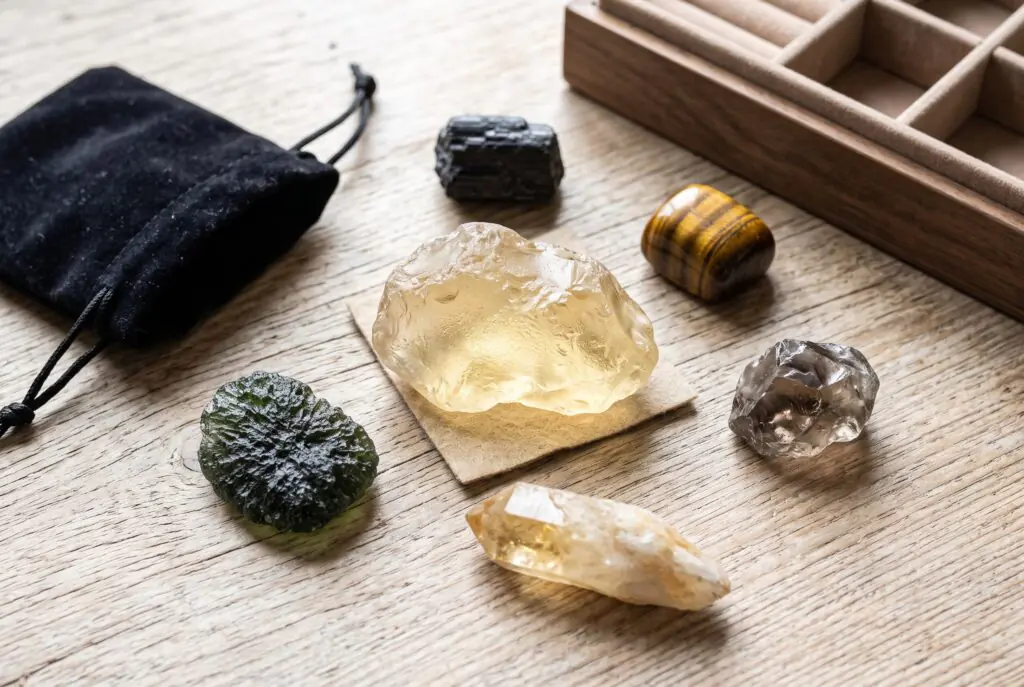
Choosing the right Libyan Desert Glass Crystal Pairings can dramatically amplify the focused, solar-driven energy of this rare 29-million-year-old natural impactite. Composed of nearly 98% pure silica and born from a hypervelocity meteorite impact in the Great Sand Sea, Libyan Desert Glass carries an intense Solar Plexus (Manipura) resonance associated with willpower, clarity, and creative momentum. When combined thoughtfully with complementary minerals—such as Moldavite for high-frequency transformation, natural Citrine for abundance, or Black Tourmaline and Smoky Quartz for grounding—you can direct and stabilise its radiant current for meditation, jewellery wear, or sacred geometry grids.
However, pairing stones energetically is only half the story; physical compatibility matters just as much. Because Libyan Desert Glass sits at 5.5 to 6.5 on the Mohs hardness scale, it is noticeably softer than everyday quartz varieties (Mohs 7), topaz, and corundum. Tossing raw specimens or pendants into the same pouch or display tray alongside harder points and tumbles will quickly leave your natural silica glass dull and scratched.
In this practical guide, we explore the most effective Libyan Desert Glass Crystal Pairings for manifestation, grounding, and spiritual amplification—alongside the essential storage rules you need to keep your pieces protected and scratch-free.
Disclaimer: Metaphysical properties reflect traditional folklore and personal mindfulness practices; they are not a substitute for professional medical or psychological advice.
High-Synergy Energetic Pairings for Libyan Desert Glass
Because Libyan Desert Glass projects an assertive, stimulating frequency through the Solar Plexus (Manipura), it pairs best with stones that either ground its cosmic charge into the body or harmonise with its solar-celestial heritage.
| Companion Stone | Mineral / Material Class | Mohs Hardness | Primary Energetic Synergy |
| Moldavite | Distal Tektite (Natural Glass) | 5.5 – 6.0 | Bridges Heart Chakra spiritual awakening with Solar Plexus willpower and decisive action |
| Lapis Lazuli | Metamorphic Rock (Lazurite/Calcite/Pyrite) | 5.0 – 5.5 | Ancient Egyptian royal pairing; unites solar confidence with higher wisdom, truth, and clear communication |
| Black Tourmaline (Schorl) | Cyclosilicate Mineral | 7.0 – 7.5 | Essential Root Chakra anchor; prevents energetic overstimulation, restlessness, or lightheadedness |
| Smoky Quartz | Macrocrystalline Quartz | 7.0 | Grounds high-frequency manifestation energy into practical, disciplined daily execution |
| Natural Citrine | Macrocrystalline Quartz | 7.0 | Amplifies solar optimism, abundance, and creative momentum without muddying LDG’s clear focus |
| Carnelian | Microcrystalline Chalcedony | 6.5 – 7.0 | Warms the Sacral Chakra (Svadhisthana), sparking courage and physical vitality alongside Solar Plexus drive |
Moldavite (The Cosmic Transformation Duo)
Pairing Libyan Desert Glass with Moldavite—the green Czech tektite forged 15 million years ago—is a favourite combination among impactite collectors. Moldavite opens the Heart and upper chakras to rapid spiritual insight, while Libyan Desert Glass anchors that transformation into the Solar Plexus so you have the confidence and clarity to act on what you discover.
Lapis Lazuli (The Royal Egyptian Pairing)
Over 3,300 years ago, Eighteenth Dynasty royal jewellers set a carved Libyan Desert Glass winged scarab alongside rich blue Lapis Lazuli and red Carnelian at the centre of Pharaoh Tutankhamun’s funerary pectoral. Energetically, Lapis Lazuli balances LDG’s fiery personal drive with calm intellect, discernment, and authentic self-expression.
Black Tourmaline & Smoky Quartz (Essential Grounding Anchors)
Because Libyan Desert Glass stimulates upper energy centres and mental focus, working with it alone can occasionally feel overly stimulating for sensitive practitioners. Introducing Black Tourmaline or Smoky Quartz creates a vertical circuit from the Solar Plexus down to the Root Chakra (Muladhara), keeping high-vibration inspiration firmly tethered to everyday reality.
Creating a Grounded Cosmic Triad
For meditation, pocket carry, or desk grids, combining three stones with distinct roles prevents energetic overwhelm while maximising focus:
- The Catalyst (Cosmic Spark): Libyan Desert Glass — ignites willpower, self-belief, and intentional manifestation.
- The Heart/Wisdom Bridge: Lapis Lazuli or Moldavite — aligns personal ambition with higher perspective and intuition.
- The Earth Anchor: Smoky Quartz or Black Tourmaline — stabilises the nervous system and grounds ideas into tangible results.
Energetic Combinations to Use with Caution
While there are no rigid “forbidden” pairings in crystal folklore, two practical cautions apply when working with Libyan Desert Glass:
- Stacking Multiple High-Vibration Tektites & Rare Silicates at Once: Wearing LDG simultaneously with Moldavite, Phenakite, Brookite, and Tanzanite can feel mentally exhausting or anxiety-inducing if you are sensitive to intense, upper-chakra frequencies. Introduce one high-frequency stone at a time.
- Heavy Sedative Stones During Active Work: Pairing LDG with deeply sedating, sleep-oriented stones such as Lepidolite or Howlite during daytime goal-setting can create a sluggish push-pull effect—save calming lithium- or borate-bearing stones for evening wind-down routines after setting your LDG aside.
Mohs Hardness Storage Rules: What Never to Store Together
Even if two stones harmonise beautifully in meditation, never allow harder crystalline minerals to touch or rub against Libyan Desert Glass in jewellery boxes, pouches, or display bowls.
- Why LDG Scratches Easily: At 5.5 to 6.5 on the Mohs scale, Libyan Desert Glass is significantly softer than the entire quartz family (Mohs 7) and harder gems. Furthermore, because it is an amorphous glass with zero cleavage and conchoidal fracture, sharp knocks against harder crystals cause permanent micro-scratches, frosted abrasion marks, and razor-sharp edge chips.
- Stones That Will Scratch LDG on Contact:
- Quartz Varieties (Mohs 7.0): Clear Quartz, Citrine, Amethyst, Rose Quartz, Smoky Quartz, Tiger’s Eye, Aventurine, Agate, Jasper, and Carnelian.
- Harder Gemstones (Mohs 7.5 – 10): Beryl (Emerald, Aquamarine, Morganite), Tourmaline, Garnet, Topaz, Spinel, Corundum (Ruby, Sapphire), and Diamond.
- Safe Storage Best Practices:
- Individual Soft Pouches: Store raw specimens and unmounted cabochons in separate velvet, cotton, or padded compartments so pieces cannot knock against one another—or even against fellow LDG fragments.
- Separate Jewellery Compartments: Keep LDG rings and pendants isolated from quartz, topaz, or diamond jewellery in a lined tray.
- Avoid Tumbling Together: Never place Libyan Desert Glass in a rotary or vibratory rock tumbler alongside quartz-hardness stones (such as Jasper or Agate), as the harder stones will pulverise and fracture the brittle silica glass.
These are my personally selected and curated Libyan Desert Glass and associated stones